A forwarding company arranges and coordinates the movement of goods and the paperwork needed to get them from the shipper to the consignee. It books carriers, consolidates freight, and manages customs documentation, but it does not usually own the trucks, ships, or planes that carry the cargo. Businesses turn to forwarders most often for international and multimodal shipments, where coordination matters more than any single leg of the trip.
TL;DR:
- For U.S. imports, a forwarder can file customs entries only if it also holds a customs broker license; otherwise, hire a licensed broker.
- Exporters remain legally responsible for accurate paperwork, even when a forwarder prepares it, so review every filing before the shipment leaves.
- Compare quotes by transit time, included services, liability limits, and separate fees; the lowest price may exclude handling or documentation you need.
- Verify credentials that match the shipment mode: IATA accreditation for air cargo and Federal Maritime Commission registration for ocean forwarding in U.S. trade.
- Ask for a sample consolidation report and confirm shipment level tracking, especially when your freight shares containers with other customers.
Table of Contents
- Definition and role: what a forwarding company does
- Key services and responsibilities of freight forwarders
- How freight forwarding works: a practical step-by-step flow
- How forwarders differ from carriers, customs brokers, and 3PLs
- Documentation, licensing, and regulatory signals to check
- When to use a forwarding company: benefits and common use cases
- How to choose a forwarding company: checklist and questions to ask
- Modern forwarding platforms and how technology changes the forwarder role
- Coordination between forwarding companies and other supply chain partners
- Common challenges in freight forwarding and how forwarding companies mitigate them
- Global network and route optimization strategies used by forwarding companies
- Author perspective: why experienced shippers still rely on forwarders
- How ORNER can help with end-to-end forwarding and fulfillment
- FAQ
- Sources
Definition and role: what a forwarding company does
A freight forwarder works like a travel agent for cargo. Instead of booking flights and hotels, it books ocean containers, air cargo space, and trucking capacity, then lines up the documents that let a shipment cross borders without getting stuck. The forwarder does not typically own the vessels, aircraft, or trucks involved. It acts as the organizing layer between a shipper and the carriers that physically move the freight, which is why the International Trade Administration describes forwarders as providing consolidation, route optimization, documentation assistance, and regulatory advice for international shipments.
A forwarder’s scope usually covers:
- Booking cargo space with ocean, air, rail, or trucking carriers.
- Consolidating smaller shipments into shared containers or pallets.
- Preparing or reviewing export and import documentation.
- Advising on routing options across multiple transport modes.
- Coordinating cargo insurance and helping with claims when something goes wrong.
Door-to-door orchestration is the real value. A forwarder can take responsibility for a shipment from a factory floor in one country to a warehouse dock in another, switching between trucks, ships, and rail without the shipper having to manage each handoff.
Key services and responsibilities of freight forwarders
A forwarder earns its fee by removing friction at each step of a shipment, not just by making a booking. Several services recur across almost every forwarding relationship:
- Consolidation and deconsolidation: combining multiple smaller loads into full container or truckload shipments to cut per-unit cost on less-than-container or less-than-truckload freight.
- Rate negotiation and booking: securing carrier space and negotiating rates based on volume and lane history.
- Cargo insurance support: arranging coverage and helping file claims if freight is lost or damaged in transit.
- Customs documentation coordination: preparing export filings and working with licensed brokers where customs entry requires one.
- Warehousing and light handling: offering short-term storage, packing, labeling, and palletization between legs of a shipment.
- Tracking and exception management: monitoring shipments and flagging delays, missed connections, or documentation gaps before they become costly.
Export documentation is where forwarders add some of their most practical value. Trade experts point to incorrect export paperwork as a leading cause of shipment delays and payment disputes, which is exactly the kind of error a forwarder is positioned to catch before a shipment leaves the dock, according to the International Trade Administration. Our guide to freight forwarding documentation covers the specific paperwork flow in more depth.
Pro Tip: Ask a forwarder for a sample consolidation report before booking. It shows whether they actually track shared-container shipments line by line or just bundle paperwork at the end.
How freight forwarding works: a practical step-by-step flow
A forwarding engagement follows a fairly consistent sequence, even when the cargo, mode, or route changes:
- Planning and quoting: the forwarder reviews cargo type, weight, dimensions, and destination to design a route and provide a rate quote across available modes.
- Booking and pickup: once the shipper accepts, the forwarder reserves carrier space and arranges pickup from the origin point.
- Consolidation and linehaul: smaller shipments are grouped with others heading the same direction, then moved on the main transport leg, whether that is ocean, air, or rail.
- Export customs handling: the forwarder files or coordinates export declarations and compiles documents like the commercial invoice and packing list before the shipment departs.
- In-transit handling and transshipment: cargo may change carriers or modes mid-route. The forwarder tracks these handoffs and manages delays or rebooking if a connection is missed.
- Import clearance: on arrival, customs entry is filed either by a licensed broker working with the forwarder or, in some markets, by the forwarder itself where it holds that license.
- Final delivery coordination: the forwarder arranges last-leg trucking or courier delivery to the consignee’s dock or warehouse.
Each step involves a handoff, and most forwarding problems happen at those handoffs rather than during the transport itself. A missed customs filing deadline or an unconfirmed pickup window causes more delay than almost anything that happens once cargo is actually moving. Our step-by-step procedure guide walks through this flow in more detail, and the ocean freight forwarding guide breaks down how this sequence plays out specifically for container shipments.
How forwarders differ from carriers, customs brokers, and 3PLs
These roles get confused constantly, and picking the wrong one for a given need wastes time. The distinctions are fairly clean once laid out:
- Carriers physically move the cargo: the airline, ocean line, or trucking company. A forwarder books space with carriers but is not one itself.
- Customs brokers are licensed to transact customs business directly with the importer. In the U.S., a freight forwarder cannot legally file customs entries unless it also holds a broker license, according to U.S. Customs and Border Protection guidance on broker power of attorney.
- Third-party logistics providers (3PLs) overlap with forwarders when a forwarder adds warehousing, pick-and-pack, and fulfillment to its transport services. At that point it is functioning as both forwarder and 3PL.
- Large carriers sometimes offer forwarding or brokerage services themselves, which can blur the line further but does not change the underlying distinction between moving cargo and arranging its movement.
Knowing which hat a provider is wearing matters when something goes wrong: liability, documentation responsibility, and who you call first all depend on it. Our breakdown of freight forwarder responsibilities covers these role boundaries for businesses managing multiple vendors.
Documentation, licensing, and regulatory signals to check
A shipment generates a predictable set of paperwork, and a forwarder’s familiarity with it is one of the clearest signs of competence. Typical documents include the bill of lading, commercial invoice, packing list, certificates of origin, and, for U.S. exports, Automated Export System (AES) filings or an Electronic Export Information (EDN) confirmation.
Licensing and membership signals worth checking:
- IATA accreditation for forwarders handling air cargo.
- Federal Maritime Commission (FMC) registration signals for ocean forwarders operating in U.S. trade.
- FIATA membership, an international trade association signal that a forwarder follows recognized industry standards, since FIATA describes its member forwarders as designing logistics chains and negotiating carrier rates under shared model rules.
- Financial responsibility filings, since U.S. regulators have increased scrutiny of freight forwarder and broker financial stability, per the Department of Transportation.
A forwarder’s documentation role has limits worth knowing: exporters remain legally responsible for the accuracy of their own export paperwork even when a forwarder prepares it, so reviewing what gets filed on your behalf is still worth the time it takes.
When to use a forwarding company: benefits and common use cases
A forwarder earns its keep whenever a shipment involves more than one carrier, one border, or one layer of paperwork. The benefits show up most clearly in a few recurring situations:
- Compliance help: a forwarder catches documentation errors before they cause a customs hold.
- Consolidated rates: grouping shipments with other cargo often brings costs down versus booking full container or truckload space alone.
- Simplified communication: one point of contact instead of juggling a carrier, a broker, and a warehouse separately.
- Faster recovery from exceptions: a forwarder with carrier relationships can rebook or reroute faster than a shipper working alone.
Exporters, importers, ecommerce sellers, and manufacturers with cross-border orders are the most common users, especially for complex routes, multi-carrier shipments, letter-of-credit transactions, or high-value and regulated goods. Our guide to freight forwarding benefits covers these scenarios with more detail for growing businesses.
How to choose a forwarding company: checklist and questions to ask
Picking a forwarder is less about the lowest quote and more about what is actually included in it. A short vetting process catches most problems before they become expensive ones:
- Ask about lane experience: has this forwarder actually moved cargo on your specific route before?
- Confirm documentation handling: who prepares and reviews export filings, and who signs off before anything ships?
- Check insurance and claims procedures: what is covered, what is excluded, and how long do claims typically take to resolve?
- Verify real-time visibility: can you see shipment status without calling for an update?
- Compare pricing transparency: does the quote separate freight, documentation, and handling fees, or bundle everything into one number?
Red flags include unverifiable licensing claims, vague liability terms buried in fine print, and slow or inconsistent communication during the quoting process itself, since that usually predicts how they will handle a delay later.
Pro Tip: When comparing quotes, line up transit time, included services, and liability limits side by side. The cheapest quote often excludes services a more complete quote bundles in.
Modern forwarding platforms and how technology changes the forwarder role
Freight forwarding has shifted from phone calls and fax confirmations toward integrated platforms that handle booking, tracking, and customs paperwork in one place. This matches how FIATA describes the forwarder’s evolution from pure intermediary to what it calls an architect of transport, often bundling advisory and managed logistics services together.
For ecommerce sellers, platform-based forwarding tends to mean:
- Automated rate comparisons across carriers instead of manual quote requests.
- Shared dashboards for tracking and exception alerts across every active shipment.
- Fewer separate vendors to manage when customs, warehousing, and transport sit on one system.
Coordination between forwarding companies and other supply chain partners
A forwarder rarely works in isolation. Once cargo clears customs and reaches a destination country, it typically needs to hand off to a warehouse, a fulfillment operation, or a last-mile courier, and that handoff is where shipments most often lose time if nobody owns the transition.
Warehousing coordination matters because inbound freight needs a receiving plan before it arrives. A forwarder that communicates container contents, arrival windows, and documentation ahead of time gives a warehouse team room to schedule labor and dock space instead of scrambling when a truck shows up unannounced. This is especially relevant for ecommerce sellers moving inventory into fulfillment centers ahead of a sales peak, where a missed receiving window can delay listings going live.
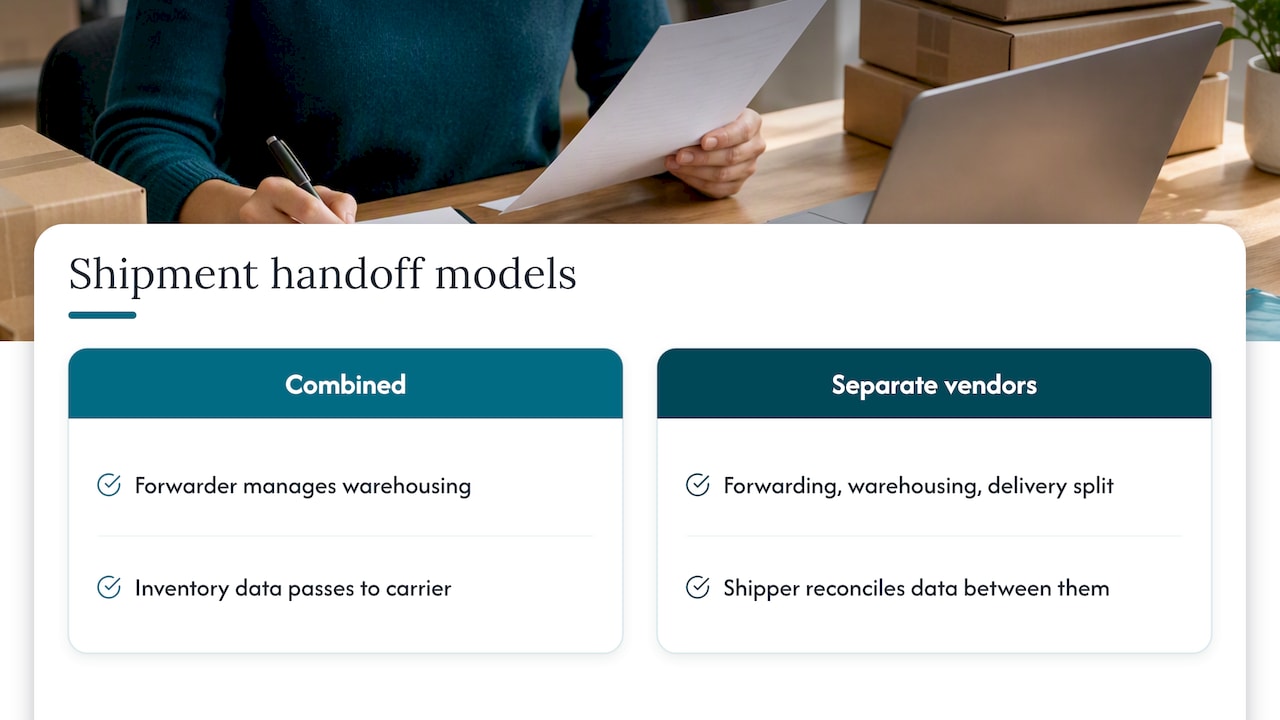
Last-mile delivery is the other connection point. Once goods clear a warehouse, they typically move to a regional courier or parcel network for final delivery to a business or consumer address. A forwarder that also manages warehousing can pass inventory data directly to the last-mile carrier, cutting the handoff down to a data transfer instead of a phone call and a spreadsheet. Where forwarding, warehousing, and last-mile delivery sit with three separate vendors, the shipper usually ends up as the one reconciling data between them, which is part of why combined logistics platforms have gained ground with sellers managing frequent, smaller shipments rather than occasional large freight moves.
Common challenges in freight forwarding and how forwarding companies mitigate them
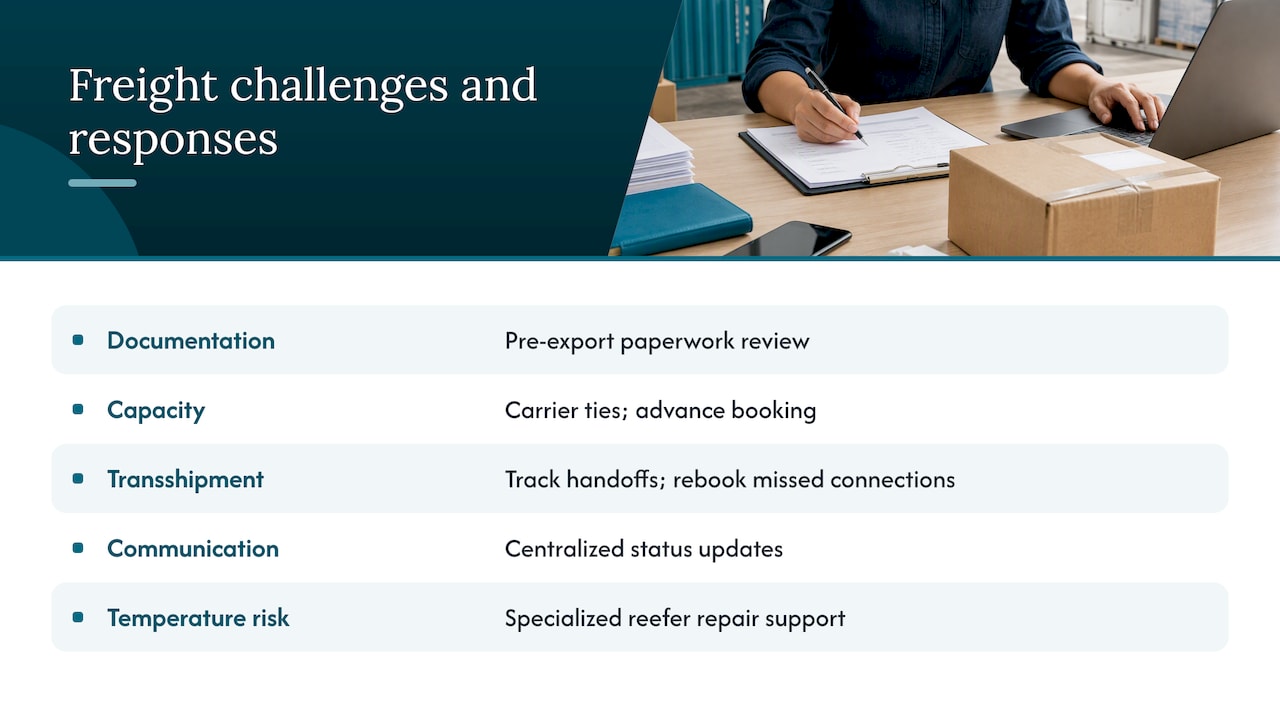
Freight forwarding runs into a predictable set of problems, and most forwarders build specific habits around each one rather than treating them as surprises.
Documentation errors remain one of the most common issues, since a single incorrect harmonized code or missing certificate can hold a shipment at customs for days. Forwarders mitigate this by reviewing paperwork against the destination country’s requirements before export, catching mismatches while there is still time to correct them.
Capacity constraints during peak shipping seasons push rates up and squeeze available space on ocean and air carriers. Forwarders with established carrier relationships and advance booking practices tend to secure space more reliably than shippers booking last minute on the open market.
Transshipment delays happen when cargo changes vessels, flights, or trucks mid-route and a connection is missed. Forwarders track these handoffs and have rebooking relationships in place so a missed connection becomes a schedule adjustment rather than a shipment going dark for a week.
Communication gaps between multiple parties, carrier, broker, warehouse, and consignee, create confusion about who is responsible for a delay. Forwarders that centralize status updates into one point of contact reduce the back-and-forth that otherwise falls on the shipper to manage.
Cargo requiring temperature control introduces its own risk, since equipment failure in a refrigerated container can damage an entire shipment quickly. Shippers moving perishable or sensitive cargo sometimes need access to specialized repair support, such as the reefer container service offered by Conexcool, when equipment issues come up in transit.
Global network and route optimization strategies used by forwarding companies
Route planning is where a forwarder’s carrier relationships and market knowledge actually show up in the final cost and transit time. A forwarder working multiple lanes regularly has visibility into which routes are congested, which ports are running behind on container handling, and which carriers currently have reliable space, information an occasional shipper booking directly would not have access to.
Network depth matters more on complex or multimodal routes than on simple point-to-point shipments. A forwarder with established relationships across multiple ports and inland trucking networks can reroute a shipment around a congested port or a canceled sailing with less disruption than a shipper trying to rebook alone. This is part of why the International Trade Administration lists route optimization as a core forwarder service rather than an occasional extra.
Multimodal routing, combining ocean, rail, and truck, or air and truck, often comes down to balancing cost against transit time rather than finding a single best option. A forwarder working a given lane regularly tends to have a clearer sense of where that tradeoff sits for a specific commodity and destination than a one-off calculation would suggest. Our sea freight versus air freight comparison covers how that tradeoff plays out for specific shipment profiles.
Author perspective: why experienced shippers still rely on forwarders
Shippers who move freight regularly rarely drop their forwarder once they have a system that works, even as booking tools get more automated. The paperwork review, the carrier relationships, and the judgment call during a missed connection are still what separates a smooth shipment from a stuck one. Vet carefully, ask for documentation specifics, and keep the checklist above close at hand.
— Maayan
How ORNER can help with end-to-end forwarding and fulfillment
Shippers who want one partner instead of three get that through our platform. Our platform supports freight booking, customs clearance, warehousing, and real-time tracking in a single system designed for ecommerce sellers and growing brands.
- Freight booking across ocean, air, and multimodal routes from one dashboard.
- Customs clearance and warehousing coordinated together instead of split across vendors.
- Inventory and catalog management built for sellers running frequent, smaller shipments.
Request a freight quote to see how a combined forwarding and fulfillment setup fits your shipping volume.
FAQ
What does a freight forwarder actually do day to day?
A freight forwarder books cargo space with carriers, consolidates shipments, and prepares or reviews export and import documentation. It coordinates the full route from origin to destination without usually owning the trucks, ships, or planes involved, according to trade.gov.
Is a freight forwarder the same as a customs broker?
No. A customs broker is licensed to transact customs business and file entries directly with the importer, while a forwarder arranges transport and documentation but cannot legally execute customs entries unless it also holds a broker license, per CBP guidance.
What documents does a forwarder typically handle?
Forwarders commonly assist with the bill of lading, commercial invoice, packing list, and certificates of origin, along with export filings like the AES declaration. Exporters remain legally responsible for the accuracy of these documents even when a forwarder prepares them.
How do I know a forwarder is financially stable and properly licensed?
Check for industry signals like FIATA membership, IATA accreditation for air cargo, or FMC registration for ocean freight, since FIATA ties these to shared industry standards. U.S. regulators have also increased scrutiny of forwarder and broker financial responsibility, which makes verifying operating history worth the extra step, per the Department of Transportation.
Can a forwarding company also handle warehousing and fulfillment?
Yes, many forwarders add warehousing, pick-and-pack, and fulfillment services, which effectively makes them function as a 3PL alongside their transport role. We offer this combination through our warehousing and customs clearance services for sellers who want transport and storage under one system.
Sources
- Trade
- About freight forwarding | FIATA
- Broker and Freight Forwarder Financial Responsibility | U.S. Department of Transportation