
Global ecommerce fulfillment means outsourcing warehousing, cross-border compliance, and last-mile delivery to a partner who can move inventory across borders without you managing customs paperwork market by market. If you’re shipping internationally, the next move is simple: run an RFP that screens candidates for delivered-duty-paid (DDP) capability and real WMS/OMS integration, not just warehouse count. Or-ner is one platform built around exactly this combination.
TL;DR:
- Using DDP and open API integration is crucial for scaling globally, with vendors needing to support customs clearance and import roles in all targeted markets.
- Cost savings of up to 24% are common when consolidating freight booking, customs, and warehousing through a single platform rather than managing multiple vendors.
- Operational triggers such as rising error rates, delivery delays, and high support tickets indicate it’s time to switch from DIY to a full-service fulfillment partner.
- Prioritizing markets with regulatory simplicity, carrier reliability, and clear demand signals helps mitigate risks and ensures smoother expansion.
- Running detailed HS code audits and testing end-to-end order flows before launch reduces delays, customs issues, and duty costs for new cross-border markets.
Table of Contents
- What Does Global Ecommerce Fulfillment Actually Include?
- When Should You Move From DIY to a Global Fulfillment Partner?
- Core Components of a Fulfillment Stack That Scales
- How Do You Evaluate and Choose a Global Fulfillment Partner?
- Your Operational Launch Checklist for a New Market
- Where Or-ner Fits This Evaluation Framework
- What 2026 Actually Demands From Fulfillment Operators
- Get Started With Or-ner’s Global Fulfillment Platform
- Sources
- FAQ
What Does Global Ecommerce Fulfillment Actually Include?
Global ecommerce fulfillment isn’t a single service. It’s a stack of operational pieces that have to work together, and vendors package them differently, which is exactly why comparing quotes line by line matters more than comparing headline prices.
A full-service partner typically covers:
- Distributed warehousing and inventory management across multiple regions, so stock sits closer to the customer instead of shipping from one hub every time.
- Pick, pack, kitting, labeling, and retail-ready packaging for orders that need bundling, branded inserts, or marketplace-specific labeling.
- Multi-modal freight and last-mile carrier handoffs that move goods by ocean, air, or ground and then hand off to regional couriers for final delivery.
- Customs clearance, HS code classification, and duty calculation, including the choice between DDP (you collect and remit duties at checkout) and DDU/DAP (the customer pays on arrival).
- Returns and reverse logistics, plus value-added services like light assembly, quality checks, or subscription-box prep.
That customs and DDP layer is where most merchants get burned. Shopify’s breakdown of global fulfillment services notes that DDP handling and landed-cost tools are now treated as core infrastructure, not an add-on, because customers abandon carts the moment they see a surprise duty bill at the door. Global ecommerce sales are approaching $6.09 trillion, with projections toward $8.09 trillion by 2028, and a growing share of that volume is cross-border, which means the compliance layer isn’t optional anymore. For a deeper look at how these pieces fit into a broader supply chain, Or-ner’s guide to logistics solutions for ecommerce walks through where each service type fits.
When Should You Move From DIY to a Global Fulfillment Partner?
Three kinds of signals tell you it’s time, and they rarely show up one at a time.
Financial triggers come first. If shipping costs are eating more than 15% of average order value, or dimensional-weight penalties keep climbing because you’re packing inefficiently, your unit economics are already leaking. Operational triggers follow: a support inbox flooded with “where’s my order” tickets, lead times creeping past what your product page promises, or error rates rising as your team stretches across SKUs it wasn’t built to handle. Volume and market triggers show up last but hit hardest, when you’re selling into three or four countries and managing separate carrier accounts, customs brokers, and return policies for each.
International shipping costs and delivery delays remain top reasons buyers abandon cross-border purchases, and operational readiness, not marketing spend, is what determines whether that international demand converts into repeat revenue.
The ROI tradeoff is real: setup fees and integration work cost more upfront than staying DIY. But per-order savings from consolidated freight rates, fewer error-driven refunds, and lower support overhead usually recover that investment within a couple of quarters for merchants already shipping several hundred international orders a month.
Core Components of a Fulfillment Stack That Scales
Four systems have to work in concert, or the whole operation slows down the moment volume spikes.
- Technology backbone. Your warehouse management system (WMS) and order management system (OMS) need to sync in near real time, not batch-update overnight. Add a checkout landed-cost engine that quotes duties and taxes before the customer pays, plus open APIs so your storefront, WMS, and carrier accounts talk to each other automatically. Digital Commerce 360’s 2026 trend analysis frames this as a shift from data volume to data velocity: the systems that win aren’t the ones with the most data, they’re the ones that move it fastest between checkout and warehouse floor.
- Compliance infrastructure. HS classification has to be consistent across every SKU, VAT and GST registration thresholds vary by country and need tracking, and you need a clear answer on whether you’re acting as your own Importer of Record (IOR) or outsourcing that role to a customs broker.
- Carrier strategy. Multi-carrier routing with defined lane-level SLAs protects you when one carrier has a bad week. Build in failover routing and regular dimensional-weight audits, since DIM pricing errors are one of the most common silent margin killers.
- Returns architecture. Regional consolidation hubs and bonded warehouses keep returned goods from getting hit with duties twice, once on the way in and again on the way back out.
Maersk’s 2026 logistics trends report identifies distributed, regionalized fulfillment networks as one of the defining shifts this year, largely because inventory placed closer to the customer cuts both transit time and duty exposure simultaneously.
Pro Tip: Run a dimensional-weight audit on your top 20 SKUs before signing any carrier contract. Most merchants discover at least one product category getting hit with avoidable DIM penalties, and that number alone can justify repackaging costs.
Warehouse orchestration tools, including AI-driven platforms like Lully, are increasingly part of this stack too, helping route inventory and time-slot warehouse tasks as order volume swings by season.
How Do You Evaluate and Choose a Global Fulfillment Partner?
Start with five non-negotiable criteria, then use specific questions to test whether a vendor’s marketing claims hold up under pressure.
Screen for these first:
- DDP and IOR capability in every market you plan to sell into, not just your top one or two.
- In-house or partnered customs brokerage with documented clearance times by lane.
- Open WMS/OMS APIs with published documentation, not a promise to “build something custom.”
- SLA commitments broken out by lane and service tier, not one blanket number for “international.”
- Transparent pricing that separates storage, pick-and-pack, freight, and duty handling into line items.
Then ask these questions directly on the vendor call:
- Can you show me an actual SLA report from a lane similar to mine, not a sales deck average?
- What’s your customs clearance failure rate, and what happens operationally when a shipment gets held?
- Can I see API documentation and talk to an engineer before I sign anything?
- What happens to my SLA and pricing if my order volume doubles in 90 days?
- Can you provide two references in my product category, not just your biggest client?
Red flags worth walking away from: vague answers about DDP support in specific countries, an unwillingness to share integration documentation before contract signature, and pricing quotes that bundle everything into one number with no line-item breakdown. Or-ner’s guide to choosing a courier partner walks through additional RFP language you can borrow directly.
Your Operational Launch Checklist for a New Market
Sequence matters more than speed here. Merchants who skip steps to launch faster almost always pay for it in returns and compliance cleanup within the first quarter.
- Prioritize markets by three factors: regulatory simplicity, carrier reliability, and a real demand signal from existing traffic or ad spend, not just population size.
- Run an HS code audit across your full catalog before you touch a new market, since misclassified codes are one of the fastest ways to trigger customs delays or fines.
- Set up landed-cost display at checkout and confirm VAT or GST registration status for that market ahead of your first order.
- Decide your returns hub location before launch, not after your first return ships back at double the duty cost.
- Run test orders end to end, verify SLA performance against what was promised, and set a reconciliation cadence (weekly for the first month, then monthly) to catch drift early.
Ecommerce Times’ framework for scaling cross-border fulfillment recommends validating ROI in one Tier 1 market completely before expanding to a second, rather than launching three markets simultaneously and troubleshooting all of them at once. For carrier and landed-cost setup specifics, Or-ner’s cross-border shipping strategy guide covers the routing decisions this checklist assumes you’ve already made.
Where Or-ner Fits This Evaluation Framework
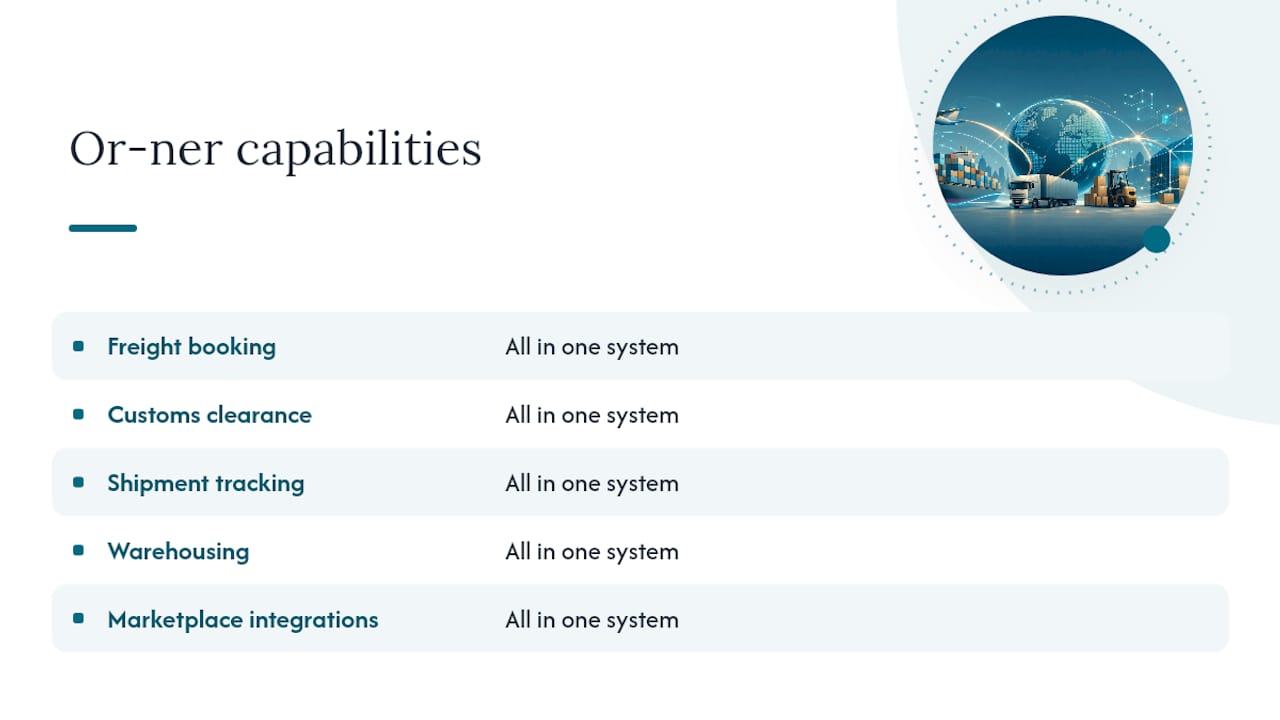
One platform runs freight booking, customs clearance, real-time shipment tracking, warehousing, and integrations with major marketplaces like Amazon all under one system. That maps directly onto the criteria above: WMS/OMS connectivity, DDP-ready customs workflows, and cross-border warehousing built for merchants scaling past a single market. If your vendor checklist includes those items, Or-ner is worth putting on your RFP list.
What 2026 Actually Demands From Fulfillment Operators
The merchants winning international share this year aren’t the ones with the flashiest storefront. They’re the ones who treat fulfillment as a growth lever, not overhead. Get DDP right, get your data moving at checkout speed, and the rest of the operation follows.
— Maayan
Get Started With Or-ner’s Global Fulfillment Platform
If your evaluation checklist includes DDP capability, real API integration, and warehousing that doesn’t require a new contract every time you enter a market, this platform was built around that exact set of requirements.
Instead of stitching together separate customs brokers, regional warehouses, and carrier accounts, Or-ner runs freight booking, customs clearance, tracking, and warehousing through one platform, which is the same integration depth this article just walked you through evaluating. Merchants using cloud-based logistics platforms have reported cost savings of up to 24% compared to managing fragmented vendor relationships separately.
The next step is straightforward: visit Or-ner’s global logistics and courier services page and request a quote based on your current shipping volume and target markets. Bring your top three markets and current shipping cost as a percentage of AOV. That’s enough for a real conversation about fit, not a generic sales pitch.
Sources
- Global Fulfillment: Services, Costs, and Solutions — Shopify
- Complete guide to logistics trends for 2026 — Maersk
- How to build a cross-border fulfillment strategy that scales in 2026 — Ecommerce Times
FAQ
What Is Ecommerce Fulfillment?
Ecommerce fulfillment is the process of receiving, storing, picking, packing, and shipping online orders to customers, typically handled either in-house or by a third-party logistics (3PL) provider.
What Are Global Fulfillment Services?
Global fulfillment services extend that process across borders, adding distributed warehousing, customs clearance, duty calculation, and multi-carrier last-mile delivery so a merchant can sell into multiple countries without setting up separate operations in each one.
What Does Global Ecommerce Mean?
Global ecommerce refers to buying and selling goods online across international borders, a market that reached close to $6.09 trillion in 2024 and is projected to keep growing through 2028.
What’s the Difference Between DDP and DDU?
DDP (delivered duty paid) means duties and taxes are collected at checkout and the seller handles remittance, while DDU (delivered duty unpaid) leaves the customer to pay duties on delivery, which frequently causes cart abandonment and delivery refusals.
How Long Does Onboarding With a Global Fulfillment Partner Take?
Onboarding timelines vary by vendor and market complexity, but most merchants should expect several weeks for integration, testing, and a first-market go-live before scaling to additional countries, following the phased sequencing outlined earlier in this guide.