
Under DAP (Delivered at Place), the seller carries transport and delivery risk until the goods are on the arriving vehicle at the named place, ready for unloading. From that point, the buyer takes over: unloading, import customs clearance, and every duty or tax tied to bringing the shipment into the country.
TL;DR:
- The named place and exact address are critical, as different locations can significantly shift terminal handling and last-mile costs onto the wrong party.
- The seller’s responsibilities end once goods arrive on the delivery vehicle at the specified place, with no obligation to unload or insure the cargo under DAP.
- Import clearance and duty payment are solely the buyer’s responsibility after the goods reach the designated location, and appointing a customs broker early can prevent delays and storage fees.
- Differences between DAP, DDP, and DPU hinge mainly on who handles import duties, customs clearance, and unloading, making contract clarity essential to avoid disputes.
- Real-time shipment tracking and precise notification clauses are vital to manage risk transfer timing, prevent costly delays, and avoid bonded storage fees during cross-border trade.
Table of Contents
- What Does DAP Mean Under Incoterms 2020?
- What Are the Seller’s Obligations Under DAP?
- What Must the Buyer Do Under DAP?
- DAP vs DDP vs DPU: Which One Actually Fits Your Shipment?
- How Do You Avoid Contract Disputes Under DAP?
- A Pre-Shipment Checklist for DAP Buyers and Sellers
- How Logistics Platforms Support DAP Shipments
- The Real Weakness in How Most Companies Handle DAP
- How Or-ner Handles DAP Shipments Without the Guesswork
- Where to Read the Official Rules
- Sources
- FAQ
What Does DAP Mean Under Incoterms 2020?
DAP freight terms fix one exact moment when risk and cost swap sides: the instant the goods arrive on the delivering vehicle at the named place, ready for unloading, per Incoterms® 2020. The seller has not finished the job until the truck, container, or railcar is sitting at that location. Unloading is the buyer’s problem.
DAP works across any transport mode, including multimodal moves that mix ocean freight with inland trucking. That flexibility is part of why it’s one of the more commonly used delivery terms in cross-border trade.
The wording of the named place matters more than most contracts treat it. “Port of Rotterdam” and “Buyer’s warehouse, Dock 3, Rotterdam” are not the same delivery point, and the gap between them can shift thousands of dollars in terminal handling, drayage, and last-mile trucking onto whichever party assumed the other was covering it. A precise address, not a city or port name, is what actually protects both sides.
What Are the Seller’s Obligations Under DAP?
The seller’s job runs from the factory floor to the named place, and nowhere else. That includes:
- Arranging and paying for carriage to the named destination, whatever combination of ocean, air, rail, or road that requires.
- Handling export formalities and paying export duties in the country of origin.
- Bearing all transport risk until the goods are on the arriving vehicle, ready for unloading.
- Giving the buyer sufficient notice and the documents needed to take delivery and clear customs.
Pro Tip: Don’t assume “delivered” means “unloaded.” A carrier invoice that includes destination charges doesn’t automatically cover forklift time or a dock crew, and that gap is where DAP disputes usually start.
One point trips up a lot of shippers: insurance is not required under DAP. Only CIF and CIP obligate the seller to insure the cargo. Under DAP, both sides decide separately whether to insure their portion of the exposure, and skipping that conversation is how uninsured cargo losses end up as a surprise line item in a dispute.
What Must the Buyer Do Under DAP?
Once the goods hit the named place, the operational and financial burden flips entirely to the buyer:
- Unload the shipment at its own risk and cost, unless the contract specifically states otherwise.
- Complete import customs clearance and pay all import duties, VAT, and excise taxes.
- Arrange and pay for any onward transport from the named place to a final destination.
The consequences of dropping any of these are not small. When import paperwork is missing or delayed, cargo can sit in bonded storage accumulating demurrage and storage fees, and the buyer bears both the cost and the risk of damage while it waits. In the worst cases, customs authorities can seize goods that clear neither classification nor duty payment in time.
Pro Tip: Appoint your customs broker before the shipment leaves origin, not after it lands. A broker scrambling to register a new import on short notice is the single most common cause of bonded-storage charges under DAP.
DAP vs DDP vs DPU: Which One Actually Fits Your Shipment?
The three terms get confused constantly, and the confusion is expensive. Here’s the operational core of each:
- DAP: buyer handles import customs clearance and pays duties and taxes; seller is not the importer of record.
- DDP (Delivered Duty Paid): seller clears imports and pays duties and taxes, acting as importer of record in the destination country.
- DPU (Delivered at Place Unloaded, formerly DAT): seller must unload the goods at the named place; under DAP, the seller is not obligated to unload at all.
The choice between DAP and DDP often comes down to a legal constraint, not a preference. Many countries restrict who can act as importer of record, and a foreign seller with no local entity or tax registration frequently can’t take on that role even if they wanted to. When that’s the case, DAP is typically the only workable option.
DPU versus DAP is simpler on paper but murkier in practice: it’s purely about who unloads the truck. According to ICC Academy guidance, that single distinction causes a disproportionate share of terminal-charge disputes, mostly because carrier quotes rarely spell out whether unloading labor is included.
How Do You Avoid Contract Disputes Under DAP?
Most DAP disagreements trace back to language that was vague when the purchase order was signed and became expensive once the container hit the port. A few clauses close most of that gap:
- Write the full delivery address, including building, dock number, or gate, not just a city or port name.
- Confirm in writing whether the carrier’s quoted price includes unloading labor and equipment.
- State explicitly who pays terminal handling charges, storage fees, and demurrage if the shipment is delayed.
- Set a notification timeline for when the seller must alert the buyer of arrival, and name the customs broker responsible for clearance.
Pro Tip: Watch for the term “DDU” on older contracts or legacy carrier platforms. It was deprecated under Incoterms 2020 and replaced by DAP. A contract still using DDU language is a sign nobody has updated the template in years, and that’s worth a second look before you sign.
A Pre-Shipment Checklist for DAP Buyers and Sellers
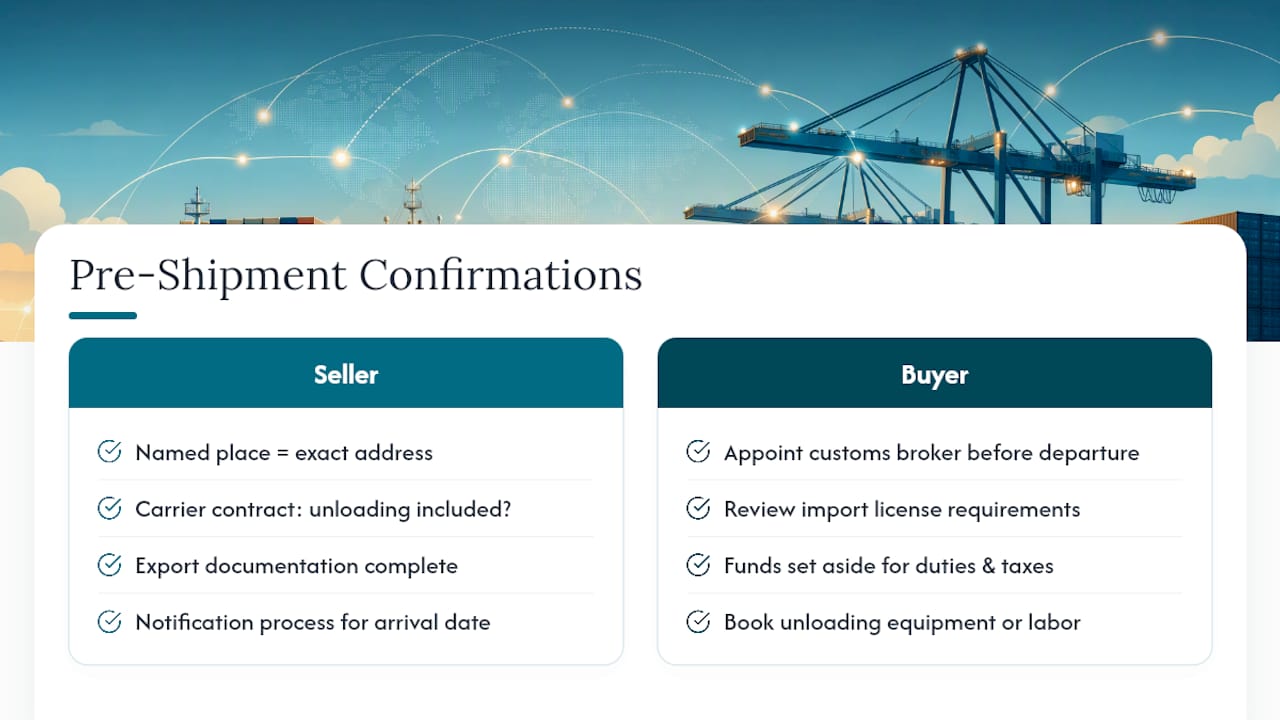
Sellers should confirm four things before the goods ever leave the dock: the named place is written down to the exact address, the carrier contract states whether unloading is included, export documentation is complete, and a notification process is in place so the buyer isn’t caught off guard by an arrival date.
Buyers carry a parallel list. Appoint a customs broker before departure, not after arrival. Review import license requirements for the product category, since misclassified goods are a leading cause of customs delays. Confirm that funds are set aside to cover duties and taxes on arrival, and make sure unloading equipment or labor is actually booked at the destination.
Contract language should assign each task by name rather than assuming it’s obvious. A line as simple as “Buyer to appoint customs broker no later than 5 business days prior to estimated arrival” closes a gap that otherwise surfaces as a dispute weeks later. Customs delays create asymmetric exposure: the buyer absorbs demurrage immediately, while the seller may technically have already fulfilled its delivery obligation. Specifying who pays demurrage after a set number of calendar days protects both sides from that mismatch.
How Logistics Platforms Support DAP Shipments
Coordinating a DAP shipment means synchronizing a carrier, an export broker, an import broker, and a buyer’s receiving team, often across three or four time zones. A platform that centralizes freight booking and shipment notifications reduces the number of places where a delivery-point misunderstanding can hide.
Real-time tracking matters specifically because DAP’s risk transfer is time-bound. If a buyer doesn’t know a shipment is arriving until it’s already at the dock, there’s no lead time to line up a broker or unloading crew. Visibility into where a shipment sits in transit, paired with customs clearance coordination, is what turns a paper Incoterm into a shipment that actually moves without a costly gap at the handoff.
The Real Weakness in How Most Companies Handle DAP
Most guidance on DAP freight terms treats it as a definitional exercise: memorize who pays what, move on. That misses where the actual money gets lost. The rule itself is clear. What isn’t clear, in most contracts, is the named place, and that ambiguity is doing far more damage than any confusion about the Incoterm’s basic mechanics.
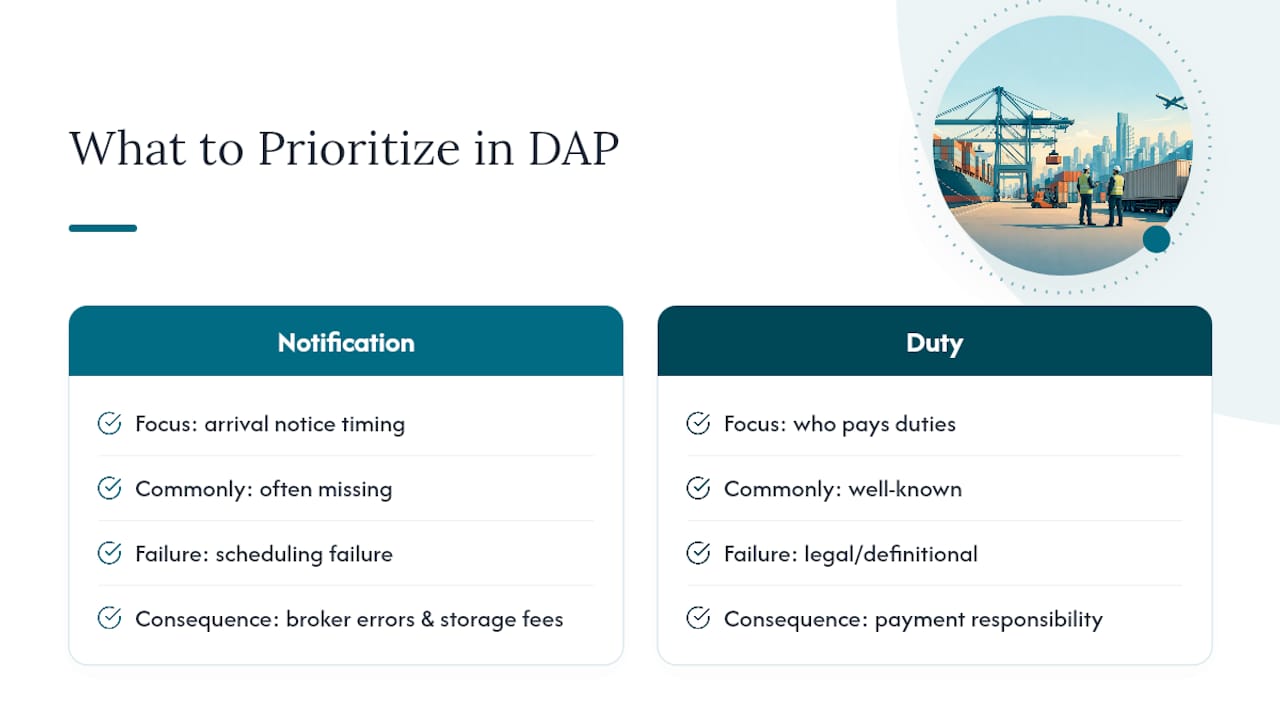
I’d argue the conventional advice underrates the timing problem specifically. Everyone talks about who pays duties. Almost nobody talks about the fact that a buyer with no advance notice of arrival has no time to appoint a broker, and a broker appointed under pressure is a broker who makes classification errors. That’s not a legal failure. It’s a scheduling failure dressed up as a customs problem.
If you take one thing from this, prioritize the notification clause over the duty clause. Everyone already knows DAP puts import clearance on the buyer. Far fewer companies build in the lead time that clearance actually requires, and that gap is where bonded storage fees quietly eat the margin on an otherwise well-negotiated deal.
— Maayan
How Or-ner Handles DAP Shipments Without the Guesswork
A solution for DAP shippers is to provide a single view of where a shipment sits between origin and the named place, so a buyer’s team isn’t finding out about an arrival the same day it happens. That lead time is what actually prevents the bonded-storage and demurrage costs covered above.
The platform supports freight booking, customs clearance coordination, and shipment tracking across ocean, air, and land modes, designed for ecommerce sellers, wholesalers, and brands managing cross-border orders. If your DAP shipments keep stalling at the customs handoff, a freight booking process built around real-time visibility closes that gap before it costs you a demurrage invoice. Sellers or buyers navigating local VAT and import compliance can also review VAT filing obligations as part of getting import documentation right the first time.
Check reliable courier services to see how Or-ner handles the last mile once your DAP shipment clears the named place.
Where to Read the Official Rules
The Incoterms rules themselves are copyrighted and licensed, so the primary text sits with the ICC, not with any freight guide.
- The ICC’s official Incoterms 2020 page is the source for the rule text itself.
- ICC Academy’s DAP vs DDP breakdown explains the importer-of-record distinction in plain terms.
- ICC Academy’s DPU vs DAP comparison covers the unloading question specifically.
- LexisNexis’s DAP practice note walks through legal interpretation and drafting language for the named place.
Sources
- Incoterms® 2020 — ICC
- Incoterms® 2020: DAP or DDP? — ICC Academy
- Incoterms® 2020: DPU or DAP? — ICC Academy
FAQ
Who Pays Freight on DAP Terms?
The seller pays for and arranges freight all the way to the named place under DAP shipping terms, including export formalities and inland transport at origin. The buyer only takes on costs once the goods arrive, covering unloading, import clearance, and duties.
What Is the Difference Between DAP and “Delivered”?
“Delivered” alone isn’t a defined shipping term; DAP delivery is precise because Incoterms 2020 defines the exact moment of delivery as when goods are on the arriving vehicle, ready for unloading, at the named place. Generic use of “delivered” in a contract without referencing an Incoterm leaves that moment undefined and open to dispute.
What’s the Difference Between DAP and DDP Shipping?
Under DAP, the buyer clears customs and pays import duties and taxes; under DDP, the seller acts as importer of record and covers those costs instead. Sellers without a legal presence in the destination country typically can’t use DDP and default to DAP.
Does DAP Require the Seller to Unload the Goods?
No. DAP delivery ends when goods are on the arriving vehicle, ready for unloading; the buyer handles the actual unloading at its own cost and risk. If the seller must unload, the correct Incoterm is DPU, not DAP.
Is Insurance Mandatory Under DAP Freight Terms?
No. Incoterms don’t require either party to insure the cargo under DAP. Businesses that want the seller contractually obligated to insure the shipment should use CIF or CIP instead.