A global project logistics network is the system of warehouses, carriers, customs brokers, and software that gets a package from your seller account to a doorstep on another continent without you managing every handoff. Done right, it cuts per-shipment cost, shortens delivery windows, and prevents the customs delays that quietly wreck margins. If you’re evaluating one, start by checking its warehouse coverage, its API integration depth, and its published SLAs before anything else.
TL;DR:
- Most sellers benefit from starting with two warehouse nodes aligned with geographic demand before adding a third to control costs and complexity.
- Automated courier allocation using live API data can reduce shipping expenses by up to 18 percent, especially with rate shopping and carrier diversification.
- Customs delays and regulatory compliance are the primary cross-border risks, making bonded storage and experienced brokers essential for smooth logistics.
- Building a flexible, API-driven network allows seamless addition of new nodes, couriers, or SKUs without extensive renegotiation or system overhaul.
- Outsourcing to third-party logistics providers is often more effective than in-house fulfillment once order volume and regional spread increase.
Table of Contents
- What Makes Up a Global Project Logistics Network?
- What Do Ecommerce Sellers Actually Gain From This?
- How Should You Design Your Node Network?
- How Do You Roll Out a Global Logistics Network?
- How Does Or-ner’s Platform Cover These Requirements?
- Who Are the Stakeholders in a Global Logistics Network?
- What Are the Biggest Risks in Global Project Logistics?
- What Technology Trends Are Changing Global Logistics Networks?
- How Do You Build a Network That Scales Without Overbuilding?
- What Do Successful Network Rollouts Actually Look Like?
- What Compliance Requirements Go Beyond Customs Forms?
- Build In-House, Outsource, or Use an Integrated Platform?
- Get a Global Network Audit From Or-ner
- Sources
- FAQ
What Makes Up a Global Project Logistics Network?
The network is only as good as its weakest node. Every functioning system has four physical layers: fulfillment centers that hold inventory close to demand, cross-dock hubs that consolidate freight before it moves across borders, customs brokers who clear goods without triggering delays, and last-mile couriers who make the final handoff.
None of that works without a data layer sitting on top of it. A warehouse management system (WMS) tracks stock by SKU and location. An order management system (OMS) routes each order to the right node. Carrier APIs pull live rates and transit estimates so the system picks the cheapest reliable option automatically, and exception management flags a stuck shipment before the customer emails asking where it is.
The network also has to absorb shocks. Returns need a reverse path back into inventory, not a dead end in a warehouse corner. Bonded storage lets goods sit near a border without triggering duties until they actually move. Peak season means the system needs headroom, not a scramble to lease extra space in November.
- Fulfillment centers and cross-dock hubs positioned by demand
- Customs brokers and bonded storage for cross-border goods
- Last-mile courier partners for final delivery
- WMS and OMS software connecting every node
- Carrier APIs for live rate and transit data
- Exception management for delays and returns
What Do Ecommerce Sellers Actually Gain From This?
The number that matters most is cost per shipment, and it drops fast once you stop shipping everything from one warehouse. Splitting inventory across two or three nodes shortens the average distance to the customer, which shrinks the shipping zone and the price that comes with it. Rate shopping and carrier diversification alone tend to cut average shipping costs by 10 to 18 percent, and pairing that with automated courier allocation can push savings toward 12 to 18 percent on top of that.
Statistic Callout: Last-mile delivery can account for a substantial portion of total shipping costs, making it the single biggest lever for cutting fulfillment expense and the biggest risk to customer experience if a courier underperforms.
Faster delivery windows aren’t just a nice-to-have. They move conversion and repeat purchase rates because shoppers abandon carts over long ship times more than almost any other checkout friction. A network with the right node mix also lowers return-to-origin (RTO) rates: better inventory placement and non-delivery-report (NDR) handling catch failed deliveries before they become full returns.
- Lower per-shipment cost through zone reduction and rate shopping
- Faster delivery windows that lift conversion and repeat orders
- Fewer RTOs through smarter inventory placement and NDR management
- More predictable cross-border transit through bonded nodes and customs expertise
You can get a deeper breakdown of the cost and speed gains from distributed logistics networks if you want the full numbers behind zone-skipping.
How Should You Design Your Node Network?
Node placement isn’t guesswork. It follows demand.
- Map order geography first. Pull twelve months of order data and plot it by region. The heaviest concentrations tell you where a node earns its keep; guessing wastes capital on the wrong coast.
- Choose two nodes before you choose three. A basic East and West split usually cuts average shipping distance enough to notice on the invoice within a quarter. Adding a Midwest node extends two-day ground coverage nationally, but it also adds a second inventory pool to manage, so don’t add it until the data justifies it.
- Set inventory allocation rules before you split stock. Decide a safety buffer per node (commonly 10 to 20% of average weekly demand) and a target split ratio so no single node runs out while another sits overstocked.
- Cap your split-shipment rate. Splitting one order across two nodes to save transit time is fine occasionally; doing it constantly erodes the savings with extra packaging and handling costs.
- Automate the courier decision. A rate-shopping engine tied to live carrier APIs should pick the cheapest reliable option per order automatically, not a warehouse employee eyeballing a spreadsheet.
Two nodes versus three isn’t really a coverage question. It’s a working-capital question, since every additional node means inventory sitting in more places at once, and returns flowing back through more doors.
Pro Tip: Run the two-node model for one full peak season before you add a third. You’ll see your actual split-shipment rate and RTO by zone, which tells you whether a third node solves a real problem or just adds overhead.
If your platform still routes every order through a single warehouse, the multimodal shipping options guide walks through how ocean, air, and land legs combine once you’re moving freight across more than one node.
How Do You Roll Out a Global Logistics Network?
Migrating to a distributed network fails most often because sellers skip the audit and jump straight to signing contracts. Do it in order.
- Audit current performance. Pull order geography, current zone distribution, carrier on-time rates, and RTO by zone. You can’t fix what you haven’t measured.
- Decide your node mix. Weigh in-house fulfillment against 3PL partners for each region. Industry data shows 87% of shippers have increased their use of outsourced logistics, and 89% report the 3PL relationship as successful, which tips the scale toward outsourcing for most sellers below enterprise scale.
- Require real-time integration before you commit. Native API connections between your OMS, WMS, and the network’s system are non-negotiable. A partner running on CSV uploads and daily batch syncs will cost you visibility exactly when you need it most.
- Pilot with a limited SKU set. Pick a manageable slice of your catalog, move it to the new network, and watch split-shipment rate, RTO, and on-time delivery (OTD) for at least one full sales cycle.
- Set a governance cadence. Weekly ops reviews during the pilot, monthly after that, with a defined trigger point for renegotiating carrier contracts when volume or performance shifts.
- Audit zone distribution and carrier performance by region
- Choose in-house nodes, 3PL nodes, or a phased mix
- Demand real-time API and WMS/OMS integration
- Pilot on a limited SKU set before a full migration
- Set reporting cadence and contract renegotiation triggers
The step-by-step cross-border logistics guide covers documentation and bonded warehousing requirements in more depth if your pilot touches international nodes from day one.
How Does Or-ner’s Platform Cover These Requirements?
Everything above (nodes, automation, customs handling, live tracking) is exactly what a comprehensive logistics platform can provide. Freight booking can span ocean, air, and land, so a unified dashboard can replace the usual patchwork of carrier logins. Real-time shipment tracking and exception management give visibility a growing catalog needs, and customs clearance support addresses the documentation delays that trip up many cross-border sellers.
- Freight booking across ocean, air, and land
- API integrations connecting OMS/WMS without manual syncs
- A network of warehouses and fulfillment centers
- Customs clearance and cross-border documentation support
- Inventory management tools designed for multi-node allocation
Onboarding can run on pre-built connectors rather than custom integration work, which shortens the time between signing and going live on a multi-node rollout.
Pro Tip: Before requesting a demo, write down your current zone distribution and RTO by region. It gives any logistics partner, Or-ner included, a real baseline to show you where a distributed network would actually move the needle.
Who Are the Stakeholders in a Global Logistics Network?
A network only functions when every stakeholder’s incentives line up. The seller owns demand forecasting and SKU strategy. Warehouse and fulfillment operators own pick, pack, and ship accuracy. Carriers and couriers own the physical movement and the delivery promise you make to customers. Customs brokers own compliance at the border, and software providers own the visibility layer connecting all of it.
The mistake most sellers make is treating these as separate vendor relationships instead of one coordinated system. A carrier missing an SLA doesn’t just delay a package. It cascades into a customer service ticket, a possible return, and a dent in repeat purchase rates. A customs broker who misfiles paperwork doesn’t just cost a day. It can trigger a hold that ties up capital sitting in transit.
Coordination works best when one platform, or at minimum one integrated dashboard, gives every stakeholder visibility into the same order status. That’s the practical argument for consolidating fragmented vendor relationships into a smaller number of deeply integrated partners rather than adding a new point solution every time a gap appears.
What Are the Biggest Risks in Global Project Logistics?
Cross-border complexity tops the list. UNCTAD’s analysis of ecommerce trade logistics identifies regulatory and customs processes as critical constraints on cross-border ecommerce, not a minor friction point sellers can ignore until it becomes a problem.
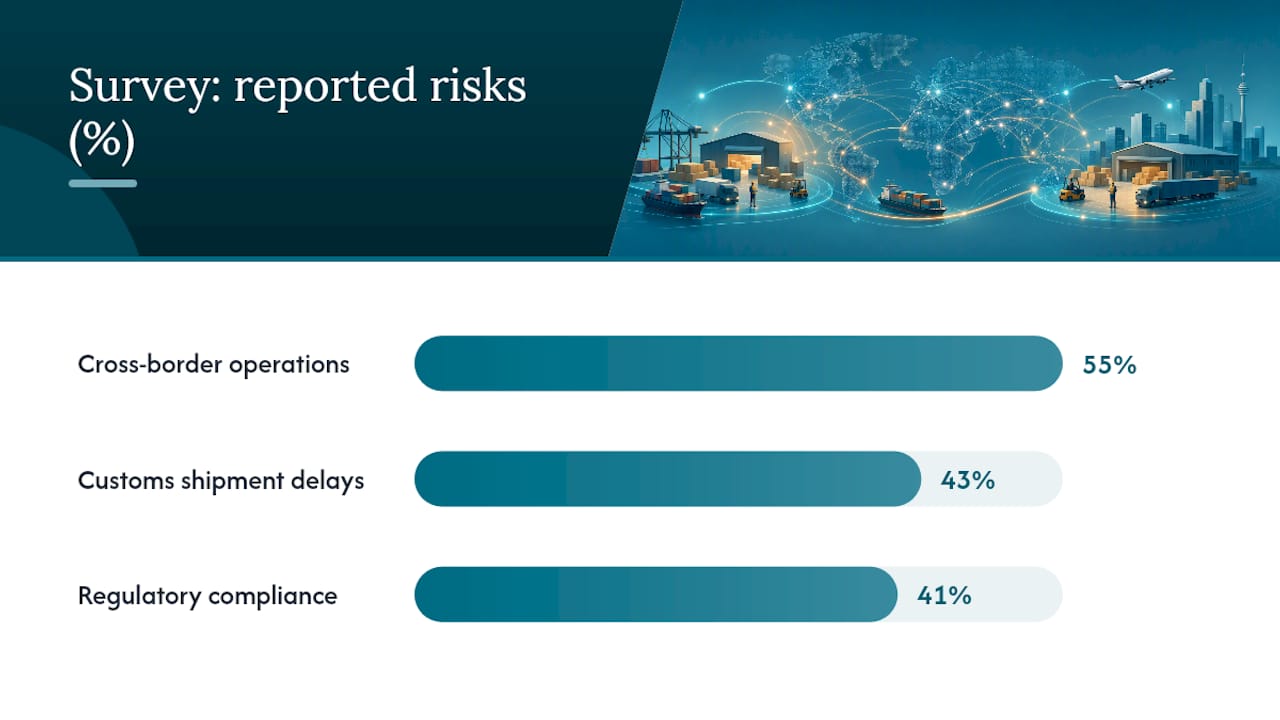
The numbers back that up directly. A Wipro industry survey found 55% of ecommerce businesses describe cross-border operations as challenging, with 43% citing customs shipment delays and 41% citing regulatory compliance as the specific hurdles. Those aren’t abstract risks. They show up as inventory sitting at a border, a customer refund request, or a chargeback.
Single-carrier dependency is the second major risk, and it’s self-inflicted; this is explained in detail in the Last-Mile Problem to highlight how last-mile delivery can become a critical vulnerability. A seller relying on one courier for last-mile delivery has no fallback when that carrier hits a service disruption, a labor issue, or a capacity crunch during peak season. Multi-courier allocation isn’t just a cost optimization. It’s insurance against a single point of failure taking down your delivery promise nationwide.
Inventory concentration risk follows the same logic. Stocking everything in one warehouse means one regional disruption (weather, a facility issue, a labor action) stalls fulfillment across your entire customer base at once. Distributing inventory across nodes spreads that exposure the same way it spreads shipping cost.
The practical fix for all three is redundancy built in at the design stage: more than one customs pathway, more than one courier per lane, and more than one fulfillment node per region.
What Technology Trends Are Changing Global Logistics Networks?
Internet of Things (IoT) sensors have moved from novelty to standard practice in high-value freight. Temperature and location sensors on containers give real-time condition data during transit, which matters for anything perishable or fragile and gives sellers proof of custody if a claim dispute comes up later.
Blockchain-based documentation is gaining traction slowly, mostly around customs paperwork and chain-of-custody records where multiple parties (broker, carrier, seller) need to trust the same version of a document without a manual reconciliation step. Adoption is still uneven across regions, so treat it as an emerging capability rather than a requirement to demand from every partner today.
The bigger near-term shift is in automation depth. Rate-shopping engines that compare live carrier pricing per order are now table stakes rather than a premium feature. Exception management systems that flag a delayed shipment before the customer notices have become the differentiator between a logistics partner and a tracking number generator.
Predictive analytics for demand forecasting is the trend worth watching closest. Systems that predict regional demand spikes before they hit let sellers pre-position inventory ahead of a sales surge instead of reacting to a stockout after it’s already cost a sale. That shifts inventory allocation from a reactive monthly review into a rolling, data-driven process.
None of these trends replace the fundamentals of good node placement and carrier diversification. They make the fundamentals execute faster and with fewer manual errors.
How Do You Build a Network That Scales Without Overbuilding?
Scalability in logistics isn’t about building for your biggest possible future volume on day one. It’s about designing a network where adding capacity doesn’t mean rebuilding the system.
The practical test is simple: can you add a fourth node, a new courier, or a new SKU category without renegotiating every integration you already have? If the answer is no, the network was built too rigid. A system built on real-time API connections rather than fixed, custom-coded integrations absorbs a new carrier or a new warehouse partner in weeks, not months.

Flexibility also means being able to flex down, not just up. Peak season capacity that gets flipped on and off (temporary warehouse space, surge courier capacity) matters as much as permanent growth capacity, especially for sellers with sharp seasonal swings like toys or apparel.
Inventory allocation rules need the same flexibility. A fixed 50/50 split between two nodes works fine until a regional demand shift makes it wrong. The systems worth trusting recalculate allocation dynamically based on rolling order data rather than a rule someone set once and forgot to revisit.
The cost-effective international shipping guide for smaller sellers covers how to build in scalability without the upfront capital commitment that scares off sellers still proving out demand in a new region.
What Do Successful Network Rollouts Actually Look Like?
The pattern across successful distributed fulfillment rollouts is consistent: sellers who moved from single-warehouse to multi-node fulfillment saw their average shipping zone shrink first, before any other metric moved. That’s the leading indicator, not final delivery speed.
A typical rollout sequence looks like this: a seller running one East Coast warehouse notices most orders shipping to the West Coast land in zone 7 or 8, the most expensive tier. Adding a West Coast node doesn’t just cut cost. It reclassifies most of that regional volume into zone 2 or 3 pricing, and the shipping line item on the P&L drops within the first full quarter of operation.
The sellers who get the most out of this transition are the ones who pilot on a limited SKU set first rather than migrating an entire catalog overnight. A toy retailer moving its top twenty SKUs to a second node before touching the long tail gets clean data on split-shipment rate and RTO without risking the whole catalog on an untested setup.
The common failure mode isn’t picking the wrong node location. It’s underestimating the integration work between the new node and existing order management, which leaves orders routing incorrectly for weeks after go-live. That’s why real-time API integration matters more at rollout than almost any other factor. Integration depth matters more than brand reputation when a partner is only as useful as the data connection between your storefront and their warehouse floor.
What Compliance Requirements Go Beyond Customs Forms?
Customs paperwork gets most of the attention, but trade agreements and security standards carry just as much operational weight. Preferential trade agreements between countries can reduce or eliminate duties on qualifying goods, but only if the shipment’s documentation proves origin correctly. Missing that paperwork means paying full duty rates on goods that could have shipped duty-free.
Security certification standards matter more as shipment volume grows across borders. Programs like Customs-Trade Partnership Against Terrorism (C-TPAT) in the United States and the Authorized Economic Operator (AEO) status in the European Union give certified shippers faster clearance and fewer random inspections. Neither is mandatory for a small seller, but both become worth pursuing once cross-border volume reaches a scale where inspection delays start costing real money.
Product-specific regulations add another layer sellers often miss until a shipment gets held. Certain product categories (electronics, textiles, anything battery-powered) carry additional labeling, testing, or import licensing requirements that vary by destination country. A musical instrument with certain wood components, for example, can trigger environmental import restrictions that a toy or apparel shipment never would.
The safest approach is treating compliance as a per-category, per-destination checklist rather than a single blanket customs process applied to every shipment. What clears easily into one country can sit held for weeks in another over a paperwork gap nobody flagged in advance.
Build In-House, Outsource, or Use an Integrated Platform?
The volume and geography of your orders should decide this, not a preference for control. If you’re shipping under a few hundred orders a week from one region, in-house fulfillment is still defensible. Once you’re splitting inventory across regions or crossing borders regularly, the integration burden of managing multiple carrier and warehouse relationships manually starts outweighing whatever control you think you’re keeping.
The pitfall I see most often isn’t a bad node choice. It’s fragmented inventory data: three warehouses reporting stock levels on different schedules, none of them talking to the OMS in real time. Returns get treated as an afterthought until RTO rates quietly erode a quarter’s margin.
Ask yourself three things before your next planning cycle: How many regions do your orders actually cluster in? Can your current systems talk to a new node without a manual data bridge? And what’s your RTO rate by zone right now, not last year? The answers tell you whether you need a bigger internal team, a 3PL partner, or a platform that already connects the pieces.
— Maayan
Get a Global Network Audit From Or-ner
A connected platform replaces the patchwork of separate carrier accounts, warehouse contracts, and customs brokers with one system, so sellers can reduce the number of vendor relationships to manage for a single shipment across a border. That’s particularly helpful for sellers who have outgrown a single warehouse but aren’t ready to build an in-house logistics team from scratch.
A network audit can map your current zone distribution, flag where a second or third node would cut cost, and lay out a migration plan that doesn’t require ripping out your existing order management setup on day one. Such audits are ideally built around real-time API integration standards, so new nodes can connect to systems in weeks rather than months.
If you’re ready to see what your shipping costs look like with a distributed network behind them, start with a look at reliable courier services built for cross-border ecommerce and request a coverage map for your specific order geography.
Sources
The figures and frameworks in this guide draw on a mix of industry research and practical implementation resources worth bookmarking if you’re building out your own network.
- Overcoming the challenges of cross-border eCommerce | Wipro
- E‑commerce and trade logistics: new challenges and opportunities for international transport and trade facilitation | UNCTAD
- Ecommerce supply chain network explained: A complete guide — Shipway
- 3PL in ecommerce: How to choose the right partner (2026) – Shopify
FAQ
What Is a Global Project Logistics Network?
It’s the combined system of warehouses, carriers, customs brokers, and connecting software that moves ecommerce inventory from origin to customer across regions and borders, built to cut cost and transit time compared to a single-warehouse setup.
How Many Fulfillment Nodes Should an Ecommerce Seller Start With?
Most sellers should start with two nodes, typically an East and West split, before adding a third for Midwest coverage, since each additional node adds inventory and integration complexity that needs to be justified by actual order data.
How Much Can Automated Courier Allocation Save on Shipping?
Automated courier allocation combined with rate shopping can reduce per-order shipping cost by roughly 12 to 18 percent compared to manual carrier selection.
Should I Outsource Fulfillment or Build an In-House Network?
It depends on order volume and geographic spread. 87% of shippers report increasing their use of outsourced logistics, and 89% call their 3PL relationships successful, which makes outsourcing the more defensible default once you’re shipping across multiple regions.
What Causes the Most Delays in Cross-Border Ecommerce Shipping?
Customs shipment delays and regulatory compliance issues are the two most commonly cited hurdles, which is why bonded storage and experienced customs brokers matter more than transit speed alone.
Does Or-ner Support Multi-Node Fulfillment and Cross-Border Shipping?
Yes. Or-ner’s platform connects freight booking, warehousing, and customs clearance into one system built for the multi-node, cross-border setups covered throughout this guide.