TL;DR:
- Effective ecommerce logistics require integrated systems covering procurement to after-sales support.
- Transition to 3PL providers is advisable above 500 orders monthly for cost efficiency.
- Continuous risk management and real-time visibility are key to overcoming common logistics edge cases.
Most ecommerce brands assume their shipping problems start and end with the courier. Wrong. The real culprit is usually a fragmented logistics system where procurement, warehousing, fulfillment, and returns operate in silos with no shared visibility. When one link breaks, the whole chain fails, and customers feel it immediately. This guide walks you through every phase of end-to-end logistics, from supplier sourcing to post-delivery support, so you can identify weak points, evaluate your current setup, and build a more scalable, reliable operation. Whether you ship 50 orders a week or 50,000, the principles here apply directly to your growth.
Table of Contents
- What is end-to-end logistics?
- Unique challenges in ecommerce logistics
- Frameworks and metrics for success
- Tech integration: The engine of modern logistics
- In-house vs. 3PL: Choosing the right logistics model
- A pragmatic take: What most ecommerce guides miss about end-to-end logistics
- Unlock seamless ecommerce logistics with expert-driven solutions
- Frequently asked questions
Key Takeaways
| Point | Details |
|---|---|
| Comprehensive coordination | Success in ecommerce logistics depends on orchestrating every phase from supplier to customer, not just shipping. |
| Integrated technology advantage | Digital platforms cut costs and errors by automating and connecting all logistics stages in real time. |
| Choose the right model | In-house suits smaller volumes, but 3PLs and hybrids deliver efficiency for growing, global brands. |
| Exception management is essential | Adaptability for returns, cross-border challenges, and system surprises makes or breaks logistics performance. |
What is end-to-end logistics?
End-to-end logistics means managing every single step in the supply chain, from the moment you purchase inventory from a supplier to the moment a customer receives their order and beyond. It is not just about shipping. It covers procurement, inventory management, warehousing, multi-modal transport, order fulfillment, real-time tracking, and after-sales support.
Think of it as the difference between managing a relay race and just running your one leg. If you only focus on your stretch, you have no idea what is happening before or after you. End-to-end logistics gives you visibility and control across every handoff.
Here is a breakdown of the core functions and how each one affects your ecommerce operation:
| Logistics function | Impact on ecommerce |
|---|---|
| Procurement | Controls cost and lead time from suppliers |
| Inventory management | Prevents stockouts and overstock situations |
| Warehousing | Determines pick speed and storage cost |
| Multi-modal transport | Balances speed vs. cost across ocean, air, land |
| Order fulfillment | Directly affects delivery accuracy and speed |
| Real-time tracking | Builds customer trust and reduces support tickets |
| Returns and after-sales | Protects revenue and customer lifetime value |
The core components include procurement, inventory management, warehousing, multi-modal transport coordination across ocean, air, and land, order fulfillment, tracking, and after-sales support. Each element connects to the next, and a gap in any one of them creates downstream problems that are expensive to fix.
You can explore the full range of types of logistics services to understand which components your current setup may be missing.
“The brands that win on logistics are not the ones with the fastest courier. They are the ones that have orchestrated every component into a single, visible system.” — Logistics operations analyst
For ecommerce brands targeting global markets, this orchestration is not optional. It is the foundation of reliable courier services and scalable growth.
Unique challenges in ecommerce logistics
Now that you understand the framework, let’s confront the real challenges ecommerce brands experience daily. Ecommerce logistics is fundamentally different from traditional freight. You are not shipping pallets to one retailer. You are shipping thousands of individual orders to thousands of different addresses, often across multiple countries, every single day.
Ecommerce operations face high return rates of 20 to 30 percent compared to just 8 to 10 percent in traditional retail, alongside 24/7 order flow, multi-channel inventory complexity, and last-mile optimization demands. That return rate alone can destroy margins if you do not have a structured reverse logistics process in place.
Here are the top five logistics headaches unique to ecommerce:
- High individual order volumes with tight delivery windows and customer expectations for next-day or two-day shipping
- Returns processing that requires dedicated workflows, restocking procedures, and refund automation
- Multi-channel inventory sync across your own site, Amazon, and wholesale channels without overselling
- Last-mile delivery complexity in urban and rural markets, which accounts for up to 53 percent of total shipping costs
- Cross-border customs clearance with inconsistent documentation requirements that delay international orders
A single delayed shipment does more than frustrate a customer. It triggers a support ticket, a potential refund request, and a negative review that can reduce conversion rates for weeks. The cost compounds fast.
Pro Tip: Build a dedicated returns portal that automates label generation and restocking triggers. Efficient returns management in ecommerce can recover 15 to 25 percent of costs that brands typically write off as losses.
The solution is not to patch individual problems as they appear. Integrated systems that connect your warehouse, courier, and customer service platforms are what actually prevent these issues from recurring. Strong warehousing best practices are a core part of that integration, not an afterthought.
Frameworks and metrics for success
With these challenges in mind, frameworks help you turn obstacles into opportunities. The SCOR model (Supply Chain Operations Reference) is the most widely used structure for evaluating and improving end-to-end logistics performance. It breaks your supply chain into six process categories: Plan, Source, Make, Deliver, Return, and Enable.
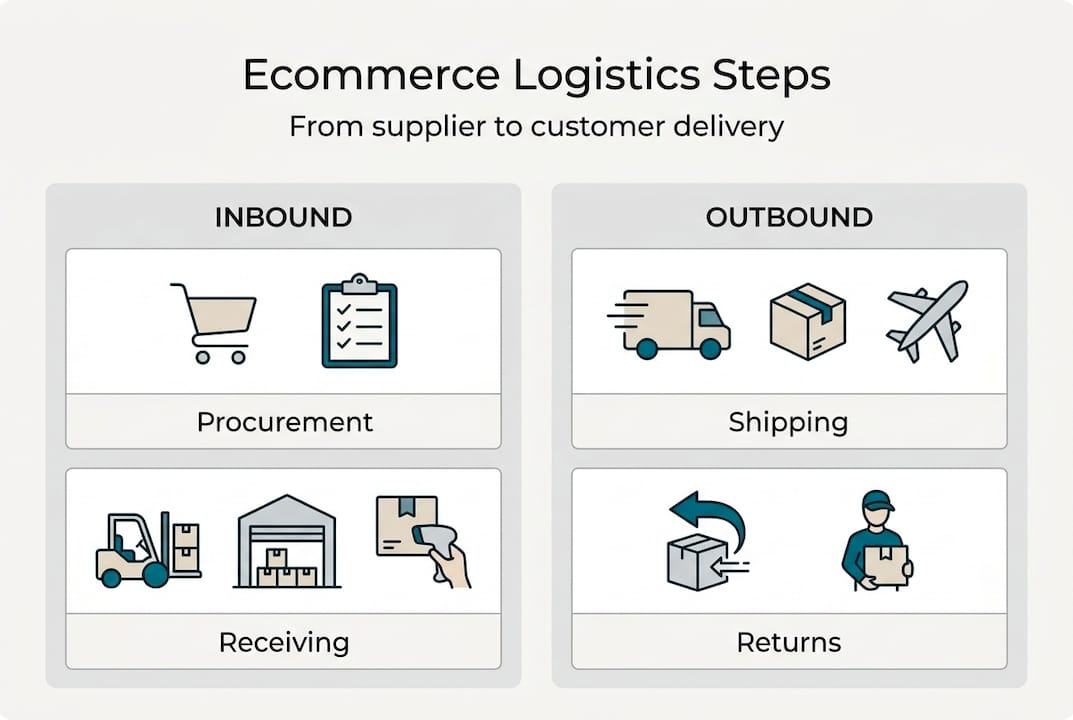
The SCOR framework structures end-to-end processes across all six stages and tracks performance using metrics like Perfect Order Fulfillment, Order Fulfillment Cycle Time, and Cash-to-Cash Cycle Time. These are not vanity metrics. They tell you exactly where money and time are being lost.
Here is how to apply SCOR for a quick self-assessment of your ecommerce logistics:
- Plan: Map your current demand forecasting accuracy. Are you consistently over or under-ordering?
- Source: Evaluate supplier lead times and on-time delivery rates from your vendors.
- Make: If you manufacture or kit products, measure production cycle time and defect rates.
- Deliver: Track order accuracy rate, on-time delivery percentage, and cost per shipment.
- Return: Measure return processing time, restocking rate, and refund cycle time.
- Enable: Assess your technology stack for integration gaps, manual processes, and reporting blind spots.
| KPI | Manual logistics | Integrated logistics |
|---|---|---|
| Order accuracy rate | 92 to 95% | 98 to 99.5% |
| On-time delivery | 78 to 85% | 92 to 97% |
| Return processing time | 5 to 10 days | 1 to 3 days |
| Cost per order | High variability | Predictable and lower |
“Centralized visibility is not a luxury. It is the only way to catch problems before they reach the customer.” — Supply chain technology consultant
For a deeper look at how these metrics translate into operational improvements, explore logistics solutions for optimization that connect your data across every logistics stage.
Tech integration: The engine of modern logistics
Precision and efficiency require more than process. They need powerful technology. Fragmented logistics systems, where your warehouse management tool does not talk to your courier platform, which does not sync with your storefront, are one of the most common and costly mistakes in ecommerce operations.

Integrated platforms automate data sharing, reduce manual entry, and enable real-time visibility, cutting costs by up to 20 percent, stockouts by 40 percent, and international delays by 30 percent. Those numbers represent real dollars and real customer experiences.
Here is what before and after integration typically looks like:
| Metric | Before integration | After integration |
|---|---|---|
| Manual data entry errors | 3 to 5% of orders | Under 0.5% |
| Stockout frequency | Monthly | Rare |
| International delay rate | 25 to 35% | Under 10% |
| Logistics cost as % of revenue | 18 to 22% | 12 to 16% |
IoT sensors now track shipment conditions like temperature and humidity in real time. AI-powered demand forecasting adjusts reorder points automatically based on sales velocity, seasonality, and supplier lead times. These tools used to be enterprise-only. In 2026, they are accessible to mid-sized ecommerce brands through cloud-based platforms.
Pro Tip: When evaluating logistics tech, prioritize API-first platforms. They connect to your existing tools without costly custom development and scale with you as order volume grows. Start with shipment tracking software that gives you and your customers live visibility from warehouse to doorstep.
In-house vs. 3PL: Choosing the right logistics model
Beyond technology, choosing your operating model affects cost, scale, and competitive edge. Many ecommerce brands hold onto in-house logistics longer than they should, often because it feels like maintaining control. But that control comes at a steep price once volume grows.
In-house logistics makes sense when you are processing fewer than 500 orders per month, have highly specialized packing requirements, or are in an early stage where learning your own operations is valuable. Above that threshold, the economics shift sharply.
3PL providers become economical above 500 orders per month, saving 15 to 40 percent on shipping through volume rates, with pick and pack costs ranging from $2.50 to $5 per order and storage at $0.50 to $1.50 per cubic foot per month.
Pros and cons at a glance:
- In-house pros: Full control, direct quality oversight, easier brand customization
- In-house cons: Fixed overhead, limited scalability, staff and space constraints
- 3PL pros: Variable cost structure, established carrier relationships, faster geographic expansion
- 3PL cons: Less direct control, minimum volume requirements, onboarding complexity
Hybrid models are increasingly popular. You handle domestic fulfillment in-house while routing international orders through a 3PL with regional warehouse networks. This balances control where it matters with cost efficiency where scale demands it.
Pro Tip: The most common mistake brands make is waiting until they are overwhelmed before switching to a 3PL. By then, errors are already compounding. Plan your transition at 400 orders per month, not 600. Understanding the 3PL vs 4PL comparison will also help you decide how much logistics management you want to retain internally.
A pragmatic take: What most ecommerce guides miss about end-to-end logistics
Here is the uncomfortable truth most logistics guides skip: even a well-designed logistics system will break in ways you did not plan for. Edge cases like returns processing failures, failed deliveries, partial shipments, order cancellations after pick and pack, cross-border customs delays, and legacy system integration conflicts are not rare exceptions. They happen weekly at any meaningful scale.
The idea of a perfect logistics stack is appealing but misleading. A single software mismatch between your ERP and your 3PL’s warehouse management system can freeze hundreds of orders. A customs documentation error in one market can delay an entire shipment batch for two weeks. No framework eliminates these risks entirely.
What separates high-performing logistics operations is not the elegance of their initial setup. It is how fast they detect and resolve exceptions. That requires adaptable teams, not just documented processes. Your people need authority to make real-time decisions, not just escalation paths that slow everything down.
Building for reverse logistics challenges from day one, rather than retrofitting solutions after problems emerge, is one of the most underrated investments an ecommerce brand can make. Continuous re-optimization is the actual competitive advantage, not any single tool or partner.
Unlock seamless ecommerce logistics with expert-driven solutions
Reliable courier services and scalable fulfillment do not happen by accident. They are built on integrated systems, smart partner choices, and continuous visibility across every logistics phase.
ORNER’s global logistics platform connects ecommerce brands to a worldwide network of couriers, fulfillment centers, and customs clearance services, all through one interface. From automating order routing to real-time shipment tracking, ORNER’s cloud logistics platforms give you the visibility and control to scale without the operational chaos. Explore end-to-end logistics solutions built specifically for ecommerce growth and see how ORNER can reduce your logistics costs while improving delivery performance across every market you serve.
Frequently asked questions
What is the difference between end-to-end and traditional logistics?
End-to-end logistics covers every step from purchasing to after-sales, while traditional models often manage only shipping or storage. Core components include procurement, inventory management, warehousing, multi-modal transport, fulfillment, tracking, and after-sales support.
At what order volume does switching to a 3PL make sense?
Switch to a 3PL when handling more than 500 orders per month for greater cost savings and efficiency. 3PL providers save 15 to 40 percent on shipping through volume carrier rates unavailable to smaller shippers.
How do real-time tracking and automation impact ecommerce logistics?
They reduce manual errors, enable global visibility, and lower operating costs by up to 20 percent while cutting stockouts and international delays significantly.
Why are returns more challenging in ecommerce logistics?
Ecommerce return rates of 20 to 30 percent are two to three times higher than retail, requiring dedicated reverse logistics workflows to protect margins and customer satisfaction.
What is the SCOR framework in logistics?
SCOR is a process model for supply chains covering planning, sourcing, making, delivering, returns, and continuous improvement. The SCOR model uses metrics like Perfect Order Fulfillment and Cash-to-Cash Cycle Time to measure performance.
Recommended
- End-to-end logistics solutions for ecommerce success in 2026 – ORNER
- Global logistics solutions: optimize your ecommerce supply chain – ORNER
- Types of logistics services: smart choices for ecommerce – ORNER
- What is Ecommerce Logistics? Key Insights for 2025 – ORNER
- Master Merch Fulfillment Workflow for Fast, Accurate Orders
- Scalable Ecommerce Solutions: Complete Guide for Business