Most ecommerce managers believe logistics is inherently fragmented, requiring separate vendors for warehousing, shipping, and returns. This misconception costs brands visibility and control. End-to-end logistics solutions integrate all supply chain stages from sourcing raw materials to after-sales support, streamlining coordination for ecommerce brands. By unifying operations under one framework, you gain real-time visibility, reduce errors, and accelerate fulfillment. This article explains the components, benchmarks, strategies, and applications that transform fragmented processes into seamless, scalable systems.
Table of Contents
- Understanding End-To-End Logistics Solutions
- Core Methodologies And Technologies Powering End-To-End Logistics
- Key Performance Benchmarks For Top Ecommerce Fulfillment
- Risk Management: Avoiding Disruptions In End-To-End Logistics
- Choosing The Right Logistics Model: 3PL, In-House, Or Hybrid
- Explore Reliable Logistics Solutions With ORNER
- Frequently Asked Questions About End-To-End Logistics Solutions
Key takeaways
| Point | Details |
|---|---|
| Full visibility | End-to-end solutions cover sourcing to after-sales with complete supply chain transparency. |
| Core methods | AI, real-time inventory tracking, and 3PL partnerships optimize fulfillment workflows. |
| Top KPIs | Perfect order rate and on-time shipping metrics measure logistics success accurately. |
| Risk mitigation | Diversifying suppliers and mapping tier-2 risks prevent costly disruptions. |
| Model selection | 3PL or hybrid models offer scalability and cost benefits for mid-large brands. |
Understanding end-to-end logistics solutions
End-to-end logistics encompasses every stage of your supply chain, from sourcing raw materials and procurement through manufacturing, warehousing, order fulfillment, transportation, last-mile delivery, and after-sales support. This holistic approach provides full visibility and streamlined coordination across all touchpoints. For ecommerce brands managing complex inventories and customer expectations, end-to-end logistics solutions eliminate silos and create a unified operational framework.
Three critical components define this model. Logistics operations manage warehousing, inventory allocation, and order processing. Deliveries include last-mile execution, the final and most expensive leg of fulfillment. Reverse logistics handle returns, exchanges, and refurbishment, closing the loop on customer satisfaction. Each component relies on data integration and process automation to function seamlessly.
Consider the main stages in detail:
- Sourcing and procurement: Identifying suppliers, negotiating contracts, and securing materials at optimal cost and quality.
- Manufacturing and production: Coordinating production schedules, quality control, and output to match demand forecasts.
- Warehousing and inventory management: Storing products strategically across locations, tracking stock levels in real time, and allocating inventory dynamically.
- Order fulfillment: Picking, packing, and preparing orders for shipment with accuracy and speed.
- Transportation and last-mile delivery: Moving products from warehouses to customers via optimized routes and reliable carriers.
- After-sales and reverse logistics: Processing returns, handling exchanges, and managing product lifecycle end-of-life activities.
Integrating these stages under one system transforms operational efficiency. You eliminate communication gaps, reduce handoff errors, and gain predictive insights into potential bottlenecks. Ecommerce logistics becomes a competitive advantage rather than a cost center.
“End-to-end logistics solutions provide ecommerce brands with the visibility, control, and agility needed to meet customer expectations while minimizing costs and risks across the entire supply chain.”
Core methodologies and technologies powering end-to-end logistics
Advanced technologies and methodologies drive the efficiency of modern end-to-end logistics. Real-time inventory tracking, AI-driven route optimization, demand forecasting, WMS/TMS integration, and data-driven allocation improve fulfillment and reduce costs across ecommerce operations. These innovations transform static processes into dynamic, responsive systems.
Real-time inventory tracking uses IoT sensors and cloud platforms to monitor stock levels, locations, and movement continuously. You know exactly where every SKU sits at any moment, enabling faster decision-making and reducing stockouts. AI optimizes delivery routes by analyzing traffic patterns, weather conditions, and delivery windows, cutting transit times and fuel costs. For example, machine learning algorithms can reduce last-mile expenses by up to 20% through dynamic route adjustments.
Demand forecasting leverages historical sales data, seasonality patterns, and external factors like promotions or market trends to predict future order volumes. Accurate forecasts align inventory with customer needs, preventing overstocking and understocking. Warehouse Management Systems (WMS) and Transportation Management Systems (TMS) integrate seamlessly, automating order routing, carrier selection, and shipment tracking. This integration eliminates manual coordination and accelerates fulfillment cycles.
Data-driven inventory allocation distributes stock across multiple warehouses based on regional demand, proximity to customers, and shipping costs. By positioning products closer to end users, you reduce delivery times and expenses. Digital transformation in logistics enables these capabilities through unified platforms that aggregate data from disparate sources.
| Company | Technology Applied | Impact Achieved |
|---|---|---|
| JD.com | AI route optimization, real-time tracking | 30% faster fulfillment, 15% cost reduction |
| nuVizz | IoT asset tracking, predictive analytics | 40% improved asset utilization, 25% fewer delays |
These results demonstrate the tangible benefits of adopting advanced logistics technologies. Best shipment tracking software integrates these capabilities into user-friendly interfaces, empowering logistics coordinators to monitor and optimize operations in real time.
Pro Tip: Adopt scalable tech platforms that integrate telemetry and analytics for continuous process improvement. Start with one high-impact area like inventory tracking, then expand to route optimization and demand forecasting as your team gains proficiency.
Key performance benchmarks for top ecommerce fulfillment
Measuring logistics performance requires clear, actionable KPIs. Top benchmarks include Perfect Order Rate >95%, Order Accuracy >99.5%, On-Time Shipping >98%, Inventory Accuracy 100%, and Returns Processing 95% for successful fulfillment in 2026. Tracking these metrics helps you identify bottlenecks, refine processes, and enhance customer satisfaction.
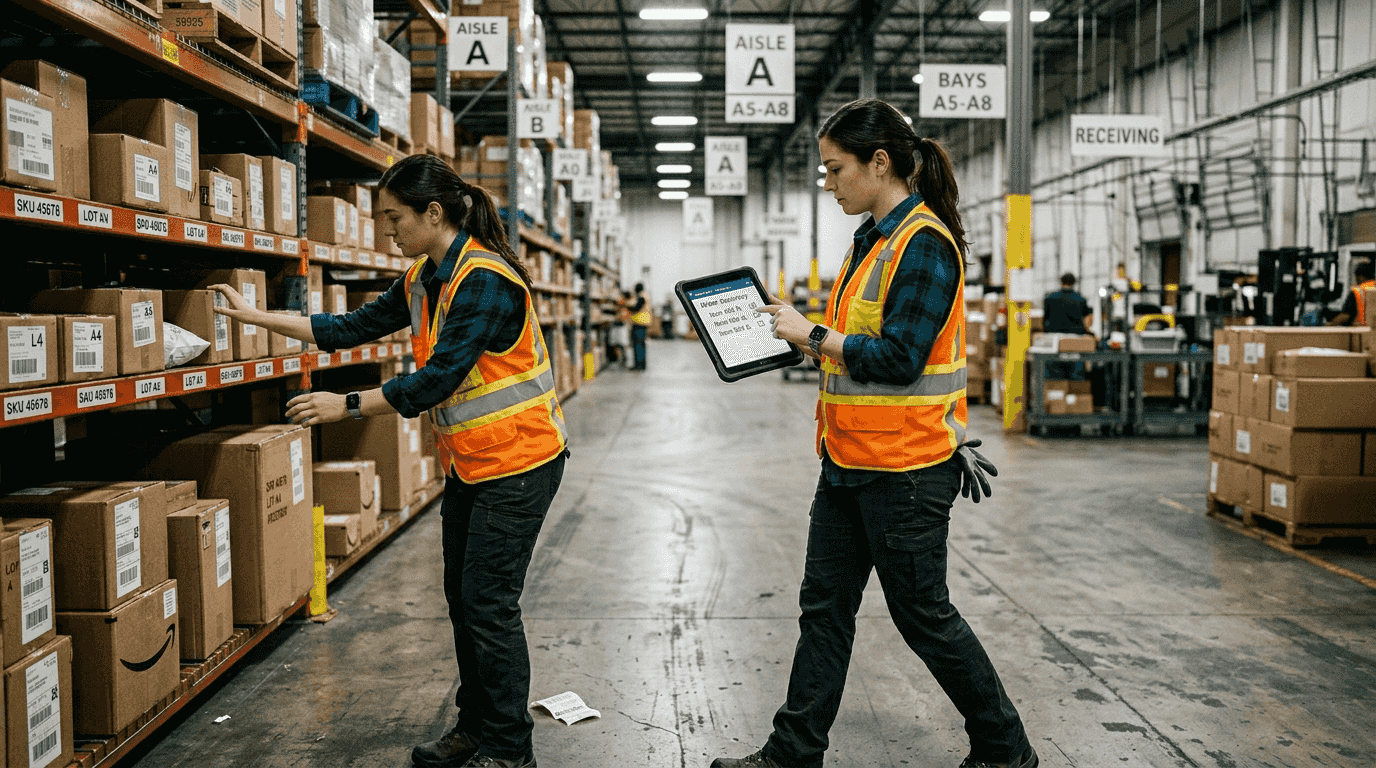
Perfect Order Rate measures the percentage of orders delivered on time, complete, and damage-free. A rate above 95% indicates strong operational control. Order Accuracy tracks how often you ship the correct items in the right quantities. Errors frustrate customers and increase return rates, so maintaining 99.5% accuracy is essential. On-Time Shipping evaluates the percentage of orders delivered within promised windows. Consistently hitting 98% or higher builds customer trust and reduces service inquiries.
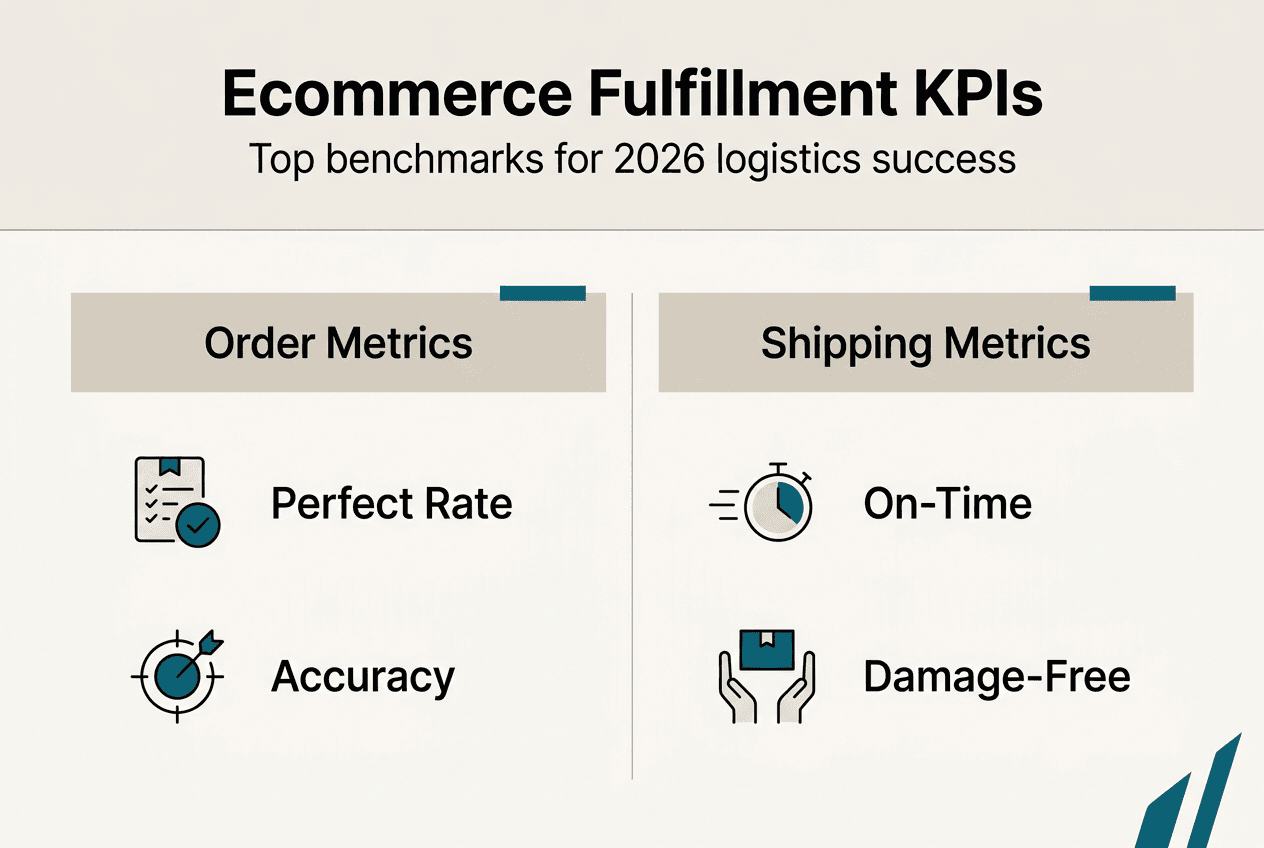
Inventory Accuracy compares physical stock to system records. Achieving 100% accuracy requires regular cycle counts and robust WMS integration. Dock-to-Stock time measures how quickly received inventory becomes available for sale. Faster processing reduces holding costs and improves cash flow. Returns Processing evaluates the speed and efficiency of handling customer returns. A 95% success rate ensures customers receive refunds or replacements promptly, maintaining loyalty.
Here’s how each KPI impacts ecommerce success:
- Perfect Order Rate: Directly influences customer retention and repeat purchase rates. High scores reduce negative reviews and support requests.
- Order Accuracy: Minimizes costly returns and exchanges while preserving brand reputation.
- On-Time Shipping: Meets customer expectations set during checkout, reducing cart abandonment on future visits.
- Inventory Accuracy: Prevents overselling, stockouts, and lost sales opportunities.
- Dock-to-Stock Time: Accelerates inventory turnover and improves working capital efficiency.
- Returns Processing: Enhances customer experience and recovers value from returned goods quickly.
| KPI | Industry Average | Top Performer Benchmark |
|---|---|---|
| Perfect Order Rate | 85-90% | >95% |
| Order Accuracy | 97-99% | >99.5% |
| On-Time Shipping | 92-95% | >98% |
| Inventory Accuracy | 95-98% | 100% |
| Returns Processing | 85-90% | >95% |
Tracking these KPIs through delivery performance metrics enables continuous operational refinement. You can benchmark against competitors, set improvement targets, and allocate resources to high-impact areas. Regular reporting and analysis turn raw data into strategic insights that drive end-to-end logistics solutions forward.
Risk management: avoiding disruptions in end-to-end logistics
Supply chain disruptions can cripple ecommerce operations overnight. Recent high-profile cases illustrate the consequences of poor risk management. Peloton overestimated pandemic demand, leading to massive inventory write-downs and layoffs. Nike’s supply chain struggled with demand forecasting errors, resulting in excess inventory and margin pressure. KFC UK ran out of chicken at 900 locations due to a single logistics provider failure. Stellantis halted production across multiple plants when a critical supplier faced operational issues.
These failures share common root causes: supplier concentration, inadequate tier-2 risk mapping, and over-reliance on just-in-time inventory. Avoid single-supplier dependency and just-in-time extremes; diversify suppliers, map tier-2 risks, and use forecasting analytics to mitigate disruptions. Supplier concentration creates single points of failure. When one vendor encounters problems, your entire operation grinds to a halt.
Tier-2 risk mapping identifies vulnerabilities deeper in the supply chain. Your direct suppliers may be reliable, but their suppliers might face capacity constraints, geopolitical risks, or financial instability. Mapping these relationships reveals hidden dependencies and enables proactive contingency planning. Predictive demand forecasting uses advanced analytics to anticipate order volumes, reducing the need for risky just-in-time practices while avoiding excess inventory.
Buffers provide operational resilience without bloating costs. Strategic safety stock, diversified supplier networks, and flexible manufacturing capacity absorb shocks from unexpected events. Consider these risk mitigation best practices:
- Diversify suppliers: Source critical components from at least two geographically separated vendors.
- Map tier-2 dependencies: Understand your suppliers’ suppliers to identify hidden vulnerabilities.
- Implement demand forecasting: Use AI and historical data to predict order patterns and adjust inventory proactively.
- Build strategic buffers: Maintain safety stock for high-velocity SKUs and critical components.
- Establish backup logistics providers: Pre-qualify alternative carriers and warehouses for rapid failover.
- Monitor geopolitical and economic indicators: Track events that could disrupt supply routes or supplier operations.
Logistics risk management strategies integrate these practices into a cohesive framework. You can’t eliminate all risks, but you can reduce their likelihood and impact dramatically. Peloton’s supply chain failure and Nike’s challenges offer valuable lessons: overconfidence in demand forecasts and underinvestment in supply chain flexibility lead to catastrophic outcomes.
Pro Tip: Blend in-house control with 3PL scalability for flexibility during disruptions. Maintain direct relationships with critical suppliers while leveraging third-party logistics for variable capacity. Understanding the difference between 3PL and 4PL helps you structure partnerships that balance control and agility.
Choosing the right logistics model: 3PL, in-house, or hybrid
Selecting the optimal logistics model depends on your order volumes, customization needs, cost goals, and growth trajectory. 3PL offers scalability, 15-40% shipping savings, no upfront costs; in-house provides control and customization; hybrid balances both for mid-large ecommerce brands. Each model presents distinct advantages and trade-offs.
| Model | Pros | Cons | Cost Structure | Ideal Order Volume |
|---|---|---|---|---|
| 3PL | Scalability, negotiated carrier rates, no upfront investment, expertise | Less control, potential quality variability, dependency | Variable per-order fees | 500+ monthly orders |
| In-house | Full control, brand consistency, customization, direct oversight | High upfront costs, fixed overhead, staffing complexity | Fixed infrastructure plus labor | <500 or >5000 monthly orders |
| Hybrid | Balanced control and scalability, risk distribution, flexibility | Coordination complexity, dual systems | Mixed fixed and variable | 1000+ monthly orders |
Third-party logistics (3PL) providers handle warehousing, fulfillment, and shipping on your behalf. You pay per order or transaction, avoiding capital expenditures on facilities and equipment. 3PLs leverage economies of scale to negotiate better carrier rates, often saving 15-40% on shipping costs. They offer rapid scalability during peak seasons without hiring temporary staff. However, you sacrifice some control over packaging, branding, and customer experience. Quality can vary between providers, and you become dependent on their systems and processes.
In-house logistics gives you complete control over every aspect of fulfillment. You can customize packaging, implement unique branding, and maintain direct oversight of quality standards. This model suits brands with very low volumes (where 3PL fees exceed in-house costs) or very high volumes (where economies of scale justify fixed investments). The downside is significant upfront capital for warehouses, equipment, and technology, plus ongoing labor and overhead expenses. Scaling during peak seasons requires hiring and training temporary workers.
Hybrid models combine in-house and 3PL capabilities. You might handle high-margin or custom orders in-house while outsourcing standard fulfillment to a 3PL. This approach balances control with scalability, distributes risk, and provides flexibility during disruptions. The challenge is coordinating between two systems, integrating technology platforms, and managing inventory across locations.
Key decision factors include:
- Control vs. scalability: In-house maximizes control; 3PL maximizes scalability; hybrid offers both.
- Cost structure: 3PL shifts costs to variable; in-house requires fixed investment; hybrid splits the difference.
- Customization needs: Complex packaging or special handling favors in-house or hybrid.
- Order volume: Below 500 monthly orders, in-house may be cheaper; above 500, 3PL or hybrid typically wins.
- Growth trajectory: Rapid growth benefits from 3PL scalability; stable volumes suit in-house efficiency.
Pro Tip: For brands exceeding 500-1000 monthly orders, prioritize 3PL or hybrid for cost efficiency without sacrificing flexibility. Implement robust WMS and tech integration within each model to maintain visibility and control regardless of who handles physical fulfillment. Understanding the difference between 3PL and 4PL helps you structure partnerships that align with your strategic goals. End-to-end logistics solutions can operate effectively under any model when supported by the right technology and processes.
Explore reliable logistics solutions with ORNER
Streamlining your end-to-end logistics requires a partner that understands the complexities of modern ecommerce fulfillment. ORNER’s global logistics platform powers scalable courier services across ocean, air, and land transport modes, integrating seamlessly with major ecommerce operators. Our technology provides real-time shipment tracking, customs clearance, and cross-border logistics support, ensuring visibility and control at every stage.
Mid-large ecommerce brands benefit from ORNER’s network of warehouses and fulfillment centers strategically positioned to minimize delivery times and costs. Our warehousing best practices optimize inventory allocation, reduce dock-to-stock times, and improve order accuracy. Logistics risk management strategies built into our platform help you diversify suppliers, map tier-2 dependencies, and respond proactively to disruptions.
Key benefits include:
- Cost reduction: Negotiated carrier rates and optimized routing lower shipping expenses by 15-40%.
- Full visibility: Real-time tracking and analytics dashboards provide actionable insights across your supply chain.
- Expert support: Dedicated logistics coordinators assist with exception management, customs clearance, and process optimization.
- Scalability: Flexible capacity adapts to seasonal peaks and growth without capital investment.
Pro Tip: Leverage ORNER’s technology to handle last-mile complexities and mitigate risks. Our platform integrates with your existing systems, providing unified visibility and control whether you operate in-house, through 3PL, or via hybrid models.
Frequently asked questions about end-to-end logistics solutions
What is the difference between 3PL and in-house logistics?
3PL providers handle warehousing, fulfillment, and shipping for variable per-order fees, offering scalability without upfront investment. In-house logistics gives you complete control over operations but requires fixed capital for facilities, equipment, and labor. Brands with 500+ monthly orders typically benefit from 3PL cost efficiency, while very low or very high volumes may justify in-house operations.
How can AI improve last-mile delivery efficiency?
AI analyzes traffic patterns, weather conditions, delivery windows, and historical data to optimize routes dynamically. Machine learning algorithms reduce transit times and fuel costs by up to 20% through real-time adjustments. AI also predicts delivery exceptions, enabling proactive customer communication and reducing failed delivery attempts.
What are the main risks in end-to-end supply chains and how to mitigate them?
Supplier concentration, tier-2 vulnerabilities, and just-in-time extremes create fragility. Mitigate risks by diversifying suppliers across geographies, mapping tier-2 dependencies to identify hidden vulnerabilities, implementing predictive demand forecasting, and maintaining strategic safety stock. Establish backup logistics providers and monitor geopolitical indicators proactively.
Which KPIs are most critical for ecommerce logistics performance?
Perfect Order Rate (>95%), Order Accuracy (>99.5%), and On-Time Shipping (>98%) directly impact customer satisfaction and retention. Inventory Accuracy (100%) prevents stockouts and overselling. Returns Processing (>95%) maintains loyalty by resolving issues quickly. Track these metrics through unified dashboards to identify bottlenecks and refine operations continuously.
When should an ecommerce brand consider switching to a hybrid logistics model?
Consider hybrid when you exceed 1000 monthly orders and need both control and scalability. Hybrid suits brands with diverse product lines where some items require custom handling while others benefit from 3PL efficiency. It also provides risk distribution during disruptions, allowing you to shift volumes between in-house and outsourced capacity as needed.
Recommended
- End-to-end logistics solutions streamline ecommerce in 2026 – ORNER
- What is Ecommerce Logistics? Key Insights for 2025 – ORNER
- 7 Top Logistics Challenges 2025 and How to Overcome Them – ORNER
- Freight Forwarding for Ecommerce: 6% CAGR Growth in 2026 – ORNER
- What is an online merch store? A guide for artists in 2026 – The Inner Sanctum Group