

TL;DR:
- Manual freight quoting wastes time and leads to inconsistency, while automation streamlines selections and reduces errors.
- Providing accurate shipment data upfront is essential to avoid billing surprises caused by surcharges and dimensional weight calculations.
If your team is still manually calling carriers and piecing together spreadsheets to compare rates, the freight quote process is costing you far more than just time. It’s one of the most consequential steps in ecommerce logistics, yet most sellers treat it as an afterthought rather than a strategic lever. Get it right and you reduce shipping costs, improve carrier relationships, and make faster decisions. Get it wrong and you’re flying blind on every shipment. This guide breaks down every stage of the freight pricing process and shows you how to work it to your advantage.
Table of Contents
- Key takeaways
- How the freight quote process actually works
- What actually drives freight pricing variability
- Manual quoting vs. automated freight rate shopping
- Best practices for requesting and evaluating freight quotes
- My take on where freight quoting really breaks down
- How Or-ner takes the complexity out of freight quoting
- FAQ
Key takeaways
| Point | Details |
|---|---|
| Shipment accuracy drives quote accuracy | Errors in weight, dimensions, or destination inflate costs and cause billing surprises. |
| Surcharges distort sticker prices | Fuel, residential, and accessorial fees can push final costs well above the base rate. |
| Automation eliminates manual rate waste | High-volume shippers lose 10-15 hours weekly to manual rate comparison that automation handles in seconds. |
| Side-by-side comparison is non-negotiable | Evaluating quotes in a structured table reveals true cost differences beyond headline rates. |
| Negotiation is available to most shippers | Carriers adjust rates for volume commitments, consistent lanes, and bundled services. |
How the freight quote process actually works
Most shippers think of a freight quote as a simple price lookup. It is not. The freight quote process is a data exchange between you and a carrier, and the quality of data you provide directly determines the accuracy of what comes back.
Before any carrier can price a shipment, you need to supply the right details. The core inputs include:
- Commodity type and description (what you are shipping and how it is classified)
- Weight (actual weight, per piece and total)
- Dimensions (length, width, height for each package or pallet)
- Origin and destination (full zip codes, not just cities)
- Freight class (for LTL shipments, this directly affects pricing)
- Pickup and delivery requirements (liftgate, inside delivery, appointment)
- Declared value (for insurance and liability purposes)
The service type you choose also shapes the quoting experience significantly. LTL (less-than-truckload) quotes are particularly complex because pricing depends on freight class, density, and the carrier’s zone-based tariff structure. FTL (full truckload) quotes are more straightforward since you are buying the whole trailer. Air freight and expedited services add speed-based premiums on top of dimensional considerations.
Carriers calculate base rates using a combination of origin-to-destination lane pricing, weight tiers, and commodity classification. From that starting number, they layer on surcharges, which is where many shippers get caught off guard. Real-time rate calculators reduce this risk by pulling current carrier pricing based on exact shipment data rather than outdated tables.
One of the most common mistakes in the logistics quote request stage is providing estimated dimensions or rounded-up weights. Carriers will reweigh and remeasure on receipt, and any discrepancy triggers a billing adjustment after the fact. Those adjustments are almost always higher than the original quote. Accurate data upfront is the only protection against that.
Pro Tip: Request a freight class confirmation from your carrier before finalizing a quote. Misclassified freight is one of the top causes of post-shipment billing discrepancies, and correcting it upfront takes minutes versus disputing an invoice afterward.
What actually drives freight pricing variability
You can submit the same shipment to five carriers and get five completely different numbers. That is not arbitrary. It reflects how each carrier models risk, capacity, and profitability on specific lanes. Understanding the underlying variables helps you interpret those differences intelligently.

Here is a comparison of the core cost components that determine your final freight shipping quote:
| Cost component | What it represents | Why it varies |
|---|---|---|
| Base rate | Starting price for moving the shipment | Carrier lane pricing, capacity, and tariff structure |
| Dimensional weight | Pricing based on package volume vs. actual weight | Carriers favor whichever is higher |
| Fuel surcharge | Weekly adjustment tied to published fuel indexes | Fluctuates with diesel prices |
| Residential delivery fee | Added cost for home vs. commercial delivery | Carriers charge a premium for residential stops |
| Accessorial fees | Liftgate, inside pickup, redelivery, etc. | Billed per service type used |
| Zone-based pricing | Distance and geography tiers | Longer zones and cross-country lanes cost more |
Dimensional weight deserves special attention. Carriers calculate it by dividing the package volume (length x width x height in inches) by a divisor, typically 139 for domestic ground. If that number exceeds the actual weight, you get billed on dimensional weight. Shipping costs vary by weight tier, package size, distance zones, and carrier surcharges like fuel and residential fees. Many ecommerce sellers lose money on lightweight but bulky products precisely because they did not account for this.
Service level affects rates in ways beyond simple speed. A two-day transit option on a five-zone lane does not just cost slightly more. It can cost two to three times the standard rate depending on the carrier’s network structure and available capacity on that lane at the time of booking.
Pro Tip: Always request quotes for multiple service levels on the same shipment. Depending on your customer’s actual delivery deadline, a standard service might provide the same delivery date as an expedited option at a fraction of the cost.
Manual quoting vs. automated freight rate shopping
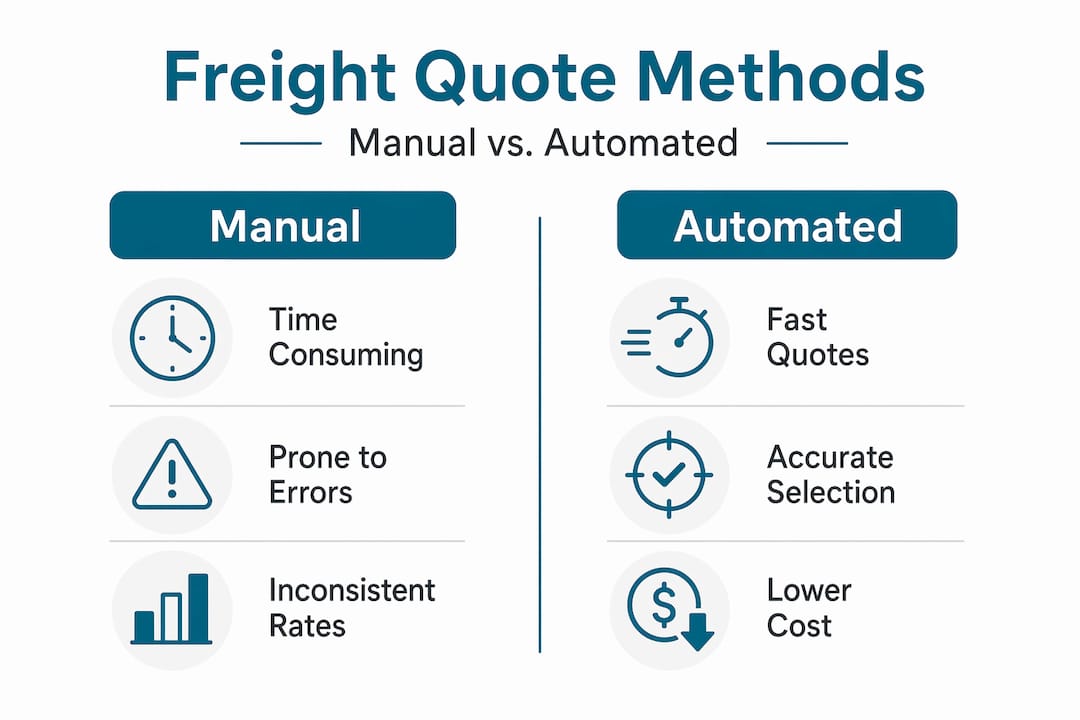
This is where most ecommerce operations leave significant money on the table. High-volume shippers spend 10-15 hours weekly manually comparing freight rates across carriers. At scale, the math becomes impossible to ignore.
Consider this: if your operation processes 1,000 daily orders and each one requires 90 seconds of manual rate comparison, that is 25 labor hours daily consumed by a task that automation handles in milliseconds. That is not an exaggeration. It is a documented reality for operations that have not yet modernized their freight pricing process.
Automated rate shopping works differently. Here is how a modern system handles it:
- Shipment data is captured at order creation from your ecommerce platform or WMS, including weight, dimensions, and destination.
- The system queries multiple carrier APIs simultaneously, pulling live rates based on that exact shipment profile.
- A rules engine applies your business logic, filtering by cost, transit time, carrier performance, or any combination you define.
- The lowest qualifying rate is selected and booked automatically, with confirmation returned to your system in real time.
- Post-shipment data is captured and analyzed, feeding back into future rate comparisons and carrier performance scoring.
Automated platforms consider destination, weight, dimensions, delivery speed, and real-time carrier rates to optimize decisions across every shipment. That kind of consistency is simply not achievable through manual processes, no matter how disciplined your team is.
The practical benefits extend beyond time savings. Automated decisioning reduces human error in rate selection, eliminates the inconsistency of having different staff members choose different carriers for similar shipments, and creates a historical data set you can use for carrier negotiations and budget forecasting. If you are researching freight booking solutions that support automation at scale, the evaluation criteria should include API connectivity, rules engine flexibility, and the breadth of carrier integrations available.
For operations moving toward warehouse automation, integrating automated rate shopping into the fulfillment workflow creates end-to-end efficiency rather than isolated improvements.
Best practices for requesting and evaluating freight quotes
Getting the best freight quotes online is not purely a technology problem. It also requires discipline in how you prepare, compare, and act on the information you receive. These practices separate operations that consistently win on shipping costs from those that accept whatever comes back.
- Standardize your shipment data inputs. Build a template for internal teams and systems that captures all required fields before a quote is ever requested. Missing data leads to placeholder rates that change at pickup.
- Request all-in quotes. Ask carriers to include all applicable surcharges in their initial quote. Some carriers quote base rates and tack on fees at invoicing. You need to compare apples to apples.
- Compare more than three carriers. Depending on your lane mix, rate differences across carriers on the same shipment can exceed 30%. Side-by-side comparison using structured tables clarifies the true cost differences beyond headline prices.
- Ask about volume tiers. Most carriers have unpublished discount tiers available for shippers who can commit to consistent volume on specific lanes. This conversation rarely happens unless you initiate it.
- Track accessorial charges separately. Isolate surcharge data from your historical invoices to identify patterns. If residential delivery fees are consistently inflating costs on a particular product line, that is a packaging or routing problem you can fix.
- Review quotes against actual invoices. The gap between quoted and billed amounts is one of the most informative data points in your shipping operation. Thorough cargo details and accurate scope descriptions reduce surcharges and disputes significantly.
When it comes to negotiation, most ecommerce professionals underestimate their leverage. Even mid-volume shippers can negotiate better rates by consolidating spend with fewer carriers, offering consistent pickup windows, or committing to volume on lanes where the carrier has excess capacity. Explore Or-ner’s guidance on negotiating shipping rates for tactics specific to ecommerce operations.
Pro Tip: Build a simple scorecard for each carrier that tracks quote accuracy, on-time performance, and invoice dispute frequency. Use that data in your next rate negotiation. Carriers respond to specifics far better than general requests for lower prices.
My take on where freight quoting really breaks down
I’ve spent years watching ecommerce operations obsess over their cost-per-click and their product margins while treating freight quoting as an administrative chore. That disconnect is expensive.
The hidden cost of manual freight quoting is not just labor. It is the inconsistency in carrier selection that compounds over thousands of shipments. I’ve seen two logistics coordinators at the same company choose different carriers for identical lanes on the same day, with a price difference of 22%. Neither made a wrong decision. They just made different ones because there was no systematic framework forcing consistency.
What I’ve found actually moves the needle is not switching to the fanciest platform. It is first understanding your lane data well enough to know which carriers compete hardest on your highest-volume routes. Most operations have three to five lanes that represent 60 to 70 percent of their freight spend. Automating rate shopping on just those lanes delivers most of the savings with a fraction of the implementation effort.
The future of the transportation quote process is not simply faster quoting. It is predictive pricing, where systems model rate trends and alert you to lock in favorable rates before seasonal capacity tightens. That capability is available today on several platforms and will be table stakes within two years. Get your data infrastructure ready for it now.
— Maayan
How Or-ner takes the complexity out of freight quoting
Or-ner’s global logistics platform is built specifically for ecommerce businesses that need more than a rate lookup tool. It connects you to a global carrier network across ocean, air, and land transport with real-time rate visibility, automated carrier selection rules, and post-shipment analytics that feed directly back into your freight pricing decisions.
For sellers ready to move from manual quoting to a fully integrated workflow, Or-ner’s step-by-step freight booking guide walks through the entire process from shipment data preparation through carrier confirmation. Or-ner also supports cross-border logistics, customs clearance, and fulfillment center integration, which means your freight quoting does not operate in isolation. It connects to every downstream step in your shipping operation. Businesses using Or-ner’s cloud logistics platform report up to 24% cost savings, with the freight quote process being one of the primary areas where that efficiency shows up.
FAQ
What information is needed for a freight quote?
A complete freight quote requires the shipment’s weight, dimensions, freight class (for LTL), origin and destination zip codes, service type, and any special handling requirements such as liftgate or residential delivery. Missing details lead to placeholder rates that change at pickup.
Why do freight quotes differ so much between carriers?
Carriers price based on their own lane capacity, tariff structures, fuel surcharge schedules, and zone models. Shipping costs vary by weight tier, dimensional weight, zone, and service level, so two carriers can price the same shipment very differently based on their current network priorities.
How does dimensional weight affect my shipping cost estimate?
Dimensional weight is calculated by dividing the package volume by a carrier-specific divisor. If that result exceeds actual weight, the carrier bills on dimensional weight instead, which can significantly inflate costs for lightweight but bulky shipments common in ecommerce.
What is the fastest way to get the best freight shipping quotes?
Automated rate shopping platforms query multiple carrier APIs simultaneously and apply rules-based decisioning to select the best option. This eliminates hours of manual comparison and produces more consistent, cost-optimized outcomes across high shipment volumes.
Can ecommerce sellers negotiate freight rates?
Yes. Carriers offer volume-based discounts, lane-specific pricing, and unpublished tiers for shippers who can commit to consistent volume. Consolidating freight spend with fewer carriers and tracking performance data gives you the specific evidence needed to negotiate from a position of strength.