Ecommerce warehouses using automated storage and retrieval systems increase picking speed by 50% to 70%, slashing fulfillment times and labor expenses. Yet many US sellers hesitate due to cost concerns or misconceptions about job displacement. This guide clarifies how warehouse automation technologies work, reveals quantitative benefits backed by data, addresses common myths, and provides a practical framework for implementation. You’ll discover real case studies, best practices, and actionable next steps to boost efficiency and competitiveness in 2026 ecommerce operations.
Table of Contents
- Introduction To Warehouse Automation
- Key Automation Technologies And Their Warehouse Applications
- Quantitative Benefits Of Automating Warehousing Operations
- Common Misconceptions And Realistic Challenges
- Framework For Selecting Warehouse Automation Technologies
- Case Studies And Real-World Applications In Ecommerce Warehousing
- Implementing Warehouse Automation: Best Practices And Next Steps
- Optimize Your Warehouse With ORNER’s Courier And Fulfillment Solutions
Key Takeaways
| Point | Details |
|---|---|
| Cost Reduction | Warehouse automation reduces labor costs by up to 30% through automating repetitive picking and packing tasks. |
| Speed and Accuracy | Technologies like AS/RS and AGVs boost picking speeds 50% to 70% while achieving order accuracy rates above 99.9%. |
| Misconceptions Cleared | Automation is accessible for small warehouses via phased investment, and workers typically move to higher-value roles rather than face layoffs. |
| Selection Framework | Evaluate automation solutions based on scalability, integration capability, ROI timeline, and workforce impact to match business goals. |
| Proven Results | US ecommerce warehouses report 30% to 40% throughput gains and faster fulfillment after deploying robots and automated systems. |
Introduction to Warehouse Automation
Warehouse automation uses technology to execute core tasks like picking, packing, sorting, and inventory management with minimal human intervention. This encompasses both hardware systems such as robots, automated storage and retrieval systems, and automated guided vehicles, plus software platforms including warehouse management systems that orchestrate operations. Integrating automation with reliable courier services creates seamless order fulfillment workflows.
For US ecommerce businesses, automation addresses critical challenges. Rising labor costs strain margins, and manual processes introduce order inaccuracies that damage customer trust. Automation enables warehouses to scale operations during peak seasons without proportional labor increases, maintaining consistent quality and speed.
Key automation categories include:
- Hardware solutions like robotic arms, conveyor systems, and mobile robots that physically move and sort goods
- Software platforms that optimize routing, inventory allocation, and order prioritization across the warehouse
- Integration tools linking warehouse systems with ecommerce platforms, courier networks, and fulfillment partners
Automation relevance grows as US ecommerce volume expands. Warehouses must handle increased order frequency, reduced delivery windows, and customer expectations for real-time tracking. Manual operations simply cannot match the throughput and consistency automation delivers at scale.
Key Automation Technologies and Their Warehouse Applications
Automated Storage and Retrieval Systems mechanize dense vertical storage with computer-controlled cranes that retrieve products rapidly. AS/RS suits high-volume warehouses where space optimization matters. These systems excel at managing large SKU counts and delivering items to pickers with minimal travel time. Initial investment runs higher than mobile solutions, but throughput gains justify costs for warehouses processing thousands of orders daily.
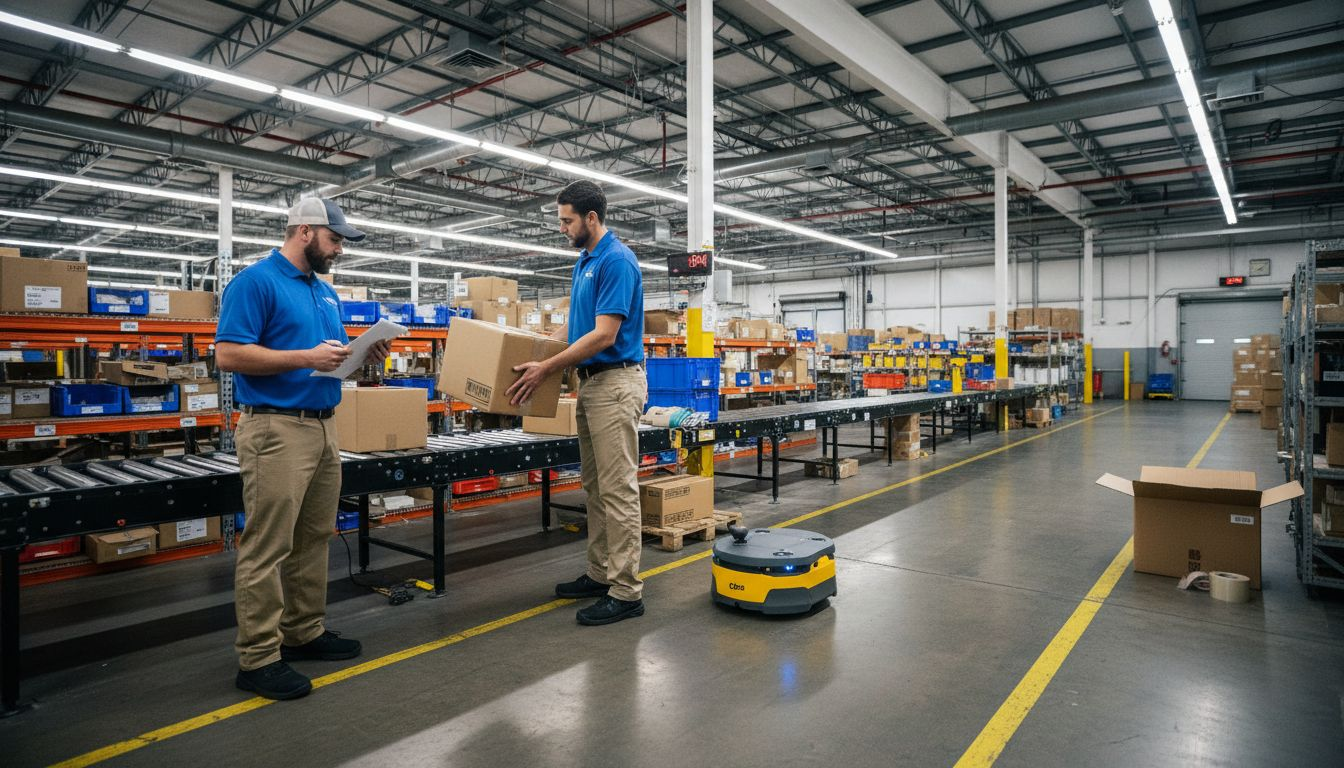
Automated guided vehicles and autonomous mobile robots reduce travel time by transporting goods between zones without fixed infrastructure. AGVs follow magnetic strips or wires, while AMRs use sensors and mapping for flexible navigation. You can deploy AMRs incrementally, adding units as volume grows. This flexibility makes them attractive for mid-sized operations expanding order capacity without major facility redesigns.
Warehouse management software integrates all automation hardware into unified workflows. Modern WMS platforms optimize pick paths, allocate inventory dynamically, and sync with courier systems for real-time shipment updates. Software provides the intelligence layer that maximizes hardware efficiency, preventing bottlenecks and ensuring balanced workload distribution.
| Technology | Speed Gain | Initial Cost | Scalability | Integration Complexity |
|---|---|---|---|---|
| AS/RS | 50% to 70% | High | Moderate | High |
| AGV/AMR | 40% to 60% | Moderate | High | Moderate |
| WMS Software | 30% to 50% | Low to Moderate | Very High | Low to Moderate |
Pro Tip: Start with WMS implementation before adding robotics. Software optimization often reveals bottlenecks that simple process changes can fix, delaying or reducing hardware investment while still capturing automation benefits. The MHI warehouse automation report details technology selection criteria based on facility size and order profiles.
Quantitative Benefits of Automating Warehousing Operations
Warehouse automation in the US reduces labor costs by up to 30% by handling repetitive workflows like picking and packing. Robots work continuous shifts without breaks, absorbing volume spikes that would otherwise require overtime pay or temp workers. This cost reduction directly improves profit margins while maintaining service levels.

Order picking speed increases 50% to 70% when automated systems replace manual cart-based picking. AS/RS delivers products to pickers in seconds rather than minutes spent walking aisles. AMRs transport completed orders to packing stations immediately, eliminating wait times. These speed gains translate to same-day fulfillment capabilities that drive customer satisfaction and repeat purchases.
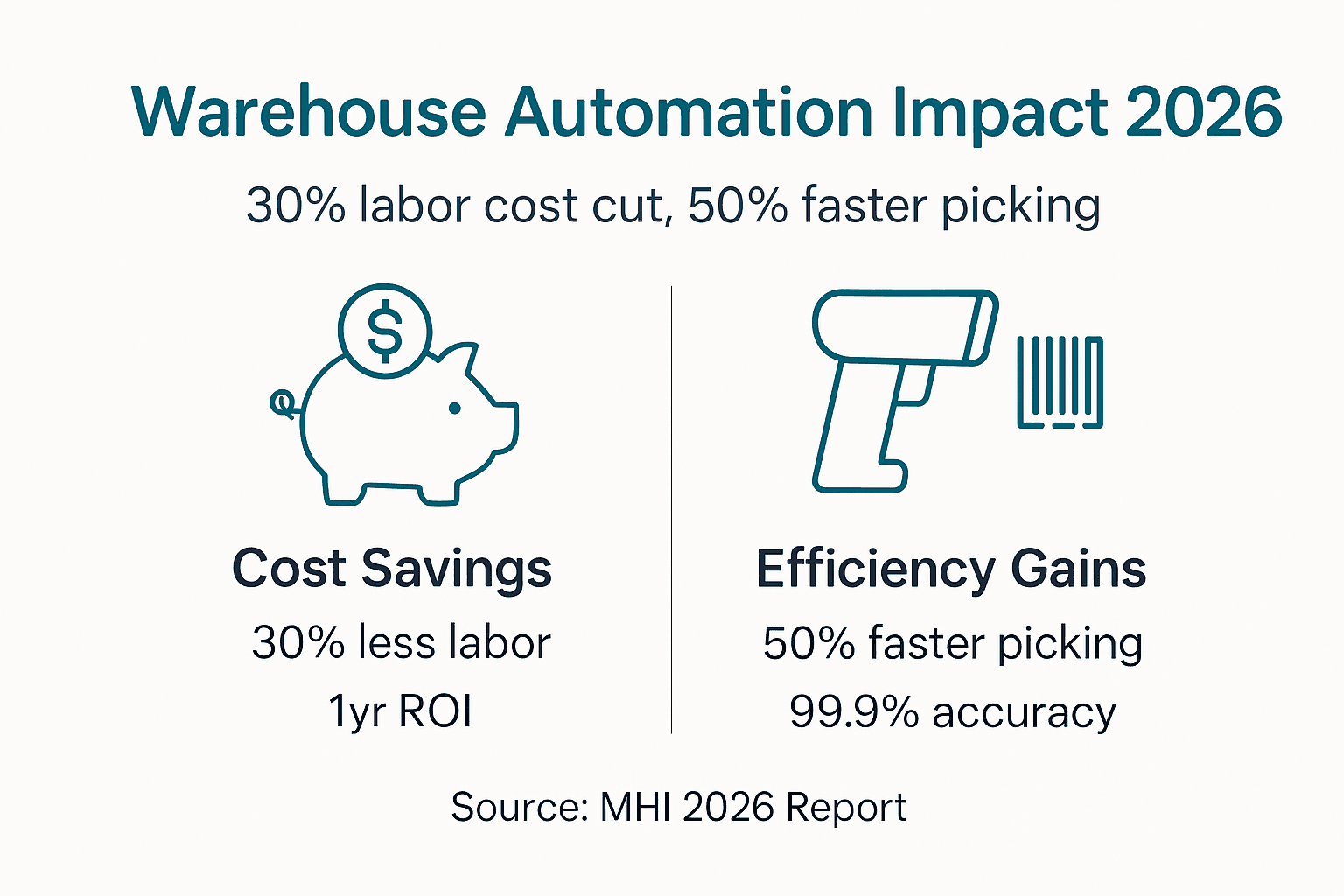
Accuracy improvements deliver equally powerful benefits. Automated systems achieve order accuracy rates exceeding 99.9% by eliminating manual scanning errors and mispicks. Reduced errors mean fewer returns, lower restocking costs, and improved customer retention. Integration with courier platforms ensures correct shipping labels and tracking data from the start.
| Metric | Manual Process | Automated Process | Improvement |
|---|---|---|---|
| Labor Cost per Order | $4.50 | $3.15 | 30% reduction |
| Picking Speed (units/hour) | 80 | 136 | 70% increase |
| Order Accuracy Rate | 97.5% | 99.9% | 2.4 percentage points |
| Throughput (orders/day) | 2,000 | 3,200 | 60% increase |
Key efficiency drivers include:
- Elimination of walking time between storage locations and packing stations
- Consistent processing speeds regardless of shift time or worker fatigue
- Real-time inventory visibility preventing stockouts and allocation errors
- Seamless handoff to warehouse automation benefits systems for immediate shipment processing
Integrated systems reduce error-related delays by catching discrepancies before orders leave the facility. The MHI labor cost savings report documents these quantitative gains across diverse warehouse sizes and product categories.
Common Misconceptions and Realistic Challenges
Many warehouse managers believe automation only makes financial sense for massive facilities processing tens of thousands of orders daily. Reality differs. Staged investments allow smaller operations to automate high-impact processes first, achieving ROI within 12 to 18 months. You might start with WMS and a handful of AMRs, then add capacity as order volume justifies expansion.
The fear that automation causes mass layoffs oversimplifies workforce dynamics. Most warehouses redeploy workers to quality control, exception handling, and customer service roles that require human judgment. Automation handles repetitive physical tasks, freeing staff for higher-value work that improves job satisfaction and career development. Some facilities report improved retention as workers appreciate less physically demanding responsibilities.
Another myth suggests automation eliminates all errors. While accuracy improves dramatically, integration challenges and system limitations mean some errors persist. Software bugs, sensor malfunctions, and edge cases require human intervention. Realistic expectations prevent disappointment and ensure you build processes to handle exceptions gracefully.
Challenges you will face:
- Capital investment ranging from tens of thousands for basic software to millions for comprehensive AS/RS installations
- Integration complexity connecting legacy systems with new automation platforms and courier networks
- Change management resistance from staff worried about job security or intimidated by new technology
- Delayed ROI realization as teams learn to optimize automated workflows and resolve initial implementation issues
Pro Tip: Invest in comprehensive staff training before launching automated systems. Workers who understand technology capabilities become advocates rather than resistors, dramatically improving adoption success and operational performance.
Framework for Selecting Warehouse Automation Technologies
Selecting appropriate automation requires systematic evaluation aligned with your specific operational challenges and growth trajectory. Follow this structured approach:
- Identify bottlenecks by analyzing current workflows and measuring time spent on each fulfillment step.
- Define scalability requirements based on projected order volume growth over the next three to five years.
- Assess integration needs with existing warehouse management systems, ecommerce platforms, and courier partners.
- Calculate ROI timelines by comparing automation costs against labor savings and throughput improvements.
- Evaluate workforce impact and plan training programs to transition staff into new roles.
| Selection Criteria | Small Warehouse (under 500 orders/day) | Mid-Size Warehouse (500 to 2,000 orders/day) | Large Warehouse (over 2,000 orders/day) |
|---|---|---|---|
| Recommended Technology | WMS + 2 to 5 AMRs | WMS + 10 to 20 AMRs + conveyor systems | AS/RS + AGVs + comprehensive WMS |
| Initial Investment | $50,000 to $150,000 | $200,000 to $500,000 | $1 million+ |
| ROI Timeline | 12 to 18 months | 18 to 24 months | 24 to 36 months |
| Scalability | Add AMRs as needed | Expand zones incrementally | Modular expansion |
Prioritize technologies based on immediate pain points. If labor costs stress margins most, focus on automating picking and packing. If inventory accuracy causes fulfillment delays, implement WMS with real-time tracking first. Phased deployment reduces risk while building organizational competency.
Small warehouses gain maximum value from flexible mobile robots paired with cloud-based WMS. This combination requires minimal infrastructure changes and scales incrementally. Large operations benefit from integrated AS/RS and AGV systems that optimize dense storage and high-volume throughput. Review technology selection criteria to compare options systematically.
Case Studies and Real-World Applications in Ecommerce Warehousing
A mid-sized apparel ecommerce company in California deployed 15 AMRs in a 60,000 square foot facility processing 800 orders daily. Within six months, throughput increased 40% without adding staff. The robots transported picked items to packing stations, eliminating worker travel time. Integration with the company’s WMS and courier platform enabled real-time shipment updates that reduced customer service inquiries by 25%.
A large sporting goods retailer implemented a hybrid system combining AS/RS for slow-moving inventory and AGVs for fast-moving SKUs across a 200,000 square foot Northeast warehouse. Labor costs dropped 30% while order fulfillment speed improved 55%. The AS/RS handled bulk storage efficiently, while AGVs provided flexibility for promotional items and seasonal surges. Staff were retrained as system operators and quality controllers rather than pickers.
Key success factors from these implementations:
- Phased rollout allowed teams to master each technology before adding complexity
- Close collaboration with automation vendors ensured customized integration with existing systems
- Comprehensive staff training programs reduced resistance and built operational expertise
- Integration with automation success stories courier platforms optimized last-mile delivery coordination
A Texas-based home goods distributor connected automated picking systems with courier APIs to dynamically route orders based on delivery windows and carrier capacity. This integration reduced delivery delays by 35% and improved on-time performance. Real-time inventory synchronization with the ecommerce platform prevented overselling and backorders.
Explore additional warehousing best practices and latest automation trends to understand how leading operations achieve competitive advantages through technology adoption.
Implementing Warehouse Automation: Best Practices and Next Steps
Successful automation implementation follows structured phases that minimize disruption while capturing quick wins. This approach builds organizational confidence and justifies continued investment.
- Conduct thorough process mapping to identify highest-impact automation opportunities based on time consumption and error rates.
- Select technology partners with proven ecommerce warehouse experience and strong post-implementation support.
- Launch pilot programs in limited warehouse zones to test integration and train staff before full deployment.
- Establish performance metrics tracking labor costs, throughput, accuracy, and ROI to measure success objectively.
- Iterate continuously based on operational data and worker feedback to optimize automated workflows.
Engage warehouse staff early in planning to address concerns and incorporate frontline insights. Workers understand current process pain points and often suggest practical improvements that technology alone cannot solve. Early involvement builds buy-in and reduces resistance during rollout.
Integration considerations:
- Ensure automation systems connect seamlessly with your WMS, ecommerce platform, and courier networks for unified data flow
- Plan for legacy system limitations that may require middleware or API development
- Test thoroughly before going live to prevent fulfillment disruptions that damage customer relationships
- Monitor system performance daily during initial weeks to catch and resolve issues quickly
Pro Tip: Partner with automation vendors who offer flexible support contracts including system optimization assistance beyond initial installation. The learning curve extends months beyond launch as you discover workflow refinements that maximize ROI.
Apply warehouse efficiency tips alongside automation to compound gains. Optimize warehouse layout planning to support robot navigation and minimize congestion. Combine automation with inventory automation strategies for comprehensive operational improvement. Coordinate with logistics integration with courier partners to ensure automated fulfillment translates to faster deliveries.
Optimize Your Warehouse with ORNER’s Courier and Fulfillment Solutions
Automating your warehouse delivers maximum impact when paired with logistics partners who match your operational speed and reliability standards. ORNER’s platform connects your automated fulfillment systems with reliable courier services optimized for US ecommerce, ensuring orders picked by robots reach customers on time.
Explore ORNER’s comprehensive resources on warehousing best practices to complement your automation strategy with proven operational techniques. Our platform integrates real-time shipment tracking, inventory management, and order fulfillment processes into unified workflows that eliminate data silos and manual handoffs. Partner with ORNER to streamline end-to-end ecommerce logistics and maximize the efficiency gains your warehouse automation investments deliver.
Frequently Asked Questions
What is warehouse automation and why is it important for ecommerce?
Warehouse automation uses technology like robots, automated storage systems, and warehouse management software to perform picking, packing, and inventory tasks faster and more accurately than manual processes. This matters for ecommerce because it lowers labor costs up to 30%, speeds fulfillment to meet customer delivery expectations, and scales operations during peak seasons without proportional staffing increases.
How quickly can a small ecommerce warehouse expect ROI from automation?
Small to mid-sized warehouses typically achieve ROI within 12 to 18 months by implementing automation in stages starting with highest-impact processes. Begin with warehouse management software and a few mobile robots rather than comprehensive systems. This phased approach reduces upfront investment while capturing immediate labor savings and throughput improvements that fund subsequent expansion.
Will automation lead to job losses in my warehouse?
Automation typically redeploys workers to higher-value roles like quality control, exception handling, and customer service rather than causing significant layoffs. Many warehouses report improved retention as staff appreciate less physically demanding work and opportunities to develop technical skills. Plan comprehensive training programs to transition workers successfully and build automation advocates within your team.
Which automation technology is best for a growing ecommerce warehouse?
Small warehouses under 500 orders daily benefit most from cloud-based warehouse management software paired with 2 to 5 autonomous mobile robots. Mid-sized operations processing 500 to 2,000 orders daily should consider 10 to 20 AMRs plus conveyor systems. Large warehouses exceeding 2,000 daily orders gain maximum efficiency from integrated AS/RS and AGV systems with comprehensive WMS. Match technology to your current volume and three to five year growth projections.
How does warehouse automation integrate with courier services to improve logistics?
Automation systems link with courier platforms through APIs that enable real-time shipment tracking, dynamic carrier selection, and automated label generation. This integration eliminates manual data entry errors and reduces fulfillment-to-shipment handoff delays. Coordinated systems route orders based on delivery windows and carrier capacity, improving on-time performance and reducing last-mile delivery costs by 20% to 35% in optimized operations.