TL;DR:
- Courier services are rapidly evolving through AI-assisted, real-time routing that improves efficiency and customer satisfaction. This technological shift enables dynamic operations that adapt instantly to changing conditions, fundamentally transforming last-mile logistics for ecommerce. Successful partnerships now depend on courier providers’ integration of advanced data-driven systems and organizational adaptability.
Courier services are not the slow-moving industry many ecommerce sellers assume them to be. Behind the scenes, the mechanics of how packages move from warehouse to doorstep are being completely rebuilt around data, artificial intelligence, and real-time decision making. AI-assisted routing is already shifting courier operations from static, pre-planned dispatch toward dynamic systems that adapt instantly as new events unfold. For ecommerce brands, understanding this transformation is no longer optional. It is the foundation of competitive fulfillment in 2026.
Table of Contents
- The changing landscape: From static to dynamic courier operations
- Key technologies shaping the future of courier services
- What these changes mean for ecommerce fulfillment strategies
- Challenges and opportunities ahead for courier service providers
- Our take: Why continuous adaptation means more than technology upgrades
- How ORNER helps you stay ahead in courier logistics
- Frequently asked questions
Key Takeaways
| Point | Details |
|---|---|
| AI-driven routing | Real-time, AI-assisted route planning dramatically improves delivery reliability and cost savings. |
| Efficiency boost | Dynamic technology cuts miles driven, fuel use, and operational costs for courier firms. |
| New fulfillment strategies | These innovations let ecommerce sellers promise faster, more reliable deliveries and improve customer satisfaction. |
| Continuous adaptation | Staying competitive means blending technology upgrades with agile processes and partnerships. |
The changing landscape: From static to dynamic courier operations
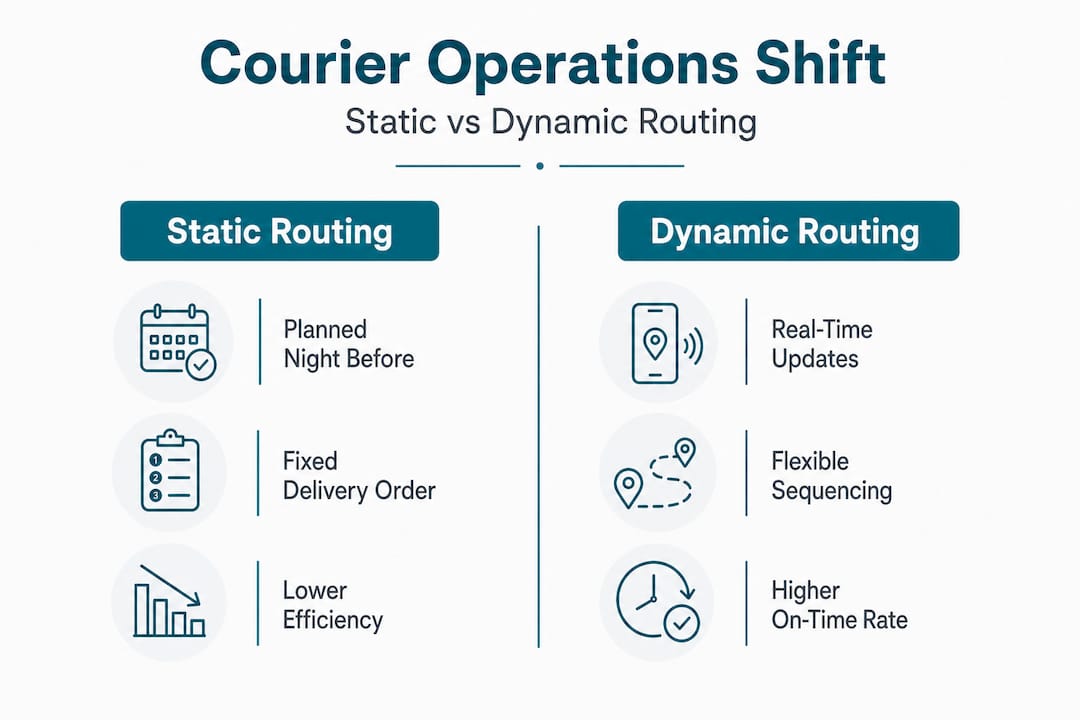
For decades, courier operations relied on a simple approach. Dispatchers would plan routes the night before, assign drivers their stops in the morning, and hope nothing disrupted the day. That model, known as static dispatch, had one major flaw. Reality never cooperates with yesterday’s plan.
Traffic accidents, last-minute order changes, customer absences, and weather events would derail carefully organized routes on a daily basis. Drivers had no way to adapt in real time. Supervisors had limited visibility into what was actually happening on the road. The result was wasted miles, missed delivery windows, frustrated customers, and ballooning fuel costs.
The shift to dynamic courier operations changes this entirely. Rather than locking in a route plan before the day begins, modern systems continuously monitor conditions and recalculate routes as new data arrives. This is what last mile delivery explained looks like in practice. Think of it as the difference between reading a printed map and using live navigation. Both get you to the destination, but only one adjusts when a road is closed halfway there.
UPS offers the most cited example of this transformation through its ORION (On-Road Integrated Optimization and Navigation) platform. ORION automates daily route design and dynamically adapts to new events during the day. The results were staggering. UPS cited savings of tens of millions of miles and approximately 10 million gallons of fuel per year in early deployments, plus hundreds of millions of dollars in annual cost savings. Pilots also removed two to four miles per driver per day through dynamic routing alone.
Consider what that means at scale. Removing even two miles per driver per day across tens of thousands of drivers produces massive compounding savings in fuel, vehicle wear, and labor hours. These are not marginal gains. They fundamentally reshape the economics of courier operations.
Here is a comparison of what static versus dynamic routing means in practice:
| Factor | Static routing | Dynamic routing |
|---|---|---|
| Route planning timing | Night before | Continuous real-time |
| Response to traffic or delays | None during day | Automatic re-routing |
| Fuel efficiency | Baseline | Measurably improved |
| Driver miles per day | Fixed or excessive | Reduced by 2 to 4 miles |
| Customer notification accuracy | Low | High |
| Failed delivery rate | Higher | Lower |
The core benefit for ecommerce brands is reliability. When last mile challenges get solved through smarter routing, your customers receive accurate delivery windows instead of vague estimates, and your brand reputation benefits directly.
“Dynamic courier operations are not just a cost story. They are a trust story. Every mile saved and every window kept builds customer loyalty that static systems cannot match.”
Key technologies shaping the future of courier services
Understanding what specific technologies are driving this shift helps ecommerce managers and logistics teams make sharper decisions about which courier partners to prioritize. The landscape breaks down into four core innovations working together.
AI-driven routing is the engine. Algorithms process thousands of variables simultaneously, including traffic patterns, parcel weight and size, time windows, driver hours, and customer availability signals. This produces optimized route sequences that no human dispatcher could calculate manually in real time. AI-assisted routing and event-driven re-planning are fundamentally shifting how couriers operate at every scale.
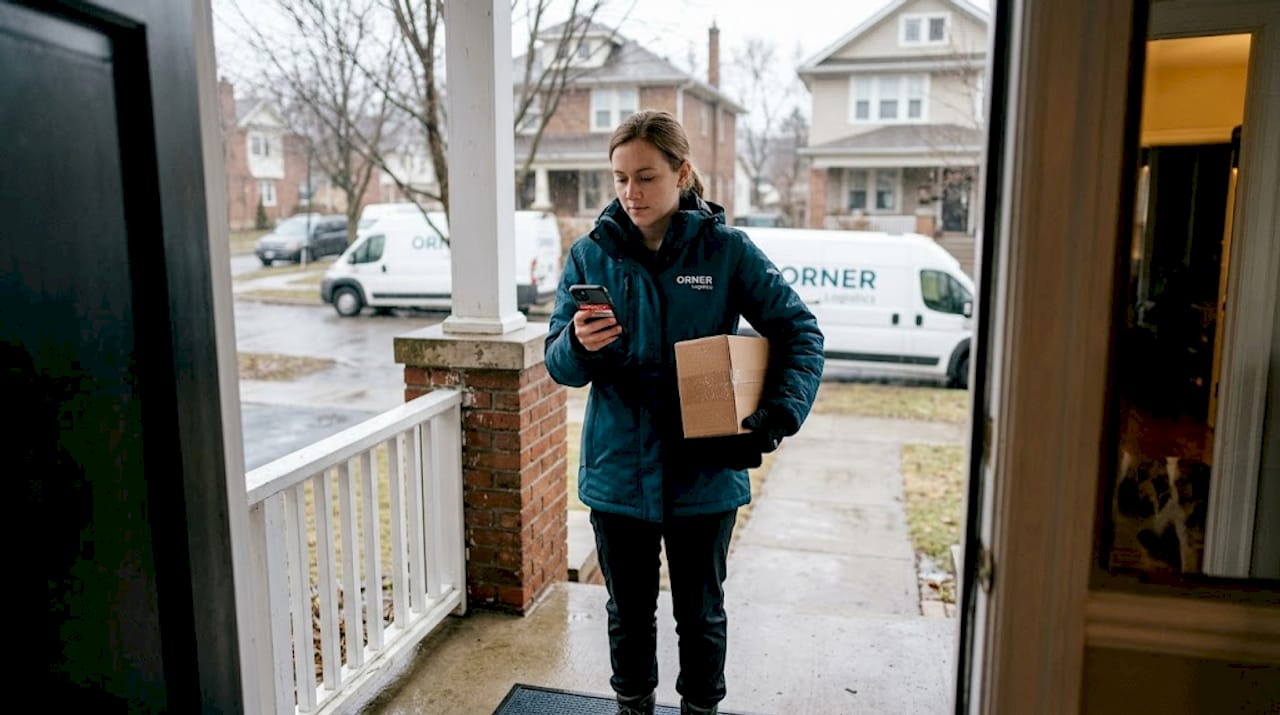
IoT (Internet of Things) tracking layers real-time visibility on top of routing intelligence. Sensors on vehicles, packages, and warehouse equipment feed live data into centralized dashboards. Logistics managers can see exactly where every shipment is, whether temperature-sensitive cargo remains within safe ranges, and how vehicle performance metrics compare against benchmarks. This is why digital transformation in courier services has become a strategic priority rather than a tech team project.
Real-time customer communication closes the loop between operations and end users. Automated SMS and email alerts, live tracking links, and proactive delay notifications transform the delivery experience. Customers who receive accurate updates rarely escalate issues to your customer service team. Those who receive vague or incorrect information do, consistently.
Warehouse and dispatch automation rounds out the stack. Automated sorting systems, barcode scanning, and smart label printing reduce human error at the point of origin. When packages leave with correct routing data attached, every downstream step gets more accurate.
Here is how dynamic versus static routing stacks up across the metrics that matter most to ecommerce operations:
| Metric | Static routing | Dynamic routing |
|---|---|---|
| On-time delivery rate | Moderate | High |
| Cost per delivery | Higher over time | Lower with scale |
| Customer satisfaction | Variable | Consistently higher |
| Failed first-attempt rate | 10 to 15% industry average | Significantly reduced |
| Scalability during peak periods | Poor | Strong |
Pro Tip: If your current courier partner does not offer API integration for real-time order status updates, you are leaving visibility on the table. Connecting courier tracking APIs directly to your order management system removes the need for manual tracking checks and lets you proactively communicate with customers before they wonder where their package is.
Common pitfalls are worth naming here. Many logistics teams delay upgrading courier partnerships because legacy systems seem “good enough.” That thinking gets expensive fast. Static systems cannot handle the volume spikes that ecommerce brands experience during peak seasons. They also cannot scale without linear cost increases. End-to-end logistics solutions built around these technologies scale far more efficiently than patched-together manual workflows.
Key indicators that your courier partner is genuinely tech-enabled:
- Real-time GPS tracking visible to your team and your customers
- API access for automated order status updates
- Documented use of AI or algorithmic route optimization
- Proactive exception alerts for delays, failed attempts, or damage
- Data exports for post-delivery analysis and performance benchmarking
What these changes mean for ecommerce fulfillment strategies
So what does all this innovation actually change for your day-to-day ecommerce or logistics operation? Quite a lot, and the impact goes well beyond faster deliveries.
Dynamic routing and technology enhancements significantly reduce costs and improve service reliability for ecommerce sellers. When courier partners can deliver more reliably, you can make bolder promises to customers. Same-day and next-day delivery windows that once required expensive premium services become accessible to mid-sized brands through smarter operations.
Here are five concrete steps ecommerce brands can take right now to capitalize on this shift:
- Audit your current courier’s technology stack. Ask directly: does your courier use dynamic routing? Can they share delivery success rate data? If they cannot answer clearly, that tells you something important.
- Map your delivery promises to partner capabilities. If you advertise two-day delivery but your courier operates on static routes with high failure rates, you are creating a customer expectation gap that erodes trust over time.
- Integrate courier tracking into your post-purchase experience. Customers who can track their own orders in real time generate fewer support tickets and higher satisfaction scores.
- Revisit your inventory placement strategy. Tech-driven reliable courier services for ecommerce enable distributed warehousing models. Placing inventory closer to high-density customer zones shortens routes, reduces transit times, and lowers per-shipment costs.
- Build courier performance reviews into your operations calendar. Monthly or quarterly reviews of on-time rates, failed delivery percentages, and cost per shipment keep courier partners accountable and surface problems before they become customer complaints.
Pro Tip: Map your specific delivery promises, such as “ships within 24 hours” or “delivered in two days,” directly against your courier’s actual live tracking data. Most ecommerce teams set SLAs (service level agreements) based on carrier estimates but never verify performance against real outcomes. Running this audit once a quarter can reveal costly gaps you did not know existed.
The impact on inventory strategy deserves extra attention. When courier partners deliver more predictably, you can operate with leaner safety stock because replenishment cycles become more reliable. Unpredictable deliveries force businesses to hold excess inventory as a buffer against uncertainty. Better couriers actually reduce your warehousing costs as a downstream effect.
Challenges and opportunities ahead for courier service providers
While the potential is impressive, there are still important hurdles on the road to future-ready courier operations. Understanding them helps ecommerce brands set realistic expectations and choose partners who handle these pressures well.
Even as technology advances, courier services must continually adapt to handle unplanned events and changing customer expectations. The demand for faster, cheaper, and more transparent deliveries only intensifies. Courier firms that cannot keep up face rapid customer attrition.
Key challenges shaping the courier industry right now include:
- Demand volatility. Peak seasons, flash sales, and viral product moments create sudden volume surges that overwhelm static-capacity operations. Dynamic systems help but require continuous model retraining to stay accurate.
- Manual override dependency. Even the best AI routing still requires human judgment for complex edge cases. Dispatcher skills remain critically important, meaning courier firms must invest in training alongside technology.
- Sustainability pressure. Regulators and consumers increasingly expect lower carbon footprints from logistics operations. Urban logistics solutions that incorporate electric vehicles and optimized urban routing are shifting from optional to expected.
- Urban density and regulation. City-center delivery restrictions, low-emission zones, and loading restrictions create complex compliance layers that AI systems must account for. Couriers operating in multiple cities face a patchwork of rules that require ongoing attention.
- Data privacy and integration complexity. Sharing real-time data across courier, ecommerce platform, and customer touchpoints requires robust API architectures and strict data handling practices.
The opportunities are equally significant. Predictive analytics tools are improving at a rapid pace, enabling couriers to forecast demand spikes, pre-position vehicles, and model weather impacts on delivery routes before they happen. Machine learning models trained on years of delivery data get meaningfully better with each passing season, compounding the efficiency gains over time.
Courier firms that build genuine technology partnerships with ecommerce platforms, rather than treating them as arms-length shipping customers, gain early access to order volume data that improves forecasting accuracy. This kind of integration benefits both sides. Ecommerce brands get better service. Couriers get smoother operations.
Our take: Why continuous adaptation means more than technology upgrades
Here is what most guides on courier innovation miss. Technology is the easy part. Software can be purchased, platforms can be deployed, and algorithms can be licensed. What cannot be shortcut is the organizational readiness to actually use these tools effectively.
The courier operations that failed to capture the gains promised by early AI routing investments had a common thread. They implemented the technology without redesigning the processes around it. Dispatchers kept working the same way. Drivers were not trained on new in-cab systems. Middle managers reverted to manual workarounds when the algorithm produced routes they did not understand.
Real transformation in courier operations happens when technology, process, and people change together. The firms getting the best results from dynamic routing are the ones that spent as much time on change management as they did on software selection. They trained dispatchers to trust algorithmic recommendations while understanding when to override them. They restructured their driver briefing routines to incorporate real-time data.
For ecommerce brands choosing courier partners, this insight matters directly. Ask potential partners not just what technology they use, but how their teams actually use it day-to-day. A company with a sophisticated platform but poor adoption among its own dispatch teams will not deliver the reliability you are paying for. The best indicator of a genuinely future-ready courier partner is not the technology they have deployed. It is the culture of continuous improvement they have built around it.
Understanding the full spectrum of options available is useful here. The range of types of courier services has expanded significantly, from hyperlocal same-day networks to cross-border specialists. Aligning the right service type with each fulfillment need, rather than defaulting to one carrier for everything, is a strategic advantage many brands leave unclaimed.
How ORNER helps you stay ahead in courier logistics
The trends covered in this article are not hypothetical. They are reshaping courier economics right now, and ecommerce brands that align with technology-forward logistics partners are compounding advantages their slower-moving competitors cannot easily match.
ORNER’s global logistics platform for couriers puts real-time visibility, automated routing intelligence, and integrated tracking directly in the hands of ecommerce sellers and logistics managers. Whether you are scaling cross-border operations, optimizing last-mile fulfillment, or building a distributed warehousing strategy, ORNER’s cloud logistics for ecommerce tools provide the infrastructure to act on these trends rather than just read about them. Explore the cross-border logistics guide to see how reliable courier services connect with global fulfillment strategies that actually scale.
Frequently asked questions
What is dynamic routing in courier services?
Dynamic routing uses real-time data and AI to update delivery routes on the fly, improving efficiency and reliability. Unlike static planning, AI-assisted routing adapts continuously as traffic, weather, and delivery outcomes change throughout the day.
How does AI improve courier delivery times?
AI reduces delivery times by automatically finding faster or less congested routes and adapting instantly as conditions change. UPS demonstrated this clearly, with tens of millions of miles saved annually through algorithmic route optimization across its driver network.
What should ecommerce brands look for in a future-ready courier partner?
Choose couriers with real-time tracking, API integrations, and proven use of AI-assisted routing to maximize fulfillment reliability. Dynamic AI-assisted operations deliver measurable cost and efficiency improvements that directly benefit your customers’ experience.
Will automation replace human couriers?
Automation aids humans in routing and planning, but most experts agree human drivers and oversight are still crucial for complex deliveries. Technology handles optimization at scale while people handle judgment calls, exceptions, and the physical act of delivery that algorithms cannot replace.