TL;DR:
- Cloud logistics platforms now enable mid-sized retailers to access advanced automation and global tracking.
- Features like AI-driven routing, customs compliance, and branded returns portals improve cross-border efficiency.
- Proper platform choice depends on scalability, integration, and ease of implementation to avoid costly mistakes.
E-commerce logistics used to be a game only large enterprises could play well. That assumption is now outdated. Cloud logistics platforms have made sophisticated automation, real-time tracking, and cross-border compliance accessible to mid-sized retailers and growing brands. Metapack delivers 24% shipping cost reductions and 40% more conversions for e-commerce retailers, proving that the efficiency gains once reserved for corporate giants are now within reach. If you manage fulfillment, carrier relationships, or international shipping, understanding these platforms is no longer optional. It is the difference between scaling profitably and getting buried in operational chaos.
Table of Contents
- What are cloud logistics platforms?
- Major cloud platforms compared: Features and strengths
- Unlocking operational efficiency: Automation and AI in logistics
- Cross-border logistics: Overcoming global challenges
- Choosing the right platform: Key considerations and pitfalls
- Why most logistics managers get platform selection wrong
- Partnering for reliable, scalable logistics success
- Frequently asked questions
Key Takeaways
| Point | Details |
|---|---|
| Automation drives efficiency | Cloud logistics platforms use AI and workflow engines to streamline shipping processes and reduce manual work. |
| Cross-border challenges solved | Top solutions integrate global carrier networks and customs tools to minimize delays and costs for international e-commerce. |
| Platform fit matters | Choosing the right platform requires matching features like returns management and data residency to your business’s scale and needs. |
| Cost transparency is key | Per-transaction pricing and empirical benchmarks help businesses understand and control logistics expenses. |
What are cloud logistics platforms?
With the growing need for efficiency, it is essential to understand exactly what cloud logistics platforms provide and how they differ from traditional logistics solutions.
A cloud logistics platform is software hosted on remote servers that manages the movement, storage, and delivery of goods. Unlike legacy transportation management systems (TMS) or warehouse management systems (WMS) installed on local servers, cloud platforms update in real time, require no hardware investment, and scale with your business without expensive IT projects.
These platforms typically cover several core functions:
- Freight booking and carrier selection across multiple shipping partners
- Real-time shipment tracking with automated customer notifications
- Inventory management and warehouse coordination
- Customs documentation and cross-border compliance
- Returns management with branded customer portals
- Data analytics and exception management dashboards
Legacy systems force logistics teams to work in silos. A cloud platform connects every function in one interface, eliminating manual data entry and reducing errors. CargoWise One is a comprehensive cloud ERP for global logistics management, handling everything from freight forwarding to customs clearance in a single environment.
For e-commerce retailers managing multiple sales channels, a global logistics platform overview shows how these tools unify operations that would otherwise require five separate software subscriptions.
Pro Tip: If you are launching on a new sales channel, connect it to your cloud logistics platform before the first order ships. Retrofitting integrations after volume builds is far more disruptive and costly than setting them up early.
Major cloud platforms compared: Features and strengths
Knowing what cloud logistics platforms do, let us see how the major players stack up and which features set them apart for different business needs.
| Platform | Best for | Key strength | Pricing model |
|---|---|---|---|
| CargoWise One | Large enterprises | End-to-end global ERP | Per-transaction |
| Metapack | E-commerce retailers | Carrier network, AI routing | Subscription |
| Shipcloud | Mid-market retailers | Multi-carrier API | Pay-as-you-go |
| Floship | Cross-border DTC brands | AI/ML order management | Custom quote |
| Extensiv | 3PL and fulfillment | Warehouse network | Subscription |
| Logitude | Mid-market forwarders | Automation and scalability | Subscription |
Metapack reduces shipping costs by 24% and increases conversions by 40%, making it one of the most results-backed platforms for e-commerce. Its strength is breadth: a massive carrier network combined with AI-powered label generation and delivery promise tools.

CargoWise offers unlimited users and per-transaction pricing, which means your cost scales with actual volume rather than seat licenses. That structure suits high-volume enterprises but can feel opaque for smaller teams trying to forecast monthly spend.
Key differentiators worth noting:
- AI automation depth: Metapack and Floship lead on machine learning for routing and order prediction
- Global carrier integrations: Metapack connects to thousands of services worldwide
- Returns management: Metapack and Shipcloud offer branded return portals out of the box
- Implementation speed: Shipcloud and Metapack onboard faster than CargoWise
For teams evaluating cross-border shipping solutions, the carrier network size and customs compliance depth matter most. If you want to understand how predictive analytics for logistics factor into platform selection, that dimension is increasingly a deciding factor for growth-stage brands.
Unlocking operational efficiency: Automation and AI in logistics
Once you know which platforms to consider, diving into their automation and AI capabilities reveals where operational gains truly come from.
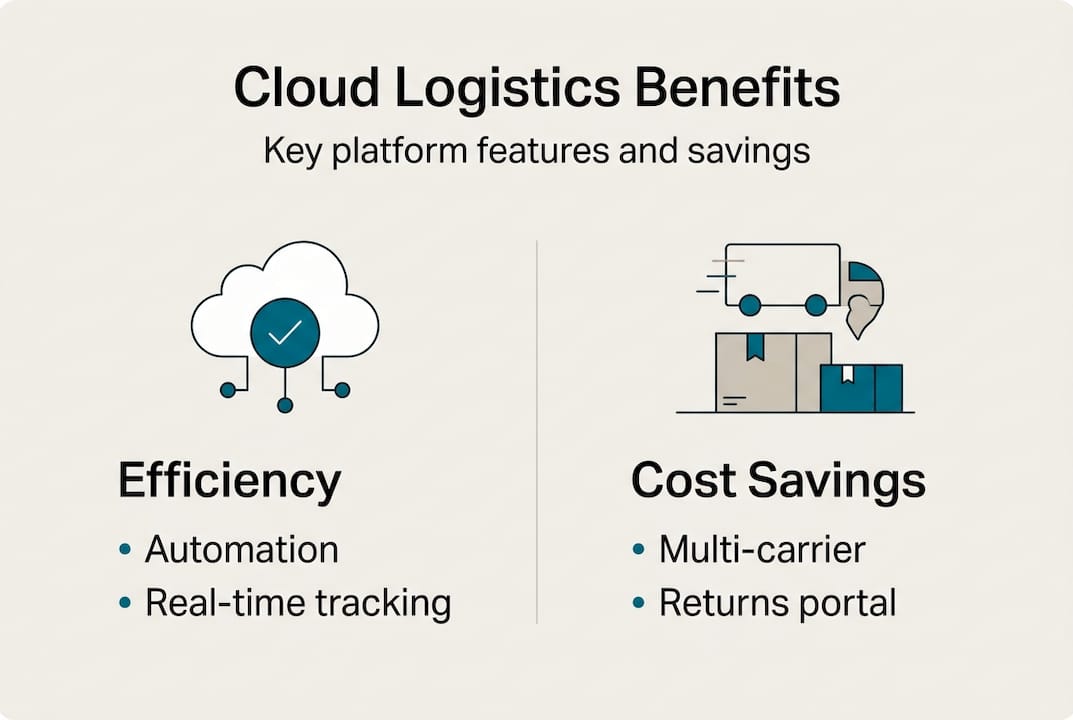
Automation in cloud logistics platforms works through workflow engines: rule-based systems that trigger actions when conditions are met. An order arrives, the system checks carrier rates, selects the optimal option, generates a label, and sends a tracking notification, all without human input. Exception handling rules flag anomalies like address errors or weight discrepancies before they become delivery failures.
CargoWise’s AI workflow engine and unlimited users empower scalable automation across global supply chains, making it possible to manage thousands of daily transactions with a lean operations team.
AI applications go further than rule-based triggers:
- Predictive inventory optimization: AI forecasts demand and flags reorder points before stockouts occur
- Dynamic route selection: Algorithms weigh cost, speed, and reliability in real time
- Anomaly detection: Machine learning spots patterns in delays or damage claims before they escalate
- Demand forecasting: Historical data and seasonal trends inform procurement decisions
Floship uses AI and ML for predictive order management, helping direct-to-consumer brands reduce overstock and improve delivery accuracy across international routes.
The biggest efficiency gains do not come from automating one task. They come from connecting automation across the entire order lifecycle, from purchase to delivery to return.
Pro Tip: Before rolling out automation platform-wide, run a pilot on one product category or one shipping lane. This surfaces configuration issues without disrupting your full operation. User buy-in also improves when staff see results on a small scale first.
For a deeper look at how warehouse automation benefits connect to platform selection, and how AI in logistics is reshaping fulfillment decisions, those resources give practical context for implementation planning.
Cross-border logistics: Overcoming global challenges
While automation and AI drive efficiency overall, handling cross-border complexity is where many platforms show their real value.
Metapack connects e-commerce retailers to 3,500+ global carrier services, giving brands immediate access to regional specialists without negotiating individual contracts. Rapid carrier onboarding is critical when entering a new market. Weeks of setup time can mean missed peak seasons.
CargoWise provides customs compliance and end-to-end supply chain visibility, including automated generation of customs declarations and landed cost calculations. Landed cost (the total price of a product once it reaches the buyer, including duties, taxes, and shipping) is a frequent pain point for cross-border retailers who underprice international orders.
Returns are an underestimated cost center. Returns in cross-border logistics can cost 1.5 times more than outbound shipping, but branded return portals significantly reduce that burden by automating label generation and customer communication.
Steps to optimize your global logistics setup:
- Map your top five destination markets and confirm carrier coverage before committing to a platform
- Audit your current customs documentation process and identify manual steps that cause delays
- Calculate your true landed cost for each market, including duties and local taxes
- Set up a branded returns portal before launching in any new country
- Use industrial container tracking tools to maintain visibility on high-value freight in transit
| Feature | Metapack | CargoWise | Floship |
|---|---|---|---|
| Carrier network size | 3,500+ services | Global freight focus | 200+ integrations |
| Customs compliance | Partial | Full end-to-end | Partial |
| Branded returns portal | Yes | No | Yes |
| Landed cost calculation | Basic | Advanced | Basic |
For a full breakdown, the cross-border logistics guide covers practical steps for e-commerce brands, and growth with cross-border shipping explains how to turn global expansion into a revenue driver rather than a cost burden.
Choosing the right platform: Key considerations and pitfalls
After evaluating cross-border features, focus on the real-world process of choosing and implementing your ideal cloud logistics solution.
CargoWise is best for large enterprises, while Logitude suits mid-market forwarders scaling with automation. That distinction matters because enterprise platforms carry implementation complexity and cost that mid-market teams often underestimate.
Features to prioritize when evaluating platforms:
- Scalability: Can the platform handle 10 times your current order volume without a pricing cliff?
- Integration depth: Does it connect natively with your e-commerce stack, ERP, and warehouse systems?
- Global trade compliance: Does it automate customs filings and duty calculations for your target markets?
- Cost structure: Is pricing per transaction, per user, or flat subscription? Each model suits different growth stages.
- Data residency: If you operate in regions with strict data sovereignty laws, confirm where your data is stored
Common pitfalls to avoid:
Over-customization is the most expensive mistake. Platforms built for your exact workflow today become rigid when your business model shifts. Stick to configuration over custom code wherever possible. User adoption is the second killer. A platform your team does not trust or understand will be bypassed, defeating its purpose.
For a structured comparison of cross-border shipping tools and a look at how warehouse automation cost savings factor into total cost of ownership, those resources help build the business case internally. An AI logistics platform comparison adds another lens for teams evaluating AI maturity across vendors.
Pro Tip: Run a 30-day pilot on a single shipping lane or product line before committing to full implementation. Real-world data from your own operation is more reliable than vendor demos.
Why most logistics managers get platform selection wrong
Even with the facts laid out, many teams still stumble. Here is where conventional wisdom misses the mark.
Most logistics managers default to the market leader because it feels safe. The problem is that platform fit matters more than brand recognition. A globally recognized platform with poor returns management will cost you more in cross-border operations than a lesser-known tool built specifically for that use case.
Returns management and customs compliance are consistently underweighted in platform evaluations. Teams spend hours comparing carrier network sizes and almost no time testing the returns portal experience. Yet returns are where customer loyalty is won or lost, and where hidden costs accumulate fastest.
Quick onboarding is also undervalued. A platform that takes six months to implement delays every efficiency gain you are counting on. Pilot successes build internal momentum and surface real configuration needs before they become expensive problems.
Cost transparency deserves more weight than it gets. Per-transaction pricing, as offered by CargoWise’s pricing model, aligns your platform cost with actual business activity. Flat subscriptions can feel cheaper upfront but create friction when you need to scale quickly.
Partnering for reliable, scalable logistics success
Having learned what matters most in cloud logistics platform selection, here is how you can take the next step with ORNER’s solutions.
Selecting the right platform is only half the equation. Reliable courier services and fulfillment infrastructure are what actually move your products. ORNER provides end-to-end logistics support built for e-commerce brands navigating cross-border complexity.
From customs clearance to last-mile delivery, ORNER’s network connects you to scalable solutions without the overhead of managing multiple vendors. The cross-border logistics guide gives you a practical starting point, while cross-border cost strategies help you reduce spend on international shipping. When you are ready to move, reliable courier services from ORNER give your operation the dependable foundation it needs to grow.
Frequently asked questions
How do cloud logistics platforms improve shipping efficiency?
They automate order routing, optimize carrier selection, and provide real-time tracking for faster, more reliable deliveries. Metapack’s AI-powered platform results in a 24% cost reduction for e-commerce retailers.
Which cloud logistics platform is best for cross-border e-commerce?
Platforms like Metapack and CargoWise offer deep global carrier networks and customs compliance tools, ideal for cross-border trade. Metapack connects to 3,500+ global carrier services, giving retailers immediate international reach.
What are the main cost reduction features in cloud logistics platforms?
AI automation, multi-carrier routing, and branded return portals all contribute to lower overall shipping and return costs. Metapack’s branded portals cut contact-to-order time by 70% for retailers like Boohoo.
How quickly can mid-market retailers onboard cloud logistics solutions?
Implementation for mid-market services like Shipcloud and Metapack can complete in as little as six weeks. Mid-market onboarding timelines vary by integration complexity and data migration requirements.
Are cloud logistics platforms suitable for small businesses?
Yes, recent automation and pricing advances allow small retailers to benefit from scalable, reliable logistics platforms. CargoWise’s per-transaction pricing and unlimited users make enterprise-grade tools accessible without large upfront commitments.
Recommended
- EDI freight forwarding: 30% cost savings for ecommerce 2026 – ORNER
- Global logistics solutions: optimize your ecommerce supply chain – ORNER
- End-to-end logistics solutions for ecommerce success in 2026 – ORNER
- Contract logistics strategies for e-commerce success – ORNER
- Blog Amazon | Strategii și Informații – Agile Consultancy