Most e-commerce businesses discover the true cost of cross-border logistics only after their first shipment sits in customs for weeks or returns eat 1.5 times their outbound shipping budget. The complexity isn’t just about moving boxes across borders. It’s about navigating documentation mazes, compliance landmines, and last-mile failures that can destroy profit margins overnight. This guide reveals the core components of cross-border logistics, exposes the most expensive pitfalls, and delivers practical frameworks you can implement immediately to streamline international shipping and protect your bottom line.
Table of Contents
- What is cross-border logistics?
- Core processes in cross-border logistics
- Key documentation and compliance essentials
- Top challenges and risk mitigation strategies
- Best practices for optimizing cross-border logistics
- How ORNER streamlines your cross-border logistics
- Frequently asked questions
Key Takeaways
| Point | Details |
|---|---|
| Cross-border complexity | International shipping involves multiple unique steps, from inventory to customs, unlike domestic logistics. |
| Documentation accuracy | Missing or incorrect paperwork is the main cause of shipment delays and costly disruptions. |
| Risk management | Mitigating risks through digital tools, collaboration, and compliance checks prevents most issues. |
| Hidden costs | Returns and last-mile failures can be significantly costlier and riskier than initial shipments. |
| Technology advantage | Digital twins and cross-partner planning are emerging as best practices for smarter logistics. |
What is cross-border logistics?
Cross-border logistics encompasses the complete process of moving goods between countries, from inventory positioning through final delivery. Unlike domestic shipping, it requires coordination across multiple jurisdictions, each with unique regulations, documentation requirements, and compliance standards.
The ecosystem involves several key players. Shippers initiate the process, carriers handle physical transport, freight forwarders coordinate complex multi-leg journeys, and customs brokers navigate regulatory clearance. Each stakeholder must execute flawlessly for shipments to arrive on time and intact.
Pro Tip: Map your entire logistics chain on paper before your first international shipment. Identify every handoff point where delays typically occur.
The core processes include inventory handling, strategic warehouse positioning, transportation mode selection, freight forwarder coordination, and customs clearance with essential documentation. Each step introduces variables that don’t exist in domestic operations.
| Aspect | Domestic Logistics | Cross-Border Logistics |
|---|---|---|
| Documentation | Basic shipping labels | Commercial invoice, packing list, bill of lading, HS codes |
| Compliance | State/provincial rules | Multiple national regulations, tariffs, trade agreements |
| Transit Time | 1-5 days typical | 7-30+ days depending on mode and customs |
| Cost Structure | Predictable per-mile rates | Variable duties, taxes, broker fees, currency fluctuations |
| Risk Factors | Weather, carrier delays | Geopolitical events, port congestion, documentation errors |
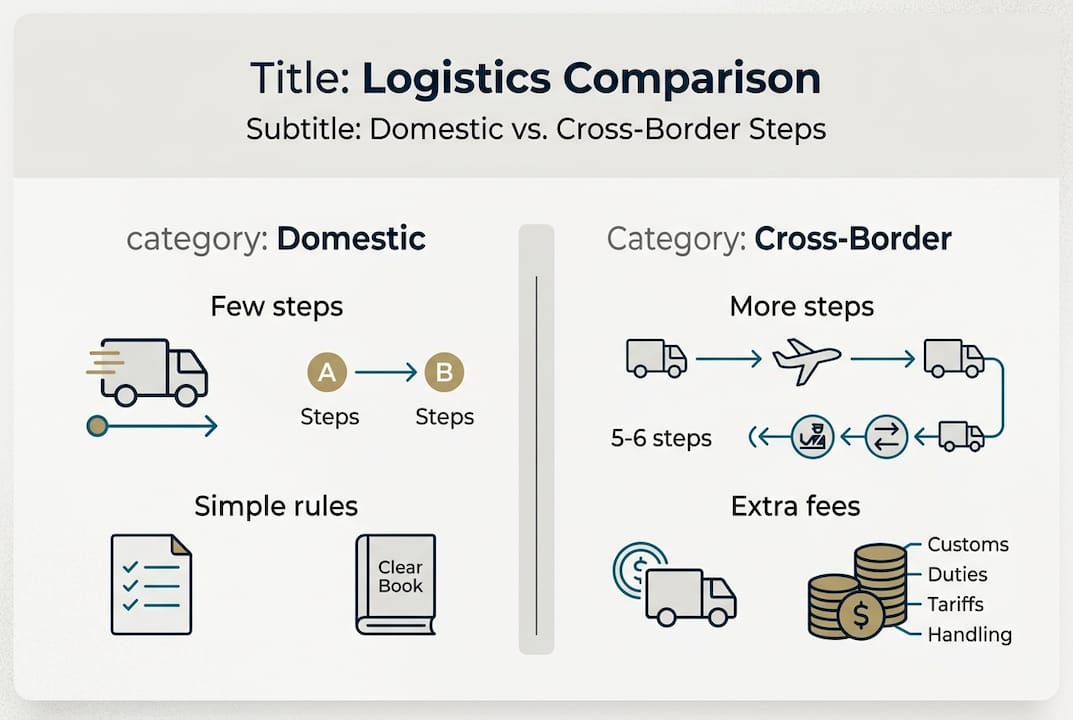
For e-commerce businesses, understanding these distinctions prevents the costly assumption that international shipping is simply domestic logistics at larger scale. The customs clearance process alone introduces complexity that can halt shipments for weeks if mishandled.
Core processes in cross-border logistics
Successful international shipping follows a precise sequence. Each stage builds on the previous one, and failures cascade quickly.
-
Inventory positioning: Determine optimal warehouse locations based on target markets, shipping costs, and delivery speed requirements. Strategic positioning reduces transit time and duties.
-
Transport mode selection: Choose between air (fast, expensive), ocean (economical, slow), or ground (regional). Your choice impacts cost, speed, and carbon footprint.
-
Freight forwarder engagement: These specialists handle carrier booking, route optimization, and multi-modal coordination. They’re essential for complex international routes.
-
Documentation preparation: Compile commercial invoices, packing lists, bills of lading, and certificates of origin. Accuracy here determines customs success.
-
Customs clearance: Submit documentation, pay duties and taxes, and await approval. This stage causes most delays when handled incorrectly.
-
Final delivery: Execute last-mile logistics in the destination country, often the most expensive and failure-prone segment.
The freight forwarder’s role extends beyond simple booking. They consolidate shipments, negotiate rates, manage documentation, and troubleshoot issues across borders. For businesses shipping regularly, this partnership becomes critical infrastructure.
Pro Tip: Digital platforms that centralize documentation and tracking eliminate 80% of coordination headaches. Invest in systems that give real-time visibility across all stages.
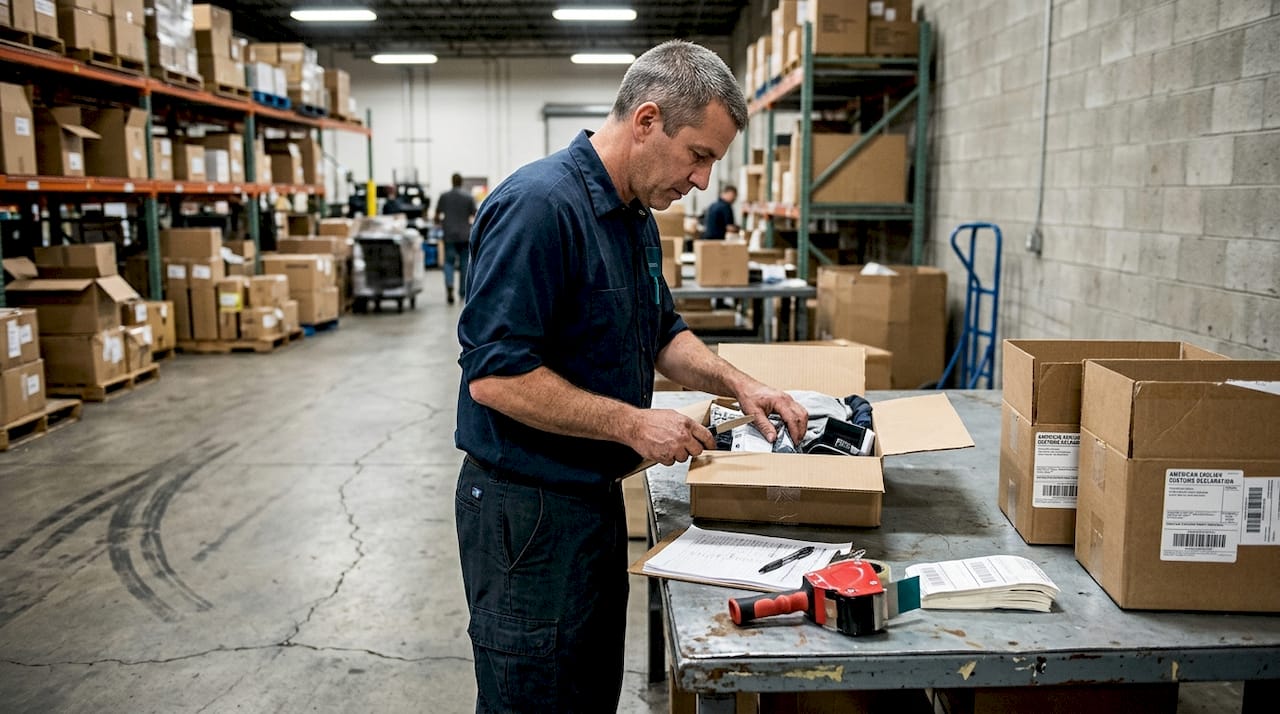
Every required shipping document serves a specific regulatory or operational purpose. Missing or incorrect paperwork doesn’t just delay shipments. It triggers inspections, fines, and sometimes cargo seizure.
Key documentation and compliance essentials
Paperwork precision separates smooth shipments from customs nightmares. Each document type serves distinct legal and operational functions.
Commercial invoice: Details goods description, value, buyer and seller information, and terms of sale. Customs uses this to assess duties and verify shipment legitimacy.
Packing list: Itemizes contents, weights, dimensions, and packaging type. Helps customs and carriers verify shipment integrity without opening every box.
Bill of lading: Legal contract between shipper and carrier. Serves as receipt, shipment tracking document, and title transfer instrument.
HS codes: Six to ten-digit classification numbers that determine applicable tariffs and regulations. Incorrect codes cause weeks-long delays as customs reclassifies goods.
| Document | Primary Purpose | Common Errors | Impact of Errors |
|---|---|---|---|
| Commercial Invoice | Duty calculation, customs clearance | Incorrect values, missing HS codes | Delayed clearance, fines, shipment holds |
| Packing List | Content verification | Weight/dimension mismatches | Physical inspections, delays |
| Bill of Lading | Legal shipment contract | Wrong consignee details | Delivery failures, legal disputes |
| Certificate of Origin | Tariff qualification | Missing signatures, expired dates | Lost preferential rates, higher duties |
Documentation errors carry steep costs. Shipments stuck in customs for weeks miss sales windows. Incorrect valuations trigger audits. Missing certificates forfeit preferential trade agreement rates that could save thousands per shipment.
When to use a customs broker: If you ship internationally more than monthly, handle high-value goods, or navigate complex trade agreements, broker fees pay for themselves through faster clearance and avoided penalties.
The trade documentation process demands attention to detail that most businesses underestimate initially. Creating templates and checklists for each destination country prevents repetitive errors. Digital systems that auto-populate fields from product databases eliminate manual entry mistakes.
Compliance isn’t optional. Governments increasingly scrutinize international shipping documentation for security, revenue protection, and trade agreement enforcement. Businesses that treat paperwork as administrative burden rather than strategic necessity pay premium prices in delays and penalties.
Top challenges and risk mitigation strategies
Even perfect documentation can’t prevent every disruption. Cross-border logistics faces systemic risks that require proactive management.
Major obstacles businesses encounter:
- Customs delays: Incomplete paperwork, random inspections, or regulatory changes halt shipments unpredictably
- Port congestion: High-volume periods create weeks-long backlogs at major shipping hubs
- Geopolitical events: Trade disputes, sanctions, or political instability close routes overnight
- Last-mile failures: Emerging markets often lack reliable final delivery infrastructure
- Returns management: Cross-border returns cost 1.5 times outbound shipping due to reverse customs and transportation complexity
The hidden cost of returns deserves special attention. When customers in Germany return products to your U.S. warehouse, you pay international shipping again, navigate customs clearance in reverse, and often deal with products that can’t be resold as new. This 1.5x cost multiplier destroys margins on low-value items.
Pro Tip: Build scenario models for your top three shipping routes. Map what happens if your primary port closes, your main carrier faces strikes, or new tariffs hit your product category. Having backup plans ready saves weeks when disruptions hit.
Digital twins and collaborative governance reduce risk by simulating supply chain scenarios before committing resources. These technologies let you test route changes, evaluate carrier alternatives, and model cost impacts without real-world consequences.
“Collaborative governance frameworks that connect shippers, carriers, and customs authorities through shared digital platforms reduce clearance times by 40% and cut documentation errors by 60%. The key is real-time data sharing that gives all parties visibility into shipment status and requirements.” — Supply Chain Digital Transformation Research, 2025
Risk mitigation starts with visibility. You can’t manage what you can’t see. Implement tracking systems that monitor shipments across all legs, alert you to delays immediately, and provide estimated arrival updates. This visibility lets you communicate proactively with customers and adjust inventory plans.
Engaging third-party logistics providers (3PLs) transfers operational risk but requires careful partner selection. Evaluate 3PLs on their technology capabilities, customs expertise, carrier relationships, and performance guarantees. The cheapest option rarely delivers the best results.
Managing supply chain disruptions requires both reactive speed and proactive planning. Maintain relationships with multiple carriers, diversify shipping routes, and build buffer inventory for critical products. Supply chain risk management isn’t about eliminating risk entirely. It’s about ensuring no single failure point can halt your business.
Best practices for optimizing cross-border logistics
Knowing the risks means nothing without actionable strategies. These practices separate efficient operations from costly chaos.
-
Standardize documentation templates: Create country-specific templates with all required fields pre-populated. Update them when regulations change.
-
Implement digital documentation systems: Paper-based processes introduce errors and slow approvals. Digital platforms enable instant sharing with customs and carriers.
-
Use real-time shipment tracking: Visibility across all logistics stages lets you spot delays early and communicate proactively with customers.
-
Conduct quarterly scenario planning: Model disruptions to your top routes and develop contingency plans before crises hit.
-
Leverage analytics for partner selection: Evaluate carriers and forwarders on on-time performance, damage rates, and customs clearance speed, not just price.
-
Build collaborative relationships: Regular communication with customs brokers, freight forwarders, and carriers prevents most costly mistakes.
Pro Tip: Schedule monthly reviews with your freight forwarder to analyze performance metrics, discuss upcoming shipments, and address recurring issues. This partnership approach catches problems before they become crises.
The freight documentation process benefits enormously from automation. Systems that pull product data directly from your inventory management platform eliminate manual entry errors. Integration with carrier APIs enables instant rate comparison and booking.
Technology alone won’t solve logistics challenges. The most successful operations combine digital tools with experienced human judgment. Use systems to handle routine tasks and data analysis. Rely on specialists for complex problem-solving and relationship management.
Returns deserve special process attention given their 1.5x cost premium. Implement clear return policies that discourage frivolous returns while maintaining customer satisfaction. Consider offering partial refunds or store credit to avoid reverse logistics costs on low-value items.
Continuous improvement requires measurement. Track key metrics: on-time delivery rate, customs clearance time, documentation error rate, and total landed cost per unit. Set quarterly improvement targets and adjust processes based on data.
How ORNER streamlines your cross-border logistics
Applying these strategies requires infrastructure most businesses don’t have in-house. That’s where specialized platforms deliver immediate value.
ORNER’s technology connects every stage of your cross-border logistics chain through a single interface. Real-time tracking shows exactly where shipments are and when they’ll arrive. Automated documentation systems pull product data directly from your catalog, eliminating manual entry errors that cause customs delays.
The platform’s freight booking solutions compare rates across carriers instantly, letting you optimize for cost or speed based on each shipment’s priority. Integration with customs systems accelerates clearance by submitting complete, accurate documentation the first time.
For businesses scaling internationally, ORNER’s warehouse network positions inventory strategically to reduce transit times and duties. The reliable courier solutions handle last-mile delivery with the same visibility and control as international legs.
Whether you’re shipping your first international order or managing thousands monthly, courier services for small businesses scale with your needs. The platform grows from simple shipment tracking to complete supply chain orchestration as your cross-border volume increases.
Frequently asked questions
What are the most common reasons for cross-border shipment delays?
Incorrect or incomplete customs documentation and improper HS codes are top causes, sometimes resulting in weeks-long wait times. Port congestion and carrier capacity issues also create significant delays during peak seasons.
How can businesses reduce risk in cross-border logistics?
They can use digital twins and collaborative planning with partners, and always double-check compliance documentation to avoid common pitfalls. Diversifying carriers and routes prevents single points of failure.
Which documents are essential for cross-border shipments?
You need a commercial invoice, packing list, bill of lading, and accurate HS codes for smooth customs clearance. Certificates of origin may be required for preferential trade agreement rates.
Why are returns more expensive in cross-border logistics?
Returns cost 1.5 times more than outbound shipping due to added compliance and transportation complexity. You pay international shipping twice and navigate customs clearance in both directions.
When should I hire a customs broker?
If you ship internationally more than monthly, handle high-value goods, or navigate complex trade agreements, broker fees pay for themselves through faster clearance and avoided penalties. Their expertise prevents costly documentation errors.