TL;DR:
- International shipping involves complex customs procedures, logistics coordination, and compliance management that require expert handling.
- Using dedicated cross-border logistics solutions reduces costs, improves delivery reliability, and enhances customer satisfaction for global ecommerce growth.
Shipping internationally sounds straightforward until you’re staring at a stack of customs documents, a delayed shipment at the port, and a customer asking where their order is. For ecommerce sellers, manufacturers, and wholesalers trying to scale globally, the gap between ambition and execution can be enormous. The global cross-border B2C ecommerce market has surpassed $1 trillion for three consecutive years, which means the opportunity is real but so is the competition. The brands winning internationally aren’t just shipping more; they’re shipping smarter.
Table of Contents
- What is cross-border logistics and who needs it?
- Key benefits of using cross-border logistics solutions
- Common challenges in international shipping (and how cross-border solutions solve them)
- How to evaluate and choose the right cross-border logistics partner
- Why “set and forget” doesn’t work for cross-border logistics
- Tap into global growth with the right logistics partner
- Frequently asked questions
Key Takeaways
| Point | Details |
|---|---|
| Unlock global markets | Specialized cross-border logistics lets businesses expand internationally with fewer obstacles. |
| Reduce shipping headaches | Partners handle compliance, documentation, and customs, saving time and money. |
| Boost efficiency and reliability | Optimized routes and advanced tech mean faster delivery and better customer experiences. |
| Choose wisely for growth | Align your logistics provider with your business goals for long-term stability and scale. |
What is cross-border logistics and who needs it?
Cross-border logistics is the end-to-end process of moving goods from one country to another. It covers everything from freight booking and customs documentation to warehousing, last-mile delivery, and returns management. It’s not just “international shipping.” It’s a coordinated system that keeps goods moving across borders without getting stuck in regulatory limbo or costing more than the product is worth.
If you’re an ecommerce seller fulfilling orders to customers in multiple countries, a manufacturer exporting products to overseas distributors, or a wholesaler supplying retailers across different regions, cross-border logistics is the infrastructure holding your entire operation together.
The growth of global ecommerce has made this a mission-critical function. Most online retailers and manufacturers now ship internationally to build their brands and increase revenue. But without the right setup, the consequences are painful: shipments delayed at customs, unexpected duties and taxes eating into margins, compliance errors triggering fines, and customers abandoning your brand because delivery is unreliable.
Here’s a snapshot of what the cross-border logistics landscape covers:
| Function | What it involves | Who handles it |
|---|---|---|
| Customs clearance | Documentation, duty calculation, inspections | Freight forwarders, brokers |
| Warehousing | Storage, pick, pack, inventory management | 3PLs, logistics platforms |
| Freight transport | Ocean, air, land routing | Carriers, freight forwarders |
| Last-mile delivery | Final delivery to end customer | Local couriers, fulfillment centers |
| Returns management | Reverse logistics across borders | 3PLs, specialized providers |
Businesses that benefit most from dedicated cross-border logistics solutions include:
- Ecommerce sellers shipping to international customers from platforms like Amazon or their own storefronts
- Manufacturers exporting finished goods or components across multiple markets
- Wholesalers coordinating bulk shipments to international buyers
- Global brands managing regional fulfillment centers and inventory buffers
The advantages for ecommerce businesses go well beyond just moving product faster. Done right, cross-border logistics becomes a competitive advantage. A practical cross-border logistics guide helps you understand exactly where to start and what to prioritize.
Key benefits of using cross-border logistics solutions
Once you move past DIY international shipping and into a purpose-built cross-border logistics solution, the difference in outcomes is significant. Freight forwarders and 3PLs handle complex supply chains including customs clearance, documentation, warehousing, and carrier selection, reducing costs, transit times, compliance errors, and improving visibility for growing ecommerce brands.
Here’s how those improvements translate to real business results:
Lower costs through scale. Logistics providers consolidate shipments across multiple clients, securing better rates from carriers than any single business could negotiate alone. You benefit from volume discounts without having to generate that volume yourself. Learn more about cost reduction strategies used by experienced logistics teams.
Faster, more reliable delivery. Optimized routing means your products take the fastest viable path to the customer, with contingency plans built in when disruptions hit. Providers with regional expertise know which carriers perform in specific markets and which routes to avoid during peak seasons.

Customs and compliance expertise. Each country has its own import rules, restricted product categories, labeling requirements, and duty structures. A dedicated logistics partner keeps up with these changes so you don’t have to. This is especially important as trade regulations shift frequently across major ecommerce markets.
Scalability as you grow. Seasonal spikes, new market launches, or sudden viral product moments don’t have to break your logistics setup when you’re working with a provider built for scale. You can ramp up and down without renegotiating contracts every few months.
Better customer experience. Reliable delivery times and real-time tracking improve customer satisfaction, reduce support tickets, and protect your brand reputation in markets where you’re still building trust.
Compare the two approaches side by side:
| Factor | DIY international shipping | Dedicated cross-border logistics |
|---|---|---|
| Customs handling | Manual, error-prone | Automated, expert-managed |
| Carrier rates | Standard retail pricing | Volume-negotiated pricing |
| Tracking visibility | Fragmented, limited | End-to-end, real-time |
| Scalability | Difficult, manual effort | Built-in, flexible |
| Compliance risk | High | Significantly reduced |
| Cost predictability | Low | High |
The ability to lower shipping costs while improving service quality is one of the most underappreciated advantages of working with an experienced logistics partner. Most businesses discover that the savings in avoided errors alone justify the investment.
Pro Tip: Before signing with any logistics provider, ask for a breakdown of how they handle unexpected customs holds. The quality of their answer will tell you a lot about their actual experience versus their marketing promises. Look into freight forwarder benefits to understand what a good provider should offer.
Common challenges in international shipping (and how cross-border solutions solve them)
International shipping without a dedicated solution is like navigating a foreign city without a map in a language you don’t speak. The obstacles are predictable, but only once you’ve already hit them.
Here are the most common barriers businesses face, and how cross-border logistics solutions address each one:
-
Customs compliance failures. Incorrect or incomplete documentation causes delays, fines, and confiscated goods. Logistics partners maintain up-to-date knowledge of import requirements by market and prepare documentation accurately the first time.
-
Unpredictable transit times. Without optimized routing and carrier relationships, shipments bounce between handlers and can sit in customs for days. Providers with established networks and cross-border shipping strategies build more reliable timelines into every shipment plan.
-
Cost overruns. Hidden fees, currency fluctuations, and duty miscalculations can turn a profitable product into a money loser by the time it reaches the customer. Experienced partners give you accurate landed cost estimates upfront.
-
Lack of shipment visibility. Customers who can’t track their orders create support volume and distrust. Real-time tracking tools integrated into your ecommerce platform keep customers informed automatically and reduce inbound support tickets dramatically.
-
Returns complexity. Cross-border returns are expensive and logistically messy. Good providers offer returns programs designed for international ecommerce, including local return hubs and refurbishment options.
The data backs this up: AI-powered route optimization can boost carrier utilization by 85%, which directly reduces cost per shipment while improving delivery speed. That kind of efficiency isn’t achievable through manual coordination.
The takeaway: Each of these challenges has a proven solution when you work with the right logistics partner. The risk isn’t in using a cross-border logistics provider. The risk is in not using one and losing ground to competitors who do.
Reviewing shipping best practices helps you understand the baseline expectations before evaluating any provider.
Pro Tip: Avoid one-size-fits-all logistics providers. Seek out partners with specific regional experience in your target markets. A provider who excels at US-to-Europe shipping may not have the same expertise in Southeast Asian last-mile delivery. Match your logistics partner to your actual expansion roadmap, not just your current shipping volume.
How to evaluate and choose the right cross-border logistics partner
Choosing a logistics partner is one of the highest-stakes decisions an ecommerce business makes. The wrong choice shows up in delivery failures, brand damage, and margin erosion. The right choice becomes a growth engine.
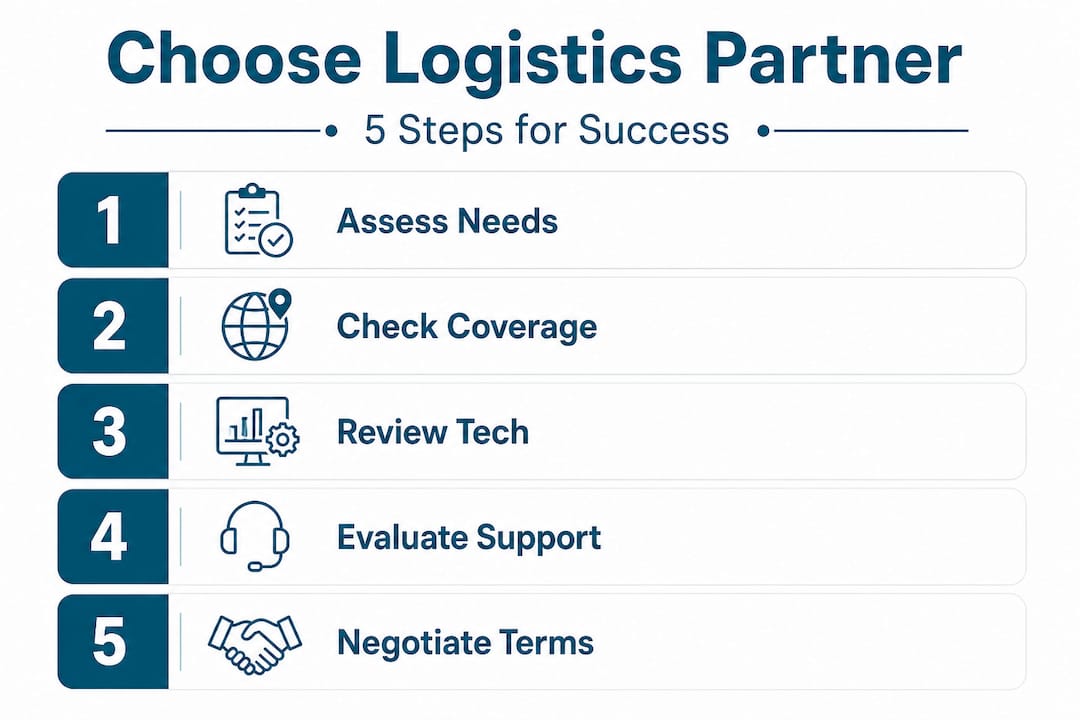
Research on evaluating international logistics service providers shows that ILSP (International Logistics Service Provider) selection should prioritize service quality, operation cost, technology level, and scale. Key metrics include transportation and storage costs, delivery speed, and network coverage. These aren’t soft criteria; they’re measurable, and you should be asking for specific numbers.
Here’s a practical framework for evaluating your options:
| Evaluation criterion | What to ask | Red flags |
|---|---|---|
| Service quality | What are your on-time delivery rates by region? | Vague answers, no data available |
| Technology | Do you offer real-time tracking integrated with my platform? | Manual tracking only, no API |
| Customs expertise | Which markets do you specialize in for customs clearance? | “We handle everything” with no specifics |
| Cost structure | What’s included in your base rate, and what triggers additional fees? | Hidden fees revealed late in negotiation |
| Scalability | How do you handle 3x volume spikes during peak season? | No documented contingency plan |
| Financial stability | How long have you operated, and what’s your client retention rate? | New providers with no track record |
According to BCG’s analysis of cross-border deal value, intra-regional logistics deals consistently outperform purely domestic ones, and aligning your ILSP with your broader business strategy produces more stable results than chasing the lowest rate.
“Strong capital and international experience in a logistics partner offers stability during disruptions, while AI-driven route planning boosts carrier utilization by 85%.”
The implication is clear: providers with deep roots in specific regions and proven financial stability will outperform budget options when disruptions hit. And disruptions, whether from weather, geopolitical events, or carrier failures, always hit eventually.
Key things to look for when evaluating any provider:
- Real-time tracking capability across all shipment legs, not just origin and destination
- Customs brokerage integration so clearance happens without manual handoffs
- Multi-modal flexibility across ocean, air, and land so you’re not locked into one shipping method
- Regional warehouse network to position inventory closer to end customers
- Technology integration with your ecommerce platforms and order management systems
Your logistics solutions for supply chain should function as a seamless extension of your operations, not a separate system you manage manually.
Why “set and forget” doesn’t work for cross-border logistics
Here’s the uncomfortable truth most logistics vendors won’t tell you: outsourcing your cross-border logistics doesn’t mean you can stop paying attention to it.
Too many ecommerce businesses sign a contract with a 3PL or freight forwarder, breathe a sigh of relief, and assume the problem is solved. Six months later, they’re dealing with rising error rates, cost creep, and service quality that’s slipped without anyone noticing. The brands that scale internationally and stay competitive treat logistics as a living part of their strategy, not a background function.
What does active logistics management actually look like? It means scheduling quarterly performance reviews with your provider, comparing actual delivery times against contracted SLAs, analyzing cost-per-shipment trends across routes, and holding your provider accountable when metrics drift. It also means staying informed about regulatory changes in your target markets so your provider isn’t the last to know.
The businesses that win long-term aren’t the ones that found a cheap logistics solution. They’re the ones that built a strategic partnership with their provider, gave feedback, pushed for technology improvements, and adapted their approach as their business evolved.
Long-term growth in cross-border ecommerce requires adaptation, monitoring, and relationship-building, not just a signed contract. The brands that treat cross-border shipping for growth as a dynamic capability, rather than a fixed cost center, are the ones adding markets year over year without the operational chaos that typically follows rapid expansion.
The lesson: your logistics partner handles the execution, but you own the strategy. Keep both sharp.
Tap into global growth with the right logistics partner
Scaling internationally doesn’t have to mean scaling your operational headaches. The businesses hitting revenue milestones in new markets are the ones that built their logistics infrastructure deliberately, not reactively.
At or-ner.com, we’ve designed a platform that gives ecommerce sellers, manufacturers, and wholesalers exactly what they need to execute cross-border shipping with confidence. From real-time tracking and customs clearance to regional warehousing and multi-modal freight, our tools and network are built for businesses that are serious about global growth. Start with our master cross-border logistics guide to build your strategy, access reliable courier services for dependable domestic and international fulfillment, and use our smooth global shipping checklist to make sure every shipment is set up for success before it leaves the warehouse.
Frequently asked questions
How can cross-border logistics reduce my ecommerce shipping costs?
Cross-border logistics providers consolidate shipments across multiple clients and negotiate volume-based carrier rates, which reduces costs, transit times, and compliance errors in ways individual businesses can’t match on their own.
What should I look for in a cross-border logistics partner?
Focus on measurable service quality, real-time tracking technology, customs expertise, and proven international coverage. According to ILSP research, the key evaluation metrics include transportation and storage costs, delivery speed, and network reach.
Can cross-border logistics help with customs and compliance?
Yes, dedicated providers specialize in documentation preparation and regulatory compliance, meaning customs clearance and documentation are handled accurately to minimize delays, fines, and confiscated shipments.
How big is the cross-border ecommerce market today?
The global cross-border B2C market has surpassed $1 trillion for three consecutive years, making international fulfillment capability a competitive necessity rather than a nice-to-have for growth-focused ecommerce brands.