
Many ecommerce entrepreneurs believe global logistics must be expensive and impossibly complex. That misconception keeps businesses stuck with fragmented carriers and inefficient fulfillment networks. Modern integrated logistics solutions actually simplify operations while reducing costs through strategic partnerships and technology. This guide explains how to evaluate fulfillment options, navigate international risks, and build scalable supply chains that support sustainable growth. You will learn actionable strategies to optimize every link in your logistics network, from procurement to final delivery, positioning your business for competitive advantage in global markets.
Table of Contents
- Key takeaways
- Understanding global logistics solutions for ecommerce
- Choosing between 3PL and in-house fulfillment for your ecommerce business
- Navigating challenges in global logistics: risk, compliance, and technology
- Strategies for building scalable and resilient global logistics networks
- Optimize your ecommerce logistics with ORNER solutions
- FAQ
Key Takeaways
| Point | Details |
|---|---|
| End to end efficiency | Global logistics platforms integrate procurement, warehousing, fulfillment, shipping, customs, and tracking to reduce coordination complexity and lower costs. |
| 3PL versus in house | Choose 3PL when labor costs and carrier rates make outsourcing more economical, since providers offer scale, multi carrier rate shopping, and seasonal flexibility. |
| Core logistics components | Core components include procurement management, warehousing near major markets, order fulfillment, multi carrier shipping, real time tracking, customs brokerage, and returns processing. |
| Clear terminology | Define internal terms like 3PL and end to end in formal documentation to ensure consistent evaluation and clear communication. |
| Visibility and intervention | End to end systems provide real time visibility across the journey, enabling you to intervene before small issues become customer complaints. |
Understanding global logistics solutions for ecommerce
Global logistics solutions integrate every stage of your supply chain into a coordinated system designed for ecommerce efficiency. Unlike traditional freight forwarding that handles only transportation, these comprehensive platforms manage procurement, warehousing, order fulfillment, international shipping, customs clearance, and real-time tracking. For ecommerce businesses, this integration eliminates the coordination burden of working with multiple disconnected vendors.
End-to-end supply chain integration connects procurement, manufacturing, and logistics to provide competitive advantage through reduced delays and faster fulfillment. This seamless flow means your inventory moves predictably from supplier to customer without the handoff friction that causes stockouts or delivery failures. When one system manages the entire journey, you gain visibility into every package and can intervene before small problems become customer complaints.
Third-party logistics providers handle outsourced fulfillment operations, while in-house fulfillment means your team manages warehousing and shipping directly. Most businesses start in-house for simplicity but transition to 3PL partnerships as order volumes grow beyond internal capacity. The decision point typically arrives when labor costs and carrier rates make outsourcing more economical than expanding your own facilities.
Core components of effective global logistics include:
- Procurement management coordinating supplier relationships and inbound freight
- Warehousing with strategic location near major markets or ports
- Order fulfillment processing picks, packs, and shipping label generation
- Multi-carrier shipping accessing negotiated rates across ocean, air, and ground
- Real-time tracking providing visibility to you and your customers
- Customs brokerage handling documentation and compliance for cross-border shipments
- Returns processing managing reverse logistics efficiently
Pro Tip: Define technical terms like 3PL and E2E clearly in your internal documentation so your entire team uses consistent language when evaluating logistics partners or discussing operational changes.
Understanding these fundamentals helps you ask the right questions when evaluating end-to-end logistics solutions and determine which services genuinely add value versus which duplicate capabilities you already have in-house.
Choosing between 3PL and in-house fulfillment for your ecommerce business
The fulfillment model you choose directly impacts your cost structure, scalability potential, and operational control. Neither option is universally superior. Your decision should align with current order volume, growth trajectory, product characteristics, and how much direct oversight you need over the customer experience.
Third-party logistics providers deliver substantial advantages through scale. 3PLs provide 15-40% lower carrier rates via economies of scale, along with built-in scalability that adapts to seasonal demand spikes without requiring you to hire temporary warehouse staff. They also handle the complexity of multi-carrier rate shopping, zone optimization, and packaging material procurement at volume discounts you cannot access independently.
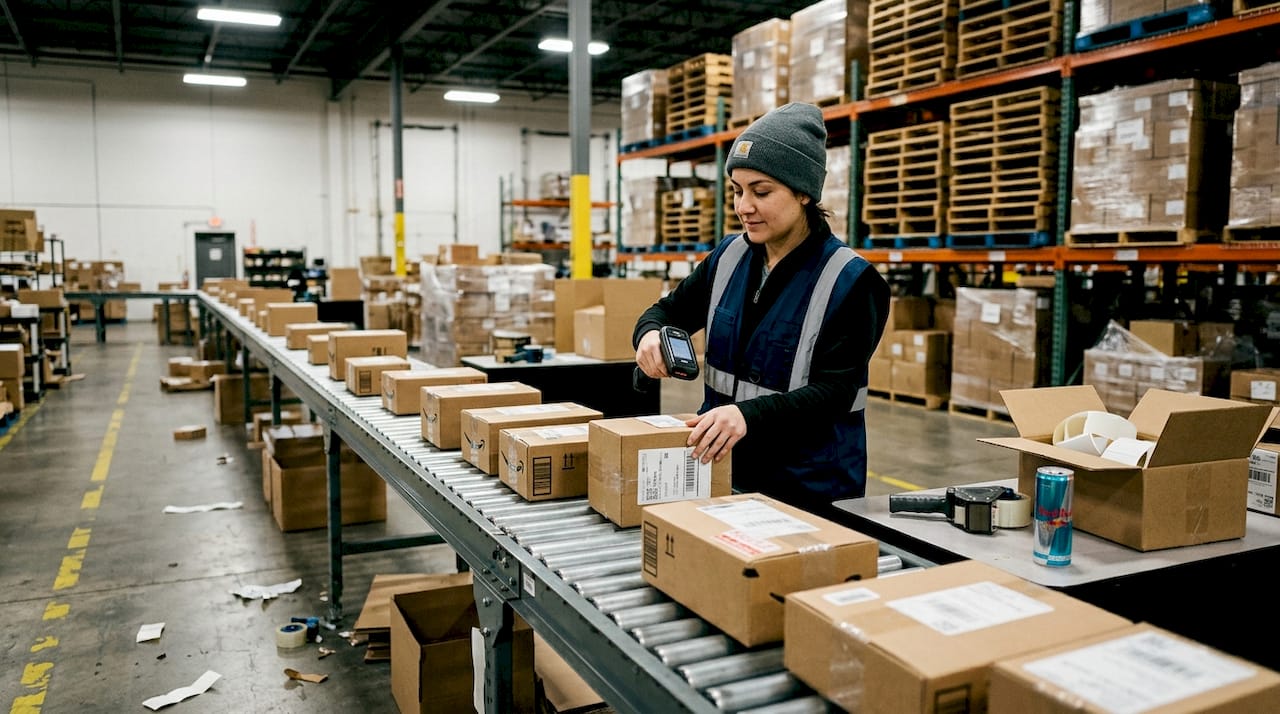
In-house fulfillment works best for businesses shipping fewer than 500 orders monthly who want complete control over packaging, branding, and quality assurance. You maintain direct oversight of inventory accuracy and can implement custom fulfillment processes for specialized products. However, labor costs, facility expenses, and full carrier rates quickly erode profitability as volume increases.
| Factor | 3PL fulfillment | In-house fulfillment |
|---|---|---|
| Best for order volume | 500+ orders/month | Under 500 orders/month |
| Carrier rate savings | 15-40% below retail | Full retail rates |
| Scalability | Instant capacity flex | Requires hiring and space expansion |
| Control over process | Limited to 3PL standards | Complete customization |
| Setup complexity | Moderate integration work | Minimal initial setup |
| Technology investment | Included in service fees | Requires separate WMS purchase |
Follow these steps to determine your optimal fulfillment approach:
- Calculate your true in-house cost per order including labor, rent, utilities, packaging materials, carrier rates, and management time
- Request quotes from three 3PL providers with transparent pricing showing per-order fees, storage costs, and any setup charges
- Project your order volume for the next 12 months accounting for seasonal peaks
- Evaluate which model offers lower total cost at your projected volume
- Consider hybrid options where you fulfill certain SKUs in-house while outsourcing high-volume or bulky items to a 3PL
- Test your chosen model with a 90-day pilot before committing to long-term contracts
Pro Tip: Implement warehouse management system software even if you choose in-house fulfillment to track labor productivity and identify the exact order volume where outsourcing becomes more economical.
Many successful ecommerce businesses use best parcel sending methods that combine both models strategically, handling high-margin or custom products internally while leveraging 3PL networks for commodity items where speed and cost matter more than personalized touches.
Navigating challenges in global logistics: risk, compliance, and technology
Global ecommerce logistics involves navigating a complex web of regulations, geopolitical uncertainties, and operational risks that can disrupt your supply chain without warning. Understanding these challenges and implementing proactive mitigation strategies protects your revenue and customer relationships when disruptions inevitably occur.
Customs and regulatory compliance create significant friction for cross-border ecommerce. Customs delays from Section 321 enforcement and IOSS compliance requirements in the EU force businesses to invest in proper documentation and duty calculation systems. The EU Import One-Stop Shop requires non-EU sellers to register for VAT collection on shipments under 150 euros, adding administrative complexity. Section 321 changes in the US similarly tightened de minimis exemptions, requiring detailed customs data even for low-value shipments.
Geopolitical risks now demand anti-fragile supply chains rather than merely efficient ones. Trade tensions, port strikes, and regional conflicts can shut down critical shipping lanes or manufacturing hubs with little notice. Many firms adopt nearshoring strategies, moving production closer to end markets to reduce exposure to long-distance supply chain vulnerabilities. This geographic diversification costs more upfront but provides resilience that cheap offshore-only models cannot match.
Specialized handling requirements for certain product categories add another layer of complexity:
- Temperature-controlled logistics for perishables requiring unbroken cold chain from origin to delivery
- Hazardous materials shipping with proper classification, labeling, and carrier certification
- High-value goods needing insurance, signature confirmation, and secure storage
- Oversized or heavy items requiring freight networks instead of standard parcel carriers
- Regulated products like supplements or electronics facing country-specific import restrictions
Supply chain visibility challenges undermine trust and operational efficiency. Inappropriate processes, lack of trust between partners, and poor performance metrics create visibility gaps where shipments disappear into black holes for days. Trust operates as both a barrier and a prerequisite for effective collaboration. Partners must share data transparently, but many fear competitive intelligence leaks or blame assignment when problems occur.
Technology solutions directly address visibility gaps:
Modern track and trace technology provides real-time location data, estimated delivery windows, and exception alerts when shipments deviate from expected routes or timelines. This transparency builds customer confidence and enables proactive communication before delivery failures damage satisfaction scores.
Implementing robust tracking systems, establishing clear communication protocols with logistics partners, and building redundancy into your carrier network transforms reactive firefighting into proactive risk management. You cannot eliminate all logistics risks, but you can build systems that detect problems early and activate backup plans before customers experience service failures.
Strategies for building scalable and resilient global logistics networks
Building logistics operations that scale efficiently while maintaining resilience requires strategic planning that goes beyond simply finding the cheapest carrier rates. The goal is optimizing total landed cost while creating flexibility to adapt when market conditions or operational requirements change.
Total landed cost encompasses every expense from supplier payment through final delivery, including product cost, inbound freight, duties and taxes, warehousing, fulfillment labor, outbound shipping, returns processing, and inventory carrying costs. Logistics managers shift to total landed cost models rather than optimizing individual cost components in isolation. A slightly higher warehousing cost near your customer base may dramatically reduce outbound shipping expenses and delivery times, improving the total equation.
Hybrid logistics models combining 3PL partnerships with selective in-house handling provide strategic flexibility. High-value SKUs with complex packaging or quality control requirements may justify in-house fulfillment, while commodity products benefit from 3PL scale and automation. This segmentation lets you optimize each product category independently rather than forcing everything through a single fulfillment channel.
Follow these steps to build a resilient, scalable logistics network:
- Map your current supply chain end to end, documenting every handoff point and calculating dwell time at each stage
- Identify single points of failure where one supplier, carrier, or facility handles critical volume with no backup option
- Establish relationships with backup suppliers and carriers before you need them, even if you pay slightly higher rates for redundancy
- Implement technology platforms that integrate multiple carriers and provide unified tracking across your entire network
- Negotiate contracts with volume commitments that secure capacity during peak seasons while maintaining flexibility to scale down during slower periods
- Review and stress test your logistics network quarterly, simulating disruptions to verify your backup plans actually work
- Build inventory buffers at strategic locations to absorb demand spikes or supply interruptions without stockouts
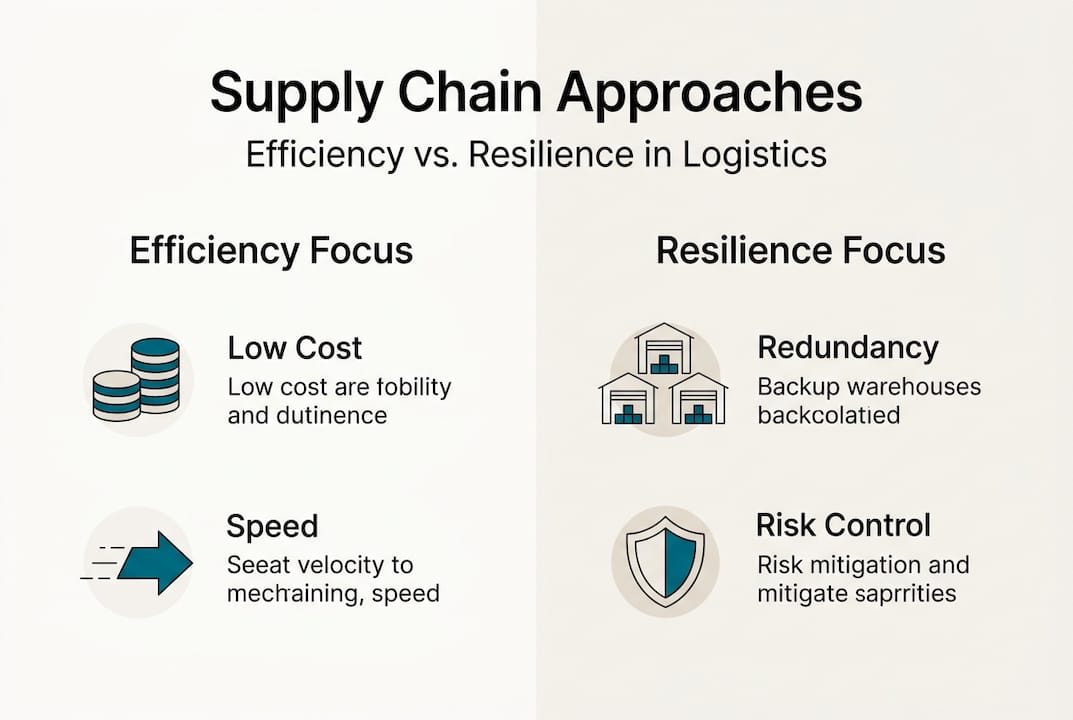
| Supply chain approach | Efficiency focus | Resilience focus |
|---|---|---|
| Primary goal | Minimize cost per unit | Maintain service during disruptions |
| Supplier strategy | Single lowest-cost source | Multiple qualified suppliers |
| Inventory levels | Just-in-time minimums | Strategic safety stock |
| Carrier relationships | Spot market rate shopping | Committed capacity agreements |
| Geographic footprint | Centralized distribution | Distributed regional hubs |
| Technology investment | Basic tracking | Predictive analytics and scenario planning |
Pro Tip: Evaluate logistics partners and suppliers not just on price and service quality but on their own resilience, including financial stability, geographic diversification, and how they handled past disruptions in your industry.
The most effective logistics networks balance cost efficiency with operational resilience, recognizing that the cheapest option often becomes the most expensive when disruptions occur. Strategic investments in warehousing best practices and time management best practices create the foundation for sustainable growth that survives market volatility and unexpected challenges.
Optimize your ecommerce logistics with ORNER solutions
Transforming logistics strategy into operational reality requires partners who understand ecommerce-specific challenges and provide integrated solutions that scale with your growth. ORNER delivers comprehensive logistics services designed specifically for online retailers navigating global supply chain complexity.
Our platform connects you with reliable courier services across ocean, air, and ground transportation modes, with real-time tracking and exception management that keeps you informed throughout every shipment journey. We specialize in courier services for small businesses that need enterprise-grade logistics capabilities without enterprise-level complexity or minimum volume requirements.
Implementing proven best courier service tips from our logistics experts helps you optimize packaging, reduce dimensional weight charges, and select the most cost-effective service levels for each shipment profile. Our global network of warehouses and fulfillment centers positions your inventory close to customers, reducing delivery times and transportation costs while maintaining the flexibility to adapt as your business grows and market demands shift.
FAQ
What are global logistics solutions for ecommerce?
Global logistics solutions encompass integrated supply chain services including procurement coordination, warehousing, order fulfillment, international shipping, customs clearance, and real-time tracking tailored specifically for ecommerce operations. These solutions ensure efficient, reliable delivery worldwide by connecting every stage of the supply chain into a unified system. Unlike traditional freight forwarding that handles only transportation, comprehensive logistics platforms manage the entire journey from supplier to customer.
How do 3PL providers differ from in-house fulfillment?
3PL providers outsource logistics operations to specialized companies that offer economies of scale, carrier rate discounts of 15-40%, and instant scalability for seasonal demand fluctuations. In-house fulfillment means your team manages warehousing, picking, packing, and shipping directly, which works best for businesses shipping fewer than 500 orders monthly who need complete control over packaging and quality assurance. The transition point typically occurs when labor costs and full retail carrier rates make outsourcing more economical than expanding internal facilities.
What are common risks in global ecommerce logistics?
Customs delays from regulatory changes, compliance requirements like EU IOSS and Section 321 enforcement, geopolitical disruptions affecting shipping lanes, and lack of supply chain visibility create major operational risks. Specialized handling for temperature-sensitive perishables, hazardous materials, high-value goods, and oversized items adds complexity requiring specific carrier certifications and insurance coverage. Supply chain visibility gaps from poor data sharing between partners undermine trust and prevent proactive problem resolution before customer service failures occur.
How can ecommerce businesses ensure scalable and resilient supply chains?
Use hybrid 3PL and in-house fulfillment models that optimize each SKU category independently, focus on total landed cost rather than individual cost components, and build anti-fragile networks with backup suppliers and carriers established before disruptions occur. Leverage technology platforms providing unified tracking across multiple carriers and implement strategic inventory buffers at distributed locations near major customer markets. Review logistics networks quarterly with stress testing that simulates disruptions to verify backup plans function effectively under real-world conditions.