
TL;DR:
- Cloud logistics platforms enable 10-15% cost savings and up to 60% labor efficiency gains.
- Technologies like AI, predictive analytics, and serverless computing drive operational improvements.
- Success depends on people, processes, and strategic implementation, not just the technology.
Route optimization alone has driven 10 to 15% cost reductions and labor efficiency gains of 50 to 60% at warehouses using cloud-powered platforms. Those aren’t numbers reserved for Amazon or UPS. Mid-size e-commerce brands and logistics managers are now capturing the same advantages through scalable, cloud-based logistics solutions that bring real-time control, route intelligence, and inventory accuracy within reach. This guide breaks down how these platforms work, what technologies drive the results, which risks to watch for, and how to choose the right implementation path so your operation can move faster, spend smarter, and scale without breaking.
Table of Contents
- What are cloud-based logistics solutions?
- Key technologies powering cloud logistics
- Real-world results: Efficiency, ROI, and use cases
- Challenges, risks, and expert tips for successful adoption
- Why success with cloud logistics is about people and process, not just tech
- Streamline your operations with expert cloud logistics support
- Frequently asked questions
Key Takeaways
| Point | Details |
|---|---|
| Proven efficiency gains | Cloud-based logistics solutions can yield up to 396% ROI, slash labor, and reduce costs. |
| Tech plus governance wins | Success hinges on aligning technology investments with process redesign and strong governance. |
| Scalable for all sizes | Cloud logistics tools are affordable and effective for both small businesses and large enterprises. |
| Watch for risks | Data security, legacy integration, and multi-vendor latency must be managed for best results. |
What are cloud-based logistics solutions?
Cloud-based logistics solutions are software platforms hosted on remote servers that give businesses access to logistics tools, data, and automation without requiring on-site hardware or proprietary IT infrastructure. Think of them as the operating system for your entire supply chain, running in the background and connecting your courier partners, warehouses, sales channels, and customers into one synchronized flow.
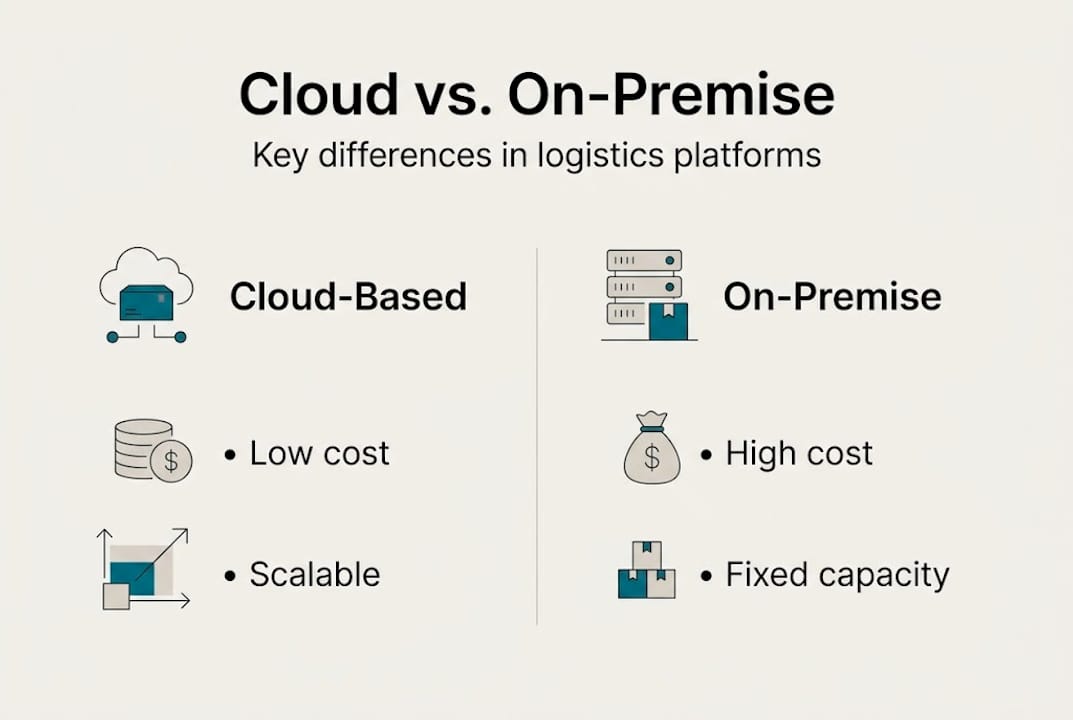
Unlike legacy on-premise systems that require expensive servers, IT staff, and rigid upgrade cycles, cloud solutions operate on a subscription or usage-based model. You pay for what you need, scale up during peak seasons, and scale back when volume drops. That flexibility is what makes cloud logistics platforms efficiency a game-changer for e-commerce businesses dealing with unpredictable demand.
Here is a quick comparison to show the difference:
| Feature | Cloud-based logistics | Traditional on-premise |
|---|---|---|
| Setup cost | Low (subscription model) | High (hardware, IT, licenses) |
| Scalability | Instant, elastic scaling | Requires new hardware |
| Real-time data | Always available | Often delayed or siloed |
| Integration | API-first, flexible | Custom builds, slow |
| Updates | Automatic, continuous | Manual, disruptive |
| Disaster recovery | Built-in redundancy | Requires separate investment |
The scalability piece is not theoretical. Cloud solutions excel in handling e-commerce surges through serverless architectures and AI orchestration, which means your platform automatically allocates more computing power during Black Friday without you lifting a finger.
A common myth is that these solutions are only built for enterprise-scale operations with large IT teams. That’s simply false. Modern platforms are designed with small to mid-size sellers in mind. Many operate through intuitive dashboards with plug-and-play integrations for Shopify, Amazon, WooCommerce, and other major platforms. Using a global logistics platform built for e-commerce means even a solo merchant can access the same tracking, routing, and analytics capabilities that large 3PLs use.
The core features you should expect from a capable platform include:
- Real-time shipment tracking across multiple carriers and transport modes
- Inventory management with automated reorder triggers and multi-location visibility
- Dynamic route optimization for last-mile and cross-border delivery
- Exception handling with automated alerts when delays or failures occur
- Data analytics and reporting for performance monitoring and forecasting
- Customs clearance tools with built-in compliance checks for cross-border shipments
- API integrations with marketplaces, ERPs, and warehouse management systems
These features combine to give your team a single source of truth across your entire logistics operation. Instead of juggling spreadsheets, tracking emails, and phone calls with courier partners, everything lives in one place.
Key technologies powering cloud logistics
With a solid understanding of cloud-based logistics, let’s look at the innovative technologies that make these solutions so effective. The platform itself is just the shell. What runs inside it determines whether you see marginal improvements or transformational gains.
Artificial intelligence and machine learning sit at the core. AI analyzes historical order data, seasonal patterns, and external variables like weather and traffic to make smarter decisions about routing, inventory positioning, and carrier selection. Machine learning models improve continuously, meaning the longer you use the platform, the sharper its recommendations become. Predictive analytics in logistics is no longer a feature reserved for Fortune 500 companies. It’s embedded in most modern cloud platforms.

Predictive demand forecasting uses those AI models to anticipate what products you’ll need, where, and when. This directly reduces overstock and stockouts, two of the most expensive problems in e-commerce logistics. Accurate demand forecasting can reduce carrying costs by 20 to 30% for businesses with diverse SKU catalogs.
Serverless computing ensures your platform handles volume spikes without crashing or slowing down. During seasonal surges, computing resources expand automatically. When volume drops, costs contract. You’re never paying for idle capacity.
Here’s a data snapshot of what these technologies deliver in practice:
| Technology | Operational impact | Typical improvement |
|---|---|---|
| AI route optimization | Fuel and time savings | 10 to 15% cost reduction |
| Predictive analytics | Inventory accuracy | 20 to 30% carrying cost reduction |
| Automated exception handling | Delay response time | 40% faster issue resolution |
| Warehouse automation | Labor efficiency | 50 to 60% productivity gain |
| Machine learning forecasting | Demand accuracy | 25 to 35% fewer stockouts |
Here’s how data moves through a cloud-based logistics platform from order placement to final delivery:
- Order received from marketplace or storefront, synced automatically to the platform
- Inventory checked in real time across all warehouse locations
- Fulfillment location selected based on proximity, stock levels, and shipping cost
- Carrier assigned through rate shopping and carrier performance scoring
- Shipment created with automated label generation and customs documentation if needed
- Route optimized using live traffic data and delivery constraints
- Tracking activated with customer-facing notifications sent automatically
- Exceptions detected and flagged with recommended actions for your team
- Delivery confirmed and data fed back into the system to improve future decisions
Key methodologies like automated exception handling and closed-loop learning from delivery data ensure the system gets smarter after every shipment, not just faster. With inventory forecasting methods built into the platform, you stop reacting to problems and start preventing them.
Pro Tip: When evaluating platforms, prioritize those with modular, API-first designs. This means you can swap out individual components, like your carrier integration or warehouse management module, without rebuilding your entire tech stack. Lock-in is real, and modular design is your best protection against it.
One important nuance: automation handles routine decisions well, but human oversight remains essential. Unusual events, supplier disputes, or geopolitical disruptions require judgment calls that no algorithm handles perfectly. Build workflows that flag edge cases for human review rather than letting automation run unchecked.
Real-world results: Efficiency, ROI, and use cases
Now that we’ve explored the technology stack, let’s look at the real-world impact these solutions deliver. Numbers matter, and the numbers here are hard to ignore.
“Oracle Analytics in logistics yielded a 396% ROI and $118.3 million in benefits over three years, while an AWS migration delivered 15% operational cost reduction and $180,000 in annual savings.”
That ROI figure represents real money recovered through better data decisions, faster exception resolution, and reduced manual labor. For a mid-size logistics operation, even capturing 10% of that efficiency through a modern platform changes the economics of the business completely.
UPS ORION, the AI-powered route optimization system, saves more than 100 million miles annually across its delivery network. BlueLine Logistics reduced headcount by 70% and cut per-shipment costs by 60% after implementing cloud-based automation. These aren’t outliers. They reflect what happens when logistics infrastructure is rebuilt around data rather than guesswork.
Here’s a summary of quantifiable improvements businesses experience after adopting cloud logistics platforms:
- Fuel and transportation savings of 10 to 15% through dynamic route optimization
- Labor productivity gains of 50 to 60% in warehouse operations using automation
- Inventory accuracy improvements reducing shrinkage and overstock by up to 30%
- SLA (service level agreement) compliance rates improving by 15 to 25% through proactive exception management
- Order processing speeds increasing by 40% through automated fulfillment triggers
- Customer satisfaction scores rising due to accurate delivery estimates and real-time tracking
Flexport, a cloud-native freight platform, grew its network by 100% while achieving a 15% pick rate increase and saving $1,300 per 10,000 order lines by leveraging data-driven warehouse optimization. That kind of efficiency compounds fast as order volume grows.
For e-commerce businesses specifically, the payback period on cloud logistics investment is often short. Reduced carrier costs, fewer manual errors, and better inventory positioning typically recover the platform cost within 6 to 12 months. After that, every efficiency gain flows directly to the bottom line.
Improving warehouse efficiency and adopting stronger warehousing best practices are two of the highest-leverage areas where cloud platforms deliver immediate, measurable returns. When your warehouse knows what’s coming before it arrives, pick accuracy goes up, labor hours go down, and your couriers spend less time waiting for correctly packed orders.
Challenges, risks, and expert tips for successful adoption
But even with strong benefits, adopting cloud-based logistics comes with challenges you should prepare for. Knowing them in advance lets you build a smarter implementation plan rather than discovering problems after you’ve already committed.
Data security and integration challenges are among the most frequently cited concerns, alongside unexpected costs from over-provisioning and market uncertainty affecting supply chain governance. These aren’t reasons to avoid cloud logistics. They’re reasons to approach adoption carefully.
The main risks e-commerce businesses encounter include:
- Data security and privacy vulnerabilities, especially when multiple vendors access sensitive shipment and customer data
- Integration friction with legacy systems, particularly older warehouse management or ERP software that lacks modern APIs
- Cost overruns from over-provisioning, where businesses pay for computing capacity they don’t use because they lack governance controls
- Vendor lock-in, where proprietary data formats or platform dependencies make switching costly
- Latency in time-critical operations, especially when cloud servers are geographically distant from distribution centers
- Governance gaps, where automation runs without clear oversight, leading to errors that go undetected
Multi-vendor environments carry a specific risk worth noting. 67% longer security response times have been observed in complex multi-vendor setups, where responsibility for incidents gets blurred across parties. This is a concrete reason to keep your vendor ecosystem as streamlined as possible.
Pro Tip: Use a multi-vendor strategy thoughtfully. Choose one primary platform with strong core capabilities and build integrations around it, rather than stitching together five different best-in-class tools that create governance gaps between them. Your logistics data analytics will be far more actionable when all data flows through a unified system.
Your adoption checklist should include these steps before going live:
- Conduct a full audit of existing systems and identify integration requirements
- Define clear KPIs and ROI goals before selecting a vendor
- Run a pilot with a single product line or geographic region before full rollout
- Establish governance policies for data access, exception handling, and vendor accountability
- Train front-line staff and warehouse teams before launch, not after
- Schedule regular platform performance reviews every 90 days
Access to strong supply chain analytics built into your platform helps you catch governance gaps early. When you can see exactly where delays, errors, and cost spikes originate, you can fix them before they scale into bigger problems.
Why success with cloud logistics is about people and process, not just tech
Here’s the perspective that most implementation guides skip over: the technology is the easy part. Every major cloud platform today offers solid route optimization, decent integrations, and passable analytics. What separates businesses that see transformational results from those that see modest improvements is almost never the software. It’s the people and processes wrapped around it.
We’ve seen businesses implement expensive platforms and see minimal ROI because they skipped change management. Front-line warehouse staff didn’t trust the system’s recommendations. Managers kept relying on spreadsheets out of habit. Nobody took ownership of exception alerts. The tech worked fine. The culture didn’t shift.
The businesses that win with cloud logistics treat implementation as a process redesign project, not a software installation. They redesign workflows around what the platform makes possible, not what they were already doing. They set clear KPI targets before going live, create feedback loops so staff can flag issues, and invest in training that explains the “why” behind each tool. Improving warehouse efficiency strategies requires all three layers working together.
Pro Tip: Run a 60-day pilot with a small team and gather structured feedback before expanding rollout. The insights from front-line users will catch integration gaps and workflow mismatches that no vendor demo ever reveals.
Genuine breakthroughs happen when technology, governance, and team buy-in all align. That combination is rarer than it should be, and it’s the real competitive advantage.
Streamline your operations with expert cloud logistics support
Ready to take cloud logistics to the next level? The benefits we’ve covered, including lower courier costs, faster fulfillment, smarter inventory management, and real-time supply chain visibility, are achievable for businesses at every scale. The key is partnering with a platform built specifically for e-commerce operations rather than retrofitting an enterprise tool.
Or-ner.com offers end-to-end logistics support designed for online sellers and logistics managers who need reliable courier services that scale with their business. From real-time shipment tracking and freight booking to customs clearance and global fulfillment, the platform connects every part of your supply chain. Explore dedicated warehousing solutions and courier coordination tools that help you move faster, reduce costs, and serve customers better across every market you operate in.
Frequently asked questions
How can cloud-based logistics reduce costs for e-commerce businesses?
Cloud-based logistics reduces costs through predictive analytics, automated route optimization, and smarter inventory positioning, with benchmarks showing 10 to 15% fuel savings, 50 to 60% labor efficiency gains, and 3.5x ROI over three years. These gains compound as order volume grows.
What are the biggest risks of adopting cloud logistics platforms?
Security vulnerabilities, legacy system integration issues, and cost overruns from over-provisioning are the most common risks, with multi-vendor setups showing 67% longer security response times when governance is unclear. A streamlined vendor strategy with strong oversight mitigates most of these risks.
Do cloud logistics solutions work for small businesses, or just large enterprises?
Modern cloud platforms are designed for businesses of all sizes, and serverless architectures enable instant scaling that benefits small e-commerce sellers as much as large enterprises. Subscription pricing models make entry affordable without large upfront investment.
What operational improvements can I expect after implementing cloud logistics?
Most businesses see faster order-to-delivery cycles, better inventory accuracy, and improved courier coordination, with Flexport reporting 100% network growth, a 15% pick rate increase, and $1,300 saved per 10,000 order lines after adopting cloud-powered logistics tools.