TL;DR:
- Less than 20% of ecommerce companies achieve a perfect order rate above 95% highlighting the importance of strategic logistics. Core logistics stages include inventory management, order processing, fulfillment, delivery, and returns, each impacting customer satisfaction and costs. Top logistics performance relies on data-driven metrics and choosing the right fulfillment model, with tools like ORNER streamlining operations.
Less than 20% of ecommerce companies consistently hit a Perfect Order Rate above 95%. That number should stop you cold. Most operators assume retail logistics is simply picking, packing, and shipping products to customers. The reality is far more demanding. Retail logistics is a strategic, data-driven system that determines whether your business grows or stalls. From inventory accuracy to last-mile delivery, every stage affects your bottom line, your customer reviews, and your ability to scale. This article breaks down each stage, the benchmarks that matter, and the fulfillment models that give you a real competitive edge.
Table of Contents
- What is retail logistics? Core process overview
- Key performance benchmarks and metrics explained
- Common pitfalls and sector-specific challenges
- Fulfillment models: In-house, 3PL, hybrid, and 4PL compared
- Why metrics-driven logistics beats intuition
- Optimize your retail logistics with ORNER solutions
- Frequently asked questions
Key Takeaways
| Point | Details |
|---|---|
| Logistics stages matter | Every stage from inventory to delivery impacts efficiency and customer satisfaction. |
| Metrics drive improvement | Tracking KPIs like Perfect Order Rate and fulfillment cost enables smarter decisions. |
| Sector challenges differ | Apparel, perishables, and cross-border shipping each face unique logistics pitfalls. |
| Choose models wisely | Picking the right fulfillment model—3PL, hybrid, or in-house—determines scalability and cost. |
| Platforms boost results | Leveraging modern logistics technology and strategic partners maximizes supply chain impact. |
What is retail logistics? Core process overview
Retail logistics covers every activity involved in moving products from a supplier or warehouse to the end customer. It is the backbone of any ecommerce operation, and it goes well beyond simply shipping boxes. A strong retail logistics workflow connects purchasing, warehousing, order processing, fulfillment, delivery, and returns into one coordinated system.
Here are the core stages every ecommerce business needs to manage:
- Inventory management: Receiving stock, tracking quantities, and maintaining accurate counts across all storage locations.
- Order processing: Capturing customer orders, verifying payment, and routing them to the correct fulfillment center.
- Fulfillment: Picking products from shelves, packing them correctly, and generating shipping labels.
- Delivery: Handing off packages to carriers and managing last-mile logistics to the customer’s door.
- Returns: Processing returned items, restocking sellable goods, and reconciling inventory records.
Each stage has its own set of targets. Before diving into benchmarks, it helps to understand common logistics terms like SKU (Stock Keeping Unit), pick accuracy, and cycle time, since they appear constantly in performance reporting.
The numbers that define success in retail logistics are specific and demanding. Industry data shows inventory accuracy at 99%, on-time delivery at 98%, pick accuracy between 97% and 99%, and a fulfillment cost of roughly $3.50 per order in the US. These are not aspirational figures. They are what top-performing operations actually achieve.
| Metric | Industry Average | Top Performer Target |
|---|---|---|
| Inventory accuracy | 93% | 99% |
| On-time delivery | 89% | 98% |
| Pick accuracy | 92% | 97-99% |
| Fulfillment cost per order | $4.80 | $3.50 |
| Perfect Order Rate | 85% | 95%+ |
The goal of a well-run retail logistics operation is to deliver the right product, to the right customer, at the right time, at the lowest possible cost. Every decision you make in operations, technology, or partnerships should tie back to that objective. Businesses that treat logistics as a cost center rather than a growth engine are the ones that struggle to scale past a certain revenue threshold.
Key performance benchmarks and metrics explained
Understanding the logistics stages is key, but how do you measure success? Let’s explore the benchmarks that guide top performers.
The Perfect Order Rate (POR) is the single most important metric in retail logistics. It measures the percentage of orders that are complete, accurate, on time, and undamaged. A POR of 85% sounds acceptable until you realize it means 15 out of every 100 customers had a problem with their order.
Here is how the key metrics are calculated and what they mean operationally:
- POR: (Complete orders / Total orders) x 100. Anything below 90% signals systemic issues.
- On-time delivery rate: Percentage of shipments delivered by the promised date. Directly tied to customer satisfaction scores.
- Inventory accuracy: How closely your system records match physical stock. Errors here cause stockouts and overstock simultaneously.
- Inventory turnover: How many times you sell and replace inventory in a given period. Low turnover ties up cash.
- Return rate: Percentage of orders sent back. In apparel, this is often the most expensive metric to manage.
The global retail logistics market was valued at $178 billion in 2023 and is projected to reach $487 billion by 2026. Online returns range from 15% to 40% depending on the product category.
The hidden cost most operators miss: A 1% drop in pick accuracy at 10,000 orders per month means 100 wrong shipments. At an average cost of $12 to correct each one, that is $1,200 in avoidable losses every single month.
| Metric | Average Ecommerce | Best-in-Class | Sector Note |
|---|---|---|---|
| Perfect Order Rate | 85% | 95%+ | Lower in apparel |
| On-time delivery | 89% | 98% | Critical for perishables |
| Return rate | 15-20% | Under 10% | Apparel hits 20-40% |
| Inventory turnover | 6-8x/year | 12x+/year | Peak seasons distort this |
Tracking delivery performance metrics consistently is what separates reactive businesses from proactive ones. Pair that with solid inventory accuracy basics and a working returns management guide, and you have the foundation for sustainable logistics performance.
Common pitfalls and sector-specific challenges
Benchmarks help set targets, but real-world challenges often prevent businesses from hitting them. Here’s where most companies stumble, by sector.
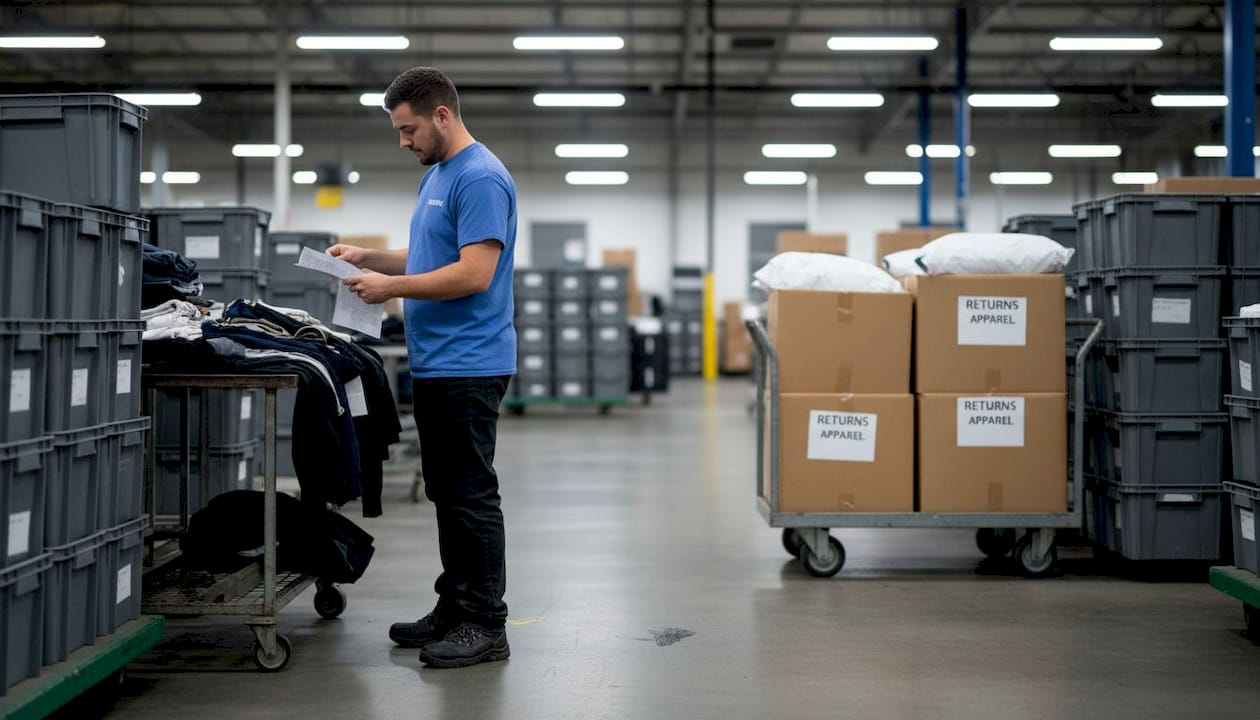
Apparel is the hardest category to manage logistically. Apparel returns run 20% to 30% on average, driven by sizing inconsistencies, color differences on screen versus real life, and customer bracketing (ordering multiple sizes with intent to return). Each return costs you twice: once for the outbound shipment and again for processing the return.
Peak season surges create a completely different set of problems. Volumes can spike 3 to 4 times normal levels during Q4 and major sale events. Businesses that have not pre-positioned inventory or secured additional carrier capacity fall apart exactly when it hurts the most.
Cross-border logistics adds customs delays, tariff complexity, and inconsistent carrier performance into the mix. Perishable goods face time-critical windows where even a 24-hour delay destroys inventory value entirely.
Omnichannel fulfillment brings its own friction. BOPIS (Buy Online, Pick Up In Store) sounds simple. In practice, it requires real-time inventory sync between your online catalog and physical store stock, plus trained staff to manage order staging. Many mid-sized operators fail here because their systems do not talk to each other.
Internal logistics gaps are more expensive than most operators realize. Internal delays cost India’s organized retail sector over Rs 2,000 crore per year, and similar inefficiencies affect businesses globally at every scale.
Common pitfalls across sectors:
- Poor carrier diversification leaves you vulnerable when one partner fails
- Inadequate buffer stock during peak periods causes stockouts
- Manual data entry creates inventory discrepancy cascades
- Lack of a formal returns policy increases processing time and cost
Pro Tip: Build your returns best practices into your product listings. Clear sizing guides, video content, and accurate product photography reduce apparel returns by up to 15% before the order is even placed. Also, review your peak season logistics strategy at least 90 days before major sale windows.
Fulfillment models: In-house, 3PL, hybrid, and 4PL compared
After tackling challenges, the next crucial question is: which fulfillment model delivers the best results for your business?
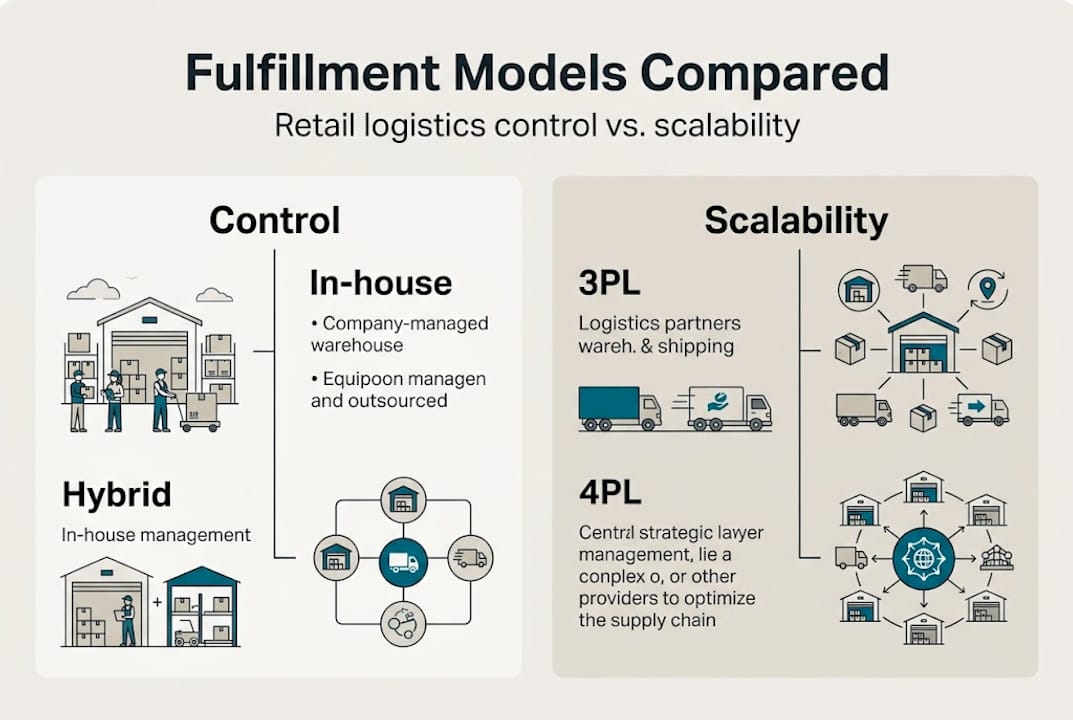
There are four primary fulfillment structures, and each one suits a different stage of business growth.
- In-house fulfillment: You own and operate your own warehouse. Maximum control, but high fixed costs. Best for businesses with unique handling requirements or proprietary packaging.
- 3PL (Third-Party Logistics): You outsource storage, picking, packing, and shipping to a specialized provider. 3PLs hold 70% market share in ecommerce fulfillment, and can save businesses 15% to 40% on carrier costs through volume negotiation.
- Hybrid: You manage some fulfillment in-house while outsourcing overflow or specific geographies to a 3PL partner. 40% of mid-market ecommerce businesses use this approach.
- 4PL (Fourth-Party Logistics): A single partner manages your entire logistics network, including oversight of multiple 3PLs. Best for complex, global operations that need unified visibility.
| Model | Control | Scalability | Cost Structure | Best For |
|---|---|---|---|---|
| In-house | High | Low | High fixed | Unique products, low volume |
| 3PL | Medium | High | Variable | 500-1,000+ orders/month |
| Hybrid | High | Medium | Mixed | Mid-market growth phase |
| 4PL | Low | Very High | Premium | Global, multi-channel ops |
The 3PL break-even point typically falls between 500 and 1,000 orders per month. Below that threshold, in-house is often cheaper. Above it, the volume discounts and operational expertise a 3PL brings usually outweigh the per-unit fees.
Pro Tip: Before signing with a 3PL, audit their technology stack. If their warehouse management system does not integrate with your ecommerce platform in real time, you will inherit their data delays as your own problem. Review all available logistics service types before committing to a long-term contract.
Why metrics-driven logistics beats intuition
Here is the uncomfortable truth: most logistics decisions are still made on gut instinct. A manager notices that orders are slow on Tuesdays and shuffles staff around. A founder assumes their primary carrier is performing well because complaints seem low. Neither of these is logistics management. It is logistics guessing.
Top ecommerce brands treat metrics for logistics success the same way a CFO treats financial statements: as non-negotiable inputs for every operational decision. When your POR drops 2%, you investigate the specific stage where failures occurred. When your cost per order creeps up, you compare it against carrier invoices and warehouse labor data before making any changes.
The brands that consistently outperform their sectors are not necessarily faster or cheaper. They are simply more precise. They know their numbers, they review them weekly, and they build logistics partnerships around accountability. Technology platforms that surface exception alerts, automate routine reporting, and integrate carrier data into one dashboard are no longer optional in 2026. They are the baseline for staying competitive. Intuition had its moment. Data has replaced it.
Optimize your retail logistics with ORNER solutions
You now have a clear picture of how retail logistics works, where the benchmarks sit, and which fulfillment models suit different growth stages. Putting this into practice is the real challenge, and that is exactly where a platform built for ecommerce logistics makes the difference.
ORNER’s global logistics platform gives ecommerce businesses access to reliable courier services, real-time shipment tracking, warehouse network management, and carrier selection tools, all in one place. Whether you are scaling from 500 to 5,000 orders per month or managing cross-border fulfillment across multiple markets, the platform’s cloud logistics efficiency tools connect your data, your partners, and your customers into one streamlined workflow. Stop managing logistics in spreadsheets and start making decisions with real-time visibility.
Frequently asked questions
What is a perfect order rate and why does it matter?
Perfect order rate measures the percentage of orders meeting all fulfillment criteria, including accuracy, completeness, and on-time delivery. Top performers reach 95%+, directly impacting customer retention and profitability.
How can ecommerce teams reduce fulfillment costs?
Switching to scalable models like 3PL providers brings costs closer to the US benchmark of $3.50 per order, and carrier savings of 15% to 40% are achievable through volume consolidation.
What causes high return rates in ecommerce apparel?
Apparel return rates of 20% to 30% stem primarily from sizing inconsistencies, inaccurate product imagery, and customer bracketing behavior.
Which fulfillment model is best for mid-sized ecommerce businesses?
Hybrid models offer the best balance of control and flexibility, with 40% of mid-market companies already using a combination of in-house and 3PL fulfillment.
What is the biggest logistics cost in ecommerce delivery?
Last-mile delivery accounts for 53% of total shipping costs for retail ecommerce businesses, making carrier selection and route optimization critical priorities.