
Picking the wrong logistics service doesn’t just slow down your shipments. It drains your margins, frustrates customers, and quietly caps your growth. Whether you’re a merchant shipping 50 orders a month or a wholesaler moving thousands of units across borders, the logistics model you choose shapes every part of your operation. This article breaks down the main types of logistics services available to ecommerce businesses, gives you a clear framework for evaluating them, and helps you match the right model to your specific volume, product type, and growth goals.
Table of Contents
- How to evaluate logistics services: Key criteria for ecommerce
- In-house fulfillment: When control matters most
- Third-party logistics (3PL): Efficient scaling for growth
- Fourth-party logistics (4PL): Full supply chain integration
- Specialized logistics services: Meeting niche needs
- Comparing logistics services: Which is right for your business?
- How to choose: Match your needs to the right service
- Ready for reliable logistics? Explore trusted service options
- Frequently asked questions
Key Takeaways
| Point | Details |
|---|---|
| Match logistics to scale | Choose in-house, 3PL, or 4PL models based on your business’s order volume and growth stage. |
| 3PL offers cost savings | Third-party logistics typically reduce shipping and operational costs as your order volumes grow. |
| Specialized services add value | Cold chain, hazardous, and dropshipping logistics address specific ecommerce or product needs. |
| Comparison guides choices | Use side-by-side comparisons to find the logistics model best suited to your ecommerce goals. |
How to evaluate logistics services: Key criteria for ecommerce
Before comparing providers, you need to know what actually matters for your business. The right logistics service for a startup selling handmade goods is completely different from what a global manufacturer needs. Understanding logistics management basics is the first step toward making a decision you won’t regret six months later.
Here are the core criteria to evaluate before committing to any logistics model:
- Order volume and scalability: Low-volume sellers (under 500 orders/month) have different needs than high-volume operations. 3PL providers break even at 500 to 1,000 monthly orders and can save merchants 15 to 40% on shipping costs.
- Geographic coverage: Are you shipping locally, regionally, or across borders? Your provider must match your reach.
- Product type: Fragile, perishable, or hazardous goods require specialized handling and compliance protocols.
- Cost structure: Compare fixed costs (warehousing, staff) against variable costs (per-shipment fees) to find your break-even point.
- Control and flexibility: How much visibility and customization do you need over packaging, branding, and returns?
Pro Tip: Map your average monthly order volume before talking to any provider. That single number will immediately narrow your options and prevent you from overpaying for capacity you don’t need.
In-house fulfillment: When control matters most
In-house fulfillment means you handle everything yourself: storage, picking, packing, and shipping. It gives you maximum control over every customer touchpoint, from the box design to the return process. For brands where packaging is part of the product experience, this matters a lot.
The tradeoff is cost and scalability. You’re responsible for warehouse space, staff, shipping software, and carrier relationships. Those costs add up fast, and they don’t scale efficiently. In-house fulfillment suits low volumes under 500 orders per month, where the overhead is manageable and the control is worth it.
Here’s when in-house fulfillment makes sense:
- You ship fewer than 500 orders per month and don’t need bulk carrier rates
- Your products require custom packaging or a branded unboxing experience
- You sell high-value or fragile items where you want hands-on quality control
- You’re testing new SKUs and need flexibility to adjust quickly
The hidden costs are where most businesses get caught off guard. Warehousing rent, labor, packing materials, and logistics software can easily exceed what a 3PL would charge. Good organization for in-house logistics becomes critical as your SKU count grows. Once you cross 500 monthly orders, the math usually starts favoring outsourcing.
Third-party logistics (3PL): Efficient scaling for growth
A third-party logistics provider, or 3PL, takes over the operational side of your fulfillment. They store your inventory in their warehouse, pick and pack orders, ship them out, and often handle returns too. You stay focused on sales, marketing, and product development while they run the back end.
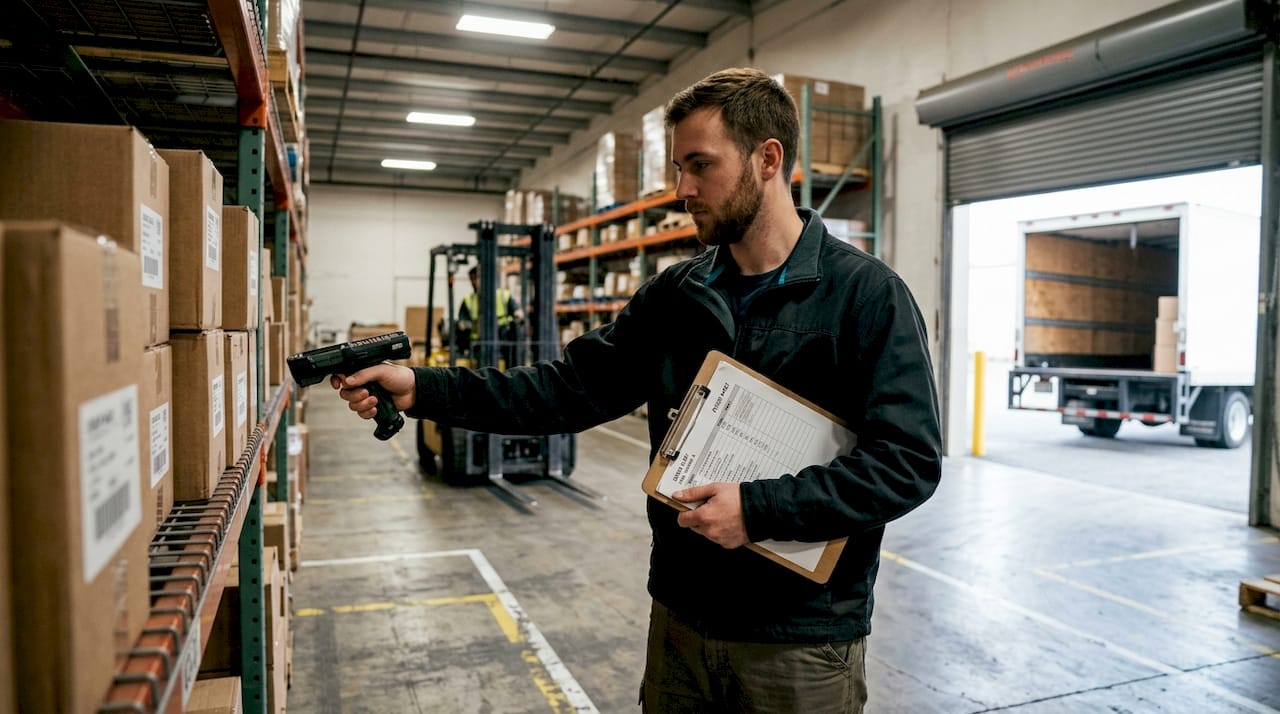
3PLs handle warehousing, transportation, and fulfillment for merchants scaling ecommerce operations, with the break-even point typically landing between 500 and 1,000 monthly orders. Beyond that threshold, the volume discounts and operational efficiencies they bring usually outweigh their fees.
Key advantages of working with a 3PL:
- Shipping cost savings of 15 to 40% through negotiated carrier rates
- No warehouse lease or staffing overhead on your balance sheet
- Faster delivery times through distributed fulfillment center networks
- Built-in returns management without building your own reverse logistics process
- Scalability during peak seasons without hiring temporary staff
“The best 3PL partnerships feel less like outsourcing and more like adding a logistics department without the overhead.”
Pro Tip: When evaluating 3PL providers for ecommerce, ask specifically about their integration with your ecommerce platform. Seamless data sync between your store and their warehouse management system eliminates manual errors and speeds up fulfillment. Also review their SLA (service level agreement) for order accuracy rates, which should be above 99%.
For a broader view of how 3PL fits into the bigger picture, understanding ecommerce logistics overview helps you see where the handoffs happen and what you’re still responsible for.
Fourth-party logistics (4PL): Full supply chain integration
If 3PL is about operational execution, 4PL is about strategic oversight. A fourth-party logistics provider manages your entire supply chain, including coordinating multiple 3PL partners, freight carriers, customs brokers, and technology systems. They don’t own warehouses or trucks. They own the strategy and the visibility.
4PL providers act as strategic integrators managing entire supply chains and overseeing 3PLs without owning assets. This model is built for complexity. Think global manufacturers sourcing from multiple countries, wholesalers managing dozens of supplier relationships, or brands with fulfillment operations across several continents.
What 4PL typically covers:
- End-to-end supply chain design and optimization
- Vendor and 3PL management across multiple regions
- Technology integration connecting all logistics data into one view
- Risk management and contingency planning across the network
- Performance reporting and continuous improvement programs
“4PL is not a service you buy. It’s a partnership you build when your supply chain has outgrown any single provider’s ability to manage it.”
For businesses exploring global logistics strategies, 4PL makes sense when the coordination cost of managing multiple providers manually exceeds the cost of a strategic integrator. It’s also worth reviewing end-to-end logistics options to understand how full-chain visibility changes your decision-making speed.
Specialized logistics services: Meeting niche needs
Not every product fits neatly into a standard fulfillment box. Some categories require specialized logistics services that go beyond warehousing and shipping. Choosing the wrong provider for these products doesn’t just create inefficiency. It can create compliance violations, product damage, or failed deliveries.
Specialized logistics types include ecommerce logistics (end-to-end for online retail), cold chain, hazardous materials, customs clearance, and dropshipping. Each serves a distinct need:
- Ecommerce logistics: Purpose-built for online sellers, covering order management, last-mile delivery, and returns through streamlined ecommerce logistics platforms
- Cold chain logistics: Temperature-controlled storage and transport for perishables, pharmaceuticals, or beauty products with strict shelf-life requirements
- Hazardous materials logistics: Compliance-heavy handling for batteries, chemicals, or flammable goods requiring certified carriers and documentation
- Customs clearance services: Essential for cross-border ecommerce, managing import duties, tariff classifications, and regulatory filings
- Dropshipping: The supplier ships directly to your customer, eliminating inventory risk but reducing your control over quality and delivery speed
Dropshipping minimizes upfront costs but can risk control and quality, making it a model that works best for testing new products or entering new markets without capital commitment.
Pro Tip: If you’re shipping internationally, customs clearance is not optional. Even small errors in tariff codes or missing documentation can hold shipments for days. Review shipping methods for ecommerce to understand how carrier selection affects customs processing times.
Comparing logistics services: Which is right for your business?
Here’s a side-by-side look at the four main logistics models to help you see the tradeoffs clearly:
| Model | Best for | Control level | Cost structure | Scalability |
|---|---|---|---|---|
| In-house | Startups, <500 orders/month | Very high | High fixed costs | Low |
| 3PL | Growing DTC brands, 500+ orders | Medium | Variable, per-unit | High |
| 4PL | Global manufacturers, wholesalers | Low (strategic) | Premium, management fee | Very high |
| Specialized | Niche products, cross-border | Varies | Varies by service | Moderate |
3PL providers deliver 15 to 40% shipping savings over in-house fulfillment at scale, which is a meaningful margin advantage for any ecommerce business operating above the break-even threshold. Meanwhile, 4PL is ideal for global manufacturers and wholesalers with complex supply chains who need a single point of accountability across multiple logistics partners.
The comparison table above is a starting point, not a final answer. Your product category, growth trajectory, and customer expectations all influence which model fits. Some businesses also benefit from exploring green logistics strategies as sustainability becomes a stronger factor in carrier and partner selection.
How to choose: Match your needs to the right service
Use this step-by-step process to match your business to the right logistics model:
- Calculate your monthly order volume. Under 500 orders points toward in-house. Over 500 points toward 3PL or hybrid.
- Identify your product requirements. Perishables, hazardous goods, or oversized items need specialized providers.
- Map your geographic footprint. Domestic only? Regional 3PL works. Cross-border? You need customs expertise or a 4PL.
- Assess your growth rate. If you’re doubling volume every quarter, build for scale now, not later.
- Evaluate your internal capacity. Do you have the staff and systems to manage logistics in-house, or is that time better spent on growth?
Here’s a quick scenario guide:
| Business scenario | Recommended model |
|---|---|
| New seller, <200 orders/month | In-house fulfillment |
| Growing DTC brand, 500 to 2,000 orders/month | 3PL provider |
| Mid-market, balancing control and scale | Hybrid in-house plus 3PL |
| Global manufacturer or wholesaler | 4PL integration |
| Niche product (cold, hazmat, cross-border) | Specialized logistics |
Hybrid in-house plus 3PL models support mid-market operations that need to balance control over certain SKUs with the scalability of outsourced fulfillment for high-velocity products. This is a practical middle ground that many growing ecommerce brands land on before fully transitioning to a 3PL.
The key takeaway: there’s no single best model. The right logistics service is the one that matches your current volume, supports your next stage of growth, and doesn’t create operational complexity you can’t manage.
Ready for reliable logistics? Explore trusted service options
Once you know which logistics model fits your business, the next step is finding providers you can actually trust. Choosing the wrong partner at this stage means starting the evaluation process all over again, often after a costly disruption.
At or-ner.com, we connect ecommerce merchants, wholesalers, and manufacturers with reliable courier services built for the demands of modern online retail. Whether you need to simplify freight booking for ecommerce or optimize your storage setup with proven warehousing best practices, our platform gives you the tools and network to move faster, cut costs, and scale with confidence. Explore our logistics resources and start building a supply chain that works as hard as your business does.
Frequently asked questions
What is the main difference between 3PL and 4PL logistics?
3PL handles operational tasks like warehousing and shipping, while 4PL acts as a strategic integrator overseeing the entire supply chain, including managing 3PL partners, without owning any physical assets.
When is it best to use in-house fulfillment?
In-house fulfillment suits small ecommerce businesses with fewer than 500 monthly orders that need high oversight over packaging, quality, and the customer experience.
What are the biggest advantages of using a 3PL?
3PLs typically reduce shipping costs by 15 to 40% and allow you to scale fulfillment capacity without adding warehouse space or staff to your own operation.
What logistics services are ideal for international ecommerce?
4PL providers or specialized logistics partners with customs clearance expertise are best for international ecommerce, as 4PL integrators manage complex cross-border supply chains and ecommerce logistics platforms handle end-to-end international fulfillment.
Is dropshipping a good logistics option for all ecommerce businesses?
Dropshipping minimizes upfront costs but introduces quality and delivery control risks, making it most suitable for new sellers testing products or niche businesses with limited capital for inventory.