
TL;DR:
- Choosing a logistics partner requires assessing business volume, destination, and technology needs.
- Key criteria include service breadth, technology integration, scalability, and customer references.
- Long-term success depends on proactive communication, regular reviews, and diversifying providers to mitigate risks.
Picking the wrong logistics partner can quietly drain your business. A retailer relying on a courier with poor tracking visibility, unreliable pickup schedules, and weak international coverage will face cascading problems: chargebacks, negative reviews, and customers who simply stop coming back. In an era when two-day delivery has become the baseline expectation, your fulfillment partner is not just a vendor but a direct extension of your brand. This guide walks you through a proven, step-by-step framework for selecting reliable courier services and logistics partners that actually support your growth instead of limiting it.
Table of Contents
- Assessing your business needs and supply chain requirements
- What to look for in a logistics partner: services, capabilities, and technology
- Evaluating and verifying potential partners: scorecards, references, and pilots
- Mitigating risks and ensuring long-term success: partnership strategies
- A realistic approach: what most guides miss about choosing a logistics partner
- Upgrade your logistics operations with proven partners
- Frequently asked questions
Key Takeaways
| Point | Details |
|---|---|
| Define your logistics needs | Identify your fulfillment goals, supply chain gaps, and key outcomes before contacting providers. |
| Evaluate expertise and technology | Choose partners with proven e-commerce experience and seamless tech integrations. |
| Use scorecards and pilots | Validate claims through scorecards, references, site visits, and real-world pilot programs. |
| Prioritize partnership readiness | Look for shared goals, transparent communication, and flexible contracts to ensure resilience. |
Assessing your business needs and supply chain requirements
Before you talk to a single provider, you need a clear picture of what your operation actually requires. Skipping this step is how companies end up overpaying for capabilities they do not need while lacking the ones that matter most.
Start with the fundamentals. Review your average monthly order volume, your most common shipment destinations (domestic, cross-border, or fully international), and your seasonality patterns. A business that ships 500 orders per month in Q1 but 5,000 in Q4 has radically different infrastructure needs than one with flat, predictable volume year-round. Document those peaks. They will shape every conversation you have with potential partners.
Next, clarify your primary business goals. Are you trying to reduce shipping costs, cut transit times, improve delivery accuracy, or expand into new markets? Each goal points toward a different type of provider. A company focused on domestic speed needs a partner with dense last-mile carrier networks. A company expanding internationally needs deep customs expertise and bonded warehousing.
As Inbound Logistics recommends, align internal requirements and define clear business outcomes before selecting a 3PL partner, including supply chain needs, value roadmap, and capability gaps. That means writing things down rather than relying on informal conversations. Spend time on supply chain optimization tips to sharpen your thinking before you start the provider search.
Here is a simple requirements matrix to build before your search:
| Requirement category | Questions to answer |
|---|---|
| Order volume | Monthly average, seasonal peaks, growth projections |
| Shipment destinations | Domestic, regional, international, specific countries |
| Product type | Dimensions, weight, fragility, hazmat classification |
| Tech stack | Current OMS, WMS, or ERP systems in use |
| Compliance needs | FDA, ISO, customs regulations, import restrictions |
| Timeline | Speed-to-market requirements, SLA expectations |
Key gaps to identify:
- Missing real-time tracking visibility
- No capability for cross-border customs handling
- Limited scalability during peak demand
- No returns management process
- Technology systems that cannot integrate with your store
Pro Tip: Ask your customer support team what the top three delivery complaints are right now. That list often reveals the most critical gaps your next logistics partner must address.
What to look for in a logistics partner: services, capabilities, and technology
With your requirements documented, you can evaluate providers objectively instead of being swayed by a polished sales deck.
Start with service breadth. A strong logistics partner for e-commerce should cover fulfillment, returns processing, freight forwarding, and last-mile delivery. If you sell internationally, customs clearance and bonded storage matter significantly. Verify whether the provider has genuine industry experience in your product category. A 3PL specializing in industrial parts may struggle with high-velocity consumer goods that require special packaging or rapid restocking cycles.
Technology is often the deciding factor. Your partner’s warehouse management system (WMS), transportation management system (TMS), and order management system (OMS) need to integrate cleanly with your existing platforms. If you sell on Shopify or Amazon, the provider must support those connections via API or EDI (Electronic Data Interchange, the automated system-to-system communication standard). Clunky or manual data transfers between your store and the warehouse are a guaranteed source of fulfillment errors.
As TLI Magazine outlines, key questions to ask include services offered, industry expertise, technology integration (WMS, TMS, OMS, API/EDI), scalability, and pricing transparency. These are not bonus considerations; they are table stakes.
Use the comparison below when reviewing providers side by side:
| Evaluation area | What to look for | Red flag |
|---|---|---|
| Fulfillment services | Picking, packing, kitting, returns | Limited or outsourced handling |
| Technology integration | API, EDI, WMS, OMS | Manual order entry only |
| Scalability | Flexible contracts, surge capacity | Rigid volume minimums |
| Pricing model | Transparent, itemized billing | Bundled or hidden fees |
| Compliance | ISO certification, FDA handling | No documented compliance |
Additional capability checkpoints:
- Real-time inventory visibility across all warehouse locations
- Exception management and proactive issue alerts
- Multi-carrier support for domestic and international routes
- Flexible logistics service types (ocean, air, ground)
- Experience with 3PL explained models relevant to your business
Pro Tip: Request a live demo of the provider’s tracking and reporting dashboard before signing anything. If their own team struggles to navigate it during the demo, your warehouse operations team will too.
Evaluating and verifying potential partners: scorecards, references, and pilots
Once you have a shortlist, the real evaluation begins. This is where most businesses make their biggest mistake: they rely on provider claims instead of verifiable evidence.
Build a scoring matrix and rate each candidate across dimensions that actually matter to your business. Score providers from 1 to 5 on each factor, then weight those scores based on priority.
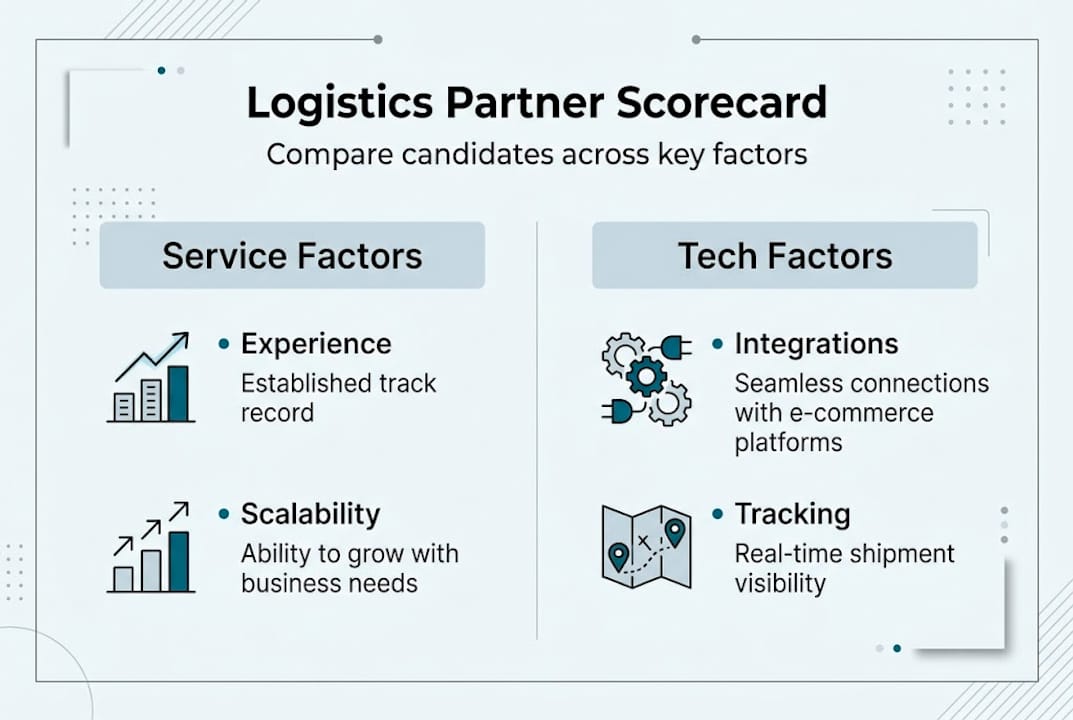
A practical scorecard looks like this:
| Evaluation factor | Weight | Provider A score | Provider B score |
|---|---|---|---|
| Industry experience | 25% | 4 | 3 |
| Technology integration | 25% | 5 | 4 |
| Scalability | 20% | 3 | 5 |
| Cost transparency | 15% | 4 | 3 |
| Customer references | 15% | 5 | 4 |
As Inbound Logistics advises, use a quantitative evaluation scorecard, request customer references, conduct site visits, and pilot programs before committing. That structured approach keeps emotion and sales pressure out of the decision.
A four-step verification process works well in practice:
- Request customer references. Ask specifically for clients in your industry and of a similar order volume. Speak to at least two. Ask them whether the provider met SLAs during peak season, how they handled errors, and whether they would sign again.
- Schedule a site visit. Walk the warehouse floor. Look at how inventory is organized, how picks are processed, and how returns are handled. A disorganized facility usually signals deeper operational problems.
- Review financial stability. Ask for basic indicators of financial health or check independent sources. A provider under financial stress may cut corners or fail to invest in the equipment your operation needs.
- Run a pilot program. Start with a defined test: a specific SKU range or a single shipping lane. Measure on-time delivery rate, order accuracy, damage rate, and responsiveness to issues.
“Pilot programs are not just a test of speed. They reveal how a provider communicates when something goes wrong, which is the truest measure of partnership quality.”
For more frameworks on ongoing relationship management, review logistics partner management strategies that align incentives over time.
Mitigating risks and ensuring long-term success: partnership strategies
Shortlisting a great provider is only the beginning. Sustaining a high-performing logistics relationship requires ongoing investment and smart risk management.

Supply Chain Brain notes that the most resilient logistics relationships are built on shared goals, clear communication, and regular performance reviews rather than transactional price negotiations. Treat your provider as an operational extension of your own team, not a commodity vendor.
Key practices for long-term partnership success:
- Schedule quarterly business reviews (QBRs) with your provider to assess performance, discuss challenges, and align on upcoming volume changes
- Establish dedicated account contacts and escalation paths before a crisis happens
- Define SLAs in writing: on-time delivery targets, order accuracy rates, returns processing windows, and issue response times
- Build joint problem-solving processes so both teams move quickly when errors occur
- Revisit contract terms annually to ensure the arrangement still reflects your current volume and service needs
One underappreciated risk is provider failure. As research on logistics risk highlights, risks include provider bankruptcy and strategic shifts, and the best mitigation strategies include using multiple 3PLs, running pilots before full commitment, conducting financial checks, and avoiding long lock-in periods.
“Diversification is not just a financial principle. Applied to logistics, it means never having a single provider handling 100% of your fulfillment volume.”
For tactical frameworks on protecting your supply chain, explore logistics risk mitigation strategies and the broader logistics partnership guide that covers both contractual and operational safeguards.
Pro Tip: Negotiate volume flexibility clauses into your contract from day one. These allow you to scale up or down by a defined percentage without penalty, which protects you during demand swings or market shifts.
A realistic approach: what most guides miss about choosing a logistics partner
Most selection guides focus heavily on scorecards and service checklists. Those tools are useful, but they miss something that consistently determines long-term success: cultural and communicative alignment.
We have seen businesses sign with technically superior providers, only to discover that the account management style was reactive, communication was slow, and priorities did not align during peak stress periods. Spreadsheets do not reveal whether a provider will call you at 9 PM on a Friday to flag a shipment delay before it becomes a customer service disaster. That kind of partnership takes trust, and trust is built before problems arise, not during them.
Fixating on price almost always backfires. The cheapest provider typically achieves that price point by reducing staff, skipping system upgrades, or operating thin margins that make financial instability more likely. What looks like savings on paper routinely turns into hidden costs through order errors, chargebacks, and customer churn.
Technology integrations also fail more often than providers admit. Even when APIs are compatible on paper, implementation requires coordination, testing, and troubleshooting. If a provider’s technical team is stretched or their platform is legacy-based, you will carry a disproportionate share of that burden. Read insights on courier partner selection to understand how compatibility goes deeper than specs.
The partners worth staying with long-term are the ones who communicate proactively, escalate transparently, and treat your growth as a shared win.
Upgrade your logistics operations with proven partners
Ready to move from research to results? The framework in this guide only works when applied to providers who are genuinely built for e-commerce scale.
At or-ner.com, we offer end-to-end logistics solutions designed for exactly this kind of decision. From freight booking for ecommerce to USA courier services that scale with your order volume, our platform connects you with reliable courier services backed by real-time tracking, customs expertise, and flexible fulfillment options. Whether you are expanding domestically or entering global markets, explore courier service tips and connect with a solution that grows alongside your business without the guesswork.
Frequently asked questions
What are the top criteria for choosing a logistics partner?
Industry experience, technology integration, scalability, cost transparency, and proven customer references matter most. A quantitative scorecard approach with site visits and pilots confirms those criteria in practice.
How can I evaluate a logistics partner’s technology capabilities?
Ask about WMS, TMS, OMS, API and EDI integrations, and whether the platform connects with Shopify or Amazon. Technology integration questions should be part of your first discovery call, not an afterthought.
What risks should I watch for when partnering with a logistics provider?
Provider bankruptcy, strategic pivots, and sudden service changes are the most serious risks. Multi-provider strategies with pilots and financial checks reduce your exposure significantly.
Should I work with more than one logistics partner?
Yes, splitting volume across multiple 3PLs increases resilience and reduces single-point-of-failure risk. Diversifying across providers also improves leverage in contract negotiations and maintains service continuity during disruptions.
Recommended
- Types of logistics services: smart choices for ecommerce – ORNER
- Why Partner With Logistics Providers: Complete Guide – ORNER
- How to choose a courier partner for ecommerce – ORNER
- How to Choose a Courier Partner for Ecommerce Success – ORNER
- Navigating the Seas with Confidence: Marine Insurance for Your Cargo – Diamondback Insurance – Solutions with Instant Online Quotes