

TL;DR:
- Dimensional thresholds now significantly impact shipping costs due to evolving carrier surcharge criteria. Accurate measurement, optimized packaging, and ongoing benchmarking are essential to prevent costly oversized shipment fees. Building automated systems and proactive processes ensure compliance and cost efficiency in managing oversized freight.
A single inch can cost you hundreds of dollars. That’s the reality logistics managers face when dimensional thresholds trigger oversize surcharges, and it catches more ecommerce operations off guard than most would admit. As carriers like UPS and FedEx refine their cubic volume criteria, surcharge exposure driven by dimensional measurements is now one of the fastest-growing cost pressures in fulfillment. This guide covers the strategies, benchmarks, and practical steps you need to manage oversized shipments without bleeding money on preventable fees.
Table of Contents
- Understanding oversized shipment thresholds and surcharges
- Dimensional reporting and compliance: avoiding costly errors
- Packaging strategies to minimize oversize risk
- Benchmarking freight and carrier performance
- Why most oversized shipment strategies fail: our hard-won lessons
- Streamline your oversized shipment operations with ORNER
- Frequently asked questions
Key Takeaways
| Point | Details |
|---|---|
| Dimensional accuracy matters | Small mistakes in measuring shipments can trigger costly surcharges and compliance issues. |
| Right-sizing avoids fees | Smart packaging strategies help keep shipments below carrier oversize thresholds and save money. |
| Benchmarking drives efficiency | Regularly comparing your freight data to industry standards reveals improvement opportunities. |
| Edge cases expose risk | Low-density bulky items and unloading complications are hidden threats to shipment efficiency. |
| ORNER solutions optimize logistics | Professional logistics platforms can streamline oversized shipment management for e-commerce brands. |
Understanding oversized shipment thresholds and surcharges
Knowing where the line is drawn matters more than ever, because carriers are no longer just measuring length and girth. The rules are more nuanced now, and the financial consequences of missing a threshold are significant.
Historically, carriers defined oversized shipments primarily by length or the combined length plus girth calculation. That’s changing fast. Oversize fee thresholds increasingly tied to cubic volume criteria mean that a box can look perfectly normal by weight standards yet still trigger a large package surcharge. For most major US carriers, the key thresholds to watch are a cubic volume exceeding 17,280 cubic inches or an actual weight above 110 pounds.
Here’s how the major carriers stack up:
| Carrier | Oversize trigger | Key surcharge type |
|---|---|---|
| UPS | Cubic volume > 17,280 cu. in. or weight > 110 lbs | Large Package Surcharge |
| FedEx | Same cubic volume threshold applies | Oversize Fee |
| USPS | Length + girth > 108 inches | Balloon Rate |
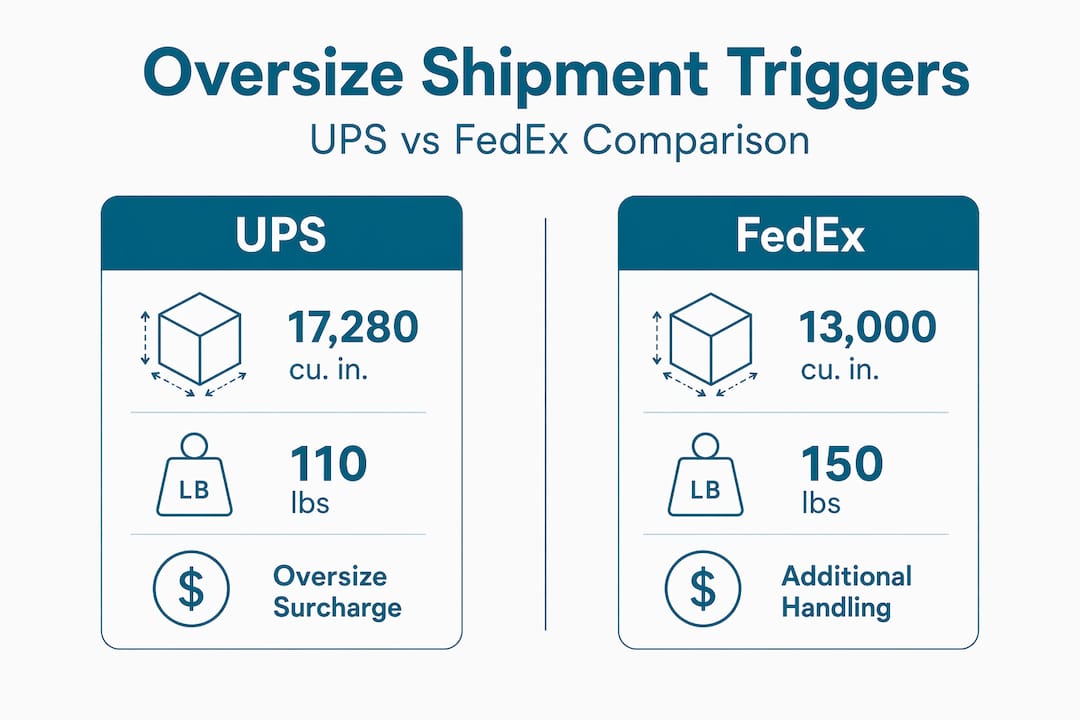
The differences matter in practice. USPS still leans heavily on the length plus girth formula, while UPS and FedEx have both expanded their definitions to capture bulky but lighter packages that used to slip through. That shift moves an order into or out of fee tiers based on a few centimeters of difference in box dimensions.
Common triggers for oversize fees include:
- Packaging that adds unnecessary bulk around a small product
- Low-density items shipped in manufacturer boxes rather than right-sized cartons
- Cubic volume miscalculations due to rounding errors in warehouse systems
- Mixed SKU shipments where a single oversized item upgrades the entire order’s rate
- Irregular shapes that are difficult to measure consistently across staff
Pro Tip: When you’re reviewing your SKU catalog, flag every product with a volume above 14,000 cubic inches as a “watch item.” That gives you a buffer zone before the 17,280 cubic inch threshold and time to make packaging adjustments before surcharges hit.
For practical guidance on shipping large items across different carrier options, understanding carrier-specific criteria upfront prevents surprises at billing time. The same logic applies when you’re handling shipping heavy items where weight and volume thresholds intersect.
“Carriers are continuously refining what counts as oversized. What didn’t trigger a surcharge two years ago might cost you $70 or more per package today. The only reliable defense is staying ahead of the rules, not catching up after the fact.”
Dimensional reporting and compliance: avoiding costly errors
With surcharge thresholds clarified, let’s tackle the practical dimension reporting pitfalls so you can avoid unnecessary fees. Reporting errors are not a minor inconvenience. They are a direct line to noncompliance fees, carrier re-rating, and damaged relationships with fulfillment partners.
Accurate L/W/H dimensions not captured in your system at the time of shipping can trigger noncompliance fees after the fact, sometimes weeks later when a carrier audits the shipment. The worst part is that by then, the product has been delivered, the customer is happy, and you’re stuck absorbing a charge you didn’t anticipate.
The edge cases are where most teams stumble. Consider a lightweight furniture item like a flat-pack shelf unit. It might weigh only 18 pounds but measure 60 by 24 by 8 inches, putting its cubic volume at 11,520 cubic inches. That’s within threshold, but add any extra void fill or a slightly larger carton and you’re in surcharge territory. Bulky but light products are a hidden trap because they look harmless on a weight-only view.
Here’s a reliable process for keeping dimension data accurate:
- Measure every SKU at intake, not at pack time. Waiting until a warehouse worker is packing an order introduces human error under time pressure.
- Store three separate dimension fields in your warehouse management system (WMS). Never rely on a single “size” field that combines measurements.
- Re-measure when packaging materials change. A new carton spec can push a product over the threshold even if the product itself hasn’t changed.
- Conduct spot audits on high-volume SKUs monthly. Pick 10 to 20 random units and compare recorded dimensions against physical measurements.
- Train warehouse staff on why accuracy matters financially. When people understand that a one-inch error costs the business real money, measurement discipline improves.
Pro Tip: Invest in a dimensioning system that integrates directly with your WMS or order management platform. These tools capture L/W/H data automatically at the time of scan, eliminating manual entry error and giving you an audit trail if a carrier disputes your reported dimensions.
Good packaging optimization starts with accurate data. You can’t right-size packaging you haven’t measured correctly first. Pairing dimensional accuracy with smart shipping cost optimization strategies gives you a two-layer defense against unnecessary fees.

Packaging strategies to minimize oversize risk
Avoiding dimensional reporting mistakes is only part of the solution. Next, let’s make packaging work for you so oversized risk is minimized from the start. The goal is to build a packaging program that keeps cubic volume under threshold by design, not by luck.
Because carrier thresholds tied to cubic volume are now standard practice, right-sizing your packaging is a financial strategy, not just an operational preference. A box that’s two inches too large in one dimension can add 480 cubic inches of unnecessary volume and push a package over the line.
The data tells the story clearly:
| Package scenario | Dimensions (in.) | Cubic volume (cu. in.) | Oversize fee triggered? |
|---|---|---|---|
| Standard carton | 30 × 20 × 12 | 7,200 | No |
| Slightly oversized carton | 36 × 24 × 20 | 17,280 | Threshold exactly |
| Poorly sized carton | 40 × 24 × 20 | 19,200 | Yes |
| Right-sized custom carton | 34 × 22 × 18 | 13,464 | No |
That last row is the goal. A custom carton that fits the product snugly, with minimal void fill, keeps you well below the 17,280 threshold and avoids the surcharge entirely.
Best practices for packaging oversized goods:
- Use on-demand box making equipment if your volume justifies the investment. These machines cut custom carton sizes per order, eliminating the compromise of using the “closest available” standard box.
- Evaluate void fill materials by density. Heavy foam adds actual weight. Air pillows add negligible weight but can increase cubic volume if used excessively.
- Review your top 50 SKUs by shipping cost and identify which ones are pushing near the threshold. These are your highest-priority candidates for packaging redesign.
- Work with your packaging supplier annually to benchmark available box sizes against your current SKU dimensions.
- For irregularly shaped products, consider molded pulp or custom foam inserts that cradle the item tightly and reduce the carton size needed.
Pro Tip: Audit your packaging specifications every time a major carrier announces fee schedule changes, which typically happens in late fall before January 1 effective dates. What was safely under threshold last year may not be this year, and catching the issue in November beats catching it in February after a month of overcharge exposure.
Connecting packaging for ecommerce decisions to live carrier rate data lets you model the cost impact of each packaging change before you commit. When packaging changes are tied directly to shipping cost optimization outcomes, leadership sees the ROI and approves upgrades faster.
Benchmarking freight and carrier performance
Once packaging practices are optimized, it’s time to ensure your overall freight operations are competitive and cost-efficient by leveraging benchmarking. Benchmarking is not a one-time exercise. It’s an ongoing operational discipline that separates high-performing logistics teams from those constantly reacting to cost surprises.
Freight benchmarking as a continuous process compares your rates, carrier performance, and operational efficiency against industry peers using normalized metrics. The key performance indicators (KPIs) most useful for oversized shipment management include cost per mile, cost per ton, surcharge rate as a percentage of total freight spend, and transit time accuracy.
Setting up a benchmarking process takes deliberate effort, but the structure is straightforward:
- Collect 12 months of internal shipment data. Pull every shipment, carrier, rate, surcharge, and transit time into a centralized view.
- Normalize the data. Convert all weights to pounds and all dimensions to cubic inches so comparisons are apples to apples.
- Identify your top 5 carrier lanes by volume and spend. These are your highest-leverage areas for negotiation and optimization.
- Compare your rates against published market benchmarks. Industry freight audit services publish quarterly rate benchmarks that let you see where you stand relative to the market.
- Set improvement targets and review quarterly. A 5% reduction in surcharge spend per quarter is achievable once you have visibility into where the leakage occurs.
Metrics worth monitoring every month include:
- Total oversize surcharge spend as a dollar amount and as a percentage of freight spend
- Number of shipments re-rated by carrier after pickup
- Average dimensional weight versus actual weight ratio by SKU
- On-time delivery rate by carrier and lane
- Claims rate for damaged oversized shipments
The cost-per-mile and cost-per-ton metrics are particularly powerful because they normalize across different shipment sizes and distances. A carrier that looks competitive on a per-shipment basis might be significantly more expensive on a normalized basis when you account for oversized surcharges layered on top.
Check out our freight shipping tips for practical guidance on rate negotiation and carrier selection. For a broader view of how different providers compare, our freight forwarding comparison resource offers structured evaluation criteria you can apply directly to your current carrier mix.
Why most oversized shipment strategies fail: our hard-won lessons
Strategies look great on paper. Where they break down is in the gap between a well-documented process and the reality of a warehouse operating at full speed during peak season.
The most common failure point we see is dimensional data that was accurate when originally captured but was never updated after packaging changes. A product gets a new box from a supplier. Someone updates the product record but forgets to update the shipping system. Three months later, the carrier is re-rating 200 shipments per week and your freight bill looks like a different company’s.
Dimensional reporting errors triggering noncompliance fees or re-rating, and low-density bulky items priced by dimensional weight, are edge cases that break most strategies because they fall outside the standard workflow. They require someone to notice an exception and act on it. Without a system that flags these proactively, they get missed.
Bulky, low-density items deserve special attention because they’re deceptive. A large decorative item that weighs 8 pounds looks cheap to ship until the dimensional weight calculation prices it as a 45-pound package. These items need their own shipping policy, not the default workflow.
Carrier refusal at delivery is another underappreciated operational challenge. Some oversized deliveries require liftgate service, inside delivery, or specialized equipment. When those services aren’t pre-arranged, carriers refuse to complete delivery, the shipment bounces back, and the customer experience deteriorates along with your cost per order.
Our recommendation is to over-invest in dimensional accuracy and scenario planning. Run quarterly “what if” scenarios where you model the cost impact of threshold changes on your current SKU mix. Review your reducing shipping costs playbook regularly against actual freight bills. And build managing logistics partners processes that include regular dimensional compliance reviews with your carriers. The teams that win on oversized shipment management don’t just react well; they build systems that prevent the problem from reaching the billing stage.
Streamline your oversized shipment operations with ORNER
Managing oversized shipments well requires more than a checklist. It requires real-time data, automated workflows, and carrier connections that give you flexibility when a shipment is on the edge of a threshold.

ORNER’s global logistics platform connects ecommerce operations to a network of carriers, warehouses, and fulfillment centers designed to handle oversized goods efficiently. Our reliable courier services in the US include dimensional weight monitoring, carrier rate comparison, and real-time tracking across shipment types. For operations looking to reduce surcharge exposure at scale, our cloud logistics savings tools provide the automation and visibility that manual processes simply can’t match. Let ORNER handle the complexity so you can focus on growing your catalog and serving your customers.
Frequently asked questions
What qualifies a shipment as oversized for major US carriers?
Oversize applies when cubic volume exceeds 17,280 cubic inches or actual weight exceeds 110 pounds for carriers like UPS and FedEx, though USPS still uses a length plus girth formula as its primary trigger.
How can I prevent dimensional reporting errors?
Using automated dimension recording tools integrated with your WMS, combined with regular spot audits, prevents most reporting mistakes. Accurate L/W/H dimensions captured at intake rather than at pack time are the single most effective control.
Are bulky, lightweight items at risk for oversize fees?
Yes. Low-density bulky items priced by dimensional weight often incur surcharges that far exceed what their actual weight would suggest, making right-sized packaging and accurate reporting critical for these SKUs.
What metrics should I use for benchmarking shipment performance?
The most actionable benchmarking KPIs include cost per mile, cost per ton, and transit time accuracy, compared against industry standards on a quarterly basis to identify cost reduction opportunities.