TL;DR:
- Staying updated in logistics now requires real-time data ingestion and automated workflows to prevent disruptions. Continuous intelligence platforms unify data and provide predictive insights, enabling proactive responses that outperform traditional periodic reviews. Organizational change and predefined decision protocols are essential for effective use of these advanced systems.
Staying updated in logistics is defined as the continuous ingestion of operational signals, real-time data, and industry intelligence to adjust workflows before disruptions become failures. This is no longer a matter of reading a weekly report or attending a quarterly review. In 2026, the planning and execution silos are collapsing into a single adaptive operating model. Platforms like Penske Logistics’ Supply Chain Insight and predictive ETA tools are setting the new standard for what it means to keep up in logistics. If you are still treating logistics updates as a periodic task, you are already behind.
Staying updated in logistics: what has changed in 2026
The phrase “staying updated” used to mean subscribing to logistics industry news, attending trade shows, and reviewing monthly KPI reports. That model is obsolete. In 2026, continuous intelligence replaces periodic planning as the operating standard for high-performing supply chains. The shift is structural, not cosmetic.
What continuous intelligence actually means is this: your systems ingest signals from transportation, warehousing, suppliers, and carriers in real time, then surface the decisions that need to happen next. It is not about having more data. It is about compressing the time between an event occurring and a coordinated response happening across your network.
The practical result is that the old separation between planning teams, execution teams, and analytics teams no longer holds. A delay flagged at a port in Rotterdam does not wait for a weekly operations call. It triggers an automated rescheduling workflow, updates the customer-facing ETA, and alerts the warehouse team to adjust inbound dock capacity. That is the difference between visibility and intelligence.
“Visibility answers ‘what is happening.’ Continuous intelligence answers ‘what matters and what should happen next.’”
For logistics professionals focused on improving logistics knowledge, this distinction is the most important concept to internalize right now. The tools have matured. The question is whether your team’s operating model has kept pace.
Key capabilities that define a continuous intelligence operating model:
- Real-time ingestion of carrier, warehouse, and supplier signals into a single data layer
- Automated exception detection with prioritized alerts ranked by operational impact
- Cross-functional workflow triggers that connect transportation delays to warehouse and fulfillment responses
- Decision cadence governance, meaning defined response protocols for each exception type
- Predictive analytics in logistics that convert raw signals into forward-looking recommendations
How unified data dashboards change the way you work
The most visible expression of continuous intelligence is the control tower dashboard. Penske Logistics’ Supply Chain Insight platform is the clearest current example. It unifies transportation, warehousing, and third-party data into a single interface with more than 85 customizable metrics, AI-powered decision support, and real-time performance visibility across the entire supply chain.

The operational impact is significant. Before platforms like this existed, logistics managers spent a meaningful portion of their day chasing updates: calling carriers, pulling reports from separate warehouse management systems, and manually reconciling data before any actual decision could be made. A unified data layer eliminates that friction. Teams shift from data hunting to performance management.
What makes these platforms genuinely useful rather than just visually impressive is the pre-built metric library. When evaluating any logistics data analytics platform, the right question is not “how many charts does it show?” The right question is “does it come with pre-built metrics tied to the decisions I actually make?” Penske’s platform answers yes, with metrics spanning carrier performance, inventory turns, fulfillment accuracy, and exception frequency.
The AI component matters here too. Raw dashboards show you what happened. AI-assisted dashboards tell you what to do about it. That distinction separates performance intelligence from mere visualization, and it is the standard logistics professionals should hold all new tools to.
Pro Tip: When selecting a control tower platform, prioritize solutions with connected data layers and pre-built metric libraries over those requiring heavy custom configuration. Custom builds delay time-to-value by months and often produce dashboards that teams abandon within a year.
For a practical look at how supply chain metrics translate into daily operational decisions, the distinction between leading and lagging indicators is the place to start.
What is the difference between static and predictive ETAs?
ETA accuracy is the single most underrated KPI in logistics. Most teams track OTIF (on-time in full) as their primary delivery performance metric. OTIF is a lagging indicator. It tells you what already went wrong. Predictive ETA accuracy is a leading indicator. It tells you what is about to go wrong, with enough time to do something about it.
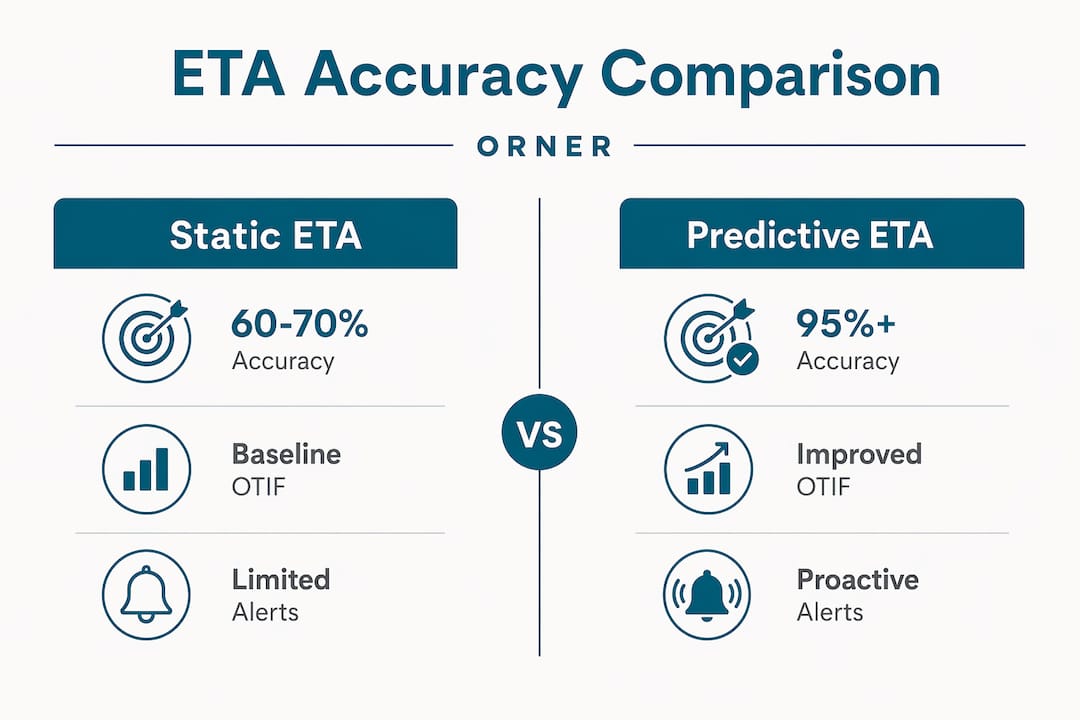
The performance gap between the two approaches is measurable. Static ETAs average 60 to 70% accuracy, meaning roughly one in three shipments arrives at a time materially different from the original estimate. That gap creates downstream chaos: missed dock appointments, idle warehouse labor, and customer service failures. Predictive ETAs, by contrast, achieve 95%+ accuracy in European road freight and improve OTIF scores by 5 to 10 percentage points. That improvement is not incremental. It is the difference between a reactive operation and a resilient one.
| Metric | Static ETA | Predictive ETA |
|---|---|---|
| Accuracy rate | 60–70% | 95%+ |
| OTIF impact | Baseline | +5 to 10 percentage points |
| Exception lead time | At failure | 30–60 minutes before failure |
| Dock conflict rate | 15–25% | Under 5% |
| Yard dwell time | ~75 minutes | Under 30 minutes |
The exception management piece is where predictive ETAs pay off most directly. Early alerts enable rescheduling and customer communication 30 to 60 minutes before a failure occurs. That window is enough to reassign dock slots, notify downstream teams, and update customer-facing delivery estimates before anyone experiences a problem. Without predictive ETAs, that same window is spent reacting after the fact.
Managing leading KPIs like ETA accuracy proactively, rather than waiting for OTIF to reflect past failures, is the operating practice that separates high-performing logistics teams from average ones. The data supports this clearly.
Pro Tip: Build a KPI operating model that monitors ETA accuracy daily as a leading indicator, then reviews OTIF weekly as the outcome metric. When ETA accuracy drops, investigate the root cause before it shows up in your OTIF score.
Practical strategies for how to keep up in logistics
Knowing that continuous intelligence is the new standard is one thing. Building the habits and systems to operate within it is another. The hardest part of staying current is closing the loop from event detection to operational action, which requires integrated workflows across transportation, warehousing, and fulfillment. Here is how logistics professionals can build that capability practically.
-
Audit your current data sources. Map every system that generates operational signals: your TMS, WMS, carrier portals, and supplier feeds. Identify where data is siloed and where manual handoffs create delays. This audit reveals your biggest intelligence gaps before you invest in new tools.
-
Adopt a control tower platform with pre-built metrics. Do not build a custom dashboard from scratch. Platforms with connected data layers and pre-built metric libraries deliver faster time-to-value and reduce the risk of building a dashboard your team ignores.
-
Follow logistics industry news through structured channels. Subscribe to publications like Supply Chain Dive, FreightWaves, and the Journal of Commerce. Set Google Alerts for topics like “predictive ETA,” “OTIF benchmarks,” and “supply chain AI.” Structured news consumption keeps you current on the latest logistics trends without creating information overload.
-
Invest in training on AI and real-time analytics. Platforms are only as useful as the people operating them. Coursera, MIT OpenCourseWare, and APICS all offer supply chain analytics training that builds the skills needed to extract value from continuous intelligence tools.
-
Participate in logistics communities and peer networks. Groups like the Council of Supply Chain Management Professionals (CSCMP) and LinkedIn communities around supply chain management provide peer benchmarking, early access to logistics updates resources, and direct exposure to how other teams are solving the same problems you face.
-
Review exception reports before KPI dashboards. Start each day with your exception queue, not your summary metrics. Exceptions represent the decisions that need to happen now. Summary metrics represent what already happened. Reversing this habit is one of the fastest ways to shift from reactive to proactive operations.
-
Benchmark against supply chain management tips from high-performing peers. Benchmarking is not just about knowing where you stand. It is about identifying the specific practices that explain the gap between your performance and the top quartile.
Key takeaways
Staying updated in logistics requires continuous intelligence systems, predictive KPI governance, and structured habits that convert operational signals into coordinated responses before disruptions escalate.
| Point | Details |
|---|---|
| Continuous intelligence is the new standard | Replace periodic planning cycles with real-time signal ingestion and adaptive workflow triggers. |
| Unified dashboards shift teams from reactive to proactive | Platforms with 85+ pre-built metrics eliminate data hunting and enable performance management. |
| Predictive ETAs outperform static ETAs by a wide margin | Predictive models achieve 95%+ accuracy versus 60 to 70% for static ETAs, improving OTIF by 5 to 10 points. |
| Leading indicators beat lagging ones | Monitor ETA accuracy daily to intervene before OTIF scores reflect failures. |
| Closing the detection-to-action loop is the hardest part | Integrated workflows across transportation, warehousing, and fulfillment are what make intelligence operational. |
The uncomfortable truth about staying current in logistics
I have worked with logistics teams that had genuinely impressive dashboards. Beautiful interfaces, real-time data, color-coded exception queues. And they were still operating reactively. The data was there. The decisions were not.
The cultural shift required for continuous intelligence is harder than the technology adoption. Most logistics teams are organized around functions: transportation does transportation, warehousing does warehousing. Continuous intelligence requires those functions to respond to the same signal at the same time. That means breaking down the organizational habits that reward functional optimization over network coordination.
The teams I have seen do this well share one trait: they defined their decision protocols before they deployed their platforms. They answered questions like “when ETA accuracy drops below 80%, who does what, and within what time window?” before the platform went live. That preparation is what separates teams that use dashboards for reporting from teams that use them for operations.
My honest advice: do not evaluate logistics updates resources by how much data they surface. Evaluate them by how clearly they tell you what to do next. Logistics networks that shift toward coordinated network responses outperform competitors not because they have better forecasts, but because they respond faster and with less organizational friction. That is the capability worth building.
— Maayan
Real-time logistics support that keeps your operations moving
Continuous intelligence only delivers value when your fulfillment and courier operations can actually execute on the signals your systems surface. Or-ner is built for exactly that. The platform gives ecommerce sellers and logistics professionals real-time shipment tracking, exception management, and cross-border fulfillment visibility across ocean, air, and land transport modes.
Whether you are managing high-volume domestic orders or coordinating international freight, Or-ner’s reliable courier services integrate directly with the operational workflows that continuous intelligence demands. The platform supports Amazon fulfillment, customs clearance, and warehouse coordination, giving you the execution layer that turns real-time data into real-world delivery performance. Explore Or-ner’s freight and fulfillment solutions to put your logistics intelligence to work.
FAQ
What does staying updated in logistics actually mean?
Staying updated in logistics means continuously monitoring operational signals, carrier performance, and industry trends to adjust workflows in real time rather than through periodic reviews. In 2026, this is defined by continuous intelligence platforms rather than weekly reports.
How do predictive ETAs improve OTIF performance?
Predictive ETAs achieve 95%+ accuracy compared to 60 to 70% for static ETAs, improving OTIF scores by 5 to 10 percentage points by enabling exception alerts 30 to 60 minutes before a delivery failure occurs.
What is the best way to follow the latest logistics trends?
Subscribe to publications like Supply Chain Dive and FreightWaves, join CSCMP networks, and set structured alerts for topics like supply chain AI and OTIF benchmarks to stay current on logistics industry news without information overload.
How do unified dashboards help logistics teams stay current?
Platforms like Penske Logistics’ Supply Chain Insight consolidate transportation, warehousing, and partner data into a single interface with 85+ customizable metrics, shifting teams from manual data collection to real-time performance management.
What is the difference between visibility and continuous intelligence?
Visibility tells you what is currently happening in your supply chain. Continuous intelligence tells you what matters most and what operational response should happen next, making it a decision-support system rather than a reporting tool.