TL;DR:
- International ecommerce shipping can incur high costs, delays, and complex customs issues that affect customer satisfaction and margins. Implementing regional micro-hubs, automating customs documentation, and adopting DDP terms can significantly improve speed and reduce expenses. Ongoing performance monitoring and strategic infrastructure investments are essential for sustainable cross-border growth and customer retention.
Shipping internationally should open new revenue channels, but for most ecommerce businesses, it opens new headaches instead. Unexpected customs holds, sky-high delivery costs, and customers who never received a clear delivery timeline all chip away at your margins and your reputation. Fixing these problems is not just a logistics exercise; it’s a direct investment in customer retention and global scale. This guide walks you through the exact infrastructure decisions, delivery strategies, and monitoring practices that reliably cut costs and speed up international orders.
Table of Contents
- Understand the key challenges in cross-border shipping
- Set up the right infrastructure: Warehousing and fulfillment models
- Optimize shipping methods and delivery strategies
- Monitor performance and avoid common cross-border pitfalls
- What most guides overlook about cross-border shipping optimization
- Streamline your cross-border shipping with expert support
- Frequently asked questions
Key Takeaways
| Point | Details |
|---|---|
| Switch to micro-hubs | Distributed warehousing can cut delivery time and costs dramatically once order volume justifies investment. |
| Prefer DDP shipping | Handling duties up-front with Delivered Duty Paid models removes friction and boosts conversions. |
| Leverage automation | AI-powered route planning and real-time tracking minimize customs delays and reduce manual errors. |
| Monitor and adapt | Ongoing performance tracking helps you spot issues early and continuously improve your shipping process. |
Understand the key challenges in cross-border shipping
Before diving into solutions, it’s vital to outline the root challenges ecommerce firms face when shipping internationally. Most sellers underestimate how different cross-border shipping is from domestic fulfillment. Domestically, you’re routing packages through a familiar network. Internationally, you’re navigating multiple carriers, foreign customs agencies, varying regulations, and final-mile providers that may have wildly different service standards.
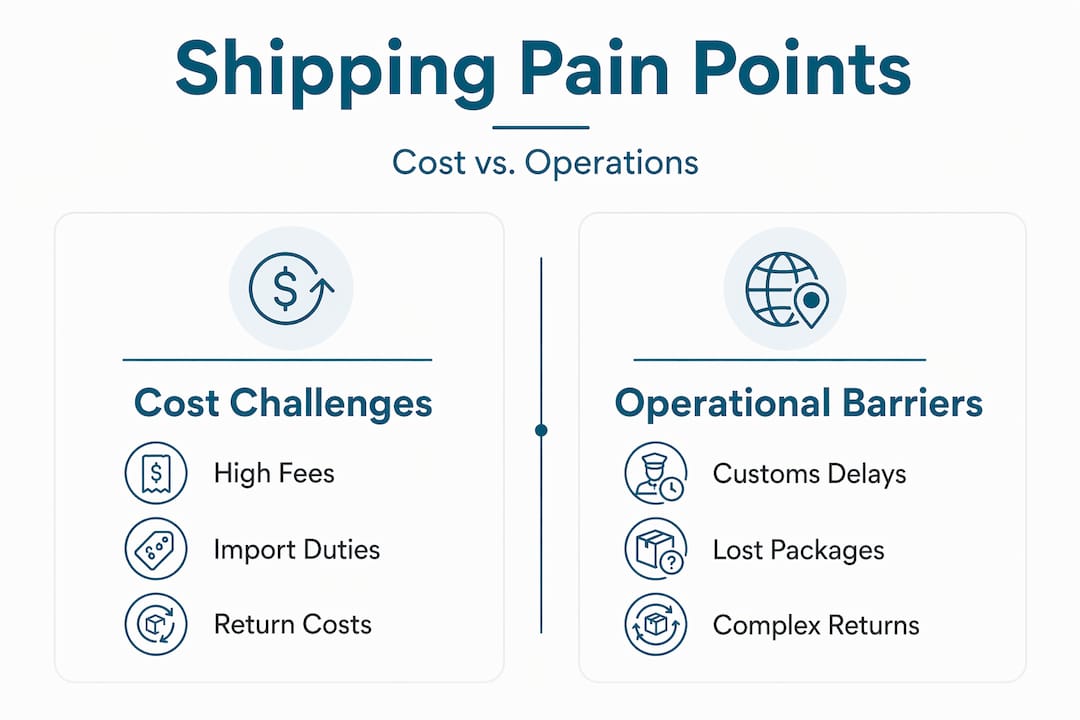
High delivery costs sit at the top of the list. International freight, import duties, brokerage fees, and insurance can easily push shipping costs 3x to 5x above domestic rates. Long transit times follow closely behind. Even a well-planned shipment can sit at a border for days due to documentation errors or regulatory reviews.
Returns make everything harder. Cross-border returns are 1.5x to 2x costlier than domestic returns because packages must clear customs twice, and last-mile logistics in a foreign country require specialized expertise. A business that ignores return infrastructure planning early will pay for it in chargebacks, negative reviews, and lost customer lifetime value.
Understanding the cross-border delivery challenges you’re likely to face is the foundation of any smart optimization plan.
Here’s a quick summary of the top operational pain points every international seller should address:
- Customs complexity: Incorrect HS codes and missing documentation cause costly delays and fines
- Carrier fragmentation: No single carrier covers every market well, forcing you to manage multiple relationships
- Duties and taxes uncertainty: Buyers who receive unexpected duty invoices at delivery often refuse packages
- Last-mile inconsistency: Delivery standards vary dramatically between countries
- Returns cost and complexity: Processing a cross-border return can cost more than the original order value
- Currency and compliance risk: Exchange rates and local regulations add unpredictable costs
“Cross-border returns can cost 1.5 to 2 times more than domestic returns, and managing last-mile delivery and customs across borders requires specialized expertise most in-house teams simply don’t have.”
Mapping these pain points before you build or redesign your system ensures you’re solving real problems rather than adding infrastructure for its own sake.
Set up the right infrastructure: Warehousing and fulfillment models
With challenges identified, the next step is designing an infrastructure that unlocks efficiency at scale. The warehousing and fulfillment model you choose will determine your cost baseline, your speed capability, and how much operational complexity you absorb.
Many sellers start with direct international shipping, which means every order ships from your home country. It’s simple and requires minimal setup, but it doesn’t scale. Transit times are long, shipping costs are high, and customs clearance happens order by order rather than in bulk. For low-volume sellers testing a new market, it works. For anyone serious about growth, it becomes a ceiling.
Once you cross roughly 200 or more monthly orders in a given international region, the economics of regional micro-hubs begin to make compelling sense. Regional micro-hubs and distributed warehousing reduce delivery times by 60% and costs by 71% once order volume justifies the setup. That’s not a marginal improvement; it’s a complete transformation of your cost structure.
A hybrid model, combining local warehousing in key markets with cross-border shipping for lower-volume destinations, offers the maximum flexibility for growing brands. You get speed where it counts most and cost control where volume doesn’t yet justify full local infrastructure.
The numbers back this up: distributed inventory cuts shipping times by 71%, and 52% of brands are actively targeting 2 to 3 day delivery for direct-to-consumer orders.
Comparison: Fulfillment model options
| Model | Cost | Speed | Control | Complexity |
|---|---|---|---|---|
| Direct cross-border shipping | Low setup, high per-order | Slow (7-21 days) | High | Low |
| Regional micro-hub | Medium setup, low per-order | Fast (2-5 days) | Medium | Medium |
| Fully distributed warehousing | High setup, lowest per-order | Fastest (1-3 days) | Medium | High |
| Hybrid model | Moderate setup, flexible | Varies by market | High | Medium-High |
Key considerations for each model:
- Direct shipping works for testing new markets or selling high-value, low-frequency items
- Regional micro-hubs suit brands shipping 200 or more monthly orders into a specific region
- Fully distributed warehousing fits mature brands with established regional demand and predictable SKU velocity
- Hybrid models give fast-growing brands the ability to operate efficiently during uneven market expansion
Pro Tip: Start by identifying your top 3 international markets by order volume. If any of them exceed 200 monthly orders consistently, that region is a prime candidate for a micro-hub investment. The payback period is often under 6 months.
When thinking about transport modes, multimodal shipping (combining air, sea, rail, and road based on urgency and cost) lets you route shipments intelligently. Urgent, high-margin products move by air. Bulk replenishment inventory travels by sea. AI-driven tools are increasingly used to select the optimal routing combination in real time, further reducing cost without sacrificing speed.
For an in-depth breakdown of building your fulfillment structure from scratch, the cross-border shipping guide covers each model in detail.
Optimize shipping methods and delivery strategies
Solid infrastructure is just the starting point. Fine-tuned delivery strategies lock in efficiency and keep customers happy from checkout to doorstep. The biggest lever most ecommerce sellers haven’t fully pulled is the choice between Delivered Duty Paid (DDP), Delivered Duty Unpaid (DDU), and Delivered at Place (DAP) shipping terms.
Comparison: International shipping terms
| Term | Who pays duties | Customer experience | Conversion impact | Best for |
|---|---|---|---|---|
| DDP | Seller (paid at checkout) | Smooth, no surprises | Highest | Scaling brands, B2C |
| DDU | Buyer (paid on delivery) | Friction, possible refusal | Lower | Low-volume testing |
| DAP | Buyer (paid on delivery) | Similar to DDU | Lower | B2B, certain markets |
DDP shipping improves conversion and satisfaction because customers know exactly what they’ll pay at checkout. There are no surprise duty invoices when the package arrives, which is one of the leading causes of package abandonment and negative reviews.
When DDP is combined with AI route optimization, the results are striking. AI automation cleared 85% of customs documents automatically in one documented case, and compressed order creation time from 15 to 20 minutes down to just 2 minutes. That kind of throughput improvement changes the entire economics of your operations team.
Steps to optimize your shipping method and delivery performance:
- Audit your current shipping terms. If you’re using DDU or DAP in B2C markets, calculate how many packages are being refused or returned and what that’s costing you annually.
- Switch high-volume B2C markets to DDP. Calculate landed cost at checkout using automated duty estimation tools. This adds transparency and significantly reduces return rates.
- Automate customs documentation. Use a platform that generates and submits customs paperwork automatically. Manual documentation is the single biggest source of delay and error.
- Integrate real-time tracking. Customers who can track their package internationally have lower support ticket rates and higher satisfaction scores.
- Evaluate 3PL partnerships for expertise and scale. Third-party logistics providers bring carrier relationships and volume discounts that most sellers can’t access independently.
The best cross-border shipping tools help automate these steps without requiring your team to become customs experts overnight.
Working with a 3PL partner gives you access to capabilities that take years to build in-house. Top 3PL platforms access 550+ couriers with substantial discounts, giving you flexibility to match the right carrier to each destination market. They also handle the expertise-intensive work of cross-border returns, which are 1.5x to 2x more expensive than domestic and require coordination across carriers, customs, and local facilities.
Pro Tip: DDP combined with AI-powered routing is the highest-leverage combination for most growing ecommerce brands. If you’re only going to make one operational change this quarter, switching your major markets from DDU to DDP will likely deliver the fastest return on effort.
The cross-border logistics checklist is a useful reference when setting up or auditing your delivery strategy across multiple markets.
Monitor performance and avoid common cross-border pitfalls
Once a shipping system is running, ongoing measurement and course-correction are the keys to sustained results. The difference between brands that successfully scale internationally and those that stall is almost always a measurement discipline, not the initial setup quality.
Track these metrics consistently:
- Average delivery time by market: Compare against your stated shipping windows and benchmark against regional standards
- Customs delay frequency: Track how often shipments are held and why, then feed this back into your documentation process
- Return rates and return cost per unit: Measure by market to identify where you need local returns infrastructure
- Order success rate: Packages that were delivered successfully versus refused, returned, or lost
- Customer satisfaction scores tied to shipping: Post-delivery surveys focused on speed, communication, and ease of returns
AI automation makes monitoring far less painful than it sounds. AI route optimization reduces order processing time from 15 to 20 minutes to under 2 minutes while auto-clearing 85% of customs documentation. When your systems handle the routine work automatically, your team can focus on exceptions and strategic improvements.
Top cross-border pitfalls and how to avoid them:
- Underestimating customs complexity. Every country has its own import rules, restricted product lists, and documentation requirements. Use a platform with built-in compliance tools and don’t rely on a single carrier’s advice.
- Poor return planning from the start. Returns infrastructure cannot be bolted on after the fact. Design your return flow before you launch in a new market, even if volume is initially low.
- Ignoring last-mile differences. Last-mile delivery in Germany operates very differently from last-mile in Brazil or Southeast Asia. Partner with providers who have local expertise rather than assuming your primary carrier handles the final leg well everywhere.
- Setting and forgetting. Regulatory environments change, consumer expectations shift, and carrier performance varies seasonally. Brands that don’t review their cross-border performance quarterly fall behind.
- Overloading your team with manual processes. Manual customs paperwork, manual tracking updates, and manual carrier selection all create bottlenecks that grow faster than your team can scale.
“Optimization is not a one-time project. It’s an ongoing practice that requires regular review, because regulations change, consumer expectations evolve, and what worked last year may actively cost you money this year.”
To boost global growth and efficiency, treat your shipping performance data as a strategic asset. Review it quarterly, share findings across your operations and customer experience teams, and use it to drive continuous improvement.
Pro Tip: Set a calendar reminder every 90 days to review your top three international markets on all five of the metrics listed above. Small performance shifts compound quickly, and early detection means you solve problems before they become customer complaints.
What most guides overlook about cross-border shipping optimization
Most optimization guides focus on tools and frameworks. They tell you to adopt DDP, use AI routing, and build regional hubs. That’s all correct. But there’s a layer of practical wisdom that only comes from watching businesses actually execute these strategies, and it rarely makes it into the standard playbook.
The most common mistake we see is waiting too long to invest in regional infrastructure. Businesses consistently underestimate how much margin they’re burning on direct international shipping after they’ve passed the inflection point where micro-hubs make financial sense. Every month of delay at 300 or more orders per region in that direct-shipping model represents real money left on the table, and real customer goodwill eroded by slower transit times. The data threshold is clear; the decision to act on it is where companies hesitate.
Returns are the second blind spot. Most brands think about returns as a cost center to minimize, rather than a fulfillment capability to build. When a customer in France has a terrible returns experience with a brand based in the United States, that customer doesn’t just return the product. They don’t buy again, and they often share the experience. Building local returns handling from day one, even at low volumes through a 3PL, turns a potential liability into a competitive advantage.
The third reality is one that makes some founders uncomfortable: optimization is never finished. Customs regulations in key markets change. Carrier performance degrades and then recovers. Consumer expectations for delivery speed increase year over year. The brands that win at international ecommerce over a 3 to 5 year horizon are those that build a quarterly review practice and treat logistics performance as a core KPI, not an operational footnote.
Maximizing cross-border shipping benefits requires treating your logistics strategy with the same rigor you’d apply to your marketing or product strategy. It deserves regular investment, clear ownership, and a genuine feedback loop.
Streamline your cross-border shipping with expert support
Optimization is ongoing, and even well-resourced logistics teams benefit from a platform that handles the complexity automatically. If you’re ready to take your international shipping to the next level, reliable courier services and intelligent automation should be your foundation.
ORNER’s global logistics platform gives ecommerce sellers and logistics managers access to end-to-end cross-border solutions, including real-time tracking, automated customs clearance, global warehouse networks, and carrier optimization across ocean, air, and land routes. Whether you’re scaling into new markets or tightening up an existing international operation, ORNER provides the infrastructure and expert support to make it work. Explore the cross-border logistics efficiency tools available on the platform, or start with the cross-border logistics checklist to identify exactly where your operation needs attention.
Frequently asked questions
At what shipping volume should I switch to regional micro-hubs?
Once you consistently reach 200 to 500 orders per month in a given region, regional micro-hubs deliver significant savings in both delivery cost and transit time, often cutting both by more than half.
What is the best way to handle customs duties for international ecommerce?
Using Delivered Duty Paid (DDP) lets you calculate and collect all customs fees at checkout, so buyers receive no surprise invoices at delivery. DDP improves conversion and customer satisfaction compared to DDU or DAP terms.
How can I cut international shipping delays and errors?
Leverage AI route optimization and automated customs documentation. In one documented case, 85% of customs documents were auto-cleared, and order processing time dropped from 15 to 20 minutes to just 2 minutes.
Why are international returns so expensive?
Cross-border returns cost 1.5x to 2x more than domestic returns because packages must clear customs in both directions, and last-mile logistics in foreign markets require local expertise that most brands don’t have in-house.