TL;DR:
- Cross-border e-commerce logistics market is expanding at an 18.1% CAGR, increasing shipping complexity.
- Managing customs, tariffs, and documentation requires automation and reliable partners to minimize delays.
- Implementing smart technology and building strong relationships helps businesses scale and reduce costs.
Cross-border e-commerce is growing faster than most logistics teams can keep up with. The cross-border logistics market jumped from $102.55B in 2025 to $121.13B in 2026 at an 18.1% CAGR, and that pace shows no sign of slowing. Yet behind those numbers, businesses are quietly struggling with customs delays, unexpected tariffs, and documentation errors that stall shipments and frustrate customers. This article cuts through the noise and gives you a practical roadmap for understanding, managing, and improving your cross-border delivery operations, from customs paperwork to partner selection and smart automation.
Table of Contents
- Understanding today’s cross-border delivery landscape
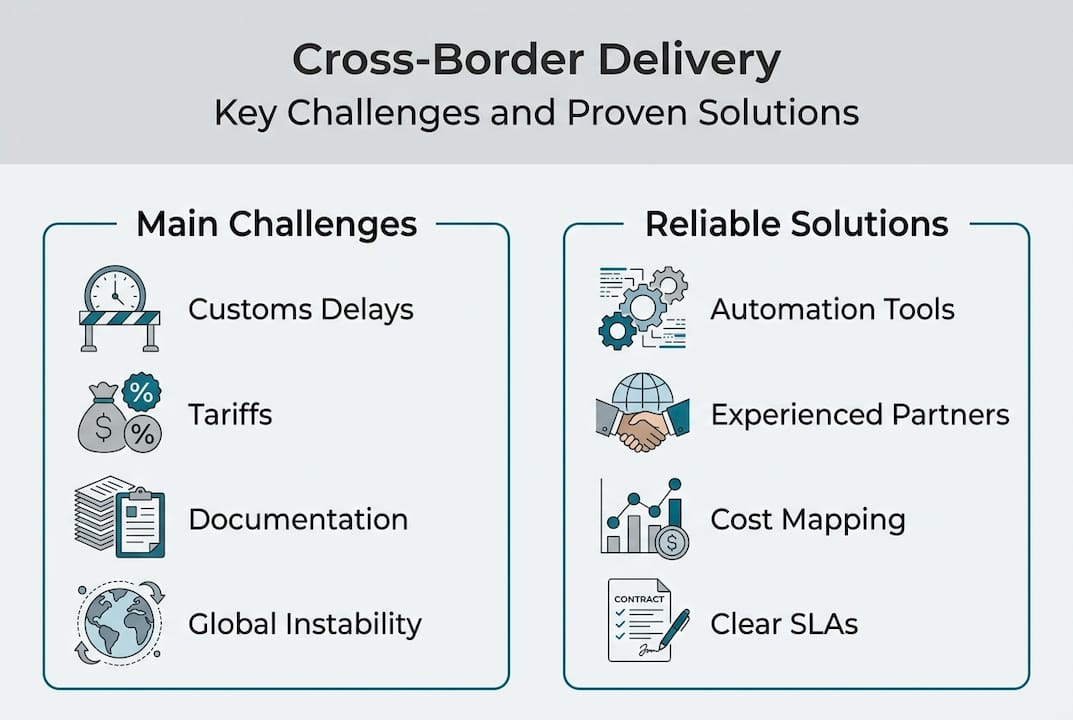
- Major cross-border delivery challenges and their impact
- Customs, documentation, and compliance explained
- Overcoming obstacles: Proven tactics and tools
- Our perspective: Why most cross-border delivery advice falls short
- Streamline your cross-border delivery with proven solutions
- Frequently asked questions
Key Takeaways
| Point | Details |
|---|---|
| Growth is accelerating | Cross-border e-commerce logistics grew 18.1% in just one year. |
| Major obstacles | Unstable regulations, tariffs, and high costs slow delivery and increase risk. |
| Compliance is critical | Mistakes in paperwork or customs processes can result in expensive delays. |
| Smart solutions exist | Automation, experienced partners, and the right tools can streamline cross-border delivery. |
| Strategic action pays off | Planning and tech adoption give businesses a reliable competitive edge internationally. |
Understanding today’s cross-border delivery landscape
Global e-commerce has fundamentally changed what customers expect. A buyer in Germany or Australia now orders from a U.S. seller with the same confidence they’d shop locally, and they expect fast, reliable delivery to match. That expectation puts enormous pressure on logistics operations that were never designed for international scale.
The cross-border e-commerce logistics market grew from $102.55B in 2025 to $121.13B in 2026 at 18.1% CAGR, signaling that international shipping is no longer optional for growth-focused sellers.
Understanding the cross-border shipping benefits is only half the equation. The other half is recognizing the complexity layered underneath. Delivery routes that cross multiple countries involve different regulatory systems, carrier networks, and duty structures, all of which must align perfectly for a shipment to arrive on time and in good condition.
Here are the core factors that make cross-border delivery uniquely difficult:
- Customs regulations that vary by country and product category
- Tariff rates that shift based on trade agreements and political decisions
- Currency fluctuations that affect landed cost calculations
- Carrier and partner selection in unfamiliar markets
- Inconsistent tracking across multiple carrier handoffs
- Local holidays and disruptions that cause unexpected delays
The freight forwarding growth in recent years reflects how many businesses are turning to third-party expertise to manage these layers. Trying to handle every variable in-house is rarely sustainable, especially for mid-sized sellers scaling into new regions. With the stage set by global growth, let’s clarify the real obstacles e-commerce businesses face.
Major cross-border delivery challenges and their impact
Knowing the landscape is one thing. Feeling the impact of these challenges on your bottom line is another. Cross-border delivery problems don’t just cause delays, they erode margins, damage customer relationships, and sometimes shut down entire market entries.
A 2025 industry survey found that global instability tops the list of concerns at 61%, followed by tariffs at 42%, and high cost pressures rounding out the top three. These aren’t abstract risks. They translate into real operational pain every week.
| Challenge | % of businesses affected | Primary impact |
|---|---|---|
| Global instability | 61% | Unpredictable transit times |
| Tariff changes | 42% | Cost overruns, margin erosion |
| High cost pressures | Top 3 | Reduced competitiveness |
| Compliance failures | Widespread | Shipment holds, fines |
Here’s how these challenges play out in practice:
- Delayed deliveries caused by customs holds or carrier disruptions lead to customer complaints and returns.
- Stockouts occur when inbound shipments are stuck at the border longer than planned.
- Unexpected duties applied at destination raise the landed cost above what was quoted to the customer.
- Compliance violations result in fines or seized goods, especially in regulated product categories.
- Partner failures in last-mile delivery damage your brand even when everything upstream went smoothly.
Using cost reduction strategies and running a proper shipping solutions comparison before entering a new market can prevent most of these outcomes.
Pro Tip: Before launching into any new country, map out your total landed cost, including duties, taxes, carrier fees, and potential customs delays. Businesses that skip this step routinely discover their margins disappear at the border.
Customs, documentation, and compliance explained
Beyond external factors, operational missteps in documentation and regulation can be equally damaging. Customs clearance is a country-specific, multi-step process, and even a single missing field on a commercial invoice can hold a shipment for days.

Every international shipment requires a specific set of documents. Missing or incorrect paperwork doesn’t just slow things down. It can trigger audits, fines, or outright rejection at the border.
Here are the core documents required for most international shipments:
- Commercial invoice with accurate product descriptions and declared values
- Bill of lading or airway bill as the primary transport contract
- HS codes (Harmonized System codes) to classify goods for duty calculation
- Certificate of origin to determine applicable trade agreements
- Packing list with weight, dimensions, and item counts
- Import/export licenses for regulated or restricted goods
The difference between managing this manually versus using automation is significant:
| Workflow | Manual process | Automated process |
|---|---|---|
| HS code classification | Error-prone, time-consuming | API-driven, consistent |
| Duty calculation | Requires specialist knowledge | Real-time, accurate |
| Document generation | Multiple tools, version risk | Integrated, audit-ready |
| Compliance updates | Manual monitoring | Automatic rule updates |
Automation in HS code and duty APIs resolves these challenges efficiently, reducing both errors and processing time. Businesses using integrated compliance tools report faster clearance and fewer shipment holds.
For a deeper look at what’s involved, the freight forwarding documentation process and the trade documentation guide cover the full paperwork chain. For regulatory specifics, trade compliance shipping and the shipping documentation guide are practical starting points.
Pro Tip: Use compliance software or duty calculation APIs to automate HS code classification. Manual classification is the single biggest source of customs errors for e-commerce sellers.
Overcoming obstacles: Proven tactics and tools
Fortunately, new tools and smarter processes make overcoming traditional cross-border headaches possible. The businesses winning in international markets aren’t necessarily the biggest. They’re the ones with the tightest systems and the most reliable partners.
Automation is the foundation. When you automate customs paperwork, rate shopping, and duty calculations, you remove the human error that causes most clearance delays. You also free your team to focus on strategy rather than data entry.
Here are the key technologies reducing friction in cross-border delivery today:
- Rate shopping platforms that compare carrier costs and transit times in real time
- Duty and tax calculators that show landed cost before checkout
- API integrations connecting your store, warehouse, and carrier systems
- Real-time tracking dashboards that give visibility across every carrier handoff
- Exception management tools that flag delays or compliance issues before they escalate
- Automated document generation for invoices, packing lists, and customs forms
Automation in HS code and duty APIs directly resolves compliance and cost challenges by removing guesswork from the equation. Pair that with the right cost reduction strategies and you have a repeatable system that scales as your order volume grows.
Choosing experienced couriers matters just as much as the technology stack. Review the courier service tips that experienced logistics managers use to evaluate partners before committing to a lane.
Pro Tip: Establish clear service-level agreements (SLAs) with every cross-border delivery partner. Define acceptable transit times, claims processes, and escalation paths in writing before your first shipment moves.
Our perspective: Why most cross-border delivery advice falls short
With these strategies in mind, here’s our blunt take on what really sets the winners apart in cross-border delivery.
Most guides tell you what paperwork you need. Few address the daily realities of shifting regulations, local public holidays, or regional carrier disruptions that nobody warned you about. A shipment can be perfectly documented and still sit at a border crossing because of a national holiday you didn’t account for.
Selecting partners based solely on price is one of the most common and costly mistakes we see. The cheapest option often comes with poor communication, slow claims resolution, and no accountability when things go wrong. Reliability and transparency are worth paying for, especially when your customer is waiting on the other end.
The real logistics cost strategies that work long-term come from building adaptable teams and upstream relationships with suppliers, freight forwarders, and customs brokers who genuinely know the markets you’re shipping into.
“Success in cross-border delivery rarely depends on just ticking compliance boxes. It’s about flexibility and knowledge.”
The businesses that grow internationally are the ones that invest in education, not just software.
Streamline your cross-border delivery with proven solutions
Armed with a clearer picture and better tactics, take practical action with ORNER’s expert support. Navigating customs rules, managing carrier relationships, and keeping delivery costs under control is exactly what we help e-commerce businesses do every day.
Whether you’re shipping your first international order or scaling an established cross-border operation, ORNER’s reliable courier services connect you to a vetted global carrier network with real-time tracking and compliance support built in. Small businesses can explore courier services for small businesses designed to scale without adding overhead. For end-to-end visibility, the order fulfillment process tools give you control from warehouse to customer doorstep.
Frequently asked questions
What is the biggest challenge in cross-border delivery?
Global instability and tariffs top the list, with 61% and 42% of businesses citing them respectively, making cost and transit time unpredictability the primary operational headache.
How can ecommerce businesses overcome customs delays?
Automating customs documentation and using compliance APIs streamlines clearance, reduces manual errors, and prevents the documentation mistakes that cause most holds.
Is cross-border delivery worth the risk for small retailers?
Yes. The 18.1% CAGR growth in cross-border logistics shows the market opportunity is real, and proper planning with automation tools makes the risks manageable even for smaller operations.
What documents are required for international shipping?
Most shipments require a commercial invoice, bill of lading, HS codes, certificate of origin, and a detailed packing list, with additional licenses needed for regulated product categories.
Can cost pressures in cross-border delivery be reduced?
Yes. Automation and innovative strategies including rate shopping platforms, duty calculators, and API integrations can meaningfully reduce both direct shipping costs and the hidden costs of compliance errors.