TL;DR:
- Many businesses underestimate the strategic importance of B2B courier services, which impact client relationships and operational efficiency.
- Integrating advanced technology, such as real-time tracking and ERP systems, enhances delivery accuracy, speed, and accountability.
Most supply chain professionals think of courier services as a commodity. You pick the cheapest option, set up an account, and move on. That assumption costs businesses far more than they realize. The global courier industry hit $580.3 billion in 2025, and the businesses driving that growth are not using couriers as an afterthought. The role of courier services in B2B is fundamentally strategic, touching everything from supplier relationships to customer retention to competitive positioning. This article breaks down exactly how and why.
Table of Contents
- Key Takeaways
- The role of courier services in B2B: definitions and scope
- Operational advantages that B2B couriers deliver
- How technology integration transforms B2B courier operations
- Selecting and managing B2B courier partners
- The strategic impact on supply chain competitiveness
- My take: couriers are strategic assets, not commodities
- How Or-ner helps you get more from B2B courier operations
- FAQ
Key Takeaways
| Point | Details |
|---|---|
| B2B courier ≠ B2C courier | B2B delivery focuses on bulk, compliance, and scheduled windows, not just speed. |
| Technology drives ROI | Businesses using courier delivery technology see ROI within 6 to 9 months through cost savings and retention gains. |
| Real-time tracking matters | GPS tracking and digital proof of delivery reduce disputes and build long-term client trust. |
| ERP integration is non-negotiable | Connecting courier platforms to your existing systems eliminates billing errors and scheduling conflicts. |
| Delivery performance is a differentiator | Superior courier execution opens access to demanding customer segments and supports stronger pricing power. |
The role of courier services in B2B: definitions and scope
The phrase “courier service” conjures images of a van dropping off a package at someone’s door. In B2B, the reality is far more complex. You are not sending a single parcel to a consumer. You are coordinating scheduled bulk deliveries across multiple business locations, managing compliance documentation, and keeping multiple supply chain partners informed in real time.
B2B fulfillment centers on bulk, scheduled deliveries with tight regulatory compliance and complex coordination requirements. Orders are often palletized. Dock scheduling is required. Chain-of-custody documentation must be airtight. A missed delivery window does not just inconvenience a customer. It can shut down a production line or breach a supplier contract.
Here is what separates B2B courier operations from consumer delivery:
- Volume and packaging: B2B shipments typically involve pallets, crates, or high-volume parcels rather than individual units
- Delivery scheduling: Business recipients require specific time windows, advance notice, and dock availability confirmation
- Documentation: Purchase orders, delivery receipts, customs paperwork, and compliance certificates must accompany shipments
- Accountability: Proof of delivery carries legal and financial weight in B2B transactions
- Relationship continuity: The same courier routes often serve the same business partners for years, building operational trust
The importance of courier services in this context extends beyond logistics. When your courier performs well, it reflects on your brand. When it fails, your relationship with the client takes the hit, not the carrier.
Operational advantages that B2B couriers deliver
The benefits of B2B delivery go well beyond getting goods from point A to point B. When courier operations are managed with precision, the financial and relational payoffs accumulate quickly.
Here are the core operational advantages professional courier services bring to B2B businesses:
- Reduced delivery errors: Multi-stop deliveries with digital proof of delivery cut errors and disputes significantly. This matters enormously in industries where a missing signature or unverified receipt can delay payment by weeks.
- Improved customer retention: Meeting strict delivery SLAs consistently is one of the most direct drivers of B2B contract renewals. Clients who trust your delivery timeline are far less likely to shop around.
- Lower cost per delivery: Route optimization software reduces mileage and idle time. Businesses that adopt courier delivery platforms report measurable improvements in billing accuracy and capacity utilization within the first three months.
- Faster dispute resolution: When every delivery is documented with timestamps, signatures, and photos, billing disputes get resolved in hours rather than weeks.
- Stronger supplier relationships: Reliable inbound deliveries from your courier partners mean less safety stock, tighter production schedules, and better cash flow. Managing supplier partnerships with precision gives you leverage most competitors simply do not have.
Pro Tip: When evaluating courier partners for B2B work, request their on-time delivery rate specifically for multi-stop business routes, not their aggregate consumer delivery stats. Those two numbers often tell very different stories.
The impact of courier services on B2B does not just appear in the logistics budget. It shows up in client satisfaction scores, contract renewal rates, and your ability to take on larger, more demanding customers.

How technology integration transforms B2B courier operations
Technology is where the gap between average and excellent courier operations becomes visible. The businesses that treat their courier setup as a technology layer, not just a transport vendor, gain capabilities their competitors struggle to replicate.
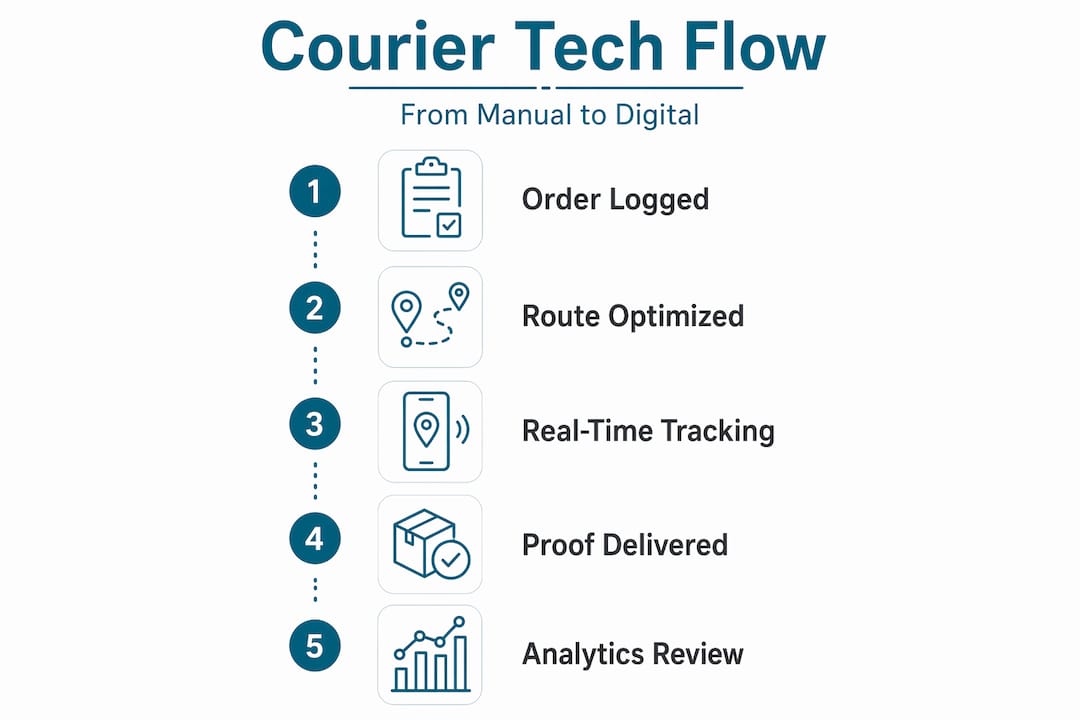
Modern B2B delivery demands integration between courier tracking systems and client ERP and WMS platforms for scheduling and compliance. That integration is what allows you to automatically confirm delivery windows, reconcile invoices, and flag exceptions without anyone picking up the phone.
Here is what a technology-enabled B2B courier stack looks like in practice:
- Real-time GPS tracking with automated ETA updates sent directly to receiving managers
- Digital proof of delivery using signatures, barcodes, or photos captured on driver devices
- ERP and accounting integration that auto-populates delivery confirmations into purchase order workflows
- Batch-stop optimization that sequences multi-stop routes for minimum mileage and maximum time efficiency
- Exception management that flags late departures, failed delivery attempts, or route deviations in real time
Real-time communication between dispatchers and drivers eliminates delays and enables proactive customer notifications, which directly improves satisfaction and operational agility. When a delivery is running 30 minutes late, your client knows before they start calling you.
| Feature | Manual courier operations | Technology-enabled courier operations |
|---|---|---|
| Proof of delivery | Paper-based, easy to lose | Digital, timestamped, stored automatically |
| ETA updates | Phone calls, estimates | Automated GPS-based notifications |
| Invoice reconciliation | Manual matching, error-prone | Auto-sync with ERP system |
| Route efficiency | Driver discretion | Optimized by algorithm |
| Dispute resolution | Days to weeks | Hours with digital audit trail |
Pro Tip: When onboarding a new courier technology platform, treat it as an operational layer on top of your existing ERP rather than a replacement. Incremental technology adoption minimizes disruption and gets your team to full adoption faster.
You can explore how shipment tracking technology supports these capabilities at scale, particularly if you are managing deliveries across multiple regions or carriers.
Selecting and managing B2B courier partners
Choosing the wrong courier partner is expensive in ways that do not always show up immediately. The operational drag from poor visibility, inconsistent documentation, and reactive communication compounds over months before it becomes a crisis.
Before signing any B2B courier agreement, evaluate these factors carefully:
- On-time delivery rate for business routes: Ask specifically about B2B performance, not blended consumer and business averages
- SLA enforcement history: How the courier handles breaches matters as much as how often they occur
- Technology compatibility: Can their platform connect to your ERP or WMS without custom development work?
- Documentation standards: Do drivers capture digital proof of delivery on every stop, or only when requested?
- Scalability: Can the carrier handle your peak volume without degrading service levels?
The most common failure mode in B2B courier management is what experienced operators call “set and forget.” A business selects a carrier, sets up the account, and then only reviews performance when something goes wrong. Successful courier operators use route optimization and mandatory digital proof uploads as ongoing standards, not one-time configurations.
For continuous improvement, build a monthly performance review into your courier management process. Track on-time rates, exception frequency, and dispute resolution times. Use that data in your carrier conversations. And if you are managing cross-border courier shipments, customs compliance adds another layer of complexity that requires proactive documentation management rather than reactive fixes.
The strategic impact on supply chain competitiveness
Delivery performance is not just an operational metric. It is a competitive asset. Superior delivery allows access to demanding customer segments and supports premium pricing in B2B markets where reliability commands a real premium.
Consider what happens when your courier execution is consistently excellent. You qualify for contracts with enterprise buyers who require documented SLA performance. You reduce client churn because switching to a competitor introduces delivery risk. You shorten your cash conversion cycle because clean proof of delivery accelerates payment. Each of these outcomes compounds over time.
“Delivery performance in B2B is not just about getting goods there on time. It determines who your customers are and how much they pay you.”
Future trends are worth watching here too. The courier services sector is evolving toward greater automation in routing, AI-driven exception management, and tighter integration between carrier networks and business systems. Businesses that invest in evolving courier capabilities now will be significantly better positioned when those shifts accelerate. The B2B businesses that treat their courier strategy as a growth lever, rather than a cost line, are the ones that scale efficiently.
My take: couriers are strategic assets, not commodities
I have worked with enough supply chain teams to know that courier services get the least strategic attention of almost any logistics function. And I think that is backwards.
What I have seen again and again is that businesses spend months optimizing their warehouse layout or negotiating freight rates, and then lose those gains entirely through poor last-mile execution. A pallet that arrives at the wrong dock at the wrong time with missing paperwork undoes everything upstream.
The businesses that change their outcomes treat courier operations the way they treat any high-value vendor relationship. They invest in technology integrations. They set performance benchmarks and review them. They understand that a driver equipped with real-time routing and digital proof tools is not just a driver. That person becomes your client’s primary point of contact on delivery day.
My advice to any supply chain professional reading this: stop accepting courier mediocrity as a cost of doing business. The tools to demand and measure excellent performance exist. The ROI on using them is documented. The only thing standing between you and better courier outcomes is the decision to treat this function as seriously as you treat everything else.
— Maayan
How Or-ner helps you get more from B2B courier operations
Or-ner brings together the core capabilities that B2B courier operations actually require: real-time shipment tracking, route visibility, proof of delivery management, and direct integration with your existing ERP workflows. Whether you are managing domestic multi-stop deliveries or coordinating global logistics across carriers, Or-ner gives you the visibility and control to hold every partner accountable.
The platform is built for businesses that move real volume. Or-ner supports white-labeled client portals, configurable automation, and analytics that turn delivery data into decisions. If you are ready to stop guessing about courier performance and start measuring it, Or-ner is the place to start. You can also explore Or-ner’s freight booking process guide to see how courier services fit into a broader logistics strategy.
FAQ
What is the role of courier services in B2B?
Courier services in B2B manage scheduled bulk deliveries, compliance documentation, and multi-stop routes that keep supply chains running reliably. They are strategic partners in maintaining client relationships and operational continuity, not just transport vendors.
How do B2B courier services differ from B2C delivery?
B2B courier services prioritize scheduled delivery windows, bulk fulfillment, and compliance over pure speed, and require deeper system integrations than typical consumer delivery. Failed B2B deliveries carry financial and contractual consequences that go well beyond consumer inconvenience.
What technology should B2B businesses look for in a courier partner?
Look for real-time GPS tracking, digital proof of delivery, and ERP integration capability. These three features alone eliminate the majority of disputes and visibility gaps that create operational drag in B2B courier management.
How quickly do businesses see ROI from courier technology?
Businesses implementing B2B delivery technology typically see return on investment within 6 to 9 months, with improvements in billing accuracy, route efficiency, and customer retention appearing within the first 3 months.
What are the biggest mistakes in managing B2B courier operations?
The most common mistake is treating courier setup as a one-time task rather than an ongoing managed process. Without regular performance reviews, route optimization, and mandatory digital proof standards, errors accumulate and costs rise without anyone noticing until the damage is done.