

TL;DR:
- Proper freight booking requires thorough preparation of essential documents, shipment details, and timing to prevent delays and extra fees. Effective coordination, clear communication, and verification post-booking are crucial to ensure smooth pickups and avoid costly mistakes. Leveraging digital platforms alongside disciplined internal processes enhances efficiency and reduces unexpected charges in ecommerce logistics.
One missed cutoff date. One incomplete packing list. One container sitting idle at a terminal while fees quietly stack up. These are not edge cases — they are everyday realities for ecommerce businesses that treat freight booking as an afterthought rather than a system. Whether you are a seller shipping truckloads to Amazon fulfillment centers, a wholesaler moving pallets overseas, or a manufacturer coordinating cross-border deliveries, getting freight booking right is the difference between healthy margins and painful, preventable losses. This guide walks you through every step, from pre-booking prep to handoff, with the pitfalls clearly marked.
Table of Contents
- What you need before you book freight
- Freight booking step by step: The complete workflow
- Preventing costly mistakes in the booking process
- Verifying your booking and preparing for smooth handoff
- The overlooked secret to freight booking efficiency: Coordination and communication
- Take the next step: Reliable freight booking for your business
- Frequently asked questions
Key Takeaways
| Point | Details |
|---|---|
| Prepare documents early | Having all required paperwork ready helps prevent costly delays and fees. |
| Follow a structured workflow | Moving step by step minimizes errors and keeps your logistics on track. |
| Schedule appointments proactively | Coordinating pickup and delivery slots ensures on-time shipments and less congestion. |
| Double-check to avoid fees | Verifying bookings and timing prevents demurrage and detention charges. |
| Communication is critical | Team alignment and confirmation with your carrier make the booking process smoother. |
What you need before you book freight
Now that you know why efficient booking is critical, let’s review exactly what to prepare before starting.
Freight booking is not something you figure out as you go. Walking into the process unprepared is one of the most reliable ways to trigger delays, fees, and carrier frustration. The documents, details, and timing decisions you make before you even open a booking portal determine how smoothly everything else flows.
Core documents you must have ready
Every freight shipment requires a specific set of paperwork. Miss one, and your cargo can be held, returned, or hit with customs penalties. Here is what you need:
- Commercial invoice: This document lists the buyer, seller, goods description, value, and terms of sale. Customs authorities use it to assess duties and taxes.
- Packing list: A detailed breakdown of every item in each package, including quantities, weights, and dimensions. Carriers and customs both rely on it for verification.
- Bill of lading (BOL): This is the legal contract between shipper and carrier. It confirms pickup, describes the goods, and acts as a title document for international ocean shipments.
- Commodity classification (HS code): A standardized code identifying your product category for customs clearance. Getting this wrong can trigger customs delays or incorrect duties.
You can use a freight booking checklist to make sure nothing slips through the cracks before your first inquiry.
Shipment details that affect every quote
Carriers quote freight based on specifics, not estimates. Before requesting any rates, gather the following:
| Detail | Why it matters |
|---|---|
| Total weight (actual and dimensional) | Determines freight class and pricing tier |
| Pallet count and dimensions | Affects truck space requirements |
| Commodity type and value | Required for customs and insurance |
| Origin and destination zip codes | Used to calculate distance-based rates |
| Hazardous material status | Triggers special handling and permits |
Timing is everything
Booking cutoff dates vary by carrier, port, and mode. Ocean carriers typically close bookings 3 to 7 days before vessel departure. Air freight cutoffs can be as tight as 24 hours before the flight. Missing these windows means waiting for the next available departure and potentially paying premium rates for it.
Pro Tip: Build a simple calendar alert for every shipment cutoff date the moment you receive a carrier’s schedule. Treat it with the same priority as a payment deadline. Five minutes of calendar setup can save thousands in demurrage fees.
And those fees are real. Demurrage and detention costs accumulate when containers sit past their free time at terminals or when equipment is held beyond the allowed period. These are not small line items. For ecommerce businesses operating on tight margins, a single container detention event can wipe out the profit from an entire product order.
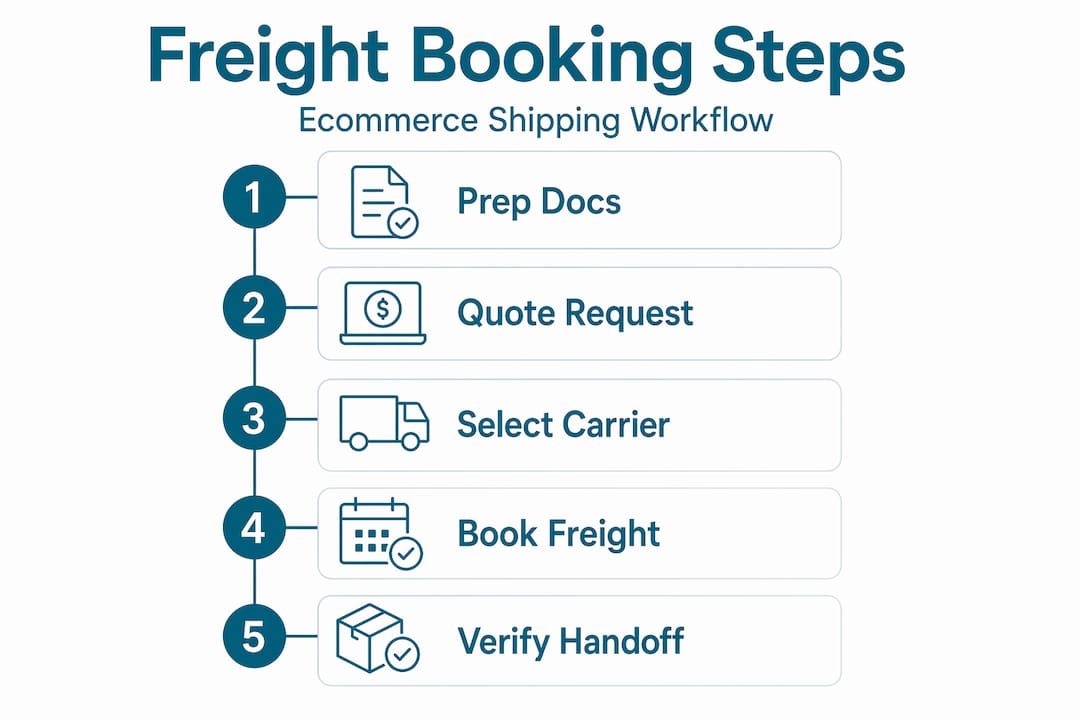
Freight booking step by step: The complete workflow
With your materials and information in order, you’re ready to move through the actual freight booking workflow.
Every efficient booking follows the same logical sequence. Skipping steps or reordering them introduces risk at every stage. Here is the process that keeps shipments on track:
-
Gather all shipment information. Confirm origin address, destination address, ready date, commodity details, weight, dimensions, and any special handling requirements. Incomplete data here creates errors in every downstream step.
-
Select your carrier and transport mode. Ocean freight works best for large volume, lower urgency shipments. Air freight fits time-sensitive, high-value goods. LTL (less than truckload) and FTL (full truckload) cover domestic ground moves. Your mode choice directly affects cost, transit time, and documentation requirements. You can explore how booking works for each mode if you are comparing options.
-
Request quotes and compare. Get at least three quotes from different carriers or through a freight marketplace. Compare total landed cost, not just the base rate. Factor in fuel surcharges, accessorial fees, insurance, and transit time.
-
Book, confirm, and provide documentation. Submit your booking request and receive a booking confirmation number. Immediately follow up with all required documents: commercial invoice, packing list, and BOL. Many carriers have document submission portals, and late document delivery is one of the most common causes of shipment holds.
-
Schedule pickup and dock appointments. This step is where many businesses lose time. Dock appointment scheduling is a core mechanic in freight booking because large shipments require time slots for loading and unloading. Failing to book and confirm appointments leads to missed pickups, congestion at the warehouse, and rescheduling fees.
-
Track your booking confirmation and prepare for changes. Freight moves. Schedules shift. Review your detailed process guide to understand what happens when a carrier rolls your booking or a port experiences delays. Having a contingency plan before you need it saves scrambling later.
Manual email booking vs. digital freight platforms
| Factor | Manual/email booking | Digital freight platform |
|---|---|---|
| Speed | Slow, 24 to 48 hour turnaround | Instant or near-instant quotes |
| Visibility | Low, relies on carrier updates | Real-time tracking and alerts |
| Error risk | High, prone to miscommunication | Lower, with built-in validation |
| Document handling | Manual submission, easy to miss | Integrated upload and storage |
| Rate comparison | Difficult across multiple carriers | Side-by-side comparison built in |
| Cost | No platform fee, but high time cost | Subscription or per-booking fee |
Digital platforms win on speed and visibility. Manual booking still makes sense for complex shipments with special requirements that need human negotiation.
Preventing costly mistakes in the booking process
Following each step helps, but many businesses still lose money to avoidable errors. Let’s spotlight the most common ones and how to stay protected.
The freight booking process has specific failure points that show up again and again across ecommerce operations of every size. Knowing where they are is the first step to avoiding them.
The most common and costly booking errors
- Missed appointment windows: If your carrier shows up and the dock is unavailable, you pay. Rescheduling fees, driver detention, and storage charges add up quickly.
- Incomplete or incorrect documentation: A commercial invoice with the wrong value or an HS code that doesn’t match the actual product can trigger customs holds that last days.
- Late pickups: When your cargo isn’t ready at the confirmed time, you create downstream delays across the entire chain. If the carrier moves on without your shipment, you may wait another cycle.
- Inaccurate weight or dimension data: Carriers reweigh and re-measure freight. If your declared specs don’t match reality, expect correction charges billed after delivery.
- Overlooked accessorial fees: Liftgate service, inside delivery, residential delivery, and fuel surcharges are real costs that don’t always appear in the initial quote.
“Inaccurate or late execution covering documentation, cutoff timing, and pickup readiness can lead to containers waiting beyond free time at terminals or with equipment, creating accessorial fee exposure that can meaningfully impact margins.”
Review your booking options to find carriers and platforms that include fee transparency upfront, so there are no post-delivery surprises.
How demurrage and detention drain your margins
Demurrage is the fee charged when your import container stays at the terminal port past the free time allowed, typically 3 to 5 days. Detention is charged when the carrier’s equipment, such as a chassis or container, stays at your facility beyond the agreed free period. Both fees compound daily. A single container left at port for an extra week can generate $1,500 to $3,000 or more in fees depending on the terminal and trade lane.
The fix is process-based, not technology-based. You need written pickup confirmations, internal notifications when free time windows are opening, and clear responsibility assigned to someone on your team to monitor each active shipment.
Pro Tip: Set an internal alert at the halfway point of your free time window. If pickup or return hasn’t been confirmed by then, escalate immediately. Waiting until the last day is how fees happen.
Check out specific cost-cutting tips for ecommerce freight to reduce these exposures across your shipping lanes.
Verifying your booking and preparing for smooth handoff
After booking, there are still a few important steps to ensure everything runs smoothly from pickup to delivery.

Booking confirmation is not the finish line. It is the starting gun for a series of verification steps that prevent last-minute scrambles.
Here is a structured post-booking verification checklist:
-
Confirm your booking number and details. Cross-check the carrier’s confirmation against your original request. Look at origin, destination, commodity, weight, and pickup date. A single transposed digit in a zip code has misdirected entire truckloads.
-
Review all submitted documents for accuracy. Even if you submitted documents through a platform, open and read each one. Commercial invoices with wrong values, packing lists with missing line items, and BOLs with incorrect shipper addresses all slip through submission portals without triggering warnings.
-
Contact your carrier’s local representative. Email confirmation is necessary, but a phone call or message to the local dispatch team confirms they have your booking on their active schedule. This single step reduces missed pickups significantly.
-
Notify your warehouse or receiving team. Give them the carrier name, booking number, expected pickup time, and contact information. Your warehouse team needs to know who is coming, when, and what they are taking. A breakdown in this communication is one of the top causes of dock confusion and missed appointments.
-
Verify dock appointment time slots. As dock appointment coordination is essential for capacity management, confirm that both your facility and the receiving facility have the appointment on record. For FTL and LTL shipments moving to major distribution centers or retail warehouses, the receiving dock appointment is often more critical than the pickup.
-
Check for last-minute fee triggers. Review the confirmed routing for any potential accessorial charges you may not have anticipated: residential delivery, limited access locations, or required liftgate service on the receiving end.
For a complete walkthrough of the post-booking process, the shipping guide covers each verification step with specific carrier considerations.
One number worth keeping in mind: Industry data consistently shows that shipments with confirmed dock appointments and complete documentation at booking time are substantially less likely to incur exception charges than those without both. The effort you invest in verification directly correlates with your freight cost predictability.
The overlooked secret to freight booking efficiency: Coordination and communication
Most guides focus on tools. Better platforms, smarter software, automated alerts. These things help, but they are not the reason the best-run ecommerce freight operations perform the way they do. The real edge is coordination.
Here is what we see consistently in practice: a business adopts a digital freight platform, gains visibility into their shipments, and still racks up detention fees and missed appointments. The platform didn’t fail them. Their internal communication did. Someone on the team knew the cutoff date but didn’t pass it to the warehouse manager. A carrier confirmed pickup but the dock was double-booked because two departments weren’t talking.
Technology surfaces information. People act on it. If the loop between your logistics team, warehouse staff, and carrier contacts isn’t tight, the best booking platform in the world won’t save you from the fee that comes from a container sitting one extra day at the terminal.
The fix is deceptively simple. Written confirmations for every milestone: booking placed, documents submitted, appointment confirmed, pickup completed. Shared visibility, meaning a channel, folder, or system where your team can see status without hunting through email threads. And a single point of accountability per shipment so no one assumes someone else is watching the free time clock.
Our experience with ecommerce sellers across sectors from apparel to home goods shows that regular check-ins and written confirmations prevent the vast majority of booking headaches. Not new software. Disciplined communication. Get the pro-level booking tips to build these habits into your team’s standard workflow.
Take the next step: Reliable freight booking for your business
You’ve learned the framework. Now it’s time to apply it with the right resources behind you.
At or-ner.com, we’ve built every resource and service in this guide into a practical, ecommerce-ready logistics platform. If you want to go deeper on any part of this process, start with our in-depth booking explanation that walks through carrier selection, documentation, and platform integration with real ecommerce examples. When you are ready to book with confidence, our reliable courier services connect you to a vetted carrier network built for sellers, wholesalers, and manufacturers moving goods across the US and globally. And before your next shipment, download the step-by-step checklist to make sure every document, appointment, and confirmation is in place before the carrier arrives.
Frequently asked questions
What documents do I need for freight booking?
You typically need a commercial invoice, packing list, and bill of lading for every freight shipment. Always confirm your specific carrier’s document requirements before booking, especially for international moves.
How can I avoid demurrage and detention fees?
Submit all required documents on time, confirm pickup appointments before the free time window closes, and assign someone on your team to actively monitor active shipments. Accurate and timely execution of documentation and pickup readiness is the most reliable way to avoid these charges.
What is a dock appointment and why is it important?
A dock appointment is a scheduled time slot for loading or unloading freight at a specific facility. As dock appointment scheduling directly affects loading capacity and congestion, missing or skipping it can result in turned-away carriers, rescheduling costs, and delayed deliveries.
Can I use a digital platform for every freight booking?
Most ecommerce freight, including LTL, FTL, ocean, and air, can now be booked through digital freight platforms. Check your carrier’s system compatibility first, especially for specialized commodities or trade lanes with limited digital infrastructure.