TL;DR:
- Reliability and consistent delivery are more important to US shoppers than just speed, influencing trust and repeat sales. Prioritizing clear expectations, accurate ETAs, and proactive communication reduces cart abandonment and enhances customer satisfaction. Building operations that balance speed with reliability through process improvements and real-time tracking creates a sustainable logistics advantage.
Speed sells. That’s the story most ecommerce sellers have heard for years. But reliability within the promised window often ranks higher than raw speed for US shoppers. The real question isn’t just how fast you can ship, it’s how consistently you deliver on what you promise. This guide breaks down what delivery speed actually means for your business, where reliability fits in, and what practical steps you can take to boost both conversions and customer trust without chasing an unsustainable speed race.
Table of Contents
- Delivery speed versus reliability: What truly matters?
- How delivery speed drives conversions and reduces abandonment
- The hidden danger of prioritizing speed over experience
- Building speed and reliability into logistics operations
- Why obsessing over delivery speed may set you back (and what actually works)
- How ORNER can help improve your delivery speed and reliability
- Frequently asked questions
Key Takeaways
| Point | Details |
|---|---|
| Reliability trumps speed | On-time delivery has a bigger impact on satisfaction than the fastest shipping option. |
| Clear delivery promises cut abandonment | Stating accurate shipping windows at checkout reduces cart abandonment. |
| Over-prioritizing speed is risky | Chasing speed at the cost of reliability leads to errors and customer disappointment. |
| Balance is best | Combining speed with operational reliability creates lasting customer trust. |
Delivery speed versus reliability: What truly matters?
Speed and reliability sound like the same thing. They’re not. Speed measures how quickly a package moves from warehouse to doorstep. Reliability measures whether it arrives when you said it would. That difference is critical.
Research from McKinsey shows that on-time delivery matters more than simply being the fastest option, with shoppers willing to wait up to a week as long as the package lands within the promised window. More than 80% of consumers say they’ll accept slower shipping if it’s free and predictable. That’s a major shift from the “next-day or bust” narrative that’s dominated ecommerce conversations.
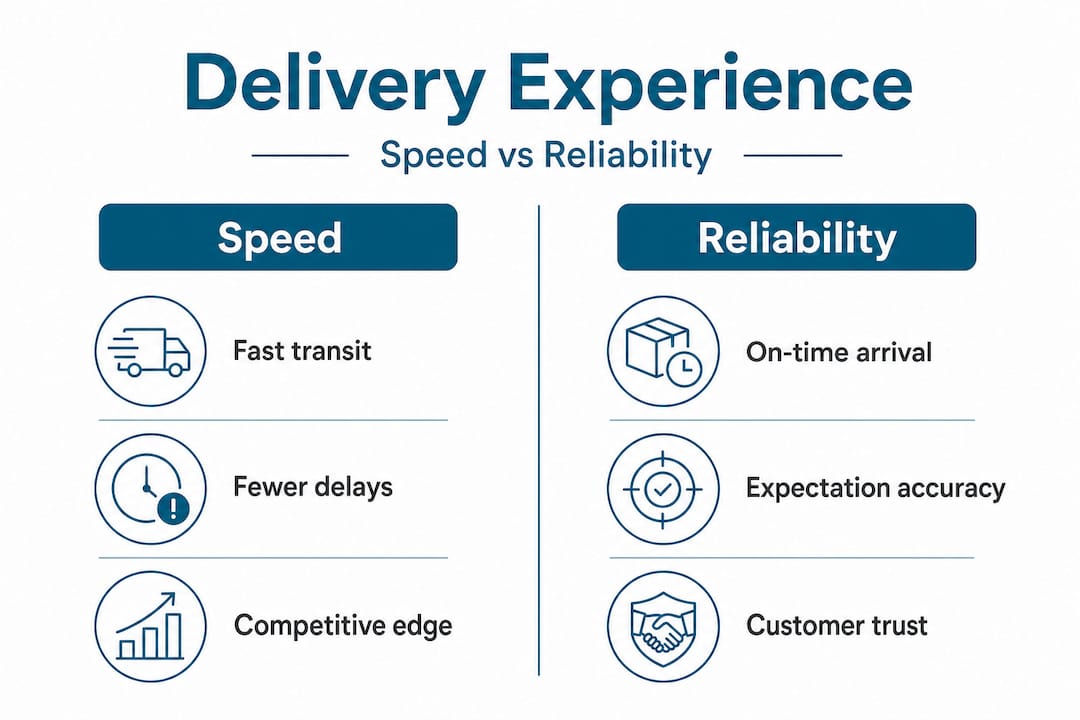
Here’s how the two approaches compare in practice:
| Focus area | Speed-only approach | Reliability-focused approach |
|---|---|---|
| Customer satisfaction | High when met, very low when missed | Consistently high when promises are kept |
| Repeat purchase rate | Volatile | Steady and growing |
| Customer complaints | Frequent during volume spikes | Manageable and predictable |
| Operational cost | High due to express carrier reliance | Lower with optimized routing |
| Cart abandonment | Reduced temporarily | Reduced sustainably |
Sellers who invest in reliable courier services understand this distinction well. They don’t just focus on cutting hours off transit time. They focus on setting accurate expectations and then meeting them, every single time.
Here’s what customers consistently say matters most at checkout and after delivery:
- A clear, specific delivery date rather than a vague range
- An honest estimate that accounts for processing time
- Proactive notifications when something changes
- Consistent performance across multiple orders
“Overpromising on delivery speed can backfire if expectations aren’t met. A customer who expects two-day delivery and receives it in four is far more frustrated than one who was told four days from the start.”
That quote captures something most ecommerce sellers learn the hard way. Speed is a marketing advantage only when your operations can back it up every time, not just when conditions are perfect.
How delivery speed drives conversions and reduces abandonment
Now that we’ve separated speed from reliability, it’s worth examining how your delivery promise shapes what shoppers actually do on your store. Cart abandonment is one of the most expensive problems in ecommerce, and your delivery terms play a bigger role than many sellers realize.
According to data, delivery too slow is the third most common reason for cart abandonment, accounting for 23% of shoppers who leave without buying. That’s a huge share of lost revenue tied directly to how you present shipping.
Here’s a breakdown of the top cart abandonment reasons to show where delivery fits:
| Abandonment reason | Share of abandoners |
|---|---|
| Unexpected extra costs (shipping, tax) | 48% |
| Required account creation | 26% |
| Delivery too slow | 23% |
| Distrust of site security | 18% |
| Complex checkout process | 17% |
Delivery speed is a top-three problem. But look closer and you’ll notice something important. The number one reason is unexpected costs, not slow speed. That means how you present your delivery terms can matter just as much as the actual transit time.
Here’s how a typical shopper weighs delivery at checkout, step by step:
- They see the product and add to cart. At this stage, speed isn’t yet a factor. Interest and price dominate.
- They reach checkout and see shipping costs or timeframes. This is the decision point. If the estimate is vague or the cost is surprising, doubt sets in.
- They compare options. A shopper might open a competitor’s site in another tab to compare delivery windows.
- They make a trust judgment. A specific, honest delivery date builds confidence. A vague “5 to 10 business days” creates hesitation.
- They complete or abandon. One clear, credible delivery date can be the difference.
Understanding your delivery performance metrics helps you identify exactly where your checkout flow is losing customers. When you can pinpoint that your average processing time is 1.5 days, your standard carrier adds 3 more, and your stated window is 2 to 5 days, you can see the disconnect and fix it.
Pro Tip: Displaying a specific estimated delivery date (“Arrives by Friday, July 18”) rather than a range (“Ships in 3 to 5 days”) can meaningfully reduce abandonment. Specificity builds trust. A range feels uncertain; a date feels like a commitment.
There are several practical ways to reduce delivery times without switching carriers entirely. Reducing pack-and-ship time, improving pick accuracy in the warehouse, and choosing the right carrier for specific zones all contribute to a faster, more reliable promise.
The hidden danger of prioritizing speed over experience
After seeing the upside of balancing speed and reliability, it’s critical to look at what happens when sellers over-index on speed alone. This is where things get expensive, and where reputations take hits that take months to recover from.
Industry analysis has found that chasing speed alone can actively degrade customer experience when it introduces uncertainty, missed ETAs, or operational errors. In other words, promising faster delivery than your operations can support doesn’t just fail to help. It actively hurts.
Here’s a checklist of negative outcomes that follow when speed becomes the only priority:
- Increased late deliveries. Carriers pushed beyond capacity make more mistakes. Promised windows get missed more often, not less.
- Higher customer complaint volumes. Every missed delivery generates at minimum one support ticket, often two or three if the issue isn’t resolved quickly.
- Rising return rates. Time-sensitive purchases (gifts, seasonal items, event-related products) that arrive late often get returned, even if the product itself is perfect.
- Ballooning operational costs. Expedited shipping costs far more per unit. Absorbing those costs to stay competitive squeezes margins fast.
- Reputational damage on review platforms. One spike of late deliveries during a peak season can leave a trail of negative reviews that affect conversion rates for months.
The role of trust and transparency in logistics can’t be understated here. When customers know where their package is and have accurate updates along the way, their tolerance for a slightly longer delivery window increases significantly. Proactive status notifications, especially when something goes wrong, defuse frustration before it turns into a complaint or a chargeback.
“Customers don’t expect perfection. They expect honesty. A proactive ‘your shipment is delayed by one day’ message is almost always better received than silence followed by a missed arrival.”
Pro Tip: Invest in ETA accuracy technology before you invest in maximum speed infrastructure. A shopper who receives their package one day later than expected, but was told in advance, is far more satisfied than one who was promised tomorrow and gets it two days later with no communication.
The bottom line is that improving delivery experience means addressing the full journey, from the moment someone sees your shipping promise on the product page to the minute the box lands on their doorstep. Speed is one variable. Communication, accuracy, and consistency are the others, and they’re often easier to fix first.
Building speed and reliability into logistics operations
With the risks of a speed-only approach clear, the next step is building operations that deliver both speed and reliability together. This isn’t about choosing one or the other. It’s about creating a system where fast and accurate is the standard, not the exception.
Research consistently shows that on-time delivery within a clear window drives satisfaction more than marginal speed increases. That means your first priority should be locking down your delivery window accuracy before you try to shrink the window itself.
Here’s a practical action plan:
- Map your entire delivery process end to end. From the moment an order is placed to when it’s marked delivered, document every step. Most sellers discover 1 to 2 unnecessary delays they didn’t know existed.
- Identify your biggest bottlenecks. Is it processing time before handoff to the carrier? Is it last mile performance in specific zones? Knowing where the friction is tells you where to invest.
- Implement real-time shipment tracking. Visibility into where every package is at any moment lets you catch problems before customers notice them. It also feeds more accurate ETAs to your storefront.
- Set clear ETA policies across your team. Everyone involved in order fulfillment should understand your stated delivery windows and the internal standards needed to meet them.
- Audit carrier performance by region. Different carriers perform differently in different geographies. Matching carrier choice to destination zone is one of the fastest ways to improve on-time performance.
- Review your packaging and pick process. Slow or error-prone packing is a hidden source of delays. Simple process improvements here often yield faster and more reliable handoffs to carriers.
Beyond these action steps, there are a few strategies worth building into your long-term operations:
- Adopt last mile delivery best practices to reduce the most expensive and failure-prone part of the shipping journey
- Focus on improving warehouse efficiency to shrink the time between order received and order shipped
- Use operational frameworks that streamline logistics for reliable couriers to remove redundancy and build consistency at scale
Quick wins like reducing processing time by standardizing packing stations can show results within days. Long-term investments like adopting advanced tracking platforms or renegotiating carrier contracts take longer but compound significantly over time. The businesses that win on delivery aren’t the ones with the most aggressive speed promises. They’re the ones with the most consistent operations behind their promises.
Why obsessing over delivery speed may set you back (and what actually works)
Here’s a perspective most ecommerce growth content skips: the marginal value of shaving one more day off your delivery time is often much smaller than fixing the avoidable failures already happening in your current operation.
Think about it this way. If you’re currently delivering in three days but missing your window 15% of the time, getting to two-day delivery doesn’t make your customers happier. It makes 15% of them even more frustrated because their expectations are now higher. The gap between promise and performance has widened, even though the average speed improved.
Most high-performing ecommerce operations we’ve studied don’t lead with speed in their logistics strategy. They lead with consistency. They ask: “Can we deliver what we promise, every time, at scale?” before they ask: “Can we deliver faster?”
The last mile delivery challenges that cause the most damage to customer relationships are almost never about speed. They’re about failed delivery attempts, poor communication, lost packages, and incorrect ETAs. These are execution problems, not speed problems. Solving them first creates a far better customer experience than adding express shipping options.
The uncomfortable truth is that investing in visibility and expectation management, the tools that tell customers exactly where their order is and exactly when it will arrive, yields higher satisfaction scores than cutting a day off your transit time. It’s less flashy. It doesn’t make for a bold headline. But the data, and the retention numbers, bear it out.
Start by fixing what’s already broken before targeting record delivery speeds. That’s the operational mindset that separates logistics-mature ecommerce businesses from those still chasing a speed advantage they can’t consistently sustain.
How ORNER can help improve your delivery speed and reliability
If the strategies above resonate and you’re ready to build a logistics operation that delivers on both speed and reliability, ORNER is built for exactly that challenge.
ORNER’s platform gives ecommerce sellers direct access to streamlined freight booking that reduces the time between order and dispatch. Real-time visibility through shipment tracking means you always know where your inventory and customer orders are, so your ETAs stay accurate and your customers stay informed. For sellers focused on the hardest part of the journey, ORNER’s resources on last mile delivery provide practical frameworks to reduce failures and build the consistency your business needs. Whether you’re an individual seller scaling up or a brand managing high-volume cross-border shipments, ORNER’s end-to-end logistics tools are designed to turn delivery performance into a competitive advantage, not a constant source of stress.
Frequently asked questions
Does delivery speed or reliability matter more for customer satisfaction?
Customers value reliable, on-time delivery more than the fastest possible speed, as long as expectations are set clearly. Research confirms that on-time delivery matters more than simply offering the fastest option available.
How does delivery speed affect shopping cart abandonment?
If delivery is too slow or the promise is unclear, shoppers are far more likely to leave without completing their purchase. Data shows delivery too slow is a leading cause of cart abandonment, affecting nearly one in four shoppers who don’t complete checkout.
Is it worth offering ultra-fast delivery at higher cost to my business?
Ultra-fast delivery can backfire if it leads to missed ETAs or operational shortcuts, so accuracy should come first. Evidence shows that chasing speed alone degrades customer experience when it increases uncertainty or delivery errors.
What are small ecommerce sellers’ best options for improving delivery speed?
Enhance warehouse pick-and-pack efficiency, implement real-time shipment tracking, and partner with reliable courier services that have strong regional performance. Fixing operational bottlenecks in your existing process will typically deliver faster gains than switching to express-only shipping.