TL;DR:
- Reliability in delivery builds trust, reduces costs, and enhances customer loyalty.
- Focusing on consistent on-time performance is more beneficial than prioritizing faster shipping.
- Advanced technology and strategic carrier partnerships are key to ensuring delivery reliability.
Most ecommerce businesses spend thousands optimizing their product pages, ads, and checkout flows, yet overlook the single factor that drives repeat purchases more than anything else: delivery reliability. Speed gets the headlines, but consumers prioritize reliability over fast shipping when it comes to satisfaction and loyalty. A package that arrives on the promised date, every time, builds trust that no marketing budget can replicate. This guide breaks down exactly how reliable courier services protect your revenue, reduce churn, and give your ecommerce brand a durable competitive edge.
Table of Contents
- The true business impact of unreliable deliveries
- Why reliability trumps speed in ecommerce shipping
- Common causes and costly effects of delivery exceptions
- How technology and strategy drive courier reliability
- Our perspective: Why reliability is your ultimate brand promise
- Streamline your shipping: Let experts handle the reliability
- Frequently asked questions
Key Takeaways
| Point | Details |
|---|---|
| Reliability beats speed | Most customers value timely, predictable delivery over sheer speed, impacting repeat purchases. |
| Delivery failures are costly | Each failed delivery can cost $15-30 plus lost future sales, quickly hurting profits. |
| Exceptions must be managed | Common issues like weather and bad addresses cause billions in losses; smart exception handling is essential. |
| Tech boosts dependability | Using route optimization, APIs, and real-time tracking reduces delays and drives higher customer satisfaction. |
The true business impact of unreliable deliveries
With the stakes established, let’s break down why reliability, not just speed, should be the focus for every ecommerce operation.
Most online retailers track conversion rates obsessively but rarely look at delivery performance until something goes wrong. That’s a costly blind spot. Average on-time delivery rates for ecommerce sit between 88% and 91%, while top performers consistently hit 95% to 98%. The gap between those two ranges is where your revenue quietly disappears.
When on-time performance drops below 95%, refund requests spike and customers start leaving. The numbers are blunt: each failed delivery costs between $15 and $30 in direct costs, plus a 3% to 5% hit to overall revenue. And 69% of customers who experience a failed delivery will never buy from that brand again. That’s not a support issue. That’s a business model problem.
The hidden costs compound fast. Here’s what a single wave of delivery failures actually triggers:
- Increased support tickets: Your team spends hours handling “where is my order” messages instead of growing the business.
- Refund and reship costs: You pay twice for the same order, plus the cost of the return.
- Damaged brand reputation: Negative reviews spread faster than positive ones, especially on social media.
- Operational chaos: Exceptions disrupt warehouse workflows, inventory counts, and carrier relationships.
- Lost lifetime value: One bad experience can eliminate years of potential repeat purchases.
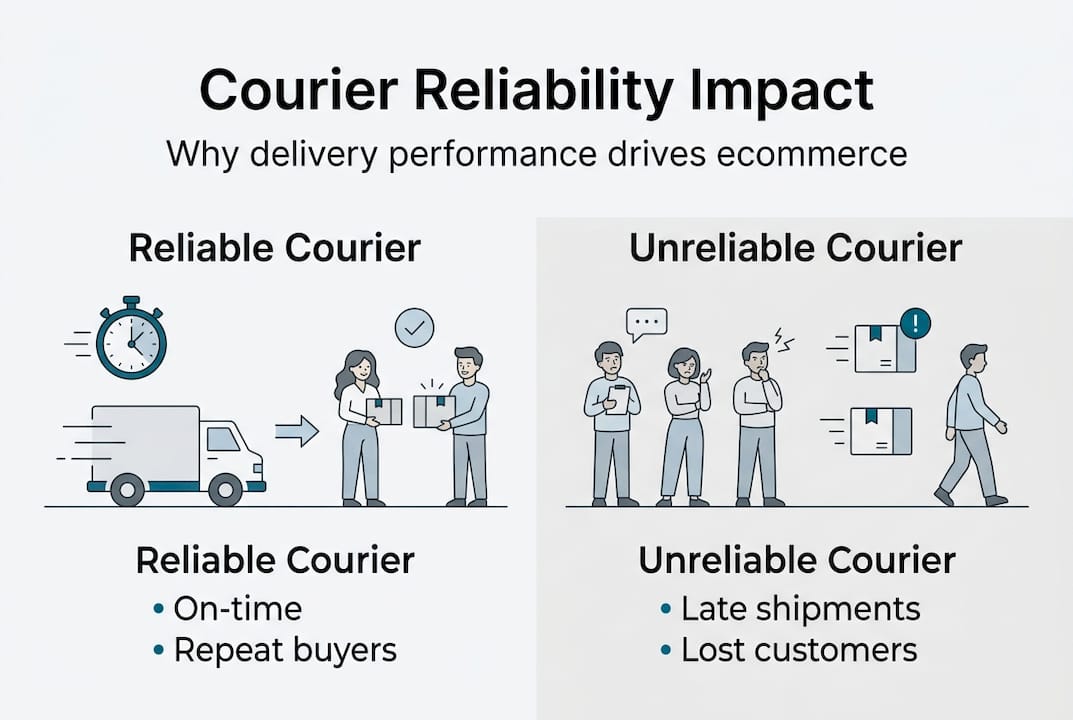
Look at how the outcomes compare when you understand reliable courier services versus ignoring performance benchmarks:
| Metric | Reliable courier | Unreliable courier |
|---|---|---|
| On-time delivery rate | 95% to 98% | 80% to 90% |
| Customer churn after exception | Under 10% | Up to 69% |
| Average exception cost | Minimized with tech | $15 to $30 per case |
| Refund rate | Low | 3% to 5% of revenue |
| Support ticket volume | Low | High |
The table makes it clear: choosing the right courier services for ecommerce is not a logistics decision. It’s a revenue decision.
Pro Tip: Add on-time performance (OTP), delivery exception rate, and Net Promoter Score (NPS) to your weekly KPI dashboard. Catching a dip early costs far less than recovering from a wave of refunds and bad reviews.
Why reliability trumps speed in ecommerce shipping
Now that we’ve seen the high costs of unreliable service, let’s examine what actually matters most to your customers and why reliability now outranks speed.
For years, ecommerce brands competed on who could ship fastest. Two-day delivery became the benchmark, then one-day, then same-day. But consumer priorities have quietly shifted, and many brands haven’t caught up. 90% of US consumers say they are willing to wait two to three days for delivery, as long as it arrives within the promised window. Speed dropped from the top consumer priority to fifth place. Reliability is now the key driver.
Think about what that means for your logistics strategy. You may be paying premium rates for expedited shipping that your customers don’t actually need. What they need is a date they can count on.
“Reliability is the strongest predictor of satisfaction and repeat purchases.” — McKinsey
This shift makes sense when you consider customer psychology. A two-day delivery that shows up on day four feels worse than a five-day delivery that arrives exactly when promised. Broken expectations are more damaging than slow expectations. That’s why investing in international courier services with proven on-time records often delivers more ROI than simply paying for faster transit.
Here are the top three reasons reliability beats speed for long-term ecommerce growth:
- Predictable ETAs reduce anxiety. When customers know exactly when their order arrives, they don’t flood your support inbox. Fewer contacts per order means lower operational costs.
- Fewer exceptions protect revenue. Reliable carriers generate fewer delivery failures, which means fewer refunds, reshipping costs, and churn events.
- Better service recovery builds loyalty. When a reliable carrier does have an issue, they handle it proactively. That responsiveness turns a potential complaint into a positive brand moment.
| Factor | Speed focus | Reliability focus |
|---|---|---|
| Customer satisfaction | Moderate | High |
| Repeat purchase rate | Lower | Higher |
| Support ticket volume | High | Low |
| Exception rate | Varies | Consistently low |
The data tells a consistent story. Networking for courier reliability across multiple carriers and regions gives you the kind of consistent performance that builds brand trust over time.
Common causes and costly effects of delivery exceptions
With reliability at the top of your customers’ wish lists, what are the real-world stumbling blocks hurting your delivery performance?
A delivery exception is any event that disrupts the normal flow of a shipment, causing a delay or failure. They are more common than most brands realize. 11% of ecommerce packages experience a delivery exception, and the industry-wide cost is $88 billion annually. That’s not a rounding error. That’s a structural problem.
The most common causes break down like this:
- Weather disruptions (32%): Storms, floods, and extreme conditions that ground vehicles or close roads.
- Address errors (24%): Incorrect or incomplete addresses entered at checkout that carriers can’t resolve.
- Recipient unavailable (18%): No one home to receive the package, leading to failed attempts and redelivery costs.
- Carrier capacity issues: Peak season surges that overwhelm networks and push packages past their promised dates.
- Customs delays: Especially relevant for cross-border shipments where documentation errors cause holds.
“69% of customers affected by exceptions won’t return, making error prevention crucial.”
Picture a mid-sized apparel brand shipping 500 orders during a holiday weekend. A regional storm causes 55 exceptions. At $20 average cost per exception, that’s $1,100 in direct costs. But if even 30 of those customers don’t come back, and each had a lifetime value of $150, the real loss is $4,500 or more. One weather event, one weekend, thousands of dollars gone.
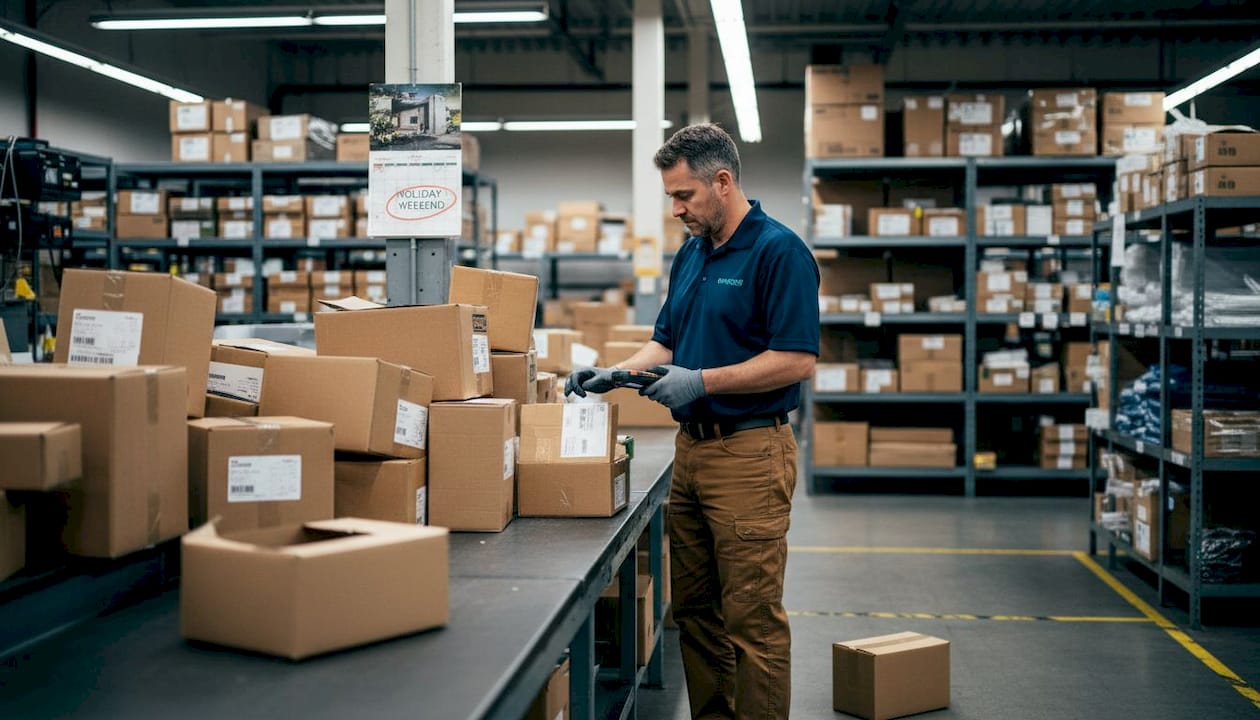
Effective delivery exception management is the difference between absorbing that hit and letting it spiral. Brands that invest in logistics streamlining catch exceptions early, communicate proactively, and retain customers even when things go wrong.
How technology and strategy drive courier reliability
After understanding the biggest sources of delivery failure, let’s see what leading couriers and ecommerce brands are actually doing to prevent and solve these problems.
The best courier operations today look nothing like they did five years ago. Real-time GPS tracking, route optimization, API integrations, and automated notifications have reduced delivery delays by up to 30%. Machine learning models now predict ETA with far greater accuracy, factoring in traffic, weather, and historical performance data.
Here’s the tech stack that separates high-performing couriers from the rest:
- Route optimization software: Algorithms calculate the most efficient delivery paths in real time, reducing fuel costs and late arrivals.
- Integrated APIs: Direct connections between your ecommerce platform and the carrier’s system mean fewer manual errors and faster label generation.
- Real-time exception alerts: Automated flags notify your team the moment a shipment goes off track, so you can act before the customer even notices.
- Diversified carrier networks: Using multiple carriers across regions means no single point of failure. If one network is overwhelmed, others absorb the volume.
Pro Tip: Automate customer notifications the moment an exception is detected. Customers are 38% less likely to churn when they receive a proactive update rather than discovering the delay themselves.
One underrated insight: regional, tech-enabled couriers often outperform national giants on reliability. They carry less volume, know their territories better, and invest heavily in visibility tools. Managing supplier relationships in courier service strategically, including regional players, gives you flexibility that a single national contract can’t. Pair that with smart returns management strategies and you have a logistics operation built to absorb disruption without losing customers.
Our perspective: Why reliability is your ultimate brand promise
You’ve seen the facts and strategies. Here’s why we believe focusing on reliability will shape the next era of ecommerce success.
Speed gets headlines. Reliability builds businesses. After years of working with ecommerce brands across every category, the pattern is always the same: the angriest customer is never the one who waited a little longer. It’s the one who was promised a date and didn’t get it. That gap between expectation and reality is where brand trust goes to die.
In a market flooded with similar products at similar prices, reliable delivery is one of the few genuine differentiators left. You can’t out-discount Amazon forever. But you can out-promise and over-deliver on consistency.
Our honest recommendation: treat reliable delivery as a core brand promise, not a logistics checkbox. Invest in the tracking tools, carrier partnerships, and exception workflows outlined above. Build your streamlined logistics operation around predictability, not just pace.
Reliability is not a feature. It’s the minimum standard for customer delight.
Brands that internalize this will retain more customers, generate more referrals, and spend less on damage control. That’s not a theory. That’s what the data consistently shows.
Streamline your shipping: Let experts handle the reliability
Ready to translate reliability into growth? Here’s how to get help from the pros.
At ORNER, we’ve built our platform specifically for ecommerce businesses that can’t afford delivery failures. From freight booking steps to real-time shipment visibility, every tool we offer is designed to close the gap between what you promise customers and what they actually receive.
Whether you’re scaling a parcel delivery service across borders or managing high-volume domestic fulfillment, our network and technology give you the reliability infrastructure your brand needs. Explore our parcel tracking systems to see how real-time visibility reduces exceptions and keeps your customers informed at every step. Reliable courier services aren’t a luxury. They’re the foundation of sustainable ecommerce growth, and we’re here to help you build on them.
Frequently asked questions
How do failed deliveries affect ecommerce profit?
Each failed delivery costs between $15 and $30 in direct expenses, and 69% of affected customers never purchase from that brand again, compounding the revenue loss well beyond the initial shipment.
Are customers more concerned about delivery speed or reliability?
90% of consumers say they will wait two to three days for delivery as long as it arrives on time, making reliability a stronger driver of satisfaction than speed.
What technologies make courier services more reliable?
GPS tracking, API integration, automated exception alerts, and route optimization software all work together to reduce delays and keep customers informed in real time.
What are the most common causes of delivery exceptions?
The top causes are weather events (32%), address errors (24%), and recipients being unavailable (18%), all of which can be partially mitigated through better data collection and proactive communication.
Can smaller regional couriers be more reliable than national carriers?
Yes. Tech-enabled regional networks often outperform national carriers because they carry lower volume, have stronger local knowledge, and invest more heavily in visibility and exception management tools.
Recommended
- Reliable courier services for ecommerce success in 2026 – ORNER
- Ecommerce Marketing Strategies for Boosting Reliable Sales – ORNER
- Understanding Reliable Courier Services for Ecommerce Success – ORNER
- Reliable courier services: 95%+ on-time delivery in 2026 – ORNER
- Essential Elements for a Successful eCommerce Website
- 10 Ecommerce Tips to Elevate Your Online Store in 2025 – Affinsy Blog | Affinsy