
Ecommerce sellers face mounting pressure to deliver products globally with speed and precision. The US logistics market is projected to grow at a CAGR of 5.6%, reaching $169.6 billion by the end of 2024, driven strongly by rising ecommerce demand and requiring efficient cross-border courier services. Your choice of international courier directly shapes customer satisfaction, repeat purchases, and your brand’s reputation in competitive markets. Understanding what makes a courier service truly reliable is essential for scaling your business across borders while maintaining control over shipping costs and delivery performance.
Table of Contents
- Why Reliable International Courier Services Matter For Ecommerce
- Key Attributes That Define Reliable International Courier Services
- Comparing Top International Courier Providers For Ecommerce
- Common Misconceptions About International Courier Reliability
- Leveraging Technology And Automation For Enhanced Shipping Reliability
- Cost Factors And Pricing Transparency In International Shipping
- How To Choose The Right International Courier Service For Your Ecommerce Business
- Building A Reliable Cross-Border Shipping Strategy
- Explore ORNER’s Global Logistics Platform For Reliable Courier Services
- Frequently Asked Questions About Reliable International Courier Services
Key takeaways
| Point | Details |
|---|---|
| Delivery performance standards | Reliable courier services maintain over 95% on-time delivery performance even during peak seasons. |
| Technology integration | Real-time GPS tracking and automated customs clearance reduce delays by approximately 30%. |
| Pricing transparency | Understanding dimensional weight fees and surcharges prevents unexpected costs in 2026. |
| Provider selection criteria | Match courier coverage, speed, and platform compatibility to your specific business size and destination markets. |
| Cost management | Carrier rate increases average 8-12% in 2026, making transparent pricing essential for budget planning. |
Why reliable international courier services matter for ecommerce
The US logistics market is projected to grow at a CAGR of 5.6%, reaching $169.6 billion by end-2024 driven by ecommerce demand. This explosive growth creates both opportunity and risk for sellers expanding globally. When your courier consistently delivers on time, customers trust your brand and return for future purchases. When shipments arrive late or disappear in transit, even a single incident can trigger negative reviews that damage your reputation permanently.
Logistics managers navigate constant challenges maintaining consistency across different countries, customs regulations, and shipping zones. Each failed delivery costs you more than the product value. You lose the customer relationship, absorb return shipping fees, and spend hours resolving complaints. Understanding courier reliability impact on ecommerce helps you avoid these pitfalls.
The stakes are higher for international shipping than domestic fulfillment:
- Longer transit times increase the chance of delays or damage
- Customs clearance adds complexity that many couriers handle poorly
- Customer expectations remain high regardless of shipping distance
- Brand reputation suffers disproportionately from cross-border delivery failures
Selecting a reliable courier transforms shipping from a cost center into a competitive advantage. Your customers receive their orders when promised, you maintain predictable delivery windows, and your operations scale smoothly as order volumes grow.
Key attributes that define reliable international courier services
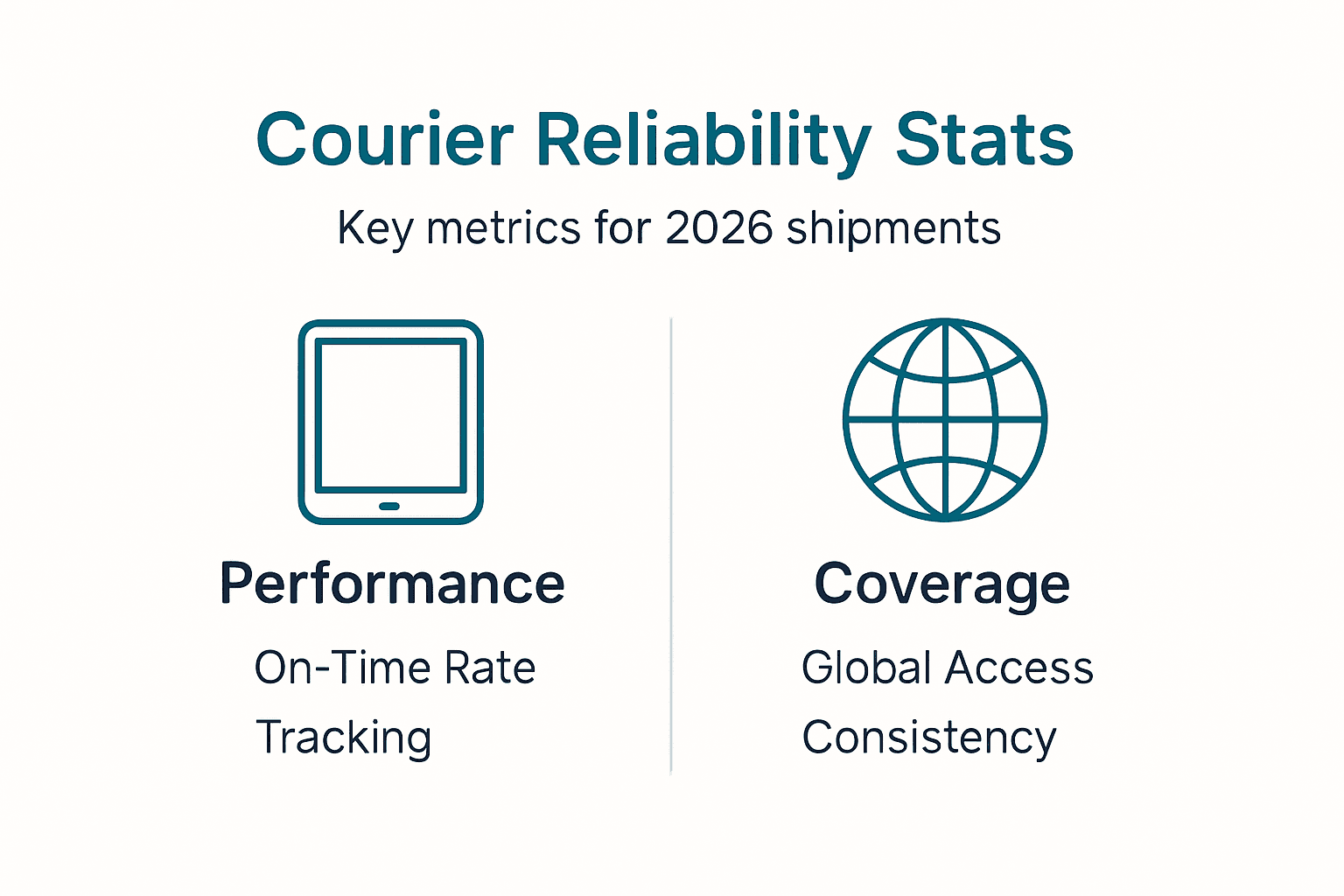
Not all courier services deliver the same level of performance. The best providers share specific characteristics that separate them from competitors struggling with inconsistent service quality. Reliable courier services maintain over 95% on-time delivery performance even during peak seasons, critical for ecommerce sellers who cannot afford holiday shipping disasters.
On-time delivery rates form the foundation of courier reliability. Anything below 95% indicates systemic problems that will hurt your business. Top tier couriers achieve 97-98% on-time performance by investing in route optimization, backup capacity, and proactive exception management. These metrics should be verifiable through historical performance reports, not just marketing claims.

Real-time tracking technology has become non-negotiable for ecommerce logistics. GPS enabled visibility lets you and your customers monitor shipments at every stage. Mobile notifications alert recipients about delivery windows, reducing failed delivery attempts. This transparency builds customer confidence and cuts support ticket volumes significantly. Understanding delivery performance metrics helps you evaluate tracking capabilities accurately.
Transparent pricing models prevent budget surprises that erode profit margins. Reliable couriers provide detailed rate cards showing base shipping costs plus all potential surcharges upfront. Hidden fees for fuel, residential delivery, dimensional weight, or peak season adjustments destroy financial planning. You need complete cost visibility before committing to a shipping partner.
Key features that signal genuine reliability include:
- Automated customs clearance reducing border delays
- Dedicated account support for issue resolution
- Flexible pickup scheduling accommodating your fulfillment workflow
- Claims processes that actually reimburse for lost or damaged shipments
- Platform integrations syncing tracking data with your ecommerce system
Pro Tip: Request sample shipment reports covering the past 90 days to verify a courier’s actual delivery and tracking performance before signing contracts. Marketing materials often exaggerate capabilities that real operational data reveals accurately.
Consistent service quality across all destination countries distinguishes elite couriers from those with spotty coverage. You need partners who perform equally well shipping to major cities and remote regions. Review courier performance features that impact your specific shipping lanes before making final decisions.
Comparing top international courier providers for ecommerce
Four major carriers dominate international shipping for US ecommerce sellers, each offering distinct advantages depending on your business model and target markets. Understanding their differences helps you match service capabilities to your operational requirements.
| Provider | Global Coverage | Technology Strengths | Delivery Speed | Best For |
|---|---|---|---|---|
| DHL | 220+ countries | Advanced tracking, customs automation | 1-4 business days | High value shipments, Europe/Asia markets |
| FedEx | 220+ countries | Platform integrations, robust API | 2-5 business days | Mid to large volume sellers, time-sensitive goods |
| UPS | 220+ countries | Comprehensive domestic network | 2-5 business days | Sellers balancing domestic and international shipping |
| USPS International | 190+ countries | Cost effective tracking | 6-10 business days | Small sellers, lightweight parcels |
DHL has operated over 50 years delivering global logistics with extensive warehousing and distribution, making it a top choice for complex ecommerce international shipping needs. Their strength lies in European and Asian markets where they maintain the densest networks and fastest customs clearance. DHL’s technology platform provides granular tracking and proactive delay notifications that help you manage customer expectations effectively.
FedEx excels at ecommerce platform integrations, offering plugins and APIs that sync seamlessly with Shopify, WooCommerce, and Amazon seller accounts. Their customs brokerage services handle documentation efficiently, reducing clearance delays that plague less experienced shippers. FedEx maintains over 95% on-time delivery performance even during peak seasons, providing consistency when holiday order volumes spike.
UPS provides balanced domestic and international coverage, making them ideal for sellers shipping significant volumes both within the US and abroad. Their technology investments include machine learning tools predicting delivery exceptions before they occur. UPS Access Point locations give recipients flexible pickup options when home delivery fails.
USPS International offers the most budget-friendly option for sellers testing new markets or shipping lightweight products. While slower than express couriers, USPS provides reliable tracking and reasonable delivery windows for price-sensitive customers. Their flat rate international boxes simplify pricing for standard sized items.
Comparing these providers requires evaluating your specific needs around delivery speed commitments, destination country priorities, and technology requirements. A comprehensive courier providers comparison should examine not just advertised rates but actual delivered costs including surcharges and dimensional weight pricing.
Common misconceptions about international courier reliability
Several persistent myths mislead ecommerce sellers when selecting international courier partners, resulting in poor service choices that damage customer relationships and inflate shipping costs unnecessarily.
Myth: The cheapest courier always provides the best value. Reality: Lowest cost does not guarantee reliability; services balancing cost with delivery performance achieve better satisfaction. Cheap carriers often sacrifice tracking visibility, customer support, and claims processing that become expensive when problems arise. Calculate total cost of ownership including your time resolving shipping issues, not just the base rate.
Myth: All major couriers offer equivalent tracking technology. Reality: Tracking sophistication varies dramatically between providers. Some offer only origin scan, destination scan, and delivery confirmation. Others provide GPS granularity showing your package location every few hours. Mobile app quality, notification options, and estimated delivery windows differ significantly. Test each courier’s tracking interface before committing to contracts.
Myth: Customs delays result from courier inefficiency. Reality: Government regulatory processes cause most customs delays, not courier performance. However, experienced couriers minimize these delays through accurate documentation, harmonized tariff code expertise, and established relationships with customs officials. Poor couriers submit incomplete paperwork that triggers inspections and extended holds.
Myth: Larger shipping volumes automatically qualify you for better rates. Reality: Volume discounts exist, but small sellers using aggregator services sometimes access better pricing than mid-size shippers negotiating directly. Your negotiating leverage depends on shipping lane concentration, package characteristics, and relationship history, not just volume alone.
Key realities to remember:
- Insurance claims require detailed documentation that many sellers fail to maintain
- Delivery guarantees often contain exclusions for weather, customs, and remote locations
- Published transit times represent averages, not commitments for every shipment
- Peak season surcharges can increase costs by 30-50% during November and December
Pro Tip: Verify a courier’s customs brokerage capabilities and documentation support before signing contracts, especially if you ship regulated products like cosmetics, electronics, or food items requiring special certifications.
Understanding these misconceptions prevents costly mistakes that undermine your international expansion efforts. Reliable courier selection requires looking beyond surface level marketing claims to evaluate actual operational performance in your specific shipping scenarios.
Leveraging technology and automation for enhanced shipping reliability
Technology separates reliable modern couriers from those stuck using outdated manual processes that introduce errors and delays. Understanding how automation improves shipping reliability helps you prioritize technology enabled partners over legacy providers.
Automated customs clearance represents the single biggest technology advantage for international shipping. Automated customs clearance reduces delays by about 30% and platform integration lowers errors while boosting speed. Digital systems validate harmonized tariff codes, calculate duties accurately, and submit documentation electronically to customs authorities. This eliminates the paper-based workflows that cause multi-day border delays.
Key automation technologies improving courier reliability:
- Electronic data interchange (EDI) syncing order details from your ecommerce platform to courier systems without manual entry
- Optical character recognition (OCR) scanning shipping labels and invoices to catch addressing errors before dispatch
- Machine learning algorithms predicting delivery exceptions and rerouting packages proactively
- Blockchain enabled documentation providing tamper-proof customs records that speed clearance
- IoT sensors monitoring temperature and shock for fragile or perishable goods during transit
Ecommerce platform integration eliminates the fulfillment bottlenecks that occur when shipping data requires manual transfer between systems. Direct API connections pull order information, generate labels, upload tracking numbers, and trigger customer notifications automatically. This reduces labor costs and the shipping errors that frustrate customers. Explore customs automation benefits for your specific product categories.
Mobile apps and GPS tracking transform customer experience by providing shipment visibility that builds confidence. Push notifications alerting recipients about approaching deliveries reduce failed attempts requiring redelivery. Two-way communication letting customers reschedule deliveries or redirect to pickup locations increases successful first-time delivery rates significantly.
Real-time analytics dashboards aggregate performance data across all shipments, helping you identify patterns in delays, damage rates, and cost variances. This visibility enables data-driven decisions about courier selection, packaging improvements, and destination market priorities. Advanced shipment tracking technology provides the operational intelligence necessary for scaling internationally.
Pro Tip: Choose couriers offering APIs or plugins compatible with your ecommerce platform to enable seamless automation, reducing manual data entry errors that cause shipping delays and customer complaints.
Technology adoption differentiates couriers committed to continuous improvement from those maintaining outdated systems that cannot scale with modern ecommerce demands. Prioritize partners investing in automation that directly benefits your shipping operations.
Cost factors and pricing transparency in international shipping
Shipping costs represent one of the largest variable expenses for ecommerce businesses, making pricing transparency essential for maintaining profit margins as you scale internationally. Understanding 2026 rate structures and hidden fees helps you budget accurately and negotiate better contracts.
Carrier rate increases in 2026 average between 8-12%, including surcharges and dimensional weight changes. This continues the trend of annual price escalations that outpace general inflation. Sellers must factor these increases into pricing strategies and margin calculations to avoid profitability erosion.
Dimensional weight pricing has become standard across all major carriers, charging based on package volume rather than actual weight for lightweight bulky items. A small pillow weighing one pound but occupying a large box might be charged as if it weighs eight pounds. This significantly impacts sellers of apparel, home goods, and other products with unfavorable weight-to-volume ratios. Calculate dimensional weight (length × width × height ÷ 139 for international shipments) before quoting shipping costs to customers.
Key surcharges impacting total shipping costs:
- Fuel surcharges fluctuating weekly based on diesel prices, typically adding 15-25% to base rates
- Peak season surcharges during November and December adding $3-6 per package
- Residential delivery fees for non-commercial addresses adding $4-5 per shipment
- Address correction fees when recipients provide incomplete information adding $15-20
- Customs clearance fees for brokerage services adding $25-75 depending on shipment value
Transparent pricing is essential for ecommerce cost management amid rising carrier rates. Reliable couriers provide detailed fee schedules showing all potential charges upfront. Hidden fees discovered after shipment completion destroy financial planning and erode customer trust when you must absorb unexpected costs.
International distribution tariffs and surcharges vary by destination country and product category. Some nations impose value-added taxes, import duties, or regulatory fees that recipients must pay before customs release. Understanding these destination-specific costs prevents customer complaints about unexpected charges.
Negotiating favorable rates requires understanding your shipping profile including average weight, destination mix, and volume predictability. Couriers offer better pricing to shippers with consistent volumes on popular lanes. Small sellers can access competitive rates through shipping aggregators or third-party logistics providers pooling volume across multiple clients.
Use detailed cost breakdowns to forecast shipping expenses accurately as part of your overall logistics budget. Monitor rate changes quarterly and renegotiate contracts annually to ensure you receive competitive pricing as your volume grows.
How to choose the right international courier service for your ecommerce business
Selecting the optimal courier partner requires systematic evaluation of your specific business requirements, shipping patterns, and growth objectives. Following a structured decision process prevents costly mistakes that lock you into unsuitable contracts.
Step-by-step courier selection criteria:
- Map your destination country priorities and required delivery speeds to identify couriers with strongest coverage in your target markets
- Evaluate technology compatibility by testing each courier’s API or plugin with your ecommerce platform’s order management system
- Request detailed pricing proposals including all surcharges and dimensional weight calculations for representative shipments
- Verify reliability claims by examining published performance data showing on-time delivery rates for the past 12 months
- Test customer service responsiveness by submitting sample inquiries and measuring response time and solution quality
- Review insurance coverage limits and claims procedures to ensure adequate protection for your product values
- Negotiate service level agreements establishing performance guarantees with financial penalties for failures
Your business size significantly impacts which courier provides the best fit. Small sellers shipping under 100 packages monthly often find USPS International or regional carriers offer the best combination of affordability and adequate service. Mid-size sellers moving 100-1000 packages benefit from direct relationships with FedEx or UPS providing volume discounts and dedicated support. Large sellers exceeding 1000 monthly shipments should negotiate custom contracts with multiple carriers, using different partners for different shipping lanes based on competitive strengths.
Destination market characteristics matter more than global coverage statistics. A courier serving 220 countries provides little value if they perform poorly in the five countries generating 80% of your international revenue. Prioritize excellence in your core markets over breadth of coverage in regions you rarely ship to.
Balance competing priorities between cost, speed, and reliability based on your customers’ expectations and willingness to pay for shipping. Budget conscious customers accept slower USPS delivery saving $10-15 per package. Premium customers expect 2-3 day express service regardless of cost. Segment your shipping options by customer type and product category rather than using one courier for everything.
Regularly review courier performance quarterly using data from your shipping platform. Track metrics including on-time delivery percentage, average transit time, damage rates, and cost per package. Replace underperforming couriers when patterns emerge showing consistent problems. Learn more about choosing courier services that align with business goals.
Consider specialized options for specific scenarios:
- Courier services for small businesses starting international expansion
- Express air freight for time-sensitive or high-value products
- Consolidated ocean freight for heavy or oversized items
- Regional carriers in specific countries offering better local delivery than global providers
Your courier strategy should evolve as your business grows. The courier perfect for testing new markets often lacks the capacity or technology for scaling to thousands of daily shipments. Plan for transitions as you reach volume thresholds that justify enterprise-level courier partnerships. Understanding various shipping methods for ecommerce helps you adapt strategies as needs change.
Building a reliable cross-border shipping strategy
Successful international ecommerce requires more than selecting a good courier. You need a comprehensive shipping strategy integrating courier performance, technology enablement, cost management, and continuous improvement processes.
Prioritize reliability and technology when evaluating courier options, not just price. The cheapest shipping becomes expensive when poor performance generates customer complaints, return shipments, and negative reviews. Technology enabled couriers provide tracking visibility and automated processes that scale efficiently as your volume grows.
Key strategic elements for reliable cross-border shipping:
- Maintain continuous visibility through performance tracking dashboards monitoring on-time delivery, transit times, and cost trends
- Implement transparent pricing models showing customers actual shipping costs including duties and taxes before purchase
- Leverage automation tools eliminating manual data entry and documentation errors that cause delays
- Establish backup courier relationships preventing service disruptions when primary carriers face capacity constraints
- Position inventory strategically in regional warehouses reducing transit distances and delivery times
The ORNER global logistics platform helps ecommerce sellers integrate these strategic elements into unified operations management. Rather than juggling multiple courier portals and manual processes, centralized platforms provide single-pane visibility across all shipments regardless of carrier.
Consistent execution matters more than perfect courier selection. Even the best courier performs poorly if you provide inaccurate product descriptions, wrong harmonized codes, or incomplete customs documentation. Invest in training your fulfillment team on international shipping requirements specific to each destination country.
Monitor customer feedback about shipping experiences to identify improvement opportunities. Late deliveries, damaged packages, and unexpected customs charges all indicate process breakdowns requiring attention. Address systemic issues through courier performance discussions or operational changes rather than treating each incident as isolated.
Your shipping strategy should support business growth objectives, not constrain them. As you expand into new markets, evaluate whether current courier partners maintain service quality in those regions. Be willing to switch providers or add new ones when performance data shows consistent problems affecting customer satisfaction.
Explore ORNER’s global logistics platform for reliable courier services
Managing multiple international couriers across different shipping lanes creates operational complexity that slows fulfillment and increases errors. You need integrated solutions bringing together courier management, customs automation, and performance tracking in one system.
The ORNER global logistics platform streamlines international shipping by connecting you with multiple vetted courier partners through a single interface. Instead of logging into separate portals for DHL, FedEx, UPS, and regional carriers, you access all services through unified workflows that simplify shipping operations and reduce training time for fulfillment staff.
Advanced automation tools handle customs documentation, harmonized tariff classification, and duty calculation, reducing the clearance delays that frustrate customers expecting prompt delivery. Real-time tracking notifications keep you and your customers informed about shipment status without manual status checking across multiple courier websites.
Transparent pricing analytics aggregate cost data across all couriers and shipping lanes, identifying opportunities to optimize carrier selection based on actual delivered costs rather than quoted rates. This visibility helps you negotiate better contracts and make data-driven decisions about which couriers to use for specific destinations. Strategic warehouse location strategy combined with courier optimization reduces total delivery time and cost.
ORNER’s platform scales with your business from initial international expansion through high-volume cross-border operations. Whether you ship 50 packages monthly or 5,000 daily, the system provides the courier management capabilities and analytics necessary for maintaining reliable delivery performance. Access proven best courier service tips through integrated platform resources.
Frequently asked questions about reliable international courier services
What delivery performance qualifies a courier as reliable?
Reliable couriers maintain over 95% on-time delivery even during peak seasons, provide real-time tracking with proactive exception notifications, and resolve delivery failures within 24 hours. Verify performance through historical data covering at least 90 days rather than relying on marketing claims.
How do dimensional weight charges affect international shipping costs?
Dimensional weight pricing charges based on package volume rather than actual weight for lightweight bulky items. Calculate by multiplying length × width × height (in inches) then dividing by 139 for international shipments. If dimensional weight exceeds actual weight, carriers charge the higher amount.
Can small ecommerce sellers negotiate better courier rates?
Small sellers access competitive rates through shipping aggregators or third-party logistics providers pooling volume across multiple clients. Direct carrier negotiations typically require minimum monthly volumes of 500-1000 packages, though regional carriers may offer better rates at lower volumes.
What customs documentation do international couriers require?
Standard requirements include commercial invoices detailing product descriptions and values, harmonized tariff codes, country of origin declarations, and customs value justification. Regulated products like cosmetics, electronics, or food require additional certificates varying by destination country.
How should I handle courier performance problems?
Document specific incidents with tracking numbers, delivery dates, and customer impacts. Request formal performance reviews quarterly showing on-time percentage, average transit time, and damage rates. Consider replacing couriers when metrics fall below 95% on-time delivery for two consecutive quarters.
Do all international couriers offer insurance coverage?
Most couriers include basic liability coverage of $100 per package, inadequate for higher value shipments. Purchase additional declared value coverage for items exceeding this limit, typically costing 1-3% of shipment value. Review claims procedures before problems occur as documentation requirements vary significantly.
Recommended
- Reliable Courier Services in the USA – ORNER
- Understanding Reliable Courier Services for Ecommerce Success – ORNER
- Types of Courier Services for Ecommerce and Global Brands 2025 – ORNER
- Business Networking Strategies for Reliable Courier Services – ORNER
- Talvirenkaiden ostopas 2026: 70% nopeammat toimitukset