
TL;DR:
- Proper preparation and understanding of shipment needs prevent costly delays and errors.
- Choosing the right freight mode depends on volume, urgency, and product requirements.
- Continuous tracking and performance review optimize costs and ensure reliable deliveries.
Freight shipping mistakes cost e-commerce sellers more than money. A missed document, a wrong carrier choice, or a poorly timed booking can delay your entire inventory, frustrate customers, and eat into your margins fast. For small merchants and global brands alike, the freight booking process can feel like navigating a maze with no map. This guide breaks it down into clear, actionable steps so you can plan smarter, book with confidence, and track every shipment from origin to destination. Whether you’re shipping your first container or optimizing a high-volume operation, you’ll find practical frameworks here that actually work.
Table of Contents
- Defining your freight needs: The starting point
- Selecting the right mode and service
- Preparing documentation and ensuring compliance
- Booking, tracking, and optimizing your shipments
- The real secret to mastering freight booking
- Streamline your next freight booking
- Frequently asked questions
Key Takeaways
| Point | Details |
|---|---|
| Know your shipping needs | Clearly defining volume, urgency, and requirements is crucial for cost-effective, reliable freight. |
| Choose the right mode | Pick between LTL, FTL, air, or ocean based on benchmarks and delivery priorities. |
| Documents and compliance matter | Missing or incorrect paperwork is the top reason for preventable shipping delays in e-commerce. |
| Track and optimize shipments | Data-driven platforms help save money and improve reliability by continuously tracking and adjusting shipments. |
Defining your freight needs: The starting point
Before you touch a booking platform or call a freight broker, you need to know exactly what you’re shipping and why it matters. The freight booking process starts with a clear picture of your shipment’s core requirements. Skip this step and you’ll end up paying for the wrong service, missing delivery windows, or worse, having your goods held at customs.
Four factors drive every freight decision you’ll make:
- Volume: How much are you shipping? A few pallets or a full container?
- Urgency: Does your customer need it in three days or three weeks?
- Destination: Domestic, cross-border, or international?
- Product type: Is it fragile, temperature-sensitive, oversized, or hazardous?
These factors directly determine whether you need LTL (less-than-truckload) or FTL (full-truckload) shipping. LTL means your goods share truck space with other shippers, which lowers cost but adds transit time. FTL means you book the entire truck, which is faster and more secure but costs more. As a key step in the freight booking checklist, defining your volume and urgency upfront saves you from expensive last-minute changes.
Here’s a quick comparison to guide your initial decision:
| Shipment size | Best option | Avg. cost factor | Typical transit time |
|---|---|---|---|
| Under 10 pallets | LTL | Lower | 3 to 7 days |
| 10 or more pallets | FTL | Higher | 1 to 3 days |
| Time-critical, small | Air courier | Highest | 1 to 2 days |
| Large volume, slow | Ocean freight | Lowest | 15 to 45 days |
Special requirements also shape your mode choice early. If you’re shipping perishables, you need refrigerated (reefer) trucking or air. If you’re moving high-value electronics, you want a carrier with strong security protocols. Fragile goods need specific packaging certifications and carrier handling standards.
Understanding LTL vs FTL shipping at this stage prevents you from locking into a service that doesn’t fit your product or timeline. The more specific you are upfront, the fewer surprises you’ll face downstream.
Pro Tip: Build a standard shipment profile for your most common product lines. Include weight, dimensions, destination, and any special handling needs. This cuts your booking prep time in half and reduces data entry errors.
Selecting the right mode and service
Once your needs are clear, the next step is picking the best way to move your freight. Each transport mode has a different cost structure, speed, and reliability profile. Choosing wrong here is one of the most common and costly mistakes e-commerce sellers make.
Here’s a direct comparison of the four main freight modes:
| Mode | Best for | Cost | Speed | On-time rate |
|---|---|---|---|---|
| LTL truck | Small to mid shipments | Low to mid | 3 to 7 days | 85 to 90% |
| FTL truck | Large or high-value loads | Mid to high | 1 to 3 days | 92 to 95% |
| Air freight | Urgent, small, high-value | Highest | 1 to 2 days | 90 to 95% |
| Ocean freight | Bulk, non-urgent, global | Lowest | 15 to 45 days | 60 to 80% |
Notice that ocean freight has the lowest on-time rate. That’s a critical insight for sellers who depend on predictable inventory replenishment. If you’re shipping to Amazon FBA warehouses with strict check-in windows, ocean freight’s variability can trigger receiving penalties.
How to choose your mode in four steps:
- Match urgency to speed. If your customer expects delivery in under a week, ocean is off the table.
- Match volume to capacity. Small shipments on FTL waste money. Large loads on LTL risk damage and delays.
- Factor in risk tolerance. High-value goods on ocean freight face longer exposure to loss or damage.
- Compare total landed cost. Air may seem expensive, but if it prevents a stockout that costs you $10,000 in lost sales, it’s the smarter choice.
For cross-border shipments, comparing sea vs air freight is worth the extra research time. The right choice depends heavily on your product margins and inventory cycle. A freight forwarding services comparison can also reveal cost differences between brokers that aren’t obvious at first glance.
Preparing documentation and ensuring compliance
With your shipping mode selected, reliable freight depends on the right paperwork and legal compliance. This is where many sellers lose time and money. A single missing or incorrect document can hold your shipment at customs for days, sometimes weeks.
Three documents are non-negotiable for almost every freight shipment:
- Bill of Lading (BOL): The legal contract between shipper and carrier. It describes the goods, origin, destination, and terms of transport.
- Commercial invoice: Details the sale transaction, including product descriptions, quantities, values, and buyer/seller information.
- Packing list: An itemized breakdown of what’s in each box or pallet, used by carriers and customs officials to verify contents.
As part of a solid freight booking checklist, preparing these documents accurately before booking prevents last-minute scrambles. Digital logistics platforms now allow you to generate and store these documents in one place, reducing the risk of version errors or missing attachments.
Incoterms (International Commercial Terms) are another layer of compliance you need to understand. They define who is responsible for shipping costs, insurance, and customs duties at each stage of the journey.
Key Incoterms for e-commerce sellers: DDP (Delivered Duty Paid) means the seller handles all costs and customs clearance to the buyer’s door. FOB (Free On Board) means the buyer takes responsibility once goods are loaded onto the vessel.
New sellers often prefer DDP because it simplifies the process. Experienced sellers frequently shift to FOB because it gives them more control over carrier selection and can reduce overall costs. Your choice depends on your experience level, your customer’s expectations, and your margin structure.
Explore your booking options for logistics to find platforms that automate document generation and flag compliance issues before they become problems.
Pro Tip: Always double-check that the product descriptions on your commercial invoice match exactly what’s on your packing list and BOL. Mismatches are the number one cause of customs holds for e-commerce shipments.
Booking, tracking, and optimizing your shipments
Confident in your documents, you’re ready for the digital booking and shipping optimization phase. This is where preparation meets execution, and where the best sellers separate themselves from the rest.
Here’s a practical booking workflow:
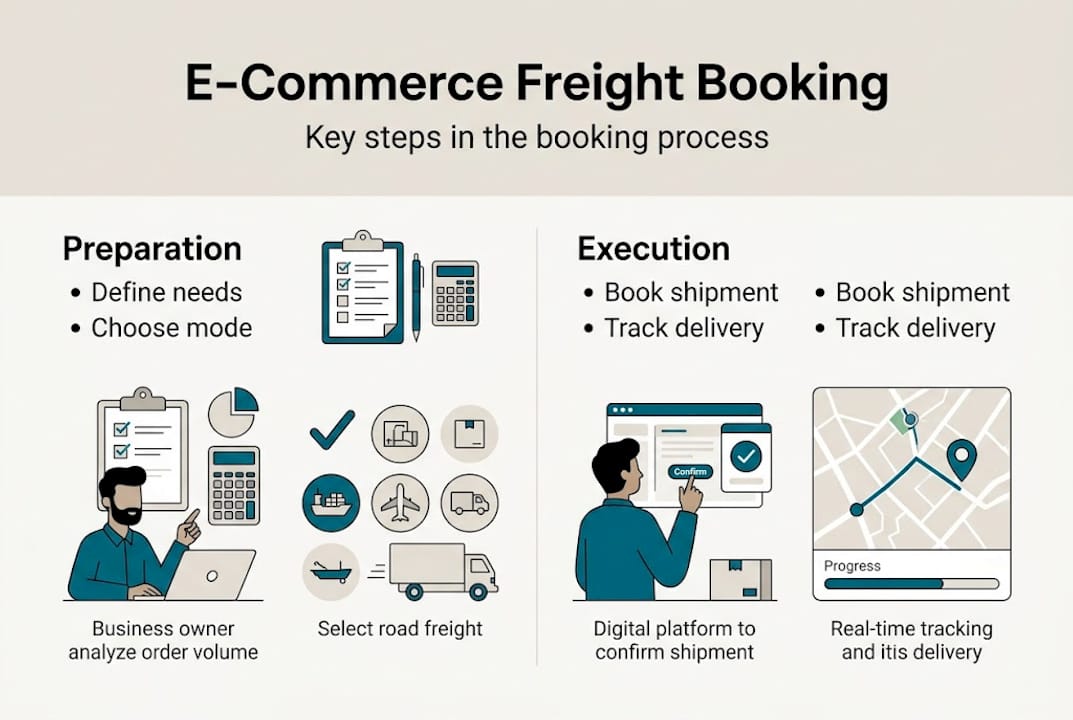
- Enter shipment details into your freight platform or share them with your broker. Include origin, destination, dimensions, weight, and special requirements.
- Compare quotes from multiple carriers. Don’t default to the cheapest. Factor in on-time rates and carrier reputation.
- Confirm and book your preferred carrier. Review all terms before confirming, especially pickup windows and liability limits.
- Generate and attach documents. Upload your BOL, commercial invoice, and packing list to the booking record.
- Track in real time. Use your platform’s tracking tools to monitor status from pickup to delivery.
- Verify delivery and review performance. Confirm receipt and log any exceptions like delays or damage.
Tracking isn’t just about knowing where your shipment is. It’s about building a performance record. Shippers who use data benchmarking save 5 to 15% on freight costs over time by identifying which carriers, routes, and modes consistently perform best for their specific needs. That’s real money back in your operation.

Here’s another number worth knowing: 43% of LTL shipments are adjusted after initial booking based on real-time feedback. That means nearly half of all LTL bookings get modified. Sellers who track performance data know when and why to make those adjustments.
Use shipping efficiency tips to build a continuous improvement loop. Every shipment gives you data. Use it to optimize logistics for the next one.
Pro Tip: Set a monthly review of your top five lanes. Compare planned vs. actual transit times and costs. Even small improvements per lane compound into significant annual savings.
The real secret to mastering freight booking
Here’s a perspective most freight guides won’t give you: technology is a tool, not a strategy. Platforms, algorithms, and automation are genuinely useful. But they don’t replace the judgment that comes from experience and honest self-review.
The sellers who consistently win at freight aren’t the ones with the fanciest software. They’re the ones who review their results, ask hard questions, and adapt. They know that new sellers prefer DDP simplicity while experienced operators use FOB for control and cost savings. That shift doesn’t happen automatically. It happens because someone paid attention, ran the numbers, and made a deliberate choice.
Freight mastery is an evolving practice. Carrier performance changes. Fuel surcharges fluctuate. Customs regulations shift. What worked last quarter may not be optimal today. The sellers who treat logistics as a living system, not a fixed process, are the ones who build real competitive advantage.
Explore ecommerce booking tips that go beyond the basics and keep your operation sharp as conditions change.
Streamline your next freight booking
Ready to put this into practice? At or-ner.com, we’ve built a platform specifically for e-commerce sellers who need reliable courier services and end-to-end freight visibility. From real-time tracking to customs clearance support, our tools are designed to remove the friction from every booking.
Start with our freight booking explained guide to see how the platform maps to each step in this process. Use our freight booking checklist to prepare your next shipment without missing a step. And when you’re ready to go deeper, master the booking process with our full 2026 framework built for growing e-commerce brands.
Frequently asked questions
What are the most important documents for freight booking?
You need a Bill of Lading, commercial invoice, and packing list for most shipments. These three documents cover legal, financial, and physical verification requirements across carriers and customs authorities.
How do I choose between LTL, FTL, air, or ocean freight?
Base your choice on shipment size, urgency, budget, and delivery location. On-time rates vary significantly across modes, from 60 to 80% for ocean to 92 to 95% for FTL, so reliability matters as much as price.
How can I save money on freight booking?
Data benchmarking and mode adjustments help shippers save 5 to 15% on costs over time. Reviewing lane performance monthly is the fastest way to find savings without sacrificing service quality.
What is the difference between DDP and FOB for e-commerce sellers?
DDP simplifies delivery for new sellers by putting all responsibility on the seller, while FOB gives experienced businesses more control over carrier selection and potential cost savings at origin.