

TL;DR:
- Proper freight booking practices directly impact ecommerce margins, customer satisfaction, and brand trust.
- Following a six-step workflow and benchmarking rates helps eliminate booking inefficiencies and overpayment.
- Using advanced tools like TMS platforms and automation enhances reliability, visibility, and long-term profitability.
Most ecommerce sellers are quietly bleeding margin on every single shipment. Without proper benchmarking, you’re likely overpaying 15-20% on freight costs you could easily control. The freight booking process sounds straightforward until late deliveries start eroding customer trust and refund requests pile up. This guide breaks down each step, compares your procurement options, and gives you the tools to fix the leaks fast. By the end, you’ll know exactly where the inefficiencies hide and how to eliminate them.
Table of Contents
- Why freight booking matters for ecommerce
- 6 essential steps of the freight booking process
- Procurement methods: Spot, contract, auction, or platform?
- Tools, tech, and best practices for freight booking success
- Our take: What most ecommerce guides miss about freight booking
- Streamline your next shipment with trusted logistics partners
- Frequently asked questions
Key Takeaways
| Point | Details |
|---|---|
| Booking impacts profits | Freight booking choices shape cost, delivery reliability, and customer retention for ecommerce businesses. |
| Follow key steps | A standardized, six-step booking process reduces errors and speeds up shipping. |
| Contracts and tech win | Contracts provide rate stability and digital platforms offer benchmarks to cut overpayment. |
| Automation boosts results | Use checklists and TMS to save time and ensure consistent success in freight booking. |
Why freight booking matters for ecommerce
Freight booking is not just a back-office task. It is a direct lever on your profitability, customer satisfaction, and brand credibility. Every missed delivery window chips away at repeat purchase rates, and in ecommerce, repeat buyers are where the real margin lives.
The numbers tell a clear story. Freight costs routinely consume 15-20% of gross margins for online sellers. When those costs are unmanaged, small inefficiencies stack up fast. A few percentage points of unnecessary spend across hundreds of monthly shipments becomes a serious profit problem by end of quarter.
Delivery reliability is equally critical. Average on-time delivery rates in ecommerce sit between 88-91%, but top-performing brands consistently hit 95-97%. That gap is not accidental. It reflects disciplined freight booking practices, proactive carrier management, and real-time tracking. When you streamline ecommerce shipping, you are directly investing in customer loyalty.
Here is what inefficient freight booking costs you in practice:
- Cost impact: Unoptimized routes and late carrier selection inflate per-shipment spend by double digits
- Service impact: Poor carrier vetting leads to delays, damaged goods, and customer complaints
- Competitive pressure: Rivals using digital platforms book faster and pass savings to customers
- Brand trust: Even one bad delivery experience reduces the probability of a repeat order significantly
“Reliability outperforms pure cost savings for long-term ecommerce success. Chasing the cheapest rate at the expense of consistency is a trade-off most growing brands cannot afford.”
Reading the freight booking tips used by high-volume sellers reveals a consistent theme: they treat freight as a strategic function, not an afterthought. Sellers who benchmark, automate, and track outperform those who simply book and hope.
Now that you understand why mastering freight booking is crucial, let’s demystify the exact steps involved.
6 essential steps of the freight booking process
The freight booking process has a logical sequence, and skipping any step creates downstream problems. Here is how it works in practice:
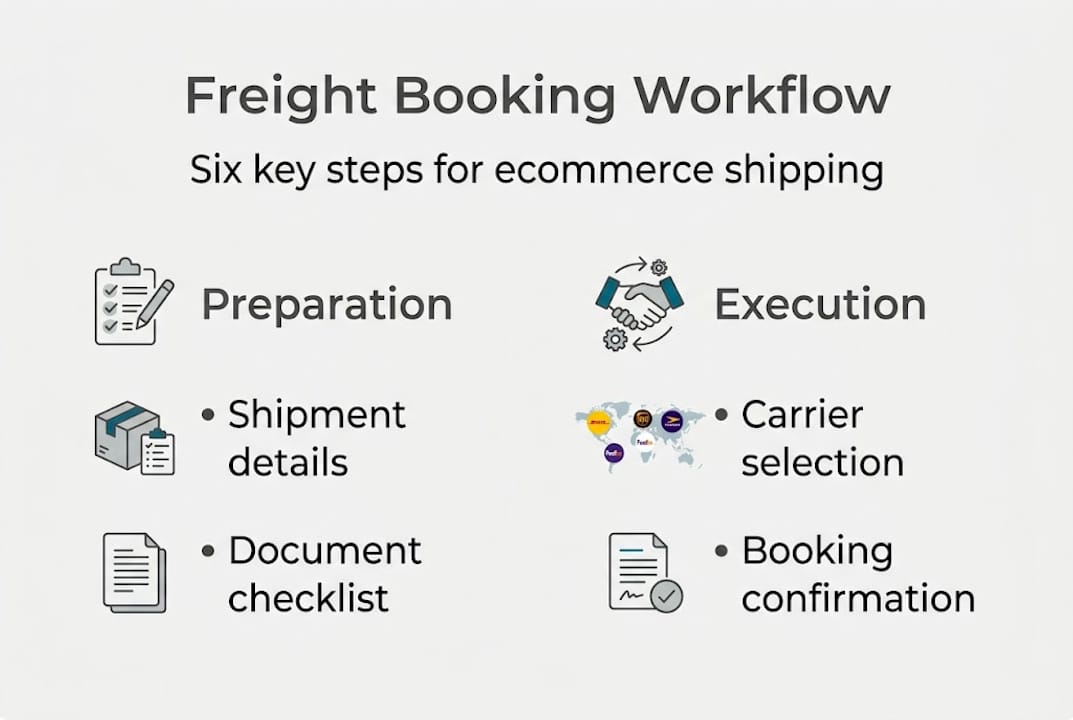
- Collect shipment details. Gather pickup and delivery addresses, cargo weight, dimensions, and Incoterms (the rules defining who handles cost and risk at each point). Missing details here delay everything that follows.
- Choose your procurement type. Decide whether you will use a freight broker, a digital marketplace, or a Transportation Management System (TMS). Each has different cost and control implications.
- Submit and compare quotes. Request rates across modes: Less-than-Truckload (LTL), Full Truckload (FTL), air freight, or ocean. Comparing at least three quotes protects you from overpaying.
- Book the shipment and receive your Bill of Lading (BOL). The BOL is your legal proof of shipment and a critical document for dispute resolution and customs. Never ship without one.
- Track and manage in-transit delivery. Real-time visibility lets you catch delays early and communicate proactively with customers before they have to ask.
- Handle customs and final-mile delivery. For international shipments, customs clearance documentation must be accurate and complete. Final-mile execution is where customer experience is made or broken.
The table below summarizes each step with the key stakeholders and documents involved:
| Step | Key stakeholder | Required document |
|---|---|---|
| Collect shipment details | Seller, warehouse team | Packing list, weight specs |
| Choose procurement type | Logistics manager | Vendor contracts, platform login |
| Compare quotes | Freight broker or TMS | Rate sheets, lane data |
| Book shipment | Carrier, forwarder | Bill of Lading (BOL) |
| Track in-transit | Carrier, TMS dashboard | Tracking confirmation |
| Customs and final-mile | Customs broker, courier | Commercial invoice, duties paperwork |
As the master freight booking guide confirms, these six steps form the backbone of any reliable booking workflow. Following the freight booking checklist format keeps your team aligned across every shipment.

Pro Tip: Using a standardized checklist before each booking reduces preparation errors and can speed up your overall booking time by 40%. Build it once, use it on every shipment, and train your team around it.
For sellers new to international shipping, reviewing a detailed freight forwarding procedure helps clarify what customs expects at each border crossing.
With the sequential flow clear, it’s vital to understand the advantages and drawbacks of different booking methods.
Procurement methods: Spot, contract, auction, or platform?
Choosing your procurement method is one of the highest-leverage decisions in freight management. Each approach carries different tradeoffs on cost, speed, and how well it integrates with your ecommerce operation.
Here is how the main options compare:
| Method | Cost predictability | Speed | Automation | Ecommerce fit |
|---|---|---|---|---|
| Spot market | Low (volatile) | Fast | Minimal | Low volume or urgent |
| Contract | High (stable) | Moderate | Moderate | Growing, steady volume |
| Auction | Medium | Moderate | Low | Cost-sensitive shippers |
| Digital marketplace | Medium-High | Very fast | High | All ecommerce sizes |
| TMS platform | High | Fast | Very high | High-volume operations |
Spot markets offer volatile rates that swing with capacity and demand. They work for one-off loads but are unpredictable for sellers who need consistent costs. Contracts add stability and are best for sellers with predictable shipping volume month over month. Auctions can deliver savings but require time and expertise to manage well.
Digital marketplaces give you speed and instant comparison, which is exactly what ecommerce sellers need during peak seasons. Brokers can negotiate cost effectively, but digital platforms win on automation and integration with your existing systems.
Use each method strategically:
- Spot: One-off or urgent shipments with flexible timelines
- Contract: Regular lanes with predictable freight volume
- Auction: Large loads where price is the primary driver
- Digital marketplace: Daily ecommerce shipping with speed and visibility needs
- TMS: Scaling operations that need full workflow automation
Exploring your freight booking options in detail helps you match the method to the shipment type. For a side-by-side look at tools, comparing digital freight platforms shows exactly where each solution excels.
Pro Tip: Benchmark your rates quarterly. Rate environments shift, and sellers who skip benchmarking regularly find themselves overpaying by 15-20% compared to the current market. Build a quarterly rate review into your logistics calendar.
Choosing the correct procurement method sets you up for smoother, more reliable logistics, but efficiency also depends on powerful tools and key best practices.
Tools, tech, and best practices for freight booking success
The difference between a seller who consistently hits 95%+ on-time delivery and one stuck at 88% often comes down to tools and discipline, not luck.
A Transportation Management System centralizes your quoting, booking, tracking, and reporting in one place. Instead of emailing carriers individually and manually reconciling invoices, a TMS automates the entire workflow. The result is faster booking, fewer errors, and full visibility into what each shipment actually costs. Optimizing ecommerce logistics through a TMS also generates the data you need to negotiate better contract rates over time.
For sellers fulfilling through Amazon FBA, structured checklists are non-negotiable. FBA has strict packaging, labeling, and scheduling requirements. Checklists reduce errors and prep time by 40%, which means fewer rejected shipments and fewer chargebacks from the warehouse.
“What gets measured and standardized always outperforms what just gets negotiated. Sellers who build checklists and use TMS integrations stop firefighting and start scaling.”
Here are the best practices that consistently separate high-performing ecommerce sellers from the rest:
- Book early for peak seasons. Carrier capacity tightens fast in Q4 and around major retail events. Waiting costs you both rate and availability.
- Work with ecommerce-focused forwarders. Generalist carriers often lack the integrations and last-mile experience that online sellers need.
- Benchmark rates quarterly against market data like ecommerce delivery benchmarks to ensure you are not overpaying on established lanes.
- Automate where possible. Use platform integrations to auto-generate BOLs, trigger tracking notifications, and flag exceptions before they become crises.
- Review exceptions weekly. Delayed or damaged shipments should trigger a root cause review, not just a replacement order.
With practical tools and tactics in hand, how should ecommerce leaders approach freight booking for long-term success?
Our take: What most ecommerce guides miss about freight booking
Most freight booking guides stop at “get the lowest rate.” That advice sounds sensible, and it is completely wrong as a long-term strategy.
Price is one variable in a system of interdependent decisions. Chasing the cheapest rate without evaluating carrier reliability, booking lead times, or documentation accuracy is how sellers end up with warehouse receiving delays, customs holds, and furious customers waiting for orders that are stuck somewhere unexplained.
What actually drives sustainable margin improvement is process rigor. A solid booking workflow with standardized checklists, a TMS, and quarterly rate benchmarking consistently outperforms any one-off deal a seller negotiates. The advanced freight booking strategies that high-volume operators use share one common thread: they automate the repeatable work so their teams can focus on exceptions and customer experience, not fixing documentation errors.
The uncomfortable truth is that most ecommerce shipping problems are upstream booking problems. Fix the process, and the delivery performance follows.
Streamline your next shipment with trusted logistics partners
You now have a clear picture of how freight booking works, which procurement methods fit your operation, and which tools will move the needle. The next step is putting it into action with a platform built specifically for ecommerce sellers.
ORNER gives you end-to-end freight booking support across ocean, air, and land, with real-time tracking and customs clearance built in. Whether you are shipping domestically or cross-border, the global logistics platform connects you to reliable courier services and a worldwide fulfillment network. Start with the ecommerce shipping checklist to get your next shipment organized and ready to move without errors or delays.
Frequently asked questions
What documents are required for freight booking?
Most shipments require a Bill of Lading (BOL), detailed shipment specs, and, for international moves, a commercial invoice and customs documentation. The BOL serves as both the shipping contract and legal proof of cargo receipt.
How do I choose between spot, contract, or digital marketplace booking?
Different procurement methods vary in cost predictability, speed, and automation. Contracts suit steady volume, spot works for urgent or one-off loads, and digital marketplaces give ecommerce sellers the fastest quote comparison and booking speed.
How can I avoid overpaying for freight?
Benchmark your rates quarterly and use instant-quote platforms to compare live options. Skipping this step means you risk overpaying by up to 20% compared to the current market rate on your regular lanes.
Are digital freight booking tools safe?
Reputable platforms like Freightos and established TMS providers are designed with ecommerce security in mind, offering instant quotes and automated tracking with full transparency across every shipment stage.