
TL;DR:
- Most ecommerce businesses lose revenue not because of product issues but due to delivery failures that damage customer experience. Managing courier performance as an end-to-end system and leveraging technology like real-time tracking and address validation enhances reliability and reduces costs. Building strategic, performance-focused relationships with multiple couriers creates a competitive advantage and improves overall delivery success.
Most ecommerce businesses losing money don’t have a product problem. They have a delivery problem. Specifically, they’re bleeding revenue through failed first-attempt deliveries, opaque handoffs, and courier partnerships treated as a line item rather than a strategic lever. Research on delivery performance shows that courier performance, when managed as an end-to-end system rather than a cost, separates growing brands from stagnant ones. This guide covers what reliable courier services actually do, how to evaluate them, and where the real operational gains are hiding.
Table of Contents
- Courier services vs. traditional shipping: A technology and reliability comparison
- The operational backbone: How couriers enable ecommerce at every stage
- Last-mile delivery: Solving the most complex and costly challenge
- Courier management, optimization, and the rise of aggregators
- Why courier services are a competitive advantage (if you treat them as a system)
- Enhance your ecommerce logistics and delivery with expert courier solutions
- Frequently asked questions
Key Takeaways
| Point | Details |
|---|---|
| Courier tech advantages | Modern couriers give ecommerce businesses powerful tools like tracking and proof of delivery for better control and reliability. |
| End-to-end value | Treating courier management as a system boosts efficiency and ensures a smoother customer experience. |
| Conquering last mile | Optimizing last-mile delivery reduces costs and makes delivery promises easier to keep. |
| Aggregator benefits | Courier aggregators simplify logistics by letting you choose the right partner for every shipment. |
| Strategic partnerships | Your courier strategy should go beyond cost, focusing on relationship, data, and mutual outcomes. |
Courier services vs. traditional shipping: A technology and reliability comparison
Before diving into operational strategies, it’s crucial to understand how courier services truly stand apart from traditional shipping options.
At the surface level, both courier services and postal systems move packages from A to B. But the similarities end there. Traditional postal systems are built for volume and low cost. Courier services are built for accountability, speed, and customer experience. For ecommerce sellers managing customer expectations in 2026, that distinction is not minor. It’s the difference between a one-star review and a repeat buyer.
When you use understanding reliable courier services as your operational benchmark, you start looking beyond price per shipment. You look at traceability, handling standards, communication frequency, and what happens when something goes wrong.
Modern courier services provide tracking software and proof-of-delivery and use door-to-door delivery options to improve reliability versus postal alternatives. That’s not a minor feature upgrade. In ecommerce, a customer who can see exactly where their package is converts into a long-term buyer. A customer left wondering doesn’t.
Here’s a practical comparison of the core differences:
| Feature | Courier services | Traditional postal |
|---|---|---|
| Delivery speed | 1 to 3 days (express options) | 3 to 10+ days |
| Real-time tracking | Yes, full visibility | Limited or delayed |
| Proof of delivery | Digital signature, photo | Rarely included |
| Handling standards | Dedicated, accountable | Bulk processing |
| Customer communication | Proactive, automated alerts | Minimal |
| Flexibility | Rescheduling, re-routing | Rigid |
| Cost | Higher per shipment | Lower per shipment |
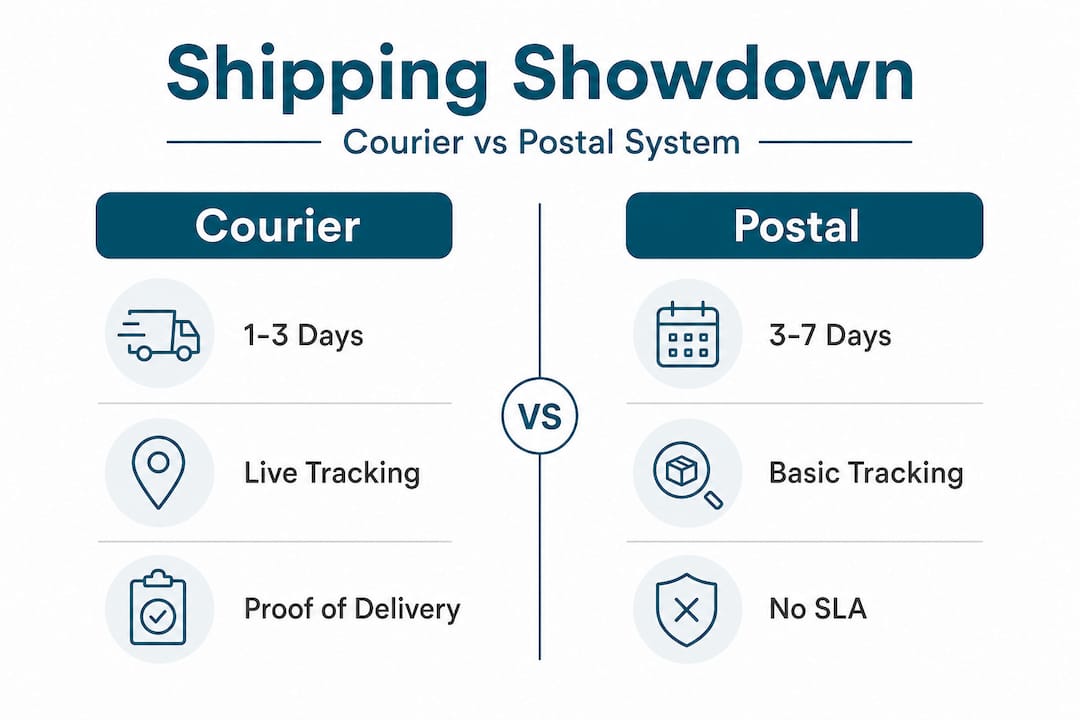
The cost column is where many ecommerce operators stop reading. That’s a mistake. Postal shipments that fail to arrive, arrive damaged, or arrive without any notification create customer service costs, refund cycles, and reputational damage that dwarf the initial per-shipment savings.
Key features to prioritize when evaluating any courier for your courier services for ecommerce success:
- Real-time GPS tracking with shareable tracking links
- Automated customer notifications at key shipment milestones
- Digital proof of delivery with timestamps and photos
- Defined SLAs (service level agreements) for on-time rates
- Clear escalation paths for exceptions and delays
“The question isn’t whether to use courier services over postal. The question is which courier system integrates best with your operations, your customers’ expectations, and your growth stage.”
The operational backbone: How couriers enable ecommerce at every stage
Now that the big-picture differences are clear, let’s explore exactly how courier services function as the backbone of modern ecommerce operations.
A standard ecommerce shipment passes through multiple critical stages between a warehouse and a customer’s door. Each stage is a potential failure point. Each failure point costs you money, customer trust, or both. Understanding these handoffs is step one in managing couriers intelligently.
Here’s how the journey typically looks:
- Order confirmation and pick/pack. Your warehouse team or fulfillment center prepares the order. Courier labels are generated and attached.
- Courier pickup or drop-off. The package transfers from your facility to the courier’s network. This handoff is where SLA clocks start ticking.
- Sorting and routing. Packages move through regional hubs and are sorted by destination zone, weight class, and service tier.
- Transit and tracking updates. The shipment moves through the network with scan-based tracking events triggering automated customer notifications.
- Last-mile dispatch. Local delivery agents receive optimized route assignments based on delivery density and time windows.
- Delivery attempt and confirmation. The agent attempts delivery, captures proof, and marks the shipment as complete or failed.
- Exception handling. Failed attempts, address corrections, or returns are flagged and managed through a defined process.
Courier performance should be managed as an end-to-end system covering handoffs, routing, dispatch SLAs, last-mile attempt success, and customer communication, not as a single “shipping cost” line item. This is the insight most logistics managers miss until they’ve paid for it the hard way.
The table below maps courier-managed touchpoints to the business value they generate:
| Courier touchpoint | Ecommerce value |
|---|---|
| Pickup SLA compliance | Predictable order lead times |
| Real-time tracking updates | Reduced customer service inquiries |
| Proof of delivery | Dispute resolution and chargeback defense |
| Failed attempt management | Lower refund rates, better recovery |
| Customer communication | Higher post-purchase satisfaction scores |
For a complete end-to-end logistics overview, this is the framework that separates reactive logistics from proactive logistics. The former puts out fires. The latter prevents them.
Pro Tip: Ask every courier candidate to share their on-time delivery rate by zone, their first-attempt success rate, and their average exception resolution time. These three numbers tell you more about a courier partner than any sales pitch.
A common mistake is treating the handoff from your warehouse to the courier as the end of your responsibility. It isn’t. Your customers don’t care who dropped the ball. They care that their package didn’t arrive on time. That means your choosing a courier partner decision is as much a customer experience decision as it is a logistics one.
Last-mile delivery: Solving the most complex and costly challenge
With the courier’s operational role mapped, it becomes clear that their greatest test and opportunity for differentiation is the last mile.
The last mile refers to the final leg of delivery: from a local hub to the customer’s address. It sounds simple. In practice, it accounts for a disproportionate share of total shipping costs and an even larger share of delivery failures. Urban congestion, imprecise addresses, customer unavailability, and cash-on-delivery friction all pile up at this stage.
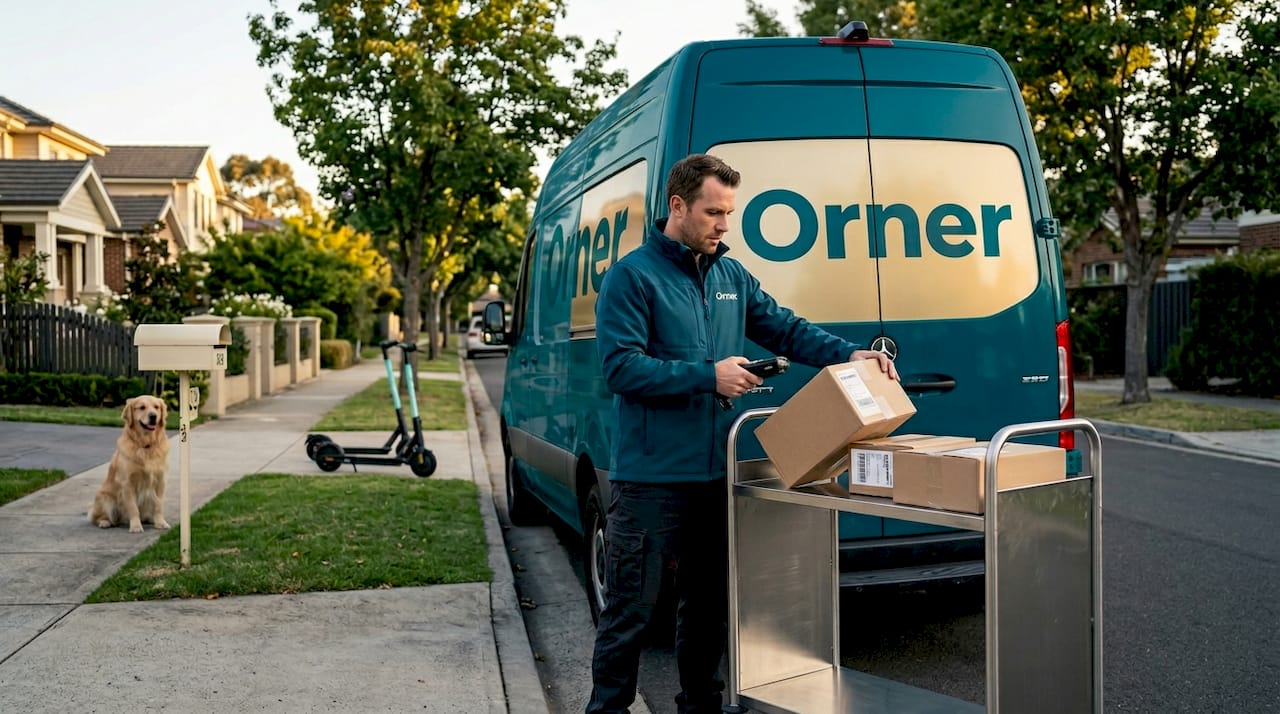
Last-mile execution is typically the most expensive and operationally intensive stage, and it is highly sensitive to urban complexity and process gaps. For ecommerce businesses operating at scale, this isn’t an abstract concern. Failed deliveries mean re-delivery costs, return processing, and in many markets, direct revenue loss if customers cancel.
The most common friction points at the last mile include:
- Address ambiguity. Incomplete or incorrect addresses are one of the leading causes of failed first attempts, especially in markets with informal addressing systems.
- Customer unavailability. Packages that arrive when no one is home require re-delivery scheduling, which drives up cost and delays resolution.
- Cash-on-delivery (COD) friction. In markets where COD is standard, the transaction itself adds a layer of complexity and failure risk that prepaid orders don’t face.
- Driver incentive misalignment. When drivers are rewarded purely for volume rather than successful delivery rates, failed attempts get marked as “attempted” without genuine effort.
- Urban density challenges. High-rise buildings, gated communities, and congested city centers create routing complexity that slows down delivery windows.
Modern couriers are addressing these issues with real technology interventions. GPS-based address pre-validation, where customers receive a confirmation request with a map pin before delivery, catches address errors before the truck rolls. Dynamic time-slot selection allows customers to pick a delivery window that works for them, cutting unavailability rates significantly. These aren’t luxury features. For last mile delivery solutions that actually move the needle, these tools are now baseline expectations.
Pro Tip: If your courier doesn’t offer address validation or customer-controlled delivery slot booking, you’re absorbing preventable failure costs. Ask specifically about these capabilities before signing any contract.
For deeper context on the operational complexity involved, reviewing last mile delivery challenges helps you understand exactly which process gaps are costing you most. The cost of a single failed delivery isn’t just the re-delivery fee. It includes customer service time, potential refund processing, and the probability that the customer simply doesn’t reorder. Quantifying these downstream costs often changes how much ecommerce businesses are willing to invest in courier quality. For a foundational overview, see last mile delivery explained to ground your strategy in operational reality.
Courier management, optimization, and the rise of aggregators
Conquering the last mile isn’t possible without smart management. Here’s how ecommerce leaders are stepping up their courier strategies.
The most sophisticated ecommerce operations don’t rely on a single courier. They manage a portfolio. They track performance data by region, product type, and delivery tier. And increasingly, they use courier aggregator platforms to do it efficiently.
Using courier aggregators is a methodology to reduce courier-management complexity and enable performance-based selection across multiple couriers rather than relying on a single partner. Think of an aggregator as a control layer that sits above your courier network. Instead of logging into three different courier portals, managing separate billing cycles, and tracking performance in spreadsheets, an aggregator centralizes everything.
For D2C brands and multichannel sellers, the aggregator model unlocks several concrete advantages:
- Performance-based routing. Route individual shipments to the courier with the best track record for that specific zip code or region.
- Rate comparison at scale. Compare real-time courier rates without manual quoting, enabling cost optimization on every order.
- Centralized visibility. Monitor all in-transit shipments across all couriers in one dashboard.
- Consolidated billing. Simplify finance operations with a single invoice instead of multiple courier accounts.
- Automated exception management. When a shipment flags as delayed or failed, receive an alert and trigger a resolution workflow automatically.
Here’s a practical courier partner selection checklist for ecommerce operators evaluating couriers or aggregators:
- Request on-time delivery rates by service tier and geographic zone.
- Ask for first-attempt success rates, specifically in your key markets.
- Confirm integration compatibility with your ecommerce platform or warehouse management system.
- Review SLA terms for both standard and exception scenarios.
- Evaluate customer communication capabilities, specifically notification frequency and customization options.
- Assess the courier’s claims and dispute resolution process with documented timelines.
- Request references from ecommerce clients operating at a similar order volume.
Pro Tip: Don’t evaluate couriers solely on price during off-peak periods. Ask for performance data from their Q4 peak season. Couriers that perform well in November and December are the ones worth building a long-term partnership with.
For businesses scaling quickly, following proven courier selection steps before committing to a partner contract prevents expensive renegotiations down the road. Scaling with the right courier builds the operational infrastructure that enables genuine reliable courier services and growth rather than chasing a new partner every six months.
Why courier services are a competitive advantage (if you treat them as a system)
Bringing all these threads together, the real lesson for ambitious ecommerce leaders is deeper than any one tactic.
Here’s the uncomfortable truth most logistics content won’t say out loud: the majority of ecommerce operators are leaving significant competitive advantage on the table by treating couriers as a commodity. The market has conditioned sellers to view shipping as a cost to minimize. But the businesses winning on customer experience, retention, and profitability are doing something fundamentally different. They’re treating their courier network as a dynamic, managed system.
The myth that “low courier cost equals delivery success” is statistically and operationally false. A cheaper courier with a 75% first-attempt success rate costs more in aggregate than a slightly pricier option delivering successfully 94% of the time. When you factor in re-delivery fees, customer service time, refund rates, and lost lifetime value from frustrated customers, the math inverts completely.
The operators who win long-term aren’t just picking the cheapest or fastest option. They’re building structured relationships with courier partners, sharing data on problem zones, providing feedback on driver performance, and continuously experimenting with new service configurations. This is the same full supply chain thinking that drives top-tier fulfillment operations.
The multi-courier, aggregator-enabled model isn’t just an operational upgrade. It’s a strategic moat. When you can route based on performance, adjust dynamically during peak periods, and negotiate from a position of data rather than dependency, you control your delivery outcomes in a way single-courier businesses simply cannot.
The most successful ecommerce logistics teams we see approach couriers the way a sports coach approaches a roster. They evaluate individual performance, identify weaknesses, develop improvement plans, and rotate talent based on current conditions. That mindset, applied to courier management, is what separates scalable operations from those perpetually stuck in firefighting mode.
Enhance your ecommerce logistics and delivery with expert courier solutions
If you’re ready to put these strategies to work and boost your delivery efficiency, the right courier partner makes all the difference.
At ORNER, we’ve built an end-to-end logistics platform specifically for ecommerce sellers who are serious about delivery performance. Whether you’re managing domestic shipments or navigating cross-border fulfillment, our reliable courier solutions are designed to give you visibility, control, and scalability from a single platform.
From growing brands to established multichannel operations, our courier services for small businesses help you compete on delivery experience without the complexity of managing multiple courier relationships in isolation. Need practical guidance before you commit? Start with our more courier shipping tips to identify the quick wins in your current setup. The right logistics partner doesn’t just ship your orders. It helps you grow.
Frequently asked questions
What features should I look for in a courier service for ecommerce?
Prioritize real-time tracking, proof of delivery, SLA compliance, and responsive customer support. Modern couriers provide tracking software and proof-of-delivery alongside door-to-door delivery options that directly improve customer satisfaction rates.
How do courier aggregators help ecommerce businesses?
Aggregators let you select the best-performing courier for each shipment type and region, all from one platform. Using courier aggregators reduces courier-management complexity while enabling data-driven performance comparisons across your entire carrier network.
Why is last-mile delivery so expensive in ecommerce?
Failed attempts, urban routing complexity, and the per-stop nature of residential delivery drive costs disproportionately high. Last-mile execution is the most expensive and operationally intensive stage, making it the highest-leverage area for cost reduction.
Are courier services always faster than postal shipping?
Couriers generally offer faster, more predictable delivery windows, but premium speed comes at higher per-shipment cost. Couriers emphasize door-to-door speed versus postal alternatives, though the right choice depends on your product category, margins, and customer expectations.
How can failed delivery attempts be reduced?
Address validation tools, customer-selected delivery windows, and accurate contact data cut failure rates significantly. Interventions like GPS pre-validation and dynamic time-slotting have demonstrated measurable improvements in first-attempt delivery success across multiple markets.