

When shipment delays pile up, customer trust erodes fast. For ecommerce operations, every hour lost to inefficient scheduling or missed handoffs translates into negative reviews and abandoned carts. This guide walks you through proven time management strategies tailored specifically for logistics professionals who need to keep inventory flowing and deliveries on schedule.
Table of Contents
- Introduction To Time Management In Ecommerce Logistics
- Prerequisites: Tools And Preparations Before Starting
- Step-By-Step Time Management Strategies For Ecommerce Operations
- Common Mistakes And How To Avoid Them
- Expected Results And Measurable Benefits
- Enhance Your Ecommerce Logistics With ORNER Solutions
- FAQ
Key takeaways
| Point | Details |
|---|---|
| Time management drives delivery reliability | Organizing workflows reduces bottlenecks and keeps shipments moving through complex supply chains. |
| Preparation requires audits and tools | Conduct baseline time audits and adopt automation platforms before rolling out new strategies. |
| Step-by-step execution ensures adoption | Prioritize tasks with proven frameworks, automate repetitive processes, and schedule focused work periods. |
| Measurable results appear within months | Most businesses see 25% fewer delays and 40% time savings from automation within 3 to 6 months. |
Introduction to time management in ecommerce logistics
Time management in ecommerce logistics means organizing and optimizing workflows to reduce delays and maximize throughput. Unlike traditional supply chain operations, ecommerce demands faster turnarounds, flexible scaling during peak seasons, and seamless coordination across multiple carriers and fulfillment centers. When you tighten scheduling and eliminate wasted motion, you directly influence delivery windows, customer satisfaction scores, and operational costs.
Challenges stack up quickly. Multi-modal shipments require coordinating ocean freight, air transport, and last-mile couriers. Cross-border complexities introduce customs paperwork and variable transit times. Demand fluctuates wildly based on promotions, seasonal trends, and unpredictable market shifts. Poor time management amplifies every one of these friction points, creating bottlenecks that ripple through your entire operation.
Effective logistics time management tackles these obstacles head-on. It transforms chaotic workflows into predictable processes where every team member knows priorities and deadlines. Implementing warehouse management system best practices creates structure around inventory handling and order picking. Adopting small business time management principles helps smaller teams punch above their weight. Following warehousing best practices ecommerce standards ensures storage and retrieval operations run smoothly. Mastering warehouse management strategies gives you frameworks to continuously improve.
Key areas where time management delivers immediate impact include:
- Order processing speed from cart checkout to shipment handoff
- Inventory cycle counts and stock level accuracy
- Carrier coordination and pickup scheduling
- Exception handling when shipments face delays or damage
- Cross-functional communication between sales, fulfillment, and customer service teams
Without deliberate time management, these activities bleed hours and create compounding delays.
Prerequisites: tools and preparations before starting
Before rolling out time management changes, you need a clear baseline. Start with a detailed time audit to spot bottlenecks and inefficiencies across your entire logistics workflow. Track how long each process step takes: receiving inventory, quality checks, picking and packing, generating shipping labels, handing off to carriers. Document wait times between steps. Identify where staff spend the most hours and where errors cluster.
Adopt workflow automation and real-time shipment tracking software next. Automation platforms handle repetitive tasks like courier bookings, label generation, and inventory updates without manual intervention. Real-time tracking gives you visibility into shipment status across all carriers and modes, letting you catch delays before customers notice. Use collaborative communication platforms for team coordination so everyone sees the same data and status updates. Siloed information creates duplicate work and missed handoffs.

Train staff continuously on tools and process changes to reduce mistakes. Regular training on time management tools increases team compliance and reduces task omissions. Schedule hands-on sessions when introducing new software or workflows. Create quick reference guides and checklists for complex processes. Review supply chain management tips regularly to stay current with industry standards.
Essential preparation steps include:
- Mapping current workflows from order receipt through final delivery
- Identifying high-impact bottlenecks where delays occur most frequently
- Selecting integrated software that connects inventory, shipping, and tracking systems
- Establishing clear ownership for each workflow stage
- Creating baseline metrics for time spent per task and overall throughput
Pro Tip: Run your time audit during a typical week, not during peak season or unusually slow periods. You want representative data that reflects normal operations.
Step-by-step time management strategies for ecommerce operations
Follow this sequence to implement time management practices that stick. Each step builds on the previous one, creating a reinforcing system.
-
Conduct time audits to create a baseline and identify wasted time. Measure current performance before changing anything. Track task durations, wait times, and error rates. Quantify exactly where hours disappear.
-
Use the Eisenhower matrix to prioritize tasks by urgency and importance. Sort activities into four quadrants: urgent and important, important but not urgent, urgent but not important, neither urgent nor important. Focus energy on the first two quadrants. Delegate or eliminate tasks in the bottom quadrants.
-
Automate repetitive workflows including courier bookings and inventory updates. Implementing how to automate inventory management eliminates manual data entry errors and frees staff for higher-value work. Set rules that trigger automatic reorder points, generate shipping labels on order confirmation, and update stock counts after every transaction.
-
Integrate real-time shipment tracking to proactively manage delays. Connect carrier APIs so you see live status updates across all shipments. Set alerts for exceptions like missed scans or customs holds. Address problems immediately instead of waiting for customer complaints.
-
Implement collaborative communication tools for transparency. Centralize updates in shared platforms where warehouse staff, customer service, and management all see the same information. Eliminate email chains and duplicate status requests.
-
Schedule focused work periods to reduce errors from multitasking. Block time for specific activities: inventory counts from 8-10am, order picking from 10am-2pm, exception resolution from 2-4pm. Protect these blocks from interruptions.
-
Plan time buffers especially for cross-border shipments. Add 20-30% padding to estimated transit times for international orders. Account for customs processing, documentation reviews, and potential inspections.
-
Establish weekly iterative schedule and workflow reviews to stay on track. Meet with your team every week to review what worked and what didn’t. Adjust priorities based on upcoming promotions, inventory arrivals, and carrier capacity.
| Strategy | Implementation Time | Impact Area |
|---|---|---|
| Time audits | 1-2 weeks | Baseline measurement |
| Task prioritization | Ongoing daily | Focus allocation |
| Workflow automation | 2-4 weeks setup | Repetitive tasks |
| Real-time tracking | 1 week integration | Exception management |
| Communication tools | 1-2 weeks rollout | Team coordination |
| Focused work periods | Immediate | Error reduction |
| Time buffers | Immediate | Delivery reliability |
| Weekly reviews | Ongoing weekly | Continuous improvement |
Pro Tip: Start with one high-impact automation before trying to overhaul everything. Prove value with courier booking automation, then expand to inventory and tracking systems.
Common mistakes and how to avoid them
Skipping regular schedule and workflow reviews causes missed delivery windows. Teams assume initial plans will hold up indefinitely, but ecommerce demand shifts constantly. Set non-negotiable weekly review meetings. Track variance between planned and actual completion times. Adjust schedules based on real performance data, not assumptions.
Using incompatible tools leads to shipment delays. When your inventory system doesn’t talk to your shipping platform, staff waste hours manually transferring data between systems. Choose integrated solutions or invest in middleware that connects your tech stack. Review inventory management tips ecommerce success for guidance on selecting compatible systems.
Multitasking overload increases errors significantly. Switching between order picking, customer emails, and inventory counts fragments attention and doubles mistake rates. Assign dedicated time blocks for each major activity. Train staff to complete one task fully before starting another. Protect focused work periods from non-urgent interruptions.
Failing to plan time buffers causes customs and transit delays. Promising delivery dates without accounting for variable processing times sets customers up for disappointment. Build in extra days for cross-border shipments. Communicate realistic timeframes upfront. Study reduce delivery times for online sellers to optimize speed without overpromising.
Neglecting ongoing training reduces task accuracy and compliance. When staff don’t understand why new processes matter or how tools work, they revert to old habits. Schedule monthly refresher sessions. Share success stories showing how time management improvements benefit everyone. Provide clear documentation for every process change. Reference best way to send a parcel for ecommerce logistics for carrier-specific best practices your team should know.
Common mistake patterns include:
- Launching new tools without adequate staff training
- Ignoring small inefficiencies that compound into major delays
- Setting unrealistic delivery promises during peak seasons
- Failing to measure baseline performance before implementing changes
- Treating time management as a one-time project instead of ongoing practice
Address these issues proactively and you’ll avoid the most painful pitfalls.
Expected results and measurable benefits
Operational improvements commonly appear between 3 to 6 months after implementation. Early wins show up in reduced manual task time and fewer missed handoffs. Deeper benefits like improved forecast accuracy and lower inventory carrying costs take longer to materialize as your team internalizes new workflows.
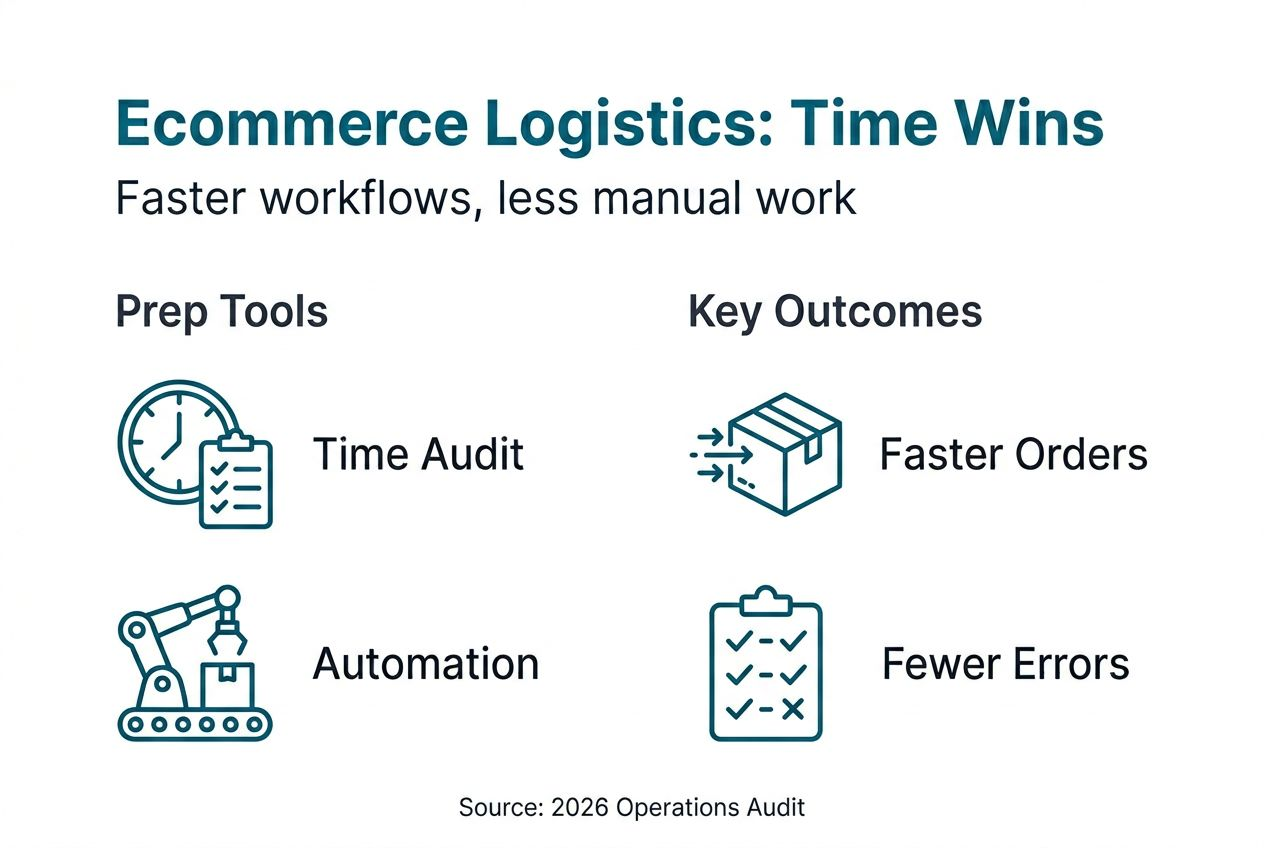
Customer satisfaction can improve substantially with reliable deliveries. When you consistently hit promised delivery windows, negative reviews drop and repeat purchase rates climb. Shipment delays and inventory discrepancies typically decrease by over 25% once automation and tracking systems stabilize. Automation reduces manual task time by about 40%, freeing staff to focus on exception handling and customer service. Real-time tracking lowers issue resolution times significantly because you catch problems before they escalate.
| Metric | Typical Improvement | Timeframe |
|---|---|---|
| Manual task time | 40% reduction | 2-4 months |
| Shipment delays | 25% decrease | 3-6 months |
| Customer satisfaction | 12% increase | 4-6 months |
| Issue resolution time | 35% faster | 2-3 months |
| Inventory accuracy | 30% improvement | 3-5 months |
| Order processing speed | 20% faster | 2-4 months |
Track these metrics monthly using your baseline audit data as the comparison point. Expect gradual improvement rather than overnight transformation. Teams need time to adapt to new tools and workflows. Celebrate incremental wins to maintain momentum. Monitor key supply chain metrics consistently to spot trends and adjust strategies.
Beyond quantitative gains, you’ll notice qualitative improvements in team morale and confidence. Staff feel less overwhelmed when clear priorities and automated systems handle routine work. Customer service teams spend less time apologizing for delays and more time building relationships. Management gains visibility into operations without micromanaging every task.
Enhance your ecommerce logistics with ORNER solutions
Ready to put these time management strategies into action? ORNER offers a global logistics platform courier services solution built specifically for ecommerce operations facing the challenges covered in this guide. Access advanced best shipment tracking software to monitor deliveries in real-time across all carriers and modes.

Our platform automates repetitive workflows, from freight booking to customs documentation, freeing your team to focus on strategic decisions. Real-time visibility into shipments lets you catch exceptions early and keep customers informed proactively. Improve team coordination with specialized collaboration tools and services through team building for companies that strengthen cross-functional communication. Whether you’re scaling up or optimizing current operations, ORNER provides the integrated infrastructure to make every hour count.
FAQ
What specific ecommerce logistics tasks benefit most from time management?
Prioritizing order processing, shipment booking, inventory updates, and customs clearance yields notable time savings. These high-frequency activities create compounding delays when handled inefficiently. Focused scheduling of high-impact tasks reduces delays and errors by ensuring staff complete critical work during peak attention periods. Automating routine elements of these tasks amplifies benefits further.
How long does it typically take to see improvements after applying these time management best practices?
Most businesses observe measurable improvements within 3 to 6 months of full implementation. Early wins like faster order processing appear within weeks, while deeper gains in forecast accuracy and customer satisfaction take longer. Continuous monitoring and iterative adjustment accelerate benefits by helping you refine strategies based on real performance data.
What are the top tools recommended for ecommerce logistics time management?
Workflow automation platforms, real-time shipment tracking software, and collaborative communication tools form the core tech stack. Automation handles repetitive tasks without manual intervention. Tracking provides visibility across carriers and modes. Communication platforms ensure everyone sees current status and priorities. Selecting integrated solutions avoids compatibility delays and data silos.
How can ecommerce businesses avoid multitasking overload in logistics operations?
Implement focused work periods using techniques like Pomodoro to help staff concentrate on one task at a time. Scheduling dedicated inventory and fulfillment blocks minimizes task-switching errors that compound when attention fragments. Protect these focused periods from non-urgent interruptions and train teams to complete activities fully before moving to the next priority.