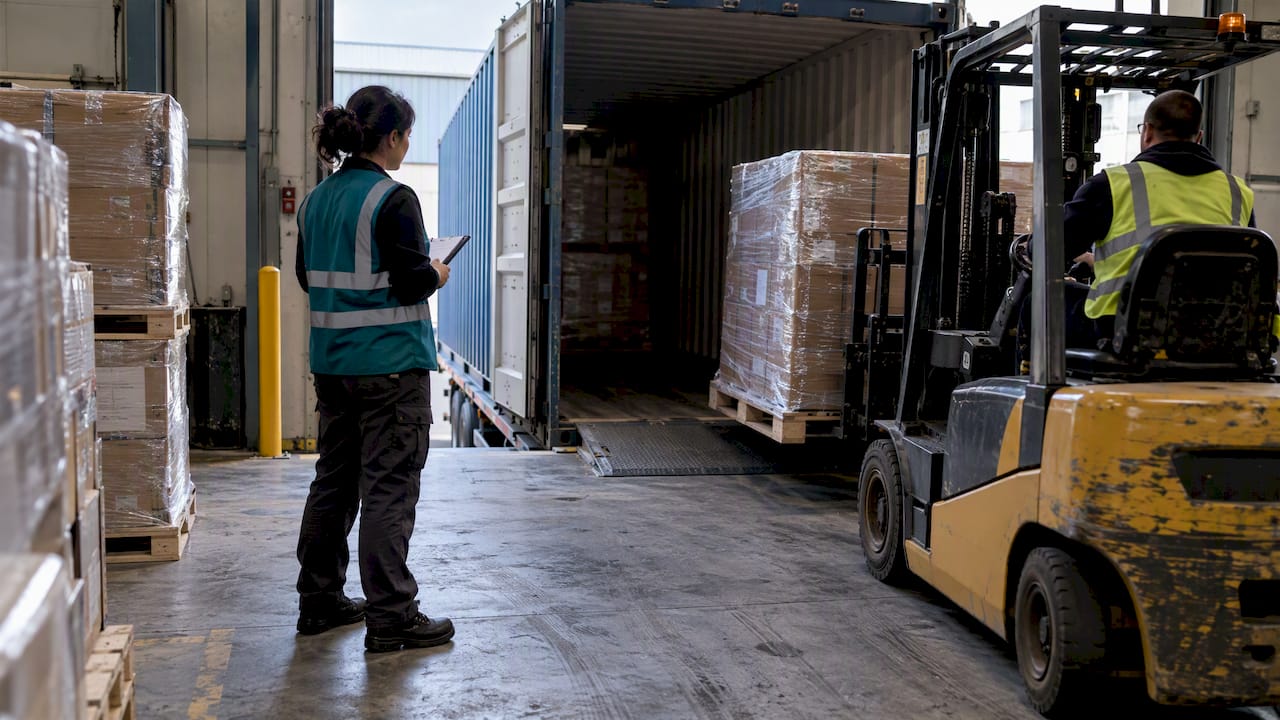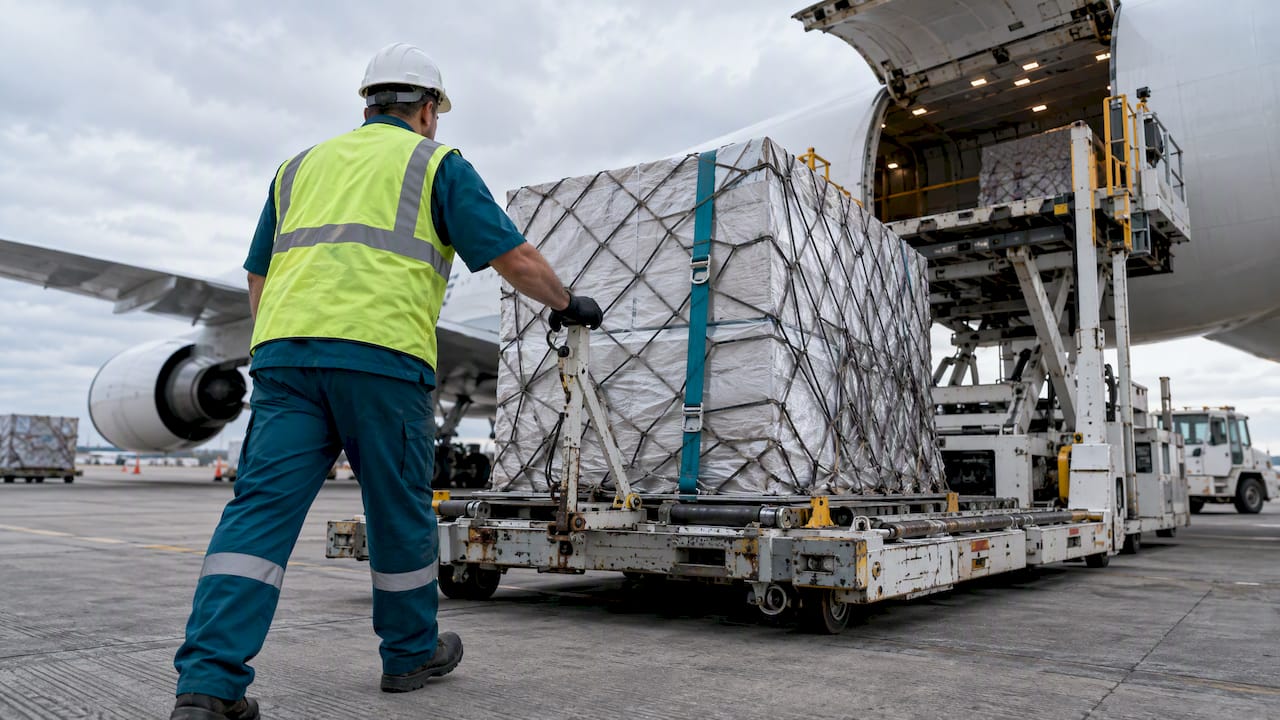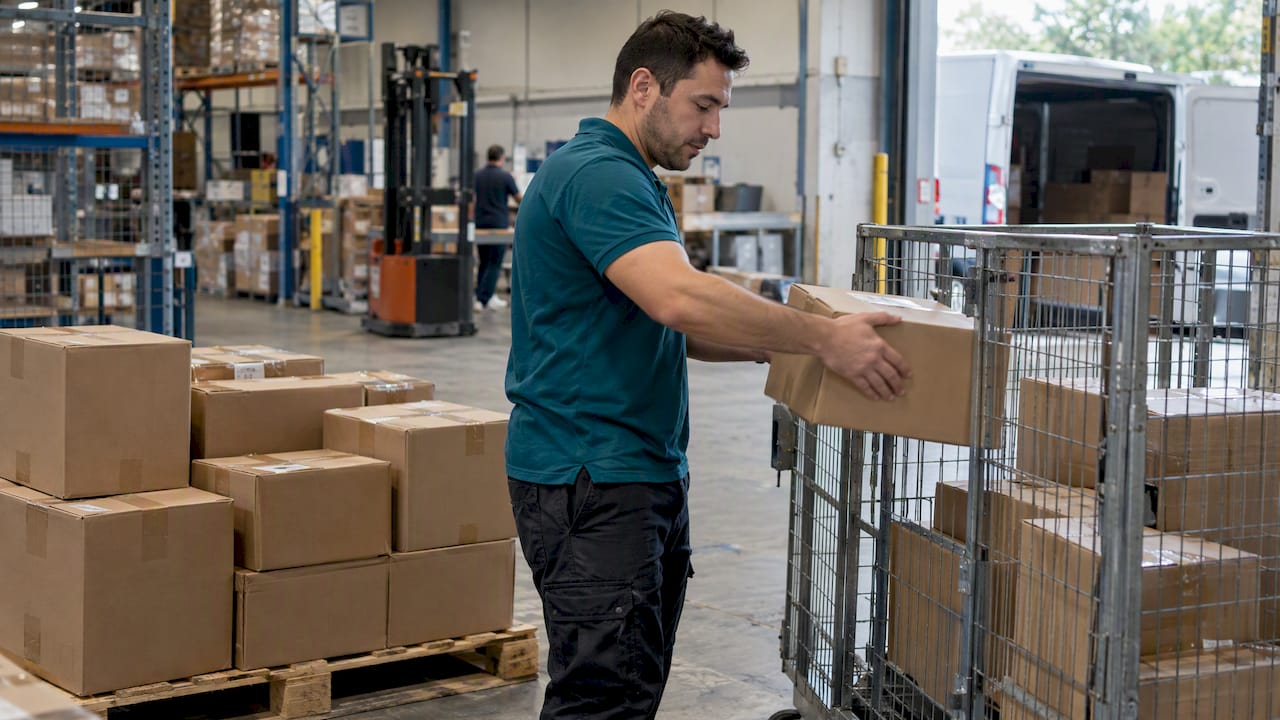
Expedited shipping is any delivery service that moves a parcel or freight shipment faster than your standard option, usually by prioritizing it at pickup, in the network and on the final leg. For a seller, the real question is not how to ship everything faster. It is which orders deserve speed, which carrier tier fits them, and how to keep the premium from eating your margin.
This guide is for ecommerce sellers, wholesalers, manufacturers and logistics managers who ship in or into the United States. It covers the speed tiers, the true cost of rushing, the legal side of promising delivery dates, and a practical way to decide what to expedite.
TL;DR
- Expedited shipping covers overnight, two-day, three-day, same-day and priority freight. The label differs by carrier, so compare committed delivery times, not names.
- Speed costs more than the rate card shows: backup suppliers, buffer inventory and rushed handling add up. Our own playbook flags cases where rushed freight costs 2 to 5 times what planned freight does.
- Expedite selectively. Use inventory and demand data to rush only high-value or time-critical items.
- If you advertise a delivery time, the FTC requires a reasonable basis for it. Missing it carries real penalties.
- Faster outbound shipping needs a faster return process, or customers feel the gap.
Table of Contents
- What expedited shipping actually means
- The main expedited options compared
- Why customers and retailers push for speed
- The real cost of speed
- Expedite selectively, not universally
- Fast does not have to mean air
- Promising delivery dates: what US law expects
- Do not forget returns
- A short checklist before you pick an expedited service
- Our perspective
- How Or-ner can help
- FAQ
- Sources
What expedited shipping actually means
There is no single legal or industry definition. In practice it means a service tier that promises delivery sooner than ground or economy service, with a committed date and often a guarantee. Overnight, express and two-day services all sit under the label. Many carriers also use the word for freight: a partial or full shipment that skips consolidation stops and goes straight from pickup to destination.
Two points trip up new sellers:
- Expedited is not the same as priority. Some postal products are called priority and sit between standard and express. Check the service commitment for your lane instead of trusting the name.
- Transit time is not delivery time. The clock that matters to your customer starts when they click buy. Order processing, cutoff times and weekends all count. A two-day service shipped on Friday afternoon may arrive Tuesday.
The main expedited options compared
Here is how the common tiers differ for a US business shipper. Exact times and prices vary by carrier, zone, weight and season, so treat this as a framework for comparing quotes.
| Tier | Typical promise | Best for | Watch out for |
|---|---|---|---|
| Same-day | Delivered the day it is ordered, usually in metro areas | Urgent replacements, local retail, perishable or time-bound goods | Tight order cutoffs, limited coverage |
| Overnight or next-day | Next business day, often by a stated time | Critical parts, high-value orders, launch dates | Highest per-parcel cost, surcharges for residential or remote delivery |
| Two-day and three-day | One to three business days depending on zone | The default upgrade for ecommerce checkout | Zone distance can turn two days into three |
| Expedited freight | Direct, dedicated or priority pallet or truckload moves | Wholesale replenishment, production-line parts | Needs booking in advance and accurate dimensions |
| Expedited air freight | Days instead of weeks for international cargo | Stock-outs, seasonal peaks, high-value inventory | Cost per kilo, airport handling, customs timing |
If you are comparing service types in more detail, our guides to types of delivery speed options for ecommerce sellers and understanding expedited shipping options for businesses go deeper on each. For a view of the carrier categories behind them, see types of courier services for ecommerce and global brands.
Courier or freight?
Parcels under roughly a carrier’s weight and size limits ride courier networks. Pallets, crates and anything heavy belong in freight. Picking the wrong mode is a common reason rush shipments cost more than they should. The distinction is laid out in our piece on the difference between courier and freight.
Ocean versus air when you are late
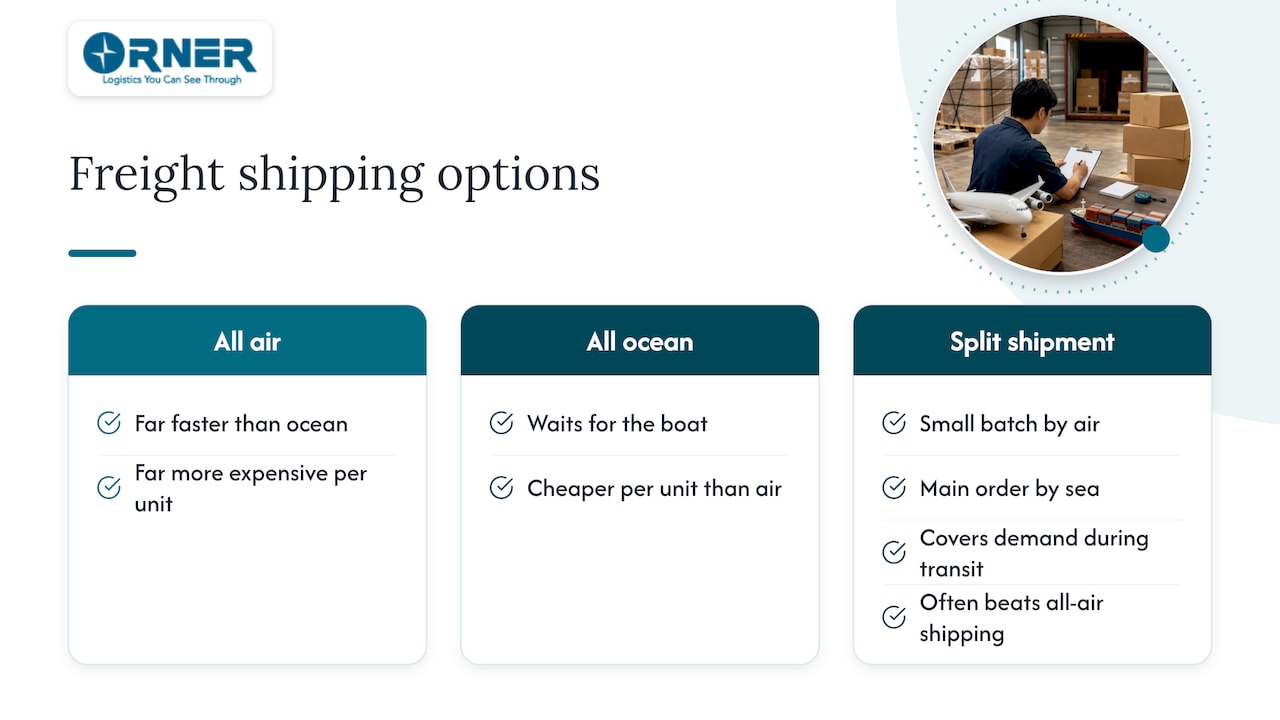
When inventory is running out overseas, the choice is usually between paying for air and waiting for the boat. Air is far faster and far more expensive per unit. A split shipment, with a small air batch to cover demand while the main order comes by sea, often beats shipping everything by air. We compare the trade-offs in sea freight vs air freight.
Why customers and retailers push for speed
Speed has become part of what shoppers expect. Industry analysis of US last-mile delivery says that same-day or next-day delivery in metro areas is now a baseline expectation, and retailers that cannot offer a reliable fast option risk losing customers even when the product is good.
The market behind it is large. One research firm values the US courier, express and parcel market at about USD 201.65 billion in 2026, growing at a 4.62% compound annual rate through 2031. A lot of that growth is carriers and retailers competing on delivery time.
For B2B shippers the pressure is different but just as real: a late part stops a production line, and a late replenishment empties a shelf.
The real cost of speed
The surcharge on the invoice is only the visible part. Supply chain managers often miss the hidden costs of speed, such as the 15 to 20% premium for backup suppliers and the financing cost of carrying buffer inventory, until they hit margins.
Fuel adds to it. In an ISM roundtable, a supply chain leader described fuel surcharges as having moved from a temporary adjustment to a structural cost pressure that squeezes shipper margins. Expedited services, which are priced on top of base rates, feel it most.
A simple way to see whether a rush is worth it:
- Take the gross margin on the order.
- Subtract the standard shipping cost you would have paid.
- Compare the result with the expedited quote.
- Add the value of what is at risk if you do not rush: a lost customer, a line stoppage, a contract penalty.
If the expedite costs more than the margin and nothing critical is at risk, ship standard and communicate honestly.
Expedite selectively, not universally
The most useful idea in the research is that expedited shipping should be data-driven. Supply chain leaders recommend using available-to-promise inventory metrics so you apply fast services to high-value items and avoid paying to rush non-critical stock.
In practice, set rules like these:
- By order value: orders above a threshold ship two-day by default, with the cost built into the price.
- By customer tier: wholesale accounts with delivery windows get priority service, others get standard.
- By stock position: if a SKU is below its reorder point and the next inbound is late, expedite the inbound, not every outbound order.
- By lane: use faster tiers only on routes where the standard option is slow, such as distant zones.
This only works with connected data. The same ISM-style thinking shows up in quality management: the value of expedited logistics lies in connecting suppliers, inventory systems and carriers into one proactive network, not in cutting price to cover delivery gaps. A parts seller that uses inventory data and connected supplier, warehouse and carrier systems to prioritize urgent shipments shows how that plays out when a customer’s truck is off the road.
Fast does not have to mean air
Expedited no longer equals flying parcels across the country. Retailers are placing stock closer to buyers. The same market report notes that some large chains now hold inventory within 10 miles of 90% of US households, which shortens line-haul distance by about 40% and lowers per-unit delivery cost. Next-day by ground from a nearby node can cost far less than next-day by air from a distant one.
For most sellers, you will not build a micro-fulfillment network yourself. You can get part of the benefit by:
- splitting inventory across two or more warehouses near your densest customer clusters;
- using a fulfillment partner with a multi-location network;
- setting cutoffs so same-day dispatch is realistic, not aspirational.
The operational side of the last leg is covered in our article on last mile delivery challenges for US ecommerce.
Promising delivery dates: what US law expects
Expedited options are marketing as well as logistics, and in the US a delivery promise is regulated. Under the FTC’s Mail, Internet, or Telephone Order Merchandise Rule, sellers need a reasonable basis for any shipping time they advertise. If you state no time, you generally must ship within 30 days of receiving a properly completed order. If you cannot, you must tell the customer and offer a choice: agree to the delay or cancel for a prompt refund.
The penalties are not theoretical. In 2020 the FTC announced a USD 9.3 million settlement with Fashion Nova, a retailer that had advertised fast and two-day shipping. Small sellers can find a plain-language summary of these obligations in the FAQ of one specialty seller, which explains how federal rules apply when shipments are delayed or no ship time is promised.
Practical rules that follow from this:
- Advertise the delivery time you can hit on a normal day, not your best day.
- Make cutoff times and holiday exceptions visible at checkout.
- Build delay notifications into your order system so customers are told before they have to ask.
- If you are unsure how the rule applies to your business, ask a lawyer who handles ecommerce compliance.
Do not forget returns
Fast outbound service creates a speed gap on the way back. Customers who receive an order in two days are not patient with a three-week refund. Experts in supplier quality advise integrating return processes into the core logistics network early rather than treating them as a secondary flow.
In practice that means a return address near your inventory, prepaid labels tied to your fulfillment system, and a refund trigger on first scan rather than on warehouse receipt for low-risk items.
A short checklist before you pick an expedited service
- Define the deadline. Is it a calendar date, an hour of the day, or a number of days from order?
- Check the commitment, not the name. Ask for committed delivery time by lane and what happens if it is missed.
- Confirm dimensions and weight. Dimensional weight can double a rush quote.
- Ask about surcharges. Residential, remote area, Saturday, fuel and peak season charges apply differently by tier.
- Plan customs for cross-border. A fast flight does not help if clearance stalls. Paperwork has to be right before the goods leave.
- Get tracking you can act on. Exception alerts matter more than a map.
- Plan the return path. See above.
Our perspective
Most of the rush shipments we see in operations did not start as emergencies. They started as small gaps: a late purchase order, a stock count that was off, an inbound with no visibility. By the time someone is booking overnight air, the expensive decision was made weeks earlier.
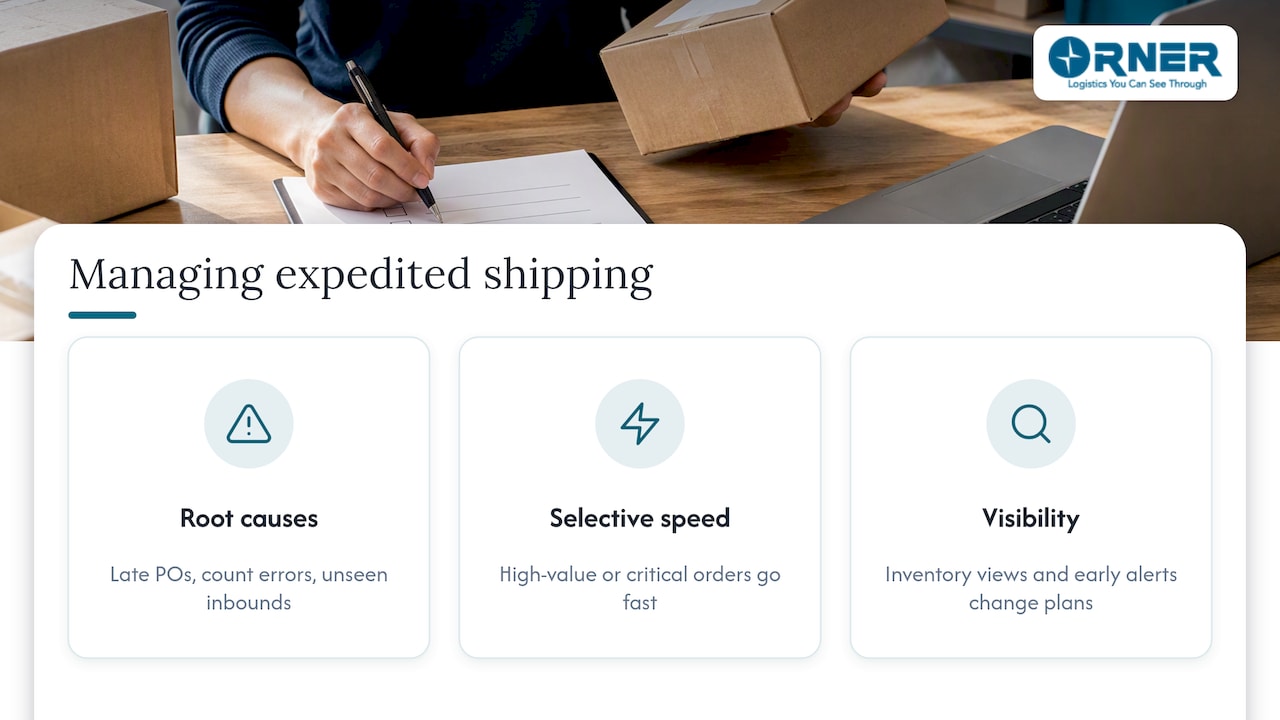
So we treat expedited shipping as a symptom to manage, not a product to sell harder. The healthiest accounts use speed as a deliberate tool: a small percentage of high-value or time-critical orders go fast, and the rest move on a planned, cheaper schedule. What makes that possible is visibility across modes, a clear view of inventory in each warehouse, and exception alerts early enough to change the plan. That is the idea behind how we build our platform: freight booking, tracking, customs, warehousing and inventory in one place, so the decision to expedite is made on data and not under panic.
If you take one thing from this article, let it be this: ask what each rush shipment says about your process, and fix that.
— Maayan
How Or-ner can help
Or-ner is a logistics and supply chain platform for ecommerce sellers, wholesalers, manufacturers and global brands. We cover freight booking, courier services, air and ocean freight, customs clearance and warehousing, plus 3PL services such as pick and pack, storage, labeling and palletization, with real-time tracking and exception management. If you want to see how your rush volume could be handled more predictably, start with our reliable courier services in the USA or explore the full offer on or-ner.com. For global inventory positioning and clearance, see our fulfillment and customs page. Pricing is quoted per shipment or contract, so request an estimate with your lanes and volumes.
FAQ
Is expedited shipping the same as express shipping?
Often yes, but not always. Express usually means a premium, time-definite service with a guarantee, while expedited is a broader term for anything faster than standard. Always compare the committed delivery time and the guarantee terms in the service description.
How much does expedited shipping cost compared with standard?
It depends on weight, dimensions, distance and the speed tier, so no single multiple is reliable. Hidden costs such as backup suppliers and buffer stock can add 15 to 20% on top of carrier fees, according to ISM. Request quotes for your specific lanes and compare total cost, not just the rate.
Should I offer expedited shipping at checkout?
If your customers compare delivery speed, yes, but be selective. Offer it as a paid upgrade, base the promised date on realistic cutoffs, and track on-time performance. Under the FTC rule, any time you advertise must have a reasonable basis.
Can ground shipping be fast enough?
Sometimes. When inventory sits close to the customer, next-day or two-day ground can match air at a lower cost per unit. A multi-location warehouse network is what makes this possible.
What should I do when a shipment is going to be late?
Tell the customer before they ask, offer the choice to wait or cancel with a prompt refund if the delay passes the promised date, and look at why it slipped. Document the cause so the next order does not repeat it.
Sources
- FTC: Selling on the Internet, Prompt Delivery Rules
- FTC: USD 9.3 million settlement and the Mail Order Rule
- Research and Markets: United States Courier, Express and Parcel market
- Last Mile Experts: Out-of-home delivery in the USA
- ISM: Supply Chain Roundtable on fuel surcharges
- ISM: The Monthly Metric, Available-to-Promise Inventory
- ISM
- ASQ: Supplier quality management