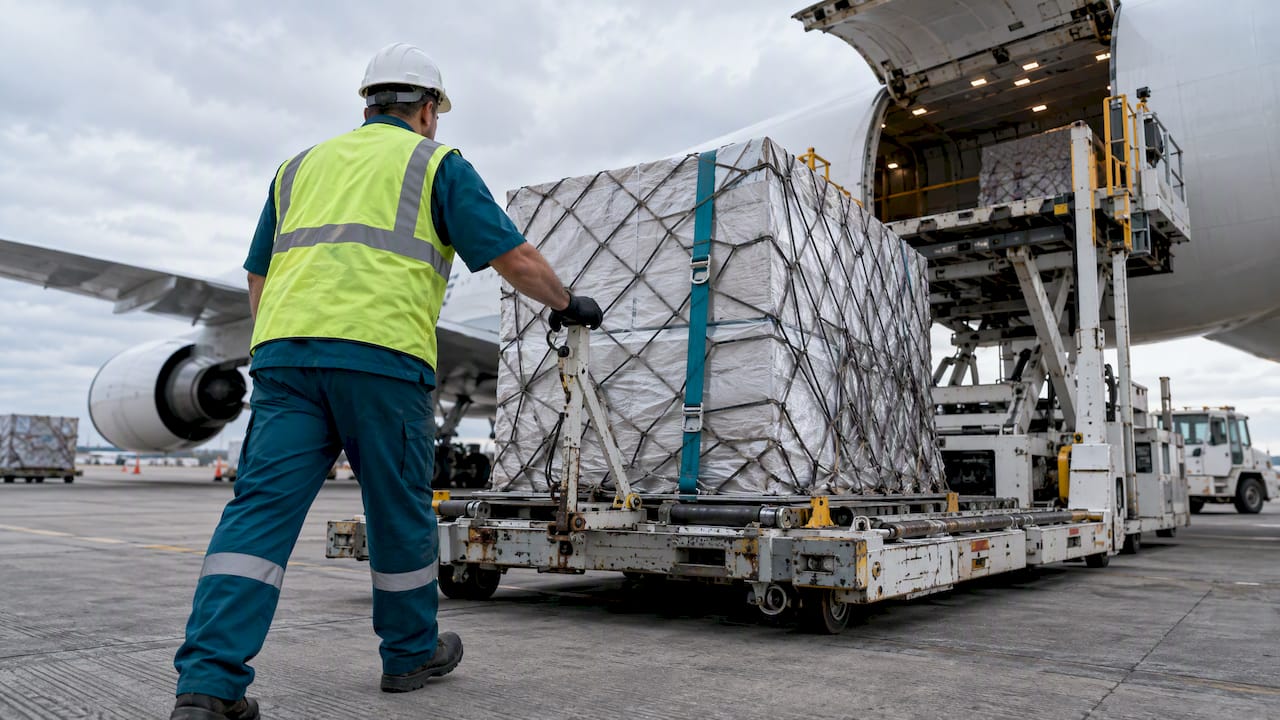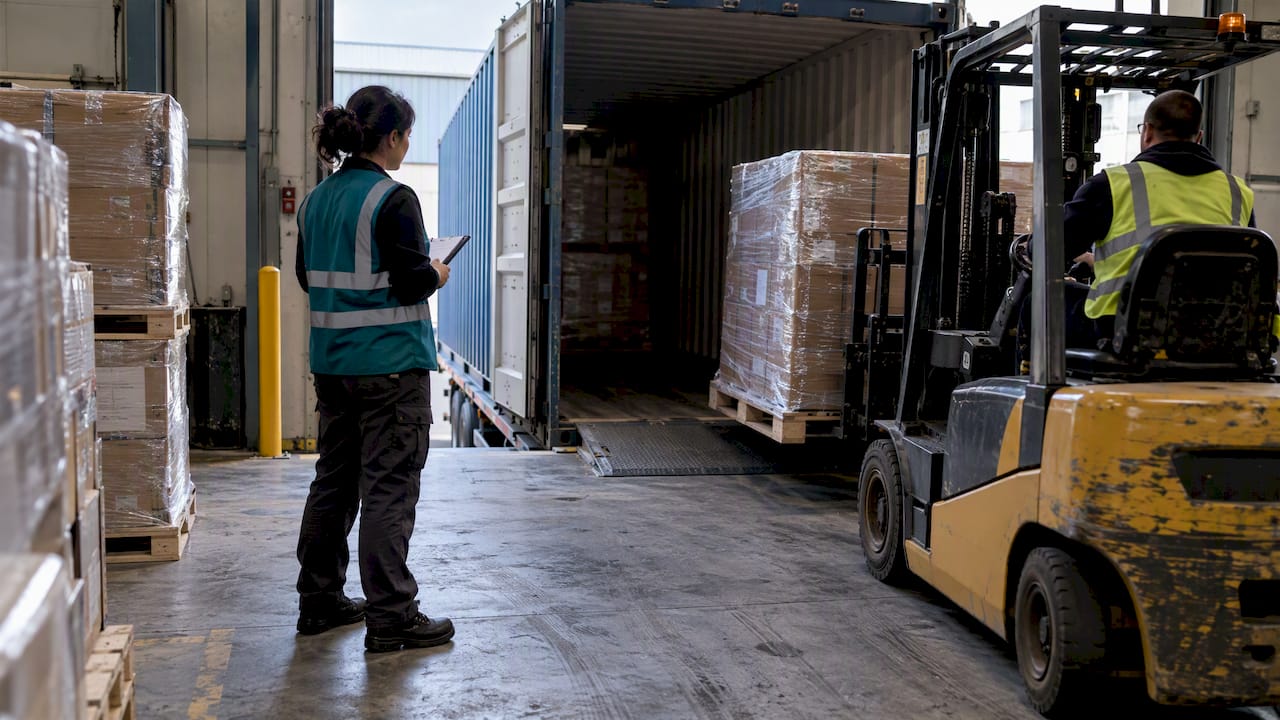
A freight forwarder is a company that organizes the movement of your goods from origin to destination. It books space with carriers, prepares the paperwork and coordinates each handoff along the way. It usually doesn’t own the ships, planes or trucks. You hire the forwarder to manage the whole chain so you don’t have to deal with each carrier, warehouse and agency yourself.
That is the short answer. The longer one matters if you sell online, manufacture goods or buy wholesale, because the forwarder you pick decides who is legally responsible when something goes wrong. Below we cover what forwarders do, what they cannot do, how they differ from couriers, brokers and customs brokers, and how to choose one.
TL;DR
- A freight forwarder plans, books and coordinates shipments by ocean, air and land on your behalf, and usually relies on carriers to move the cargo.
- Under U.S. law, a forwarder holds itself out to the public to provide transportation for compensation and takes responsibility for the shipment, unlike a broker who only arranges it.
- A forwarder is not automatically a customs broker. Customs clearance in the U.S. requires a licensed broker.
- For exports, you stay responsible for the accuracy of the data you hand over, so clear written instructions matter.
- Couriers suit small, urgent parcels. Forwarders suit pallets, containers and anything that crosses several modes or borders.
Table of Contents
- What a freight forwarder does
- How U.S. law defines a forwarder
- Forwarder vs. broker vs. customs broker vs. carrier
- What a forwarder does on an export
- How a typical forwarded shipment runs
- When you need a forwarder, and when you don’t
- How to choose a forwarder
- Our perspective
- Where Or-ner fits
- FAQ
- Sources
What a freight forwarder does
Think of a forwarder as the project manager of a shipment. You tell it what you are moving, where it starts, where it must arrive and by when. The forwarder then designs the route, picks carriers, books capacity and keeps the paperwork consistent from start to finish.
In practice that covers a handful of jobs:
- Route and mode planning. Ocean, air, truck or a combination, based on your budget and deadline.
- Booking. Reserving container space, air cargo capacity or trucking, often by consolidating your goods with other shippers’ cargo.
- Documentation. Commercial invoices, packing lists, bills of lading and air waybills. Our guide to the ocean freight bill of lading explains the most important of these.
- Cargo handling. Pickup, warehousing, palletizing, labeling and loading.
- Insurance and compliance support. Arranging cargo insurance and, for exports, filing the required export data when you authorize it.
- Tracking and exceptions. Watching the shipment and acting when a vessel rolls, a flight is cancelled or a hold appears.
If you want the full list of duties by role, see our breakdown of freight forwarder responsibilities.
Forwarder, forwarding agent, global forwarder: the same idea
You will see many labels for the same business: freight forwarder, forwarding agent, forwarding company, international forwarder, global forwarder. The Bureau of Industry and Security uses “freight forwarder or forwarding agent” in its export guidance. “International” or “global” simply signals that the company handles cross-border moves. “Air” or “ocean” forwarder names the mode it specializes in. If you are focused on one mode, we have separate guides to air freight forwarders and ocean freight forwarding.
A side note: if you landed here from a forestry search, a “forwarder” is also a machine that carries felled logs to a roadside landing. This article is about the logistics business.
How U.S. law defines a forwarder
The term has a legal meaning. In 49 U.S.C. § 13102, a freight forwarder is a person holding itself out to the general public, other than as a pipeline, rail, motor or water carrier, to provide transportation of property for compensation. In the ordinary course of business it assembles and consolidates shipments, takes responsibility for transportation from the place of receipt to the place of destination, and uses a regulated carrier for at least part of the move. A matching definition appears in 49 CFR 387.401.
Two parts of that definition deserve attention:
- Responsibility from receipt to destination. A forwarder doesn’t just pass your order along. It answers for the movement.
- Use of a regulated carrier. The forwarder buys transportation from carriers and resells it to you as one service.
The liability rule follows from this. Under 49 U.S.C. § 14706, a freight forwarder is both the receiving and the delivering carrier. In plain terms, you have one party to look to if cargo is lost or damaged, not a chain of subcontractors. Liability limits and claim deadlines depend on the contract and bill of lading, so read those terms before you ship. For ocean moves, ask whether the company issues its own bill of lading, since that is what defines its responsibility.
Forwarder vs. broker vs. customs broker vs. carrier
These four roles get mixed up constantly, and the confusion can be expensive.
| Role | What it does | Takes responsibility for the cargo? |
|---|---|---|
| Carrier | Physically moves the goods with its own vessels, aircraft or trucks | Yes, for the leg it operates |
| Freight forwarder | Organizes and coordinates the whole move, often using several carriers | Yes, from receipt to destination |
| Freight broker | Connects shippers with motor carriers | Generally no |
| Customs broker | Licensed to handle customs entries and import compliance | For the customs filing, not for the freight |
Forwarder vs. broker
The FMCSA explains that brokers arrange transportation by procuring motor carriers, while forwarders assume legal responsibility for the goods. The Department of Transportation adds that brokers generally do not handle the freight or take on liability for cargo loss and damage. For a shipper, the practical question is simple: who do I call, and who pays, if the pallets arrive crushed?
Forwarder vs. customs broker
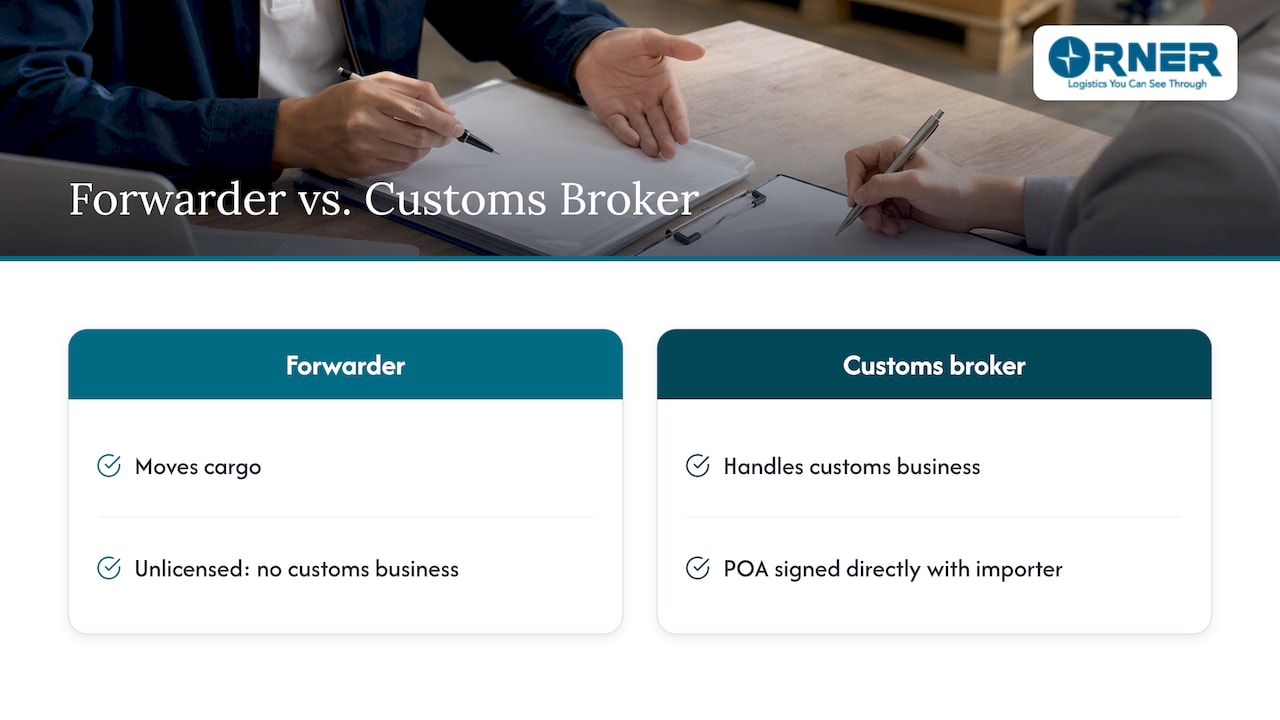
This is the mistake we see most often. Moving cargo and clearing it through customs are different regulated activities. U.S. Customs and Border Protection regulates customs brokers under 19 CFR 111, and a forwarder that does not hold a broker license cannot transact customs business for you. Many large logistics groups run a separate licensed brokerage for exactly this reason.
There is a second detail. CBP’s modernization rules say a broker must execute the customs power of attorney directly with the importer of record, not through a freight forwarder or other unlicensed third party. So when you import, ask two questions: who is my customs broker, and have I signed the power of attorney with them directly?
Forwarder vs. courier
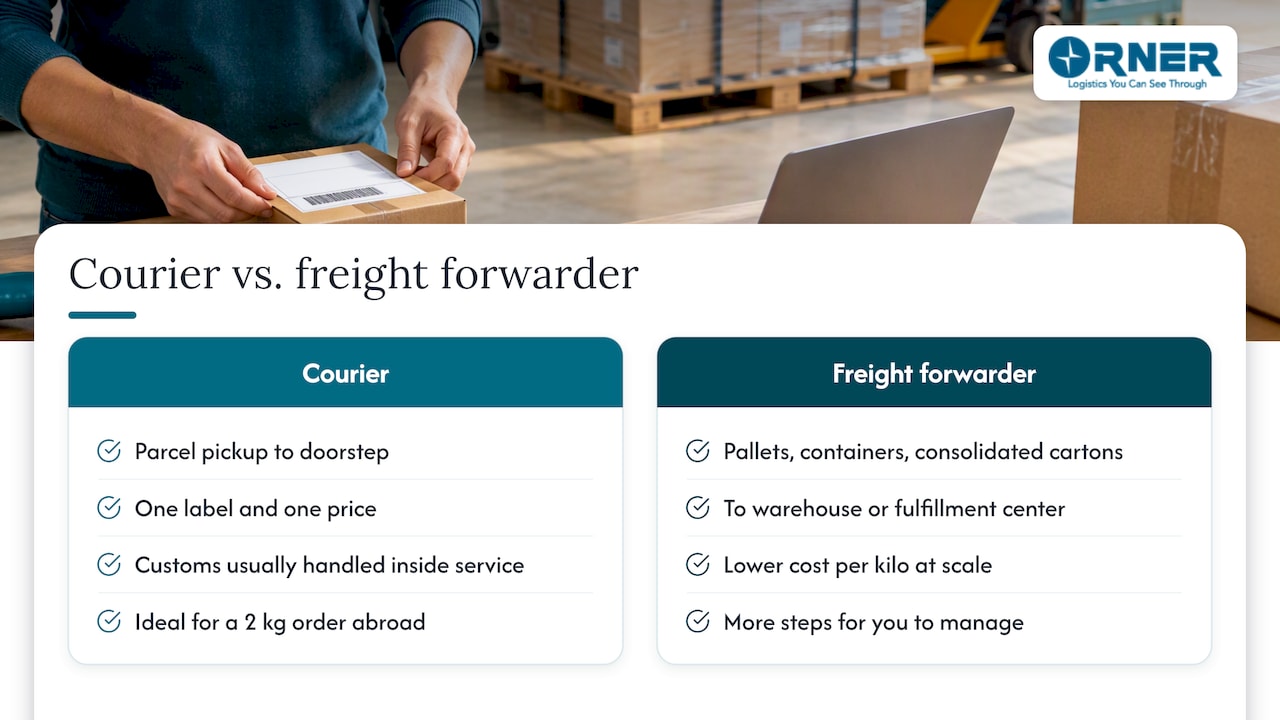
A courier takes a parcel from pickup to doorstep under one label and one price, usually with customs handled inside the service. That is ideal for a 2 kg order to a customer in another country. A forwarder is built for volume: pallets, full containers, consolidated cartons headed to a warehouse or fulfillment center. The tradeoff is a lower cost per kilo at scale against more steps for you to manage. Our guide on the difference between courier and freight compares the two in more detail, and our overview of reliable courier services for ecommerce shows where parcels make more sense.
What a forwarder does on an export
Exports add a compliance layer that many small sellers overlook. BIS guidance says a forwarder must be authorized by the principal party in interest, usually the exporter, before filing Electronic Export Information (EEI) in the Automated Export System. The same guidance stresses that you remain responsible for the accuracy of the information you provide, including details such as the Export Control Classification Number where it applies.
Two documents keep that relationship clean:
- Power of attorney (POA): gives the forwarder written authority to act for you in filing export data.
- Shipper’s letter of instruction (SLI): tells the forwarder exactly what to ship, to whom, under what terms and with what routing.
A forwarder works from the instructions it receives. Vague or incorrect instructions are how shipments get held at the port, and the cost lands on you. For the wider rulebook, read our 2026 guide to export shipping regulations.
How a typical forwarded shipment runs
Exact steps differ by mode, but most international moves follow this pattern. Our freight forwarding procedure and process overview go deeper.
- Quote request. You share cargo details: dimensions, weight, commodity, origin, destination, target delivery date and Incoterms.
- Routing and booking. The forwarder selects mode and carriers and confirms capacity.
- Pickup and consolidation. Goods are collected, checked, palletized or loaded, and labeled.
- Documents and export filing. Invoices, packing lists, the bill of lading or air waybill, and export data where required.
- Main carriage. The cargo travels by ocean, air or road, with status updates.
- Import clearance. A licensed customs broker clears the goods at the destination.
- Final delivery. Trucking to a warehouse, fulfillment center or buyer, followed by proof of delivery.
If you are importing into the U.S. for an online store, our import freight forwarder guide walks through that flow from a seller’s point of view.
When you need a forwarder, and when you don’t
You probably need one when:
- You ship pallets, cartons in bulk or full containers.
- Cargo crosses borders and you want one accountable party.
- You are moving inventory to a warehouse or to Amazon fulfillment centers.
- You want a choice between sea freight and air freight based on deadline and budget.
- You do not have an in-house logistics team.
You probably do not need one when you send a handful of small parcels a week, or when a courier’s all-in rate covers your destination countries. Many growing brands use both: a courier for customer orders, a forwarder for replenishment.
How to choose a forwarder
Price matters, but a low quote with hidden terms often costs more. Check these points before you sign:
- Scope. Does the quote include pickup, origin fees, main carriage, destination charges and delivery? Ask for each line.
- Customs. Who is the licensed customs broker, and is it you or the forwarder who signs the power of attorney?
- Liability and insurance. Read the bill of lading terms and decide whether you need separate cargo insurance.
- Mode coverage. Can they move your cargo by ocean, air and land, or only one?
- Visibility. Can you see status and exceptions in one place, without chasing emails?
- Your sector. Apparel, toys, footwear, musical instruments and home goods each have their own packing, labeling and compliance quirks.
- After the border. Can they store, pick and pack, or deliver to end customers, so you do not need a second vendor?
For a side-by-side view of how to weigh providers, our freight forwarding services comparison lays out the criteria.
Our perspective
Most sellers come to us after one painful shipment, not before. The goods were fine. The problem was that nobody owned the gaps: the handoff between the factory and the port, the missing document, the customs question that surfaced after the vessel left.
We built Or-ner around the idea that a forwarder is only as useful as its visibility. Freight booking, tracking, customs clearance support, warehousing and inventory management should live in one workflow, with exceptions flagged early rather than discovered late. Our work is aimed at ecommerce sellers, wholesalers, manufacturers and global brands, and we integrate with major ecommerce operators such as Amazon.
Our advice is plain. Ask every provider, including us, who is legally responsible at each stage, who files what, and what you must supply. The shippers who ask those questions up front rarely have the bad shipment.
— Maayan
Where Or-ner fits
If you need to move freight and also store, prepare and deliver it, we cover that chain: freight booking across ocean, air and land, plus customs clearance and warehousing through our global network of warehouses and fulfillment centers. For parcels and customer orders, we also offer reliable courier services. We do not publish prices, so the way to see numbers for your lanes is to request an estimate.
FAQ
What is the difference between a shipper and a forwarder?
The shipper is the party that owns or sends the goods, usually the seller or manufacturer. The forwarder is the service provider the shipper hires to organize transportation. The shipper stays responsible for accurate product and export information, even when the forwarder files it.
Is a freight forwarder the same as a customs broker?
No. In the U.S., customs business is regulated under 19 CFR 111 and requires a licensed customs broker. A forwarder may employ or partner with one, but you should confirm who your broker is rather than assume.
Does a freight forwarder own the ships and planes?
Usually not. The forwarder buys space from carriers and combines it with services such as pickup, documentation and warehousing. U.S. law treats the forwarder as responsible for the shipment from receipt to destination even when carriers do the moving.
What is the difference between a freight forwarder and a courier?
A courier moves small, time-sensitive parcels door to door under one service. A forwarder coordinates larger cargo across several carriers and modes, and you typically handle more of the customs and delivery steps yourself or through a broker.
Sources
- 49 U.S.C. § 13102, Definitions
- 49 CFR 387.401, Definitions (eCFR)
- 49 U.S.C. § 14706, Liability of carriers (GovInfo)
- FMCSA: definitions of motor carrier, broker and freight forwarder authorities
- U.S. Department of Transportation: FMCSA’s jurisdiction over interstate property brokers
- CBP: Customs Broker Frequently Asked Questions
- CBP: Customs Broker Modernization Regulations, 19 CFR 111
- Bureau of Industry and Security: freight forwarder guidance and best practices