

TL;DR:
- Implementing proactive, branded order tracking significantly reduces WISMO inquiries and enhances customer satisfaction.
- Effective tracking systems provide operational insights, improve retention, and turn logistics into a strategic profit lever.
Proactive shipment visibility is no longer a luxury feature reserved for enterprise retailers. WISMO inquiries drop by 50 to 70% when ecommerce stores implement branded tracking pages and automated notifications, and that number represents more than a customer service win. It represents fewer agents, lower overhead, and more revenue reinvested into growth. If you still think of real-time order tracking as a nice perk for shoppers, this guide will change your perspective entirely. From the technology powering it, to cross-border complications, to the exact steps you need to take this week, here is everything you need to know.
Table of Contents
- Why real-time order tracking matters in ecommerce
- How real-time tracking systems work
- Comparing real-time tracking solutions: Features and trade-offs
- Cross-border tracking: Special challenges and best practices
- Putting real-time tracking to work: Action steps for ecommerce managers
- The overlooked opportunity: Real-time tracking as a profit lever, not just an add-on
- Power up your ecommerce tracking with proven solutions
- Frequently asked questions
Key Takeaways
| Point | Details |
|---|---|
| Reduce support workload | Real-time order tracking can lower customer service requests by up to 70%. |
| Increase customer satisfaction | Visibility into order status correlates strongly with lasting satisfaction and loyalty. |
| Optimize globally | Cross-border ecommerce requires special tracking strategies to balance cost and transparency. |
| Choose the right solution | Compare tracking systems for features, integration ease, and branding capabilities before implementing. |
| Leverage data for profit | Use tracking analytics to identify bottlenecks, streamline fulfillment, and drive future sales. |
Why real-time order tracking matters in ecommerce
Most ecommerce managers focus on acquisition. They pour money into ads, conversion rate optimization, and product pages. The post-purchase experience, the window between “order confirmed” and “package delivered,” gets treated as an afterthought. That is a costly mistake.
WISMO inquiries (Where Is My Order?) are the single most common reason customers contact support. Each ticket costs time and money. Multiply that by thousands of monthly orders and you start to see why WISMO reductions of 50 to 70% from proactive notifications can dramatically change your support economics.
The connection between tracking and repeat purchases is real and measurable. Research shows that tracking correlates more strongly with customer satisfaction (r=0.686) than delivery timeliness (r=0.529). In plain terms, your customers care more about knowing where their package is than about getting it fast. That is counterintuitive, but it changes everything about how you should invest in the post-purchase experience.
Here is what strong order tracking delivers operationally:
- Reduced inbound support tickets from status inquiries
- Higher net promoter scores tied to post-purchase communication
- Fewer chargebacks and disputes because customers feel informed
- Increased repeat purchase rates from buyers who felt confident the first time
- Better internal visibility into carrier performance and delay patterns
“Order visibility is the new standard. Customers who feel informed during shipping are far more likely to return than customers who simply received fast deliveries without context.”
Learning more about improving customer delivery experience can help you frame tracking as a retention strategy, not just a logistics function. And when you explore order tracking technology in depth, the operational gains become even clearer.
How real-time tracking systems work
Understanding the mechanics of real-time tracking helps you make better technology decisions. Many ecommerce managers buy a tracking tool without realizing it depends on carrier API quality, scan frequency, and integration depth. When those pieces are weak, “real-time” becomes a marketing term rather than a reality.
Here is how information flows from your warehouse to your customer’s screen:
- Order is picked and packed. Your warehouse management system (WMS) generates a shipment record and assigns a tracking number.
- Carrier pickup is scanned. The carrier’s handheld or fixed scanner logs the package into their system. This scan is the first real-time event.
- Data flows to your platform. Via carrier API or EDI (Electronic Data Interchange), scan events push to your ecommerce platform or third-party tracking software.
- Notification is triggered. A rule in your notification engine fires an email or SMS to the customer based on the event type (shipped, out for delivery, delivered).
- Customer views the branded tracking page. Instead of a raw carrier page, they see your logo, your messaging, and optionally a cross-sell recommendation.
- Analytics are recorded. Every event, delay flag, or exception is logged for your operations team to review.
| Component | Function | Common challenge |
|---|---|---|
| Carrier API | Feeds scan events to your system | Delay between scan and API push |
| Tracking platform | Aggregates data from multiple carriers | Coverage gaps for regional carriers |
| Notification engine | Sends email, SMS, or push updates | Over-messaging or poor trigger logic |
| Branded tracking page | Hosts customer-facing status updates | Low engagement if generic |
| Analytics dashboard | Shows delay trends and carrier performance | Requires clean data to be useful |
The term “real-time” is worth questioning. Most systems have a lag between the physical scan and the data becoming visible in your dashboard, anywhere from a few minutes to several hours depending on the carrier and their API infrastructure. Parcel tracking explained in detail helps set realistic expectations for both your team and your customers.
The best shipment tracking software options in 2026 now aggregate data across hundreds of carriers, reducing those blind spots significantly.

Pro Tip: Integrate your tracking platform with your CRM. When a customer’s order shows a delay event, your support team can proactively reach out before the customer ever contacts you. That simple workflow shift can reduce inbound tickets by a significant margin on its own.
Comparing real-time tracking solutions: Features and trade-offs
Not all tracking solutions are built for ecommerce operations of every size. Choosing the wrong platform wastes budget and creates technical debt. Here is a direct comparison of the three main approaches.
| Solution type | Best for | Real-time updates | Branded experience | Cost | Integration effort |
|---|---|---|---|---|---|
| Built-in carrier tracking | Low-volume sellers, single carrier | Moderate | None | Free | Minimal |
| Third-party tracking platform | Mid to large sellers, multi-carrier | High | Partial to full | Subscription | Medium |
| Custom branded tracking page | Brand-focused sellers, high volume | High | Full | Higher | High |
Each approach has real trade-offs you need to think through carefully.
Built-in carrier tracking is the default for most new ecommerce sellers. You share a UPS, FedEx, or USPS link with the customer and let the carrier’s page handle the rest. It works, but it sends customers away from your brand, offers no cross-sell opportunity, and gives you zero analytics.
Third-party platforms like AfterShip or 17TRACK aggregate carrier data and offer notification engines. They are the most practical choice for growing stores because they balance functionality, cost, and speed of implementation. Shopify AfterShip data consistently shows these platforms cutting WISMO tickets in half within the first month of deployment.
Custom branded tracking pages require more engineering time but deliver the highest ROI for stores doing serious volume. Your tracking page becomes a marketing touchpoint. You can show recommendations, loyalty reminders, or review requests at the exact moment when customer engagement is at its peak.
Key features to prioritize when evaluating any solution:
- Multi-carrier support (especially if you use regional or international carriers)
- Proactive notification customization by event type
- Exception management alerts for delays or failed deliveries
- Analytics with carrier performance benchmarking
- API access for CRM and helpdesk integration
Pro Tip: Choose platforms that allow branded notifications at every stage of the shipment journey. A delivery confirmation email with your logo and a 10% off coupon converts at a measurably higher rate than a generic carrier notification. That is a revenue opportunity hiding in your logistics workflow.
Cross-border tracking: Special challenges and best practices
Cross-border ecommerce introduces a layer of complexity that domestic tracking simply does not face. A package traveling from China to the United States, for example, may pass through a domestic carrier, an international freight handler, a customs facility, and a last-mile delivery partner. Each hand-off is a potential tracking black hole.
Research on cross-border delivery challenges confirms that visibility gaps are the primary driver of international WISMO inquiries. Customers ordering internationally already expect longer delivery times. What they cannot tolerate is silence.
The economics are also nuanced. Real-time tracking in cross-border commerce can reduce costs tied to promised delivery windows, but it can also backfire if ETA accuracy is poor and customers feel misled. This is what some researchers call the “honesty penalty.” If you show a customer a real-time ETA that later slips by three days, the frustration may exceed what they would have felt with no ETA at all.
Best practices for cross-border order tracking:
- Set conservative delivery windows. It is better to surprise customers with early delivery than to miss a promised date.
- Use tracking providers with strong international carrier coverage. Not all platforms handle regional carriers in Southeast Asia, Latin America, or Eastern Europe well.
- Communicate proactively around customs holds. This is the most common cross-border delay and the least explained. An automated email at customs entry reduces panic significantly.
- Translate tracking notifications. If you sell in non-English markets, a notification in the customer’s language builds trust immediately.
- Monitor carrier performance by lane. Not every route is equal. Use your tracking analytics to identify which origin-destination combinations underperform consistently.
“Transparency beats speed. A customer who understands why their order is delayed will forgive the delay far more readily than one who was kept in the dark.”
A solid cross-border logistics guide will help you choose carriers and fulfillment strategies that support end-to-end visibility, not just domestic legs.
Putting real-time tracking to work: Action steps for ecommerce managers
Knowing the theory is not enough. Here is a practical roadmap you can start executing this week.
Step 1: Audit your current tracking experience.
Place a test order and go through the exact experience your customers have. Note every gap in communication, every moment you feel uncertain about delivery status. That feeling is what your customers experience on real orders.
Step 2: Define your customer experience goals.
Do you want to reduce WISMO tickets by 50%? Increase your post-purchase Net Promoter Score by 20 points? Improve repeat purchase rate by 15%? Set measurable targets before you select technology.
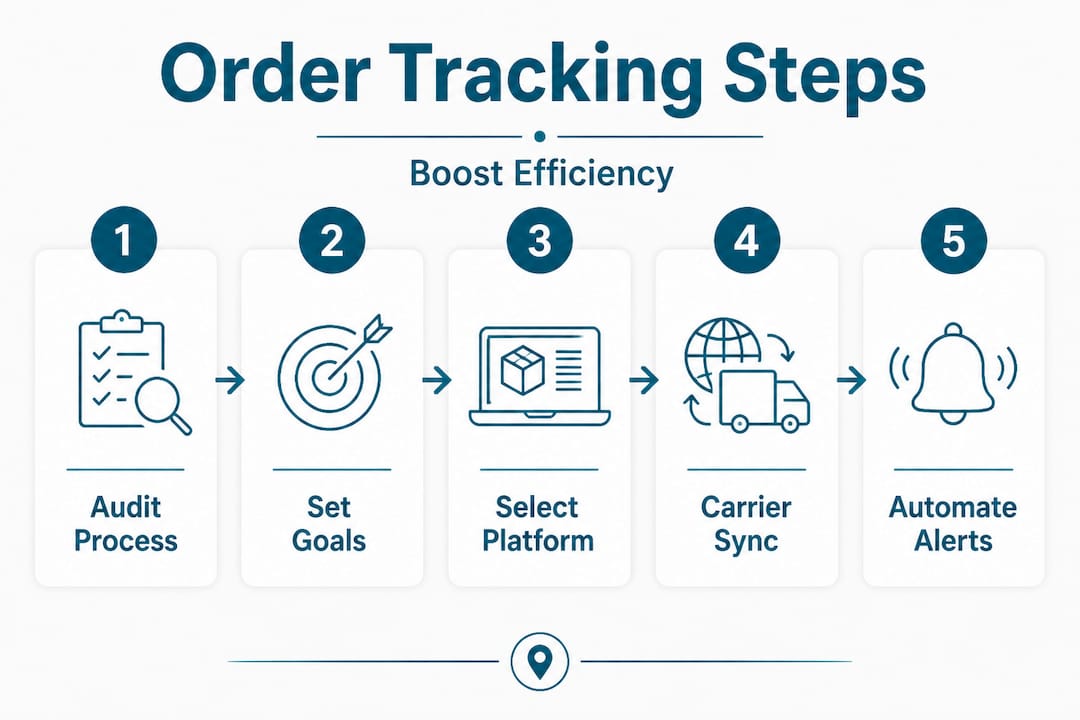
Step 3: Choose and implement a tracking platform.
Based on your volume and technical resources, select a solution from the comparison above. Prioritize multi-carrier support and notification customization.
Step 4: Align with your carriers.
Not all carriers provide equally rich API data. If a key carrier in your network delivers poor scan frequency, raise it with your account manager or consider switching. Your tracking is only as good as the data feeding it.
Step 5: Automate your notification logic.
Map out every shipment event (label created, picked up, in transit, out for delivery, delivered, exception) and create a corresponding customer notification. Do not wait for customers to ask.
Step 6: Monitor and optimize monthly.
Review your support ticket categories monthly. If WISMO tickets are still high for a specific carrier or region, investigate the root cause. Delivery delays are shown to negatively impact purchase frequency over time, so catching delay patterns early protects your repeat order rate.
Common mistakes to avoid:
- Sending too many notifications and training customers to ignore them
- Ignoring international tracking gaps by assuming domestic logic applies globally
- Treating tracking as a set-and-forget system rather than an ongoing optimization
- Skipping post-delivery communication, which is the highest-engagement moment in the entire order journey
If you are actively working to reduce delivery times, pairing speed improvements with tracking transparency will compound your customer satisfaction gains significantly.
The overlooked opportunity: Real-time tracking as a profit lever, not just an add-on
Here is the perspective most ecommerce guides miss entirely. Businesses treat real-time tracking as an operational checkbox. Implement it, move on. The businesses that actually win with tracking treat it as an ongoing revenue system.
Think about what the data is telling you every single day. Which carriers are slow on which routes? Where do exceptions cluster geographically? Which delivery windows are you consistently missing and why? Most ecommerce managers have access to this data and never look at it. That is a missed opportunity to reduce costs, renegotiate carrier contracts, and optimize inventory positioning.
The satisfaction data backs this up. Tracking correlates with satisfaction at r=0.686. That number is not just about good feelings. It directly predicts lifetime customer value. A customer who feels confident and informed during shipping is dramatically more likely to buy again, leave a positive review, and refer others.
There is also a competitive angle here that is easy to undervalue. In a market where product differentiation is shrinking and ad costs are rising, reliable courier services and the visibility that comes with them are becoming a genuine brand differentiator. Customers remember the experience, not just the product.
The real lesson from working with high-growth ecommerce operations is this: the stores that scale profitably are not the ones with the cheapest shipping. They are the ones with the most consistent, transparent, and reliable delivery experience. Invest in order tracking technology as a strategic asset, not a cost center, and measure it like one.
Power up your ecommerce tracking with proven solutions
Real-time order tracking is the kind of investment that pays back faster than almost anything else in ecommerce logistics. Reduced support costs, higher repeat purchase rates, and stronger customer loyalty are all within reach once you commit to a serious tracking infrastructure.
OR-NER is built for exactly this challenge. As a full-service logistics and supply chain platform, OR-NER gives ecommerce sellers access to advanced shipment tracking tools, multi-carrier integrations, and warehousing networks that support both domestic and cross-border fulfillment. Whether you are a small merchant or a global brand scaling into new markets, the cross-border logistics guide and suite of tracking solutions on OR-NER are designed to help you deliver reliably, track accurately, and grow confidently. The platform also integrates with Amazon and other major ecommerce operators, so your workflows stay connected end to end.
Frequently asked questions
How does real-time order tracking reduce WISMO inquiries?
Automated tracking events trigger email and SMS notifications that answer the “where is my order” question before customers think to ask it, cutting support tickets by 50 to 70% in stores with full notification coverage.
Is real-time tracking worth it for small ecommerce stores?
Absolutely. Even low-volume stores benefit because tracking satisfaction correlation at r=0.686 means every informed customer is more likely to return, and support savings offset platform costs quickly.
What’s the biggest challenge in cross-border order tracking?
Customs checkpoints, multiple carrier hand-offs, and regional carrier API gaps create visibility black holes. Research on cross-border tracking also shows that poor ETA accuracy can hurt consumer trust even when real-time data is available.
Does better tracking really boost repeat orders?
Yes. Delivery delays reduce purchase frequency over time, while proactive, transparent tracking builds the post-purchase confidence that turns first-time buyers into loyal repeat customers.
Recommended
- Order tracking technology: Maximize visibility and efficiency – ORNER
- Shipment Tracking Basics: Boost Delivery Efficiency – ORNER
- 7 Best Shipment Tracking Software for Fast Fulfillment – ORNER
- 7 Proven Ways to Reduce Delivery Times for Online Sellers – ORNER
- How CRM boosts client satisfaction for booking agencies – LiveDesk CRM