TL;DR:
- Outsourcing ecommerce logistics is increasingly cost-effective and critical for mid-sized businesses facing growth challenges. Selecting a reliable 3PL involves evaluating their exception handling, integration capabilities, and transparency to ensure a seamless customer experience. Proactive management of logistics partnerships, especially regarding exception workflows, is essential to protect brand reputation and enable scalable growth.
There’s a persistent myth in ecommerce that outsourcing logistics is a luxury reserved for high-volume retailers with deep pockets. Meanwhile, mid-sized sellers are drowning in pick-and-pack errors, missed shipping windows, and customer complaints about slow returns. The truth is that reliable courier services and third-party logistics providers (3PLs) are increasingly accessible and often more cost-effective than managing fulfillment in-house, even for businesses processing a few hundred orders a month. This guide will show you exactly how to evaluate, choose, and work with an outsourced logistics partner to scale without sacrificing customer experience.
Table of Contents
- Understanding ecommerce logistics outsourcing
- When does outsourcing ecommerce logistics make sense?
- Choosing a logistics partner: What really matters
- Pitfalls and best practices for smooth outsourcing
- The overlooked power of exception management in outsourced logistics
- Unlock seamless logistics for your ecommerce growth
- Frequently asked questions
Key Takeaways
| Point | Details |
|---|---|
| Plan for exceptions | Effective logistics outsourcing means focusing on returns and errors, not just shipping speed. |
| Start before scaling stress | Outsourcing is most effective when implemented before growth strains in-house processes. |
| Evaluate provider transparency | Choose partners who clearly explain how they handle exceptions and provide tracking updates. |
| Ongoing oversight pays off | Regular check-ins and performance reviews ensure your logistics partner keeps meeting your needs. |
Understanding ecommerce logistics outsourcing
Ecommerce logistics outsourcing means handing off some or all of your supply chain operations to a specialized external provider. These providers are commonly called 3PLs (third-party logistics companies) or fulfillment providers. Instead of renting your own warehouse space, hiring pickers and packers, and negotiating your own carrier rates, you pay a provider to handle those functions on your behalf. That arrangement frees up your team to focus on what drives revenue: marketing, product development, and customer relationships.
A typical outsourced logistics arrangement covers a wide range of services:
- Order fulfillment: Receiving, picking, packing, and shipping customer orders
- Warehousing: Storing your inventory in strategically located facilities
- Inventory tracking: Real-time visibility into stock levels across locations
- Returns processing: Generating return labels, receiving returned items, and restocking or disposing of them
- Labeling and packaging: Custom packaging, branded inserts, and compliance labeling
- Multi-channel coordination: Syncing fulfillment across your own store, Amazon, and other marketplaces
Understanding what is 3PL is essential before committing to any provider, because not all 3PLs offer the same depth of service. Some specialize in fast domestic shipping. Others excel at cross-border fulfillment or handling fragile product categories like musical instruments or home goods.
The pain of managing fulfillment in-house grows sharply once your order volume climbs past a manageable threshold or when you start selling across multiple channels. You hit a wall where the manual work of tracking inventory, printing labels, and managing carrier relationships consumes hours that should go toward growth. That’s exactly where outsourcing becomes not just helpful but necessary.
Pro Tip: Look for logistics partners that integrate directly with your shopping cart or order management system (OMS). Real-time data sync eliminates manual entry errors and gives you visibility into order status without chasing emails. As 3PL selection experts note, exception handling including returns, packaging, and multi-channel complexity should be covered under clear service-level agreements (SLAs) with customer-visible tracking updates built in.
Explore the types of logistics solutions available to ecommerce businesses before narrowing your search, since the right model depends heavily on your product type, average order value, and geographic reach.
When does outsourcing ecommerce logistics make sense?
Not every ecommerce business needs to outsource on day one. But there are clear signals that tell you the moment has arrived, and ignoring those signals costs you customers.
Common triggers that indicate it’s time to outsource include:
- Order volume spikes that overwhelm your current packing and shipping process during peak seasons
- Multichannel selling across Amazon, your own site, and wholesale channels simultaneously
- Missed SLAs where orders consistently ship late or tracking updates lag behind customer expectations
- SKU diversification where you’ve added product lines that require different storage conditions or packaging
- Geographic expansion where shipping from a single location creates unacceptably long delivery times for distant customers
- High return volumes that are eating up staff time and creating a backlog in processing
The cost-benefit calculation changes depending on where your business sits. Here’s a simplified comparison that shows how in-house versus outsourced logistics stack up at different order volumes:
| Monthly orders | In-house cost (estimated) | Outsourced cost (estimated) | Key difference |
|---|---|---|---|
| Under 200 | Lower (owner-operated) | Comparable or higher | In-house works if simple SKUs |
| 200 to 800 | Rising fast (staff, space) | Competitive per-order pricing | Outsourcing saves labor overhead |
| 800 to 2,500 | High (warehouse lease, staff) | Lower per unit at volume | 3PL leverages shared infrastructure |
| Over 2,500 | Requires significant capital | Scales without fixed cost spikes | Strong case for outsourcing |
What smaller businesses often miss is that even moderate order volumes can justify outsourcing when SKU complexity rises or when workload spikes are unpredictable. A 400-order-per-month business selling five product variants is very different from one selling 50 variants with seasonal demand swings.
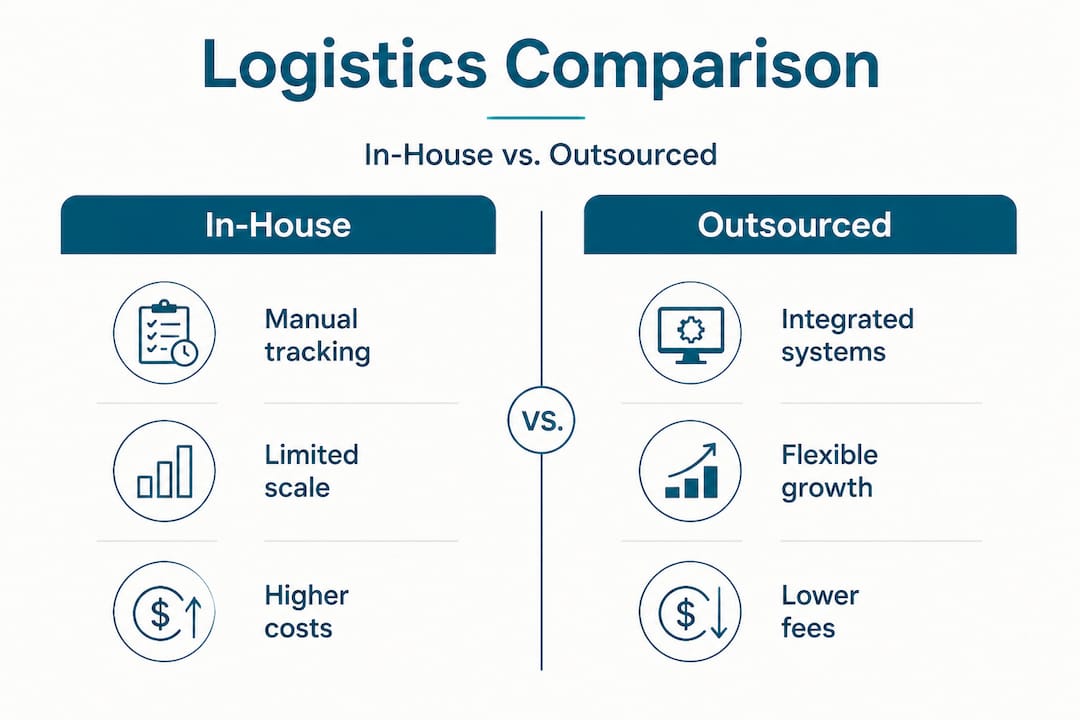
When choosing a logistics partner, ask specifically about fulfillment procedure details and where the provider ships from. As provider selection guidance highlights, transparency about shipping origin, returns handling capability, and references from comparable businesses are non-negotiable criteria.
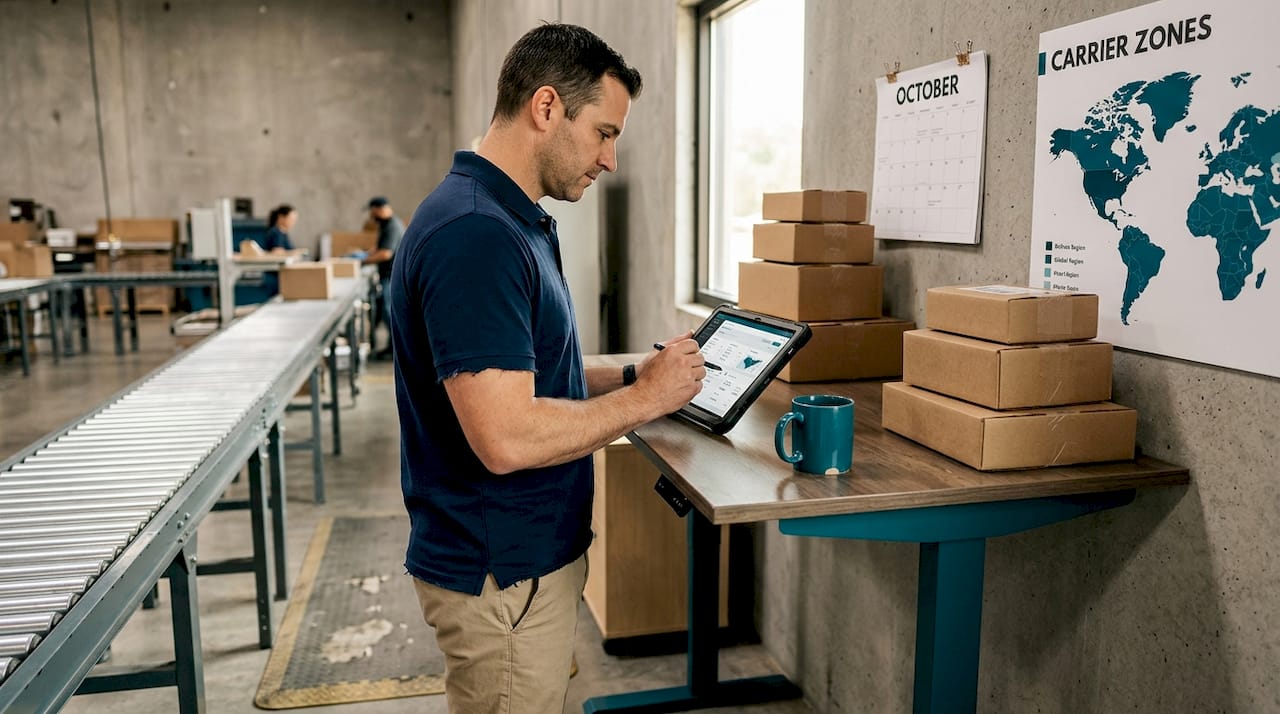
Pro Tip: Don’t wait until your fulfillment operation is in crisis mode to consider outsourcing. Switching providers under pressure leads to rushed contracts and overlooked details. Proactive outsourcing, before you hit the wall, keeps your customer experience steady during transitions.
Choosing a logistics partner: What really matters
Once you’ve decided outsourcing makes sense, the evaluation process is where most businesses make costly mistakes. They compare pricing sheets and shipping speeds, then sign a contract without asking about what happens when things go wrong. And things will go wrong.
Here are the key questions you must ask every provider before committing:
- What is your process when an item is reported missing or damaged? Who owns the investigation, and what’s the resolution timeline?
- How do you handle incorrect orders? What’s your accuracy rate, and what’s the reshipment process?
- Can you generate return labels automatically? How fast do you process received returns back into available inventory?
- What system integrations do you support? Can you connect to Shopify, WooCommerce, Amazon Seller Central, or custom OMS platforms?
- What SLAs do you guarantee for order fulfillment cutoff times? What penalties or remedies apply if SLAs are missed?
- Can you provide references from businesses in our product category or order volume range?
- How do you communicate exceptions to us? Do you use a dashboard, email alerts, or dedicated account managers?
Poor return handling isn’t just an operational inconvenience. It’s a reputational risk that compounds quickly. A single high-profile negative review citing a difficult return experience can appear prominently in search results, influence purchasing decisions, and drive up your customer support volume. The cost of poor exception management extends well beyond the individual order. Missing items, incorrect quantities, and slow returns are the exact failure modes that generate one-star reviews, chargebacks, and social media complaints.
Here’s how different types of providers typically handle common edge cases:
| Scenario | Full-service 3PL | Basic fulfillment house | In-house operation |
|---|---|---|---|
| Lost package | Carrier claim + proactive reship | Carrier claim only | You handle everything |
| Incorrect order sent | Reship + return label generated | Reship only (return manual) | Fully manual process |
| Return received | Auto-processed, restocked, dashboard updated | Manual processing, variable speed | Dependent on staff capacity |
| Inventory discrepancy | Real-time alert, audit triggered | Periodic reporting only | Discovered on stockout |
| Multi-channel conflict | Synced inventory, automatic hold | Manual reconciliation | Manual and error-prone |
Reviewing the types of logistics services available helps you match provider capability to your actual operational requirements rather than generic sales promises.
Pitfalls and best practices for smooth outsourcing
Even with a well-chosen provider, outsourcing can fail quietly. The most common breakdowns happen not at launch but three to six months in, when the initial honeymoon phase ends and process gaps start showing up in customer complaints and return rates.
Common pitfalls to watch for include:
- Unclear SLAs from the start: Vague language like “fast shipping” or “quick returns” is not an SLA. Demand specific timeframes and escalation procedures in writing before signing.
- No exception communication protocol: If your provider only contacts you when you contact them, you’re flying blind. Proactive alerts on exceptions are a basic requirement.
- Skipping integration testing: Assuming your cart and the provider’s warehouse management system (WMS) sync correctly without thorough testing leads to overselling, duplicate orders, and inventory chaos.
- Ignoring post-launch performance reviews: The first 90 days of any outsourcing relationship should include weekly check-ins on order accuracy, fulfillment speed, and return processing time.
- Over-relying on the provider for customer communication: Your customers see delays and errors as your fault, not the 3PL’s. You need visibility into what’s happening so you can get ahead of issues.
Best practices that keep outsourced logistics running smoothly:
- Schedule monthly performance reviews with concrete metrics: order accuracy rate, average fulfillment time, return processing speed, and exception frequency.
- Test your integrations quarterly, especially after platform updates on either end.
- Build a simple exception log that tracks every fulfillment error, its cause, and the resolution. This data reveals patterns that drive improvement conversations with your provider.
- Negotiate escalation paths upfront. Know who your contact is when a major problem arises, not just your day-to-day account manager.
Strategies for managing logistics partners well are as important as the initial selection. The relationship requires ongoing management, not just a signed contract.
Pro Tip: Prioritize providers who give you return metrics in your dashboard: volume, processing time, restock rate, and reason codes. That data tells you whether your products, your packaging, or your descriptions need adjustment, not just whether returns are being processed.
For a broader picture of how all these moving parts connect, reviewing an end-to-end logistics overview helps you see where outsourcing fits into your supply chain and where you still need internal ownership.
The overlooked power of exception management in outsourced logistics
Here’s the reality that most articles about outsourcing logistics skip entirely: the quality of your logistics partner is almost never revealed on a normal day. It’s revealed the moment something breaks.
Fast shipping speeds and competitive pricing are table stakes. Every provider claims them. What separates a genuinely strong logistics partner from an average one is how they behave when an order goes missing, when a return sits unprocessed for two weeks, or when a warehouse error ships 50 wrong units to customers. Those moments define your brand in the eyes of your customers, even though the mistake originated in a warehouse you’ve never visited.
We’ve seen businesses lose significant portions of their Amazon seller ratings not because their products were bad, but because their 3PL was slow to process returns and even slower to communicate that slowness. A single spike in negative reviews during a peak sales period can suppress your product rankings for months. The downstream effects of poor exception handling reach far beyond the immediate support ticket, touching ad performance, conversion rates, and lifetime customer value.
The conventional advice is to pick a provider with good reviews and competitive rates, then monitor performance. That’s not wrong, but it misses the depth required. You need to actively co-design exception workflows with your provider before you launch. What does the escalation path look like when a high-value order goes missing? How quickly can they generate a return label and communicate that to your customer? What data do they share with you in real time versus in weekly reports?
Understanding 3PL operations at a deeper level makes these conversations more productive. When you know how warehouse management systems and carrier integrations work together, you ask better questions and set better expectations.
The businesses that thrive with outsourced logistics treat their 3PL relationship as a living partnership, not a set-it-and-forget-it vendor contract. They review exception data regularly, push providers for continuous improvement, and maintain enough internal visibility to catch problems before customers do.
Unlock seamless logistics for your ecommerce growth
The principles in this guide point to one consistent truth: successful outsourcing requires the right partner with the right tools and the right level of transparency into every step of your fulfillment operation.
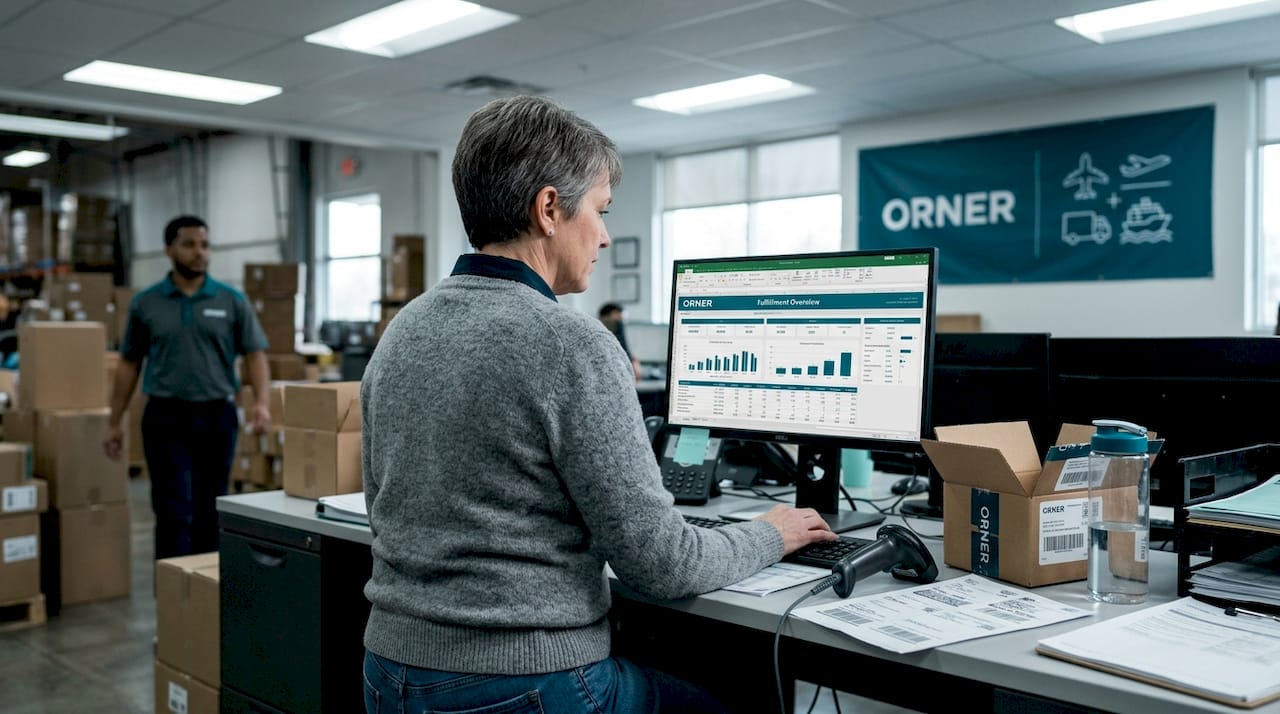
ORNER gives ecommerce businesses exactly that. From freight booking explained to end-user delivery, the platform provides real-time tracking, exception management, and returns visibility across ocean, air, and land transport. Whether you’re scaling across Amazon marketplaces or managing cross-border shipments for the first time, ORNER’s network of global warehouses and fulfillment centers connects you with reliable courier services that integrate directly with your existing systems. And with built-in ecommerce inventory management, you stay in control of stock levels without the spreadsheet chaos. Explore ORNER’s platform today and start building a logistics operation that scales with your ambitions.
Frequently asked questions
What is ecommerce logistics outsourcing?
Ecommerce logistics outsourcing means hiring a third-party provider to handle shipping, fulfillment, inventory, and returns for your online store. As 3PL selection standards make clear, a strong provider covers exception handling, tracking updates, returns label generation, and return processing speed under defined SLAs.
How do I choose the right logistics provider for my business?
Compare providers on exception handling, integration options, and references, not just price and shipping speed. Due diligence criteria should explicitly cover how providers manage returns label generation, exception escalation, and customer-visible failure modes like missing items or incorrect quantities.
Will outsourcing logistics affect my delivery speed or customer experience?
It often improves speed and consistency, but you must choose a provider that communicates clearly about exceptions and tracking. Provider transparency about fulfillment procedures, shipping origins, and returns handling is essential for maintaining a strong customer experience.
What services should ecommerce logistics outsourcing cover?
Comprehensive providers cover order fulfillment, inventory storage, returns handling, labeling, and tracking. Look for SLA-backed coverage of packaging, returns label generation, return processing speed, and real-time tracking updates to ensure customer-visible steps are fully managed.
Recommended
- How to Streamline Logistics for Reliable Courier Services – ORNER
- Cross-Border Shipping Guide: Streamline Ecommerce Logistics – ORNER
- Types of logistics solutions for ecommerce: optimize fulfillment – ORNER
- Freight Booking Process Explained: Streamline Ecommerce Shipping – ORNER
- Logistics Consulting in Central & Eastern Europe | Yellow Brick Project