TL;DR:
- Most startups underestimate shipping costs, which can erode margins despite excellent products and marketing strategies.
- Choosing the right fulfillment method—self-fulfillment, software, or 3PL—depends on order volume, control preferences, and scalability needs.
Shipping costs are quietly destroying startup margins. Most early-stage ecommerce founders accept whatever rate their carrier quotes, never realizing that 45% shipping cost reductions are achievable with the right solution. The difference between a profitable and struggling startup often comes down not to product quality or marketing, but to how well you manage fulfillment. This guide breaks down the real challenges, compares every major solution type, and gives you practical frameworks to cut costs, protect margins, and use shipping as a genuine competitive advantage.
Table of Contents
- Understanding the startup shipping challenge
- Shipping solutions compared: Self-fulfillment, shipping software, and third-party logistics (3PL)
- How to choose the right shipping partner for your startup
- Cost-saving strategies and negotiation tips for startup shipping
- What most startups get wrong about shipping and how to fix it
- Streamline your startup’s shipping with expert support
- Frequently asked questions
Key Takeaways
| Point | Details |
|---|---|
| Substantial shipping savings | Startups can cut shipping and fulfillment costs by 28-45% using the right solutions and negotiating rates. |
| Choose by growth stage | Self-fulfillment works early, but software and 3PL solutions become essential as your ecommerce operation scales. |
| Hidden cost traps | Watch for storage, additional item fees, and minimums when evaluating partners or platforms. |
| Power of negotiation | Comparing offers and negotiating with providers often results in significant discounts and better contract terms. |
| Shipping as growth lever | Treat your shipping strategy as a way to boost customer experience and drive scalable growth, not just control costs. |
Understanding the startup shipping challenge
Shipping seems simple until you’re doing it at scale. Early on, most founders pack boxes at home, slap on a label, and head to the post office. That works for ten orders a week. At fifty or a hundred, it becomes a second job that eats into product development, marketing, and sleep.
The true cost of shipping goes far beyond postage. You’re also paying in time, errors, packaging materials, returns processing, and lost customers who abandon carts because your shipping options aren’t competitive. These hidden costs compound fast and are rarely tracked on a spreadsheet.
Key cost categories most startups miss:
- Labor time: At 15 minutes per order and a $25/hour opportunity cost, you’re spending $6.25 per order just on your own time
- Error rates: Manual fulfillment mistakes typically run 1 to 3% of orders, each costing $10 to $50 to resolve
- Packaging inefficiency: Using boxes that are too large triggers dimensional weight pricing from carriers
- Missed carrier discounts: Retail rates are rarely the best available, yet most startups pay them anyway
- Customer experience: Slow or unreliable shipping drives negative reviews and repeat purchase rates down
Understanding shipping challenges for startups reveals that international shipments add customs complexity, longer transit times, and additional risk that most early-stage teams aren’t equipped to handle without outside help.
The fixed versus variable cost distinction matters enormously here. Self-fulfillment carries high fixed costs in labor and space but low variable cost per order at low volumes. As volume grows, however, variable costs including shipping rates, error correction, and time become the dominant factor. Most founders wait too long to transition, burning cash before they act.
Following ecommerce shipping best practices from the start can save thousands in the first year alone. The startups that move fastest are the ones that treat shipping decisions as strategic, not administrative.
Shipping solutions compared: Self-fulfillment, shipping software, and third-party logistics (3PL)
Once you understand the problem, the next question is which solution fits your stage, volume, and goals. There are three main models, and each has a distinct economic profile that suits different situations.
Self-fulfillment means you or your team handle every order from your own location. You buy packaging, print labels, and drop off or arrange pickup. The advantage is complete control over branding, packaging, and the customer experience. The downside is that it does not scale without significant labor investment.

Shipping software (tools like Shippo or ShipStation) connects your store to multiple carriers and gives you access to pre-negotiated rates. You still fulfill orders in-house, but the software handles rate comparison, label printing, and tracking automatically. This is the fastest way to get discounted rates without outsourcing fulfillment.
Third-party logistics (3PL) providers warehouse your inventory and handle pick, pack, and ship on your behalf. You send them stock, and they fulfill orders as they come in. The tradeoff is less hands-on control but significantly greater scalability and potential cost savings at volume.
| Solution | Best for | Cost range | Control level | Scalability |
|---|---|---|---|---|
| Self-fulfillment | Under 50 orders/month | Low upfront, high time cost | High | Low |
| Shipping software | 50 to 500 orders/month | $25 to $99/month + carrier rates | Medium-High | Medium |
| 3PL | 200+ orders/month | Pick-pack $2.50 to $4/order + storage | Medium | High |
Storage fees at 3PL providers typically run $10 to $50 per pallet per month, and the shipping discounts they pass on range from 15 to 40% off retail carrier rates. That discount alone can justify the switch for a startup shipping more than 200 orders a month.
“The decision between software and 3PL is not just about cost. It’s about where your team’s time creates the most value. If you’re spending 20 hours a week on packing boxes instead of acquiring customers, the math on outsourcing often works out even before you factor in the rate savings.”
A useful courier services comparison helps you identify not just price differences but also reliability metrics, transit times, and integration capabilities that affect your customer experience directly.
Pro Tip: Before committing to a 3PL, ask for a detailed breakdown of every fee line in their pricing model. The base pick-pack rate is rarely the full picture. Ask specifically about receiving fees, account minimums, long-term storage penalties, and return processing charges.
The contrarian insight from reviewing ShipBob versus Shippo is that neither is universally better. Shipping software wins when you want in-house control and are shipping under 500 orders per month. A 3PL wins when speed and scale matter more than hands-on packaging control.
How to choose the right shipping partner for your startup
Choosing a shipping partner is a decision that will shape your customer experience, your margins, and your operational capacity for the next one to two years. Getting it right requires a structured evaluation process, not just a quick Google search.
Step-by-step partner selection process:
- Audit your current shipping data. Pull your last 90 days of orders. Calculate average order weight, dimensions, destination zip codes, and fulfillment time. This data is the foundation of every conversation you have with a potential partner.
- Define your non-negotiables. Is delivery speed the top priority? Cost? Integration with your Shopify or Amazon store? Write these down before taking any demos or reading any pitch decks.
- Request rate quotes from at least three providers. Never evaluate a single quote in isolation. You need comparison data to identify what’s competitive and what’s inflated.
- Read the contract for hidden fees. Look specifically for minimum volume commitments, price increase clauses, termination penalties, and surcharge schedules for fuel, residential delivery, and dimensional weight.
- Test customer support before you sign. Send a few test inquiries and see how fast and how helpfully they respond. Poor support during onboarding is a strong predictor of poor support during a crisis.
- Check tech integration depth. A partner that integrates directly with your ecommerce platform saves hours per week on data entry and reduces errors. Ask for a live demo of the integration, not just a screenshot.
When it comes to choosing a courier partner, reliability matters as much as price. A carrier offering 10% lower rates but with a 5% damage rate will cost you more in the long run through returns, refunds, and lost customers.
Understanding how to approach selecting shipping carriers strategically means looking at zone-based pricing, which measures how far a shipment travels across carrier zones, as one of the biggest variables in your final cost. If most of your customers are on the West Coast and your warehouse is in New York, you’re paying top-tier rates for nearly every shipment.
Courier comparison tips confirm that structured comparison shopping consistently delivers savings, often uncovering 20 to 30% cost differences between providers for identical shipment profiles.
Pro Tip: Use a spreadsheet to model your top 10 most common shipment types across three to five carrier options. Calculate the real delivered cost including all surcharges. That single exercise will tell you more than any sales presentation.
Cost-saving strategies and negotiation tips for startup shipping
Even after choosing the right solution, there’s significant room to reduce costs further through smart negotiation, rate shopping, and operational optimization. Most startups leave real money on the table simply because they don’t know these levers exist.
Common startup overpayments:
- Paying retail carrier rates when pre-negotiated rates are available through software platforms
- Not auditing dimensional weight billing, which can charge you for a “heavier” package than you actually shipped
- Ignoring zone skipping, where you move inventory closer to your customers to reduce zone charges
- Failing to consolidate shipments that could ship together at lower per-unit cost
- Missing out on prepaid or multi-carrier discount programs
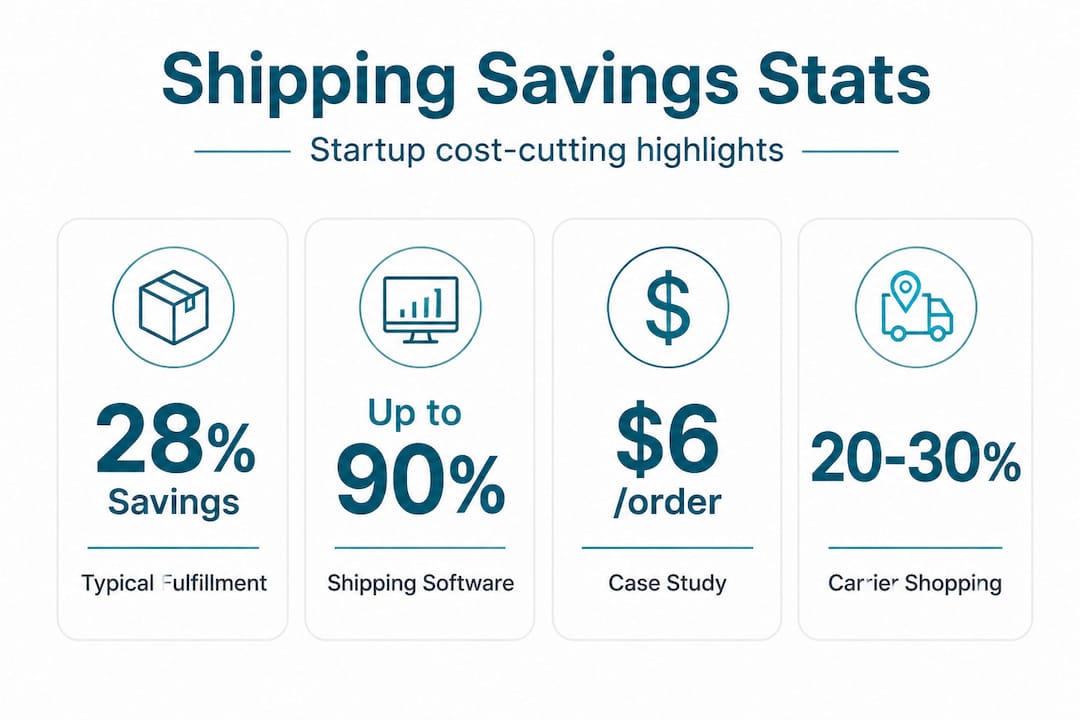
Platforms that deliver real results back this up: reported savings include $6 per order saved by Aroma360 and a 28% fulfillment cost reduction, while shipping software typically unlocks up to 90% off retail rates through carrier partnerships.
| Strategy | Typical savings | Effort required |
|---|---|---|
| Switch to shipping software | Up to 90% off retail rates | Low |
| 3PL volume discounts | 15 to 40% off retail | Medium |
| Dimensional weight audit | 5 to 15% | Medium |
| Zone skipping / inventory placement | 10 to 25% | High |
| Carrier rate negotiation | 5 to 20% | Medium |
For negotiating shipping rates effectively, your volume projection is your most powerful tool. Even if you’re shipping 200 orders per month today, if your trend line shows 1,000 orders per month in six months, carriers and 3PLs will often price for future volume to win your business now.
Quick-win checklist for founders:
- Sign up for shipping software to immediately access discounted carrier rates
- Audit your last 30 invoices for dimensional weight overcharges
- Ask your current carrier for a rate review based on your past 90 days of volume
- Investigate transparent shipping rate advice to understand how rate structures work
- Model the cost of a single distributed warehouse location closer to your top customer zip codes
The bundling and batching principle is underused. Consolidating shipments to the same region, printing labels in batch runs, and using zone-optimized carrier selection per order can add up to meaningful per-order savings without changing your core fulfillment model.
For higher-volume operations, applying freight shipping tips to your inbound supplier shipments can reduce landed cost of goods, indirectly improving your shipping economics at the customer-facing end.
What most startups get wrong about shipping and how to fix it
Here’s the uncomfortable truth: most founders optimize for the wrong metric. They chase the lowest per-label cost and ignore the full picture of what shipping does to their brand and their repeat purchase rate.
Shipping is often the only physical touchpoint your customer has with your business. The unboxing experience, the delivery speed, the accuracy of the order, these are brand moments. A startup that saves $0.50 per shipment by switching to a slower carrier but sees its review score drop from 4.8 to 4.2 has made a terrible trade. The math only works if customers never notice. They almost always do.
The second mistake is treating shipping as a cost center rather than a growth lever. Smart ecommerce brands use shipping strategically. Free shipping thresholds drive higher average order values. Faster delivery options at checkout reduce cart abandonment. Transparent tracking reduces customer service contacts and improves satisfaction scores. Every one of these effects has a direct dollar value that typically exceeds the cost of the better shipping option.
We’ve seen founders get caught in analysis paralysis, waiting for the “perfect” shipping setup before scaling marketing. The right approach is to implement a good-enough solution now, track the key metrics (cost per order, delivery time, damage rate, customer complaints), and iterate from there. Perfection later beats paralysis now every time.
The lesson from real customer shipping experiences is clear: customers forgive a lot, but they do not forgive late or damaged deliveries. Prioritize reliability first, then optimize for cost. That sequence produces better long-term outcomes than the reverse.
Streamline your startup’s shipping with expert support
Putting these strategies into practice requires more than a checklist. It requires access to the right partners, tools, and infrastructure designed specifically for growing ecommerce operations.
ORNER’s platform connects startups with reliable courier services across the U.S. and internationally, giving you access to pre-negotiated rates, real-time tracking, and fulfillment infrastructure that scales with your business. Whether you’re processing 50 orders a month or 5,000, the platform is built to flex with your growth curve. For founders just getting started, small business courier services provide a cost-effective entry point without the overhead of a full 3PL commitment. For those ready to scale, ORNER’s ecommerce warehousing best practices guide and fulfillment network give you the infrastructure to grow without the operational headaches.
Frequently asked questions
What is the most cost-effective shipping solution for a new ecommerce startup?
For most new startups, shipping software offers the lowest entry cost and immediate access to discounted rates up to 90% off retail, while 3PL becomes cost-effective as order volumes grow and pick-pack fees of $2.50 to $4 per order are offset by carrier discounts.
How can I negotiate better shipping rates for my startup?
Use your projected volume as leverage in conversations with carriers and 3PLs, and always compare at least three offers to identify the market rate before negotiating. Platforms with pre-negotiated carrier rates also give you an immediate baseline that’s often better than what you can negotiate alone.
When should a startup switch from self-fulfillment to a 3PL solution?
Switch when orders exceed 200 per month, fulfillment errors are increasing, or when your team’s time is better spent on growth rather than packing boxes. 3PL storage and fulfillment costs become economically justified as volume and customer delivery expectations increase.
Are there any hidden fees I should watch out for with shipping partners?
Yes, watch closely for receiving fees, long-term storage charges, return processing costs, and minimum volume penalties. Standard 3PL pricing includes additional item fees of $0.50 to $1 per item beyond the base pick-pack rate, which can significantly change your per-order economics.
Recommended
- Maximize Profits with Effective Shipping Cost Optimization – ORNER
- Mastering Reducing Shipping Costs: 6 Effective Strategies – ORNER
- Top freight shipping tips to cut costs and boost efficiency – ORNER
- How Can You Reduce International Shipping Costs? – ORNER
- Cost-saving methods in manufacturing: boost efficiency