
TL;DR:
- Contract logistics offers a long-term, technology-enabled partnership managing end-to-end supply chain functions.
- It is vital for e-commerce growth, improving efficiency, reducing costs, and enhancing fulfillment reliability.
- Key performance KPIs include order accuracy, inventory accuracy, on-time delivery, and dock-to-stock time.
The global contract logistics market is projected to grow from roughly USD 400 to 450 billion in 2024 to as much as USD 880 billion by 2032, and e-commerce is the engine behind that surge. Yet most online sellers still treat logistics as an afterthought, scrambling to fix broken fulfillment only after customers complain. Contract logistics is a structured, long-term outsourcing arrangement where a provider manages a defined set of supply chain functions on your behalf. This guide breaks down what contract logistics covers, which KPIs actually move the needle, costly pitfalls to sidestep, and how to turn your shipping operations into a genuine competitive advantage.
Table of Contents
- What is contract logistics?
- Contract logistics market size and growth
- Key performance benchmarks in contract logistics
- How contract logistics increases fulfillment reliability and reduces costs
- Why most e-commerce brands underestimate contract logistics
- Streamline your shipping with trusted logistics partners
- Frequently asked questions
Key Takeaways
| Point | Details |
|---|---|
| Contract logistics defined | It goes beyond warehousing by combining custom supply chain services for scalable fulfillment. |
| Market is booming | Driven by e-commerce, contract logistics is growing at 6–8% annually worldwide. |
| KPIs drive results | Inventory accuracy, order accuracy, and on-time delivery are the core metrics that matter most. |
| Improves cost and reliability | Real-world results include 20%+ better delivery rates and over 30% logistics cost savings. |
| Strategy matters | Tech adoption, KPI tracking, and provider diversification are crucial for long-term success. |
What is contract logistics?
Contract logistics is not the same as renting warehouse space or calling a courier. It is a customized, technology-enabled partnership where a provider takes on end-to-end responsibility for specific supply chain functions under a formal agreement. Think of it as the difference between hiring a temp worker and retaining a dedicated operations team that lives inside your business.
Understanding what is ecommerce logistics helps clarify why contract logistics is a step above traditional third-party logistics (3PL). Classic 3PL is often transactional: you pay per pallet stored, per shipment moved. Contract logistics goes deeper, embedding the provider into your workflows with agreed service levels, performance targets, and continuous improvement cycles.
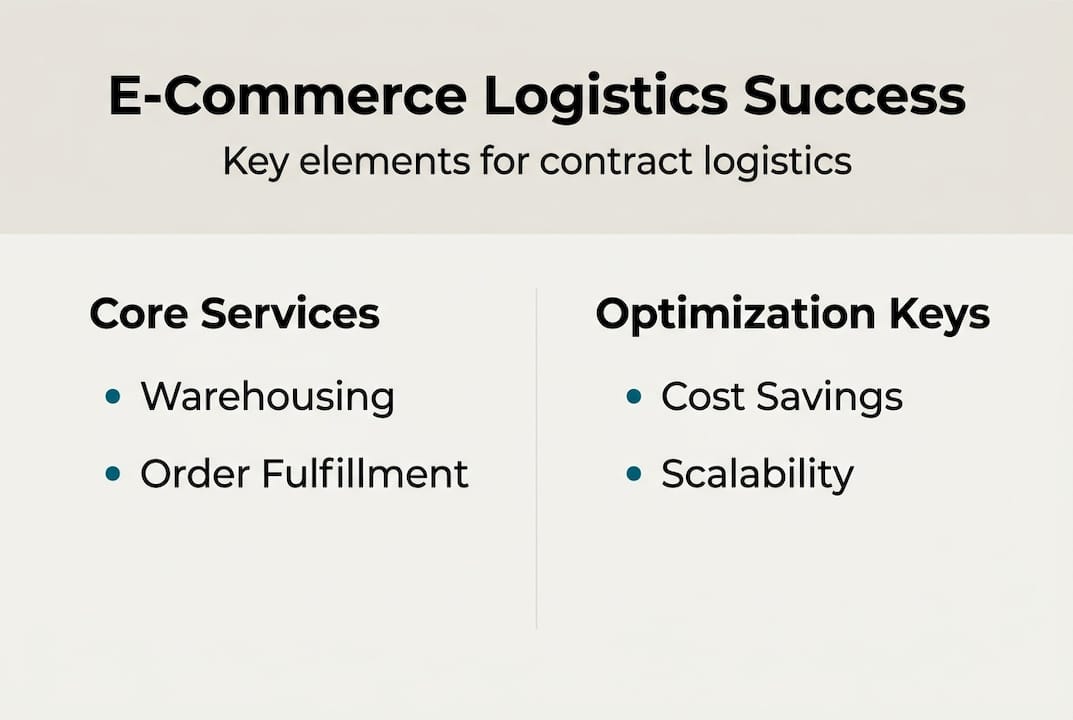
Core services typically covered under a contract logistics agreement include:
- Inventory management: Real-time stock visibility, cycle counting, and replenishment planning
- Order fulfillment: Pick, pack, and ship operations aligned to your brand standards
- Value-added services: Kitting, labeling, customization, and quality inspection
- Returns handling: Reverse logistics that protect margin and customer satisfaction
- Last-mile delivery: Final delivery coordination to the end customer’s door
For e-commerce sellers managing cross-border shipments, this structure is transformative. Supply chain automation trends show that technology integration, such as warehouse management systems and real-time tracking, is what separates high-performing contract logistics setups from outdated manual operations. E-commerce and retail drive over 30% of total contract logistics demand globally, which tells you exactly where the growth is concentrated.
Pro Tip: Before signing any contract logistics agreement, digitize all service-level agreements (SLAs) and define your KPIs in writing. Vague language like “timely delivery” costs you leverage when performance slips.
The scalability factor is what makes contract logistics especially attractive for growing brands. Whether you are shipping 500 orders a month or 50,000, a well-structured contract logistics partner adjusts capacity without you having to hire, train, or fire warehouse staff. That flexibility directly reduces overhead and improves your ability to respond to demand spikes.
Contract logistics market size and growth
Understanding what contract logistics is sets the stage for why it is booming across the globe. The numbers are striking. The global market is projected to grow at a compound annual growth rate (CAGR) of 6 to 8 percent, reaching USD 650 to 880 billion by 2032 to 2034. That is not incremental growth. That is a structural shift in how businesses manage their supply chains.
| Region | 2024 Market Share | Growth Driver |
|---|---|---|
| North America | High | E-commerce surge, automation adoption |
| Asia-Pacific | Fastest growing | Manufacturing scale, cross-border trade |
| Europe | Mature, steady | Omnichannel retail, sustainability focus |
Several forces are accelerating this expansion:
- E-commerce growth: Online retail now accounts for more than 30% of contract logistics demand, and that share keeps climbing
- Omnichannel retail strategies: Brands need unified inventory visibility across physical stores, online channels, and marketplaces like Amazon
- Technology adoption: Automation, robotics, and AI-powered forecasting are making contract logistics faster and more accurate than ever
- Rising consumer expectations: Two-day and next-day delivery windows have become baseline expectations, not premium features
The United States market deserves special attention. North America benefits from a mature infrastructure network combined with aggressive e-commerce adoption, making it one of the most active regions for contract logistics investment. For sellers operating in or expanding into the U.S., understanding logistics challenges and solutions is critical to navigating this competitive landscape.
Here is the uncomfortable reality: e-commerce brands that delay adopting structured contract logistics arrangements are not standing still. They are falling behind. Competitors who invest now are locking in better rates, better technology integrations, and better provider relationships. By the time a late adopter decides to act, the best providers may already be at capacity or focused on larger clients.

Key performance benchmarks in contract logistics
With the market growing fast, measuring what matters is the key to getting ROI from your logistics investment. KPIs (key performance indicators) are the scorecards that tell you whether your contract logistics partner is actually delivering.
Here are the four benchmarks every e-commerce operator should track:
- Order accuracy rate: The percentage of orders fulfilled without errors. Industry leaders achieve 99.5%+ as a standard benchmark.
- Inventory accuracy: How closely your system records match physical stock. Top performers maintain over 99% accuracy, reducing costly stockouts and overstock situations.
- On-time delivery rate: The share of shipments arriving within the promised window. High performers consistently hit 95% on-time delivery or better.
- Dock-to-stock time: How quickly received inventory is processed and available for fulfillment. Faster dock-to-stock directly reduces backorders and improves cash flow.
| KPI | Industry Average | High Performer Target |
|---|---|---|
| Order accuracy | 98% | 99.5%+ |
| Inventory accuracy | 97% | 99%+ |
| On-time delivery | 90% | 95%+ |
| Dock-to-stock time | 24-48 hours | Under 12 hours |
“The difference between a 90% and a 95% on-time delivery rate is not just a number. It is the difference between retaining customers and losing them to a competitor who ships faster.”
For sellers scaling internationally, these benchmarks are not optional targets. They are survival metrics. Explore logistics KPI examples to see how leading brands structure their measurement frameworks, and review delivery performance metrics to understand how tracking these numbers translates into customer loyalty and repeat revenue.
The brands that win in cross-border e-commerce are the ones that treat these KPIs as living data, reviewing them weekly and holding providers accountable in real time, not quarterly.
How contract logistics increases fulfillment reliability and reduces costs
Benchmarks and KPIs are only valuable if your operations actually improve. Here is how the right logistics partner makes a measurable difference.
Real-world results are compelling. One documented case study showed on-time delivery improved from 78.4% to 95.6% after implementing structured contract logistics, alongside a 31% reduction in total logistics costs. Those are not marginal gains. They are the kind of results that change the trajectory of a business.
Here is a proven framework for making contract logistics work:
- Robust technology integration: Connect your e-commerce platform, warehouse management system, and carrier networks through APIs. Real-time data eliminates the blind spots that cause delays and errors. Learning how to streamline logistics starts with removing information gaps.
- Continuous KPI monitoring: Set up automated dashboards that flag exceptions immediately. Do not wait for monthly reports to discover a problem that started three weeks ago.
- Process change workflow: Define a clear escalation path for when performance dips below agreed thresholds. Who gets notified? What is the resolution timeline? Document it before you need it.
- Provider diversification: Relying on a single logistics provider for all your volume is a risk. Spreading volume across two or three vetted partners gives you negotiating leverage and resilience during disruptions. Strategies for reducing shipping costs often include this kind of multi-provider approach.
For sellers focused on shipping cost optimization, contract logistics creates structural savings through volume consolidation, better carrier rate negotiations, and reduced error-related rework costs. You can also reduce delivery times by positioning inventory closer to your highest-density customer markets through a provider’s fulfillment network.
Pro Tip: Over-reliance on a single logistics provider is one of the most common and costly mistakes growing brands make. Even a short-term disruption at one facility can cascade into thousands of delayed orders. Diversify your provider base before you need to, not after a crisis forces your hand.
Why most e-commerce brands underestimate contract logistics
Here is the hard truth most logistics consultants will not say directly: the brands struggling most with fulfillment are not struggling because of bad carriers or warehouse locations. They are struggling because they treat logistics as a cost to minimize rather than a capability to build.
Smaller and midsized brands often assume contract logistics is designed for enterprise players with massive volumes. That assumption is increasingly wrong. Providers have scaled their offerings to serve brands shipping as few as a few hundred orders per day, and the technology that powers these arrangements is more accessible than ever. Explore outsourcing order fulfillment to see how brands at various stages are making this work.
The real cost of avoiding structured contract logistics is hidden in chargebacks, customer service overhead, return rates, and lost repeat purchases. Brands that treat logistics as a growth driver, investing in SLAs, KPI accountability, and provider relationships, scale faster and recover from disruptions more easily than those who treat it as a line item to cut.
Streamline your shipping with trusted logistics partners
Ready to take the next step and unlock new levels of fulfillment efficiency? At or-ner.com, we work with e-commerce sellers and logistics managers who are serious about building reliable, scalable shipping operations.
Our platform connects you with reliable courier services across the U.S. and globally, with tools for real-time tracking, customs clearance, and cross-border coordination. Whether you are refining your domestic fulfillment or expanding internationally, our cross-border logistics guide gives you a practical roadmap. You can also sharpen your stock control with our inventory management tips built specifically for e-commerce growth. Reach out to explore how we can tailor a logistics solution to your exact needs.
Frequently asked questions
What are the main services included in contract logistics?
Contract logistics typically includes warehousing, inventory management, order fulfillment, transportation, and value-added services like returns processing. The scope extends well beyond traditional warehousing to cover the full fulfillment cycle.
How do I measure contract logistics performance?
Use KPIs like order accuracy, inventory accuracy, on-time delivery rate, and dock-to-stock time to track performance and efficiency. These benchmarks are the core metrics used across the industry to evaluate provider performance.
Why is contract logistics important for growing e-commerce brands?
Reliable contract logistics enables brands to scale efficiently, maintain high service levels, and compete internationally without building their own warehouse infrastructure. E-commerce drives over 30% of total contract logistics market demand, reflecting how central it has become to online retail growth.
What’s the difference between contract logistics and 3PL?
Contract logistics involves a customized, long-term partnership managing a defined range of supply chain services under formal SLAs, while 3PLs often provide more basic or transactional support without the same level of accountability or integration.