
TL;DR:
- Effective freight booking relies on accurate, centralized data, integrated tools, and disciplined process execution. Regular measurement of KPIs like load utilization, planning time, and detention helps sustain operational improvements. Human ownership and real-time dock scheduling integration are crucial to prevent errors and maximize efficiency.
Freight booking should be a workflow. Too often, it’s a fire drill. Delayed shipments, cost overruns from poor load planning, and booking errors caused by disconnected systems are daily frustrations for ecommerce sellers and supply chain managers who know exactly how to improve freight booking in theory but struggle to execute consistently. The difference between a profitable logistics operation and a chaotic one often comes down to preparation, the right tools, and disciplined process execution. This article walks you through exactly what to fix, step by step.
Table of Contents
- Key takeaways
- How to improve freight booking: the foundation first
- Execution tactics that actually move the needle
- Common mistakes that undermine freight booking gains
- Measuring what you fixed: KPIs and tracking
- My take on where freight booking optimization actually fails
- How Or-ner helps you put this into practice
- FAQ
Key takeaways
| Point | Details |
|---|---|
| Start with data accuracy | Clean, centralized shipment data prevents downstream booking errors and documentation failures. |
| Automate documentation workflows | Generating eBOLs directly from load data eliminates costly manual re-entry errors. |
| Use AI for load planning | Predictive load planning cuts planning time and improves load utilization within weeks. |
| Schedule docks proactively | Integrated dock scheduling prevents arrival bottlenecks and reduces detention charges significantly. |
| Track KPIs continuously | Monitor load utilization, planning time, and dock adherence to sustain long-term improvement. |
How to improve freight booking: the foundation first
Before you change a single workflow, you need to get your data house in order. Most freight booking problems trace back to a messy foundation, not bad execution.
What accurate shipment data actually means
Accurate shipment details go beyond knowing what you are shipping. You need precise weights, dimensions, commodity classifications, hazmat flags, and delivery constraints documented in a single system before a booking is ever created. When this data lives in spreadsheets, email threads, or legacy ERPs with no integration, errors compound fast. A mislabeled weight class can trigger a reweigh fee. A missing delivery window can cost you a carrier appointment.
The goal is centralized information management. Every stakeholder — from the warehouse team to the carrier rep — should pull from the same data source.
Tools and team alignment you need in place
A Transportation Management System (TMS) is the backbone of freight booking optimization. Modern TMS platforms offer unified quoting, booking, and carrier communication in one interface, which dramatically cuts down on switching costs and version conflicts. If your team is still toggling between three different tabs to get a rate quote, that is a sign your TMS is due for an upgrade.

Equally important is dock scheduling software. Without it, your carrier communication and load planning improvements will hit a wall the moment trucks start piling up at your facility.
Here is a quick reference for the foundational setup:
| Component | What it does | Who owns it |
|---|---|---|
| TMS platform | Centralized quoting, booking, and tracking | Logistics manager |
| Dock scheduling tool | Appointment management and real-time ETA sync | Warehouse supervisor |
| Data governance process | Ensures clean, consistent shipment records | Operations team |
| Carrier communication portal | Self-service scheduling and updates for carriers | Carrier relations lead |
| Document automation | Generates eBOLs and compliance docs from live data | Freight coordinator |
Getting these components aligned before you try to optimize anything else saves you from fixing the same problems twice.
Execution tactics that actually move the needle
Once the foundation is solid, these are the tactics that produce real, measurable improvements in freight booking efficiency.
-
Deploy AI-driven predictive load planning. Logistics providers using predictive load planning have seen planning time drop 65%, load utilization improve by 31%, and empty miles cut by 22%, all within 90 days. These are not incremental gains. AI tools analyze historical shipment patterns, carrier capacity, and routing constraints to build optimized loads before you ever contact a carrier.
-
Automate your documentation. Electronic Bills of Lading generated directly from load data eliminate manual errors caused by data re-entry. When your eBOL matches your TMS record exactly, you avoid shipment holds and billing disputes that can take days to resolve.
-
Consolidate freight loads wherever possible. LTL (Less than Truckload) shipments are expensive and slow. Consolidating smaller shipments into full truckloads using load-building tools reduces per-unit costs and simplifies carrier management. Freight load optimization requires automatic enforcement of stacking rules and weight limits to prevent compliance issues downstream.
-
Use carrier self-service portals for scheduling. Facilities that give carriers direct access to dock appointment portals see scheduling labor reduced by 70% and significantly better arrival predictability. Carriers prefer it too, because they are not waiting on hold or chasing confirmation emails.
-
Integrate dock scheduling with your TMS in real time. API-based TMS and dock scheduling integration updates ETAs dynamically and adjusts dock door assignments as conditions change. This keeps your receiving and shipping floors synchronized instead of reactive.
-
Audit your carrier roster regularly. Not all carriers perform equally across lanes. Review on-time delivery rates, damage claims, and communication responsiveness quarterly. Concentrating volume with high-performing carriers gives you negotiating leverage and service consistency.
Pro Tip: When configuring loads in your TMS, build commodity-specific loading profiles that account for weight distribution, stackability, and temperature sensitivity. A generic load template applied to fragile goods or heavy machinery will create compliance headaches that cost more than the time you saved.
These steps work best when executed in sequence. Jumping to AI load planning before your data is clean will produce optimized plans built on bad inputs.
Common mistakes that undermine freight booking gains
Even teams with good intentions and decent tools fall into patterns that erode efficiency. Knowing where the traps are is half the battle.
-
Managing bookings across disconnected systems. When your quoting tool, TMS, and carrier communication happen in separate platforms with no integration, data discrepancies are inevitable. A single workspace for freight management reduces errors and cuts the time spent reconciling records manually.
-
Ignoring real-time data during active shipments. Booking a shipment and then going dark until delivery is a recipe for expensive surprises. Traffic delays, port congestion, and weather disruptions change ETAs constantly. Teams that monitor live updates can reschedule dock appointments proactively and avoid detention charges.
-
Weak carrier communication. Carriers need accurate, timely information to perform. Inconsistent load details, last-minute changes, and unclear delivery windows erode carrier relationships over time. The best carriers start deprioritizing shippers who create operational headaches.
-
Overbooking docks without scheduling logic. Scheduling too many trucks into the same time window creates congestion that ripples through your entire operation. Integrated dock portals using real-time ETAs prevent these bottlenecks by spacing arrivals based on actual capacity and live arrival data.
-
Inaccurate or incomplete documentation. A freight booking is only as good as the paperwork behind it. Missing a hazmat declaration, wrong consignee address, or incorrect freight class triggers holds, redelivery fees, and carrier penalties.
Pro Tip: Run a monthly documentation audit by pulling a random sample of completed shipments and checking whether the eBOL matched the original booking record. Even a 5% discrepancy rate across high volume operations adds up to thousands in avoidable costs.
The common thread across all these mistakes is a lack of system integration and real-time visibility. Fixing those two things eliminates most of the risk.
Measuring what you fixed: KPIs and tracking
Improvement without measurement is just hope. After you implement changes, these are the metrics that tell you whether they are working.
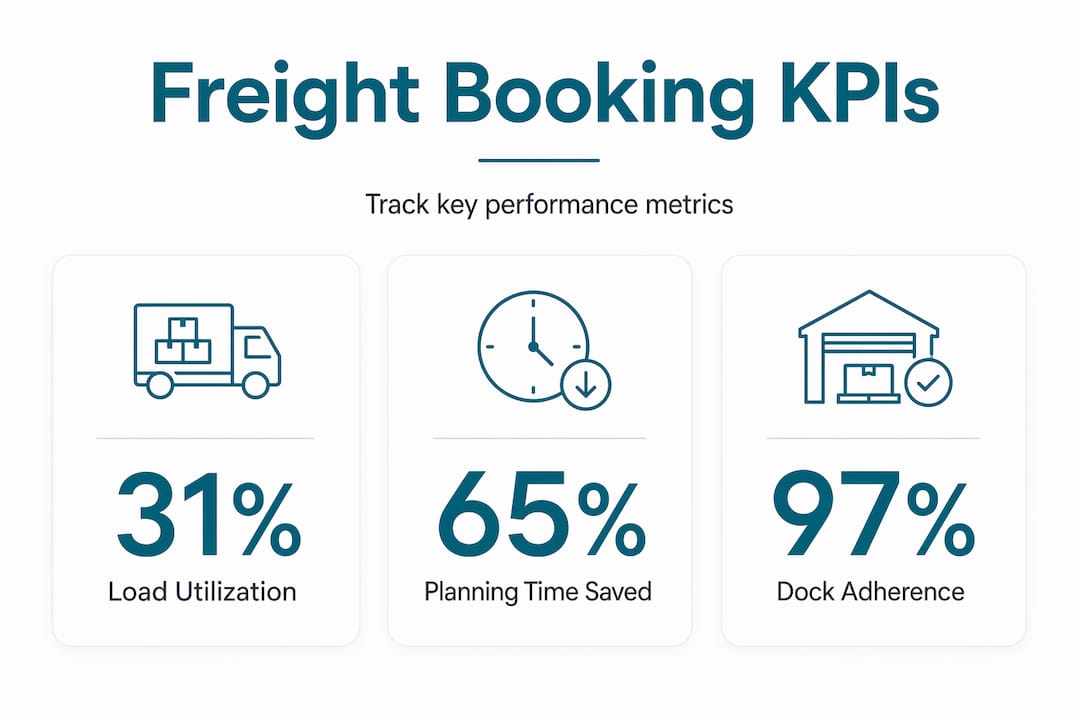
| KPI | Definition | Target benchmark |
|---|---|---|
| Planning time per shipment | Minutes spent configuring and booking each load | Reduce by 40% within 90 days |
| Load utilization rate | Percentage of trailer capacity filled per booking | 90% or higher |
| Empty miles percentage | Miles driven without freight | Below 15% |
| Dock appointment adherence | Percentage of trucks arriving within their scheduled window | 85% or higher |
| Detention time per load | Hours trucks spend waiting at docks beyond appointment time | Under 30 minutes average |
| Documentation error rate | Percentage of shipments with eBOL discrepancies | Under 2% |
Your TMS reporting dashboard should surface most of these automatically. If it does not, that is itself a signal that your platform needs attention. Good freight booking optimization creates a data trail. You should be able to pull weekly trends on load utilization and dock adherence and identify which lanes or carriers are dragging the numbers down.
The most underused KPI on this list is detention time. It is expensive (carriers charge detention fees after a free window, often starting at $50 to $100 per hour), and it is almost entirely preventable with proper dock scheduling. Teams that track it consistently find the pattern within two or three weeks and fix it. Teams that do not track it keep paying indefinitely.
Use these KPIs as a freight booking checklist that you revisit on a set schedule, not just when something goes wrong.
My take on where freight booking optimization actually fails
I have worked with enough ecommerce and supply chain teams to recognize a pattern. The technology is rarely the problem. Companies invest in a modern TMS, add a dock scheduling portal, and then watch their metrics barely move. The reason, almost every time, is that the human layer was not rebuilt alongside the tech layer.
Warehouse supervisors still route urgent trucks outside the scheduling system because “it’s faster.” Freight coordinators still key data manually from carrier emails because the integration was set up wrong and nobody filed the ticket to fix it. The tools are there. The habits are not.
What I have learned is that freight booking optimization is change management first and technology second. The most effective teams I have seen appoint a single process owner for freight booking, someone whose job is explicitly to maintain data quality, audit KPIs weekly, and hold carrier and warehouse teams accountable to the new workflow. Without that ownership, every tool investment decays within six months.
The other thing worth saying plainly: real-time dock scheduling integration is dramatically underestimated. Most discussions focus on load planning and carrier rates, but the dock is where money gets lost in real time. A truck sitting for two hours at an overcrowded facility costs you the detention fee, the driver’s goodwill, and sometimes the carrier relationship. Fixing the dock fixes the downstream.
The freight booking tips that have the highest ROI are not the flashiest. Accurate data, proactive scheduling, and consistent measurement compound over time into a serious competitive advantage.
— Maayan
How Or-ner helps you put this into practice
If the tactics above sound right but the implementation feels daunting, Or-ner’s logistics platform is built for exactly this kind of work.
Or-ner provides ecommerce sellers and supply chain teams with reliable courier services and AI-powered freight booking tools designed to manage the full booking lifecycle, from load planning and documentation to real-time tracking and customs clearance. The platform integrates across ocean, air, and land transport modes, connecting directly with major ecommerce operators including Amazon. Whether you are shipping domestically or managing cross-border logistics across multiple regions, Or-ner’s network of global warehouses and fulfillment centers gives you the infrastructure to execute at scale. You can start with Or-ner’s practical freight booking guide to map your current process against best practices, or explore 2026 freight booking strategies tailored specifically for ecommerce sellers navigating today’s market.
FAQ
What is the fastest way to improve freight booking efficiency?
Centralizing your quoting, booking, and carrier communication in a single TMS platform delivers the fastest efficiency gains because it eliminates data reconciliation across disconnected systems.
How does AI improve the freight booking process?
AI-driven predictive load planning can reduce planning time by up to 65% and improve load utilization by 31% by analyzing historical data and carrier capacity to build optimized shipments automatically.
Why does dock scheduling matter for freight booking optimization?
Poor dock scheduling creates congestion that triggers detention charges and damages carrier relationships. Integrated self-service dock portals reduce scheduling labor by 70% and improve arrival predictability significantly.
What KPIs should I track after improving my freight booking process?
Focus on load utilization rate, planning time per shipment, dock appointment adherence, detention time, and documentation error rate. These metrics directly reflect booking quality and operational cost.
How do I prevent documentation errors in freight booking?
Generate electronic Bills of Lading directly from your TMS load records rather than keying data manually. Automated eBOLs match system data exactly, preventing the shipment holds and billing discrepancies that come from re-entry mistakes.