
TL;DR:
- Most ecommerce sellers confuse transit time with delivery time, risking customer trust through inaccurate promises. Understanding the separate measurement of processing, transit, and delivery phases helps sellers set realistic expectations and improve fulfillment efficiency. Applying real-time tracking and transparent communication significantly reduces customer complaints and enhances satisfaction.
Most ecommerce sellers treat transit time and delivery time as the same number. They are not, and conflating them is one of the fastest ways to erode customer trust. When a customer sees “3-day delivery” but waits five days, the problem usually is not the carrier. It is a miscalculation that started before the package ever left the warehouse. Understanding transit time vs delivery time as two separate, measurable clocks is the foundation of accurate shipping promises and efficient fulfillment operations.
Table of Contents
- Understanding transit time and delivery time: definitions and differences
- How seller processing impacts estimated delivery time
- Breaking down transit time: carrier network and shipment status
- How to use transit and delivery times to optimize fulfillment and customer promises
- Why most ecommerce shipping ETAs miss the mark — and how to fix it
- Streamline your shipping with ORNER’s global logistics solutions
- Frequently asked questions
Key Takeaways
| Point | Details |
|---|---|
| Transit time defined | Transit time is the period a carrier moves a package after pickup until delivery. |
| Delivery time meaning | Delivery time is when the package physically arrives at the customer’s location. |
| Processing impacts delivery | Seller processing time before handoff affects the overall delivery estimate. |
| Separate timing clocks | Differentiate warehouse processing, carrier transit, and promise buffers to avoid errors. |
| Clear communication | Being transparent about all timing elements sets accurate customer expectations. |
Understanding transit time and delivery time: definitions and differences
These two terms describe different phases of the same journey, and mixing them up creates real problems at scale.
Transit time is the period that begins when a carrier physically takes possession of a shipment and ends when it reaches the destination address. It is entirely carrier-controlled. The clock starts at pickup and stops at the door. As Shopify explains, transit time is the elapsed time a shipment spends moving through the carrier’s network after pickup, while delivery time is the customer-facing date when the parcel arrives at the destination.
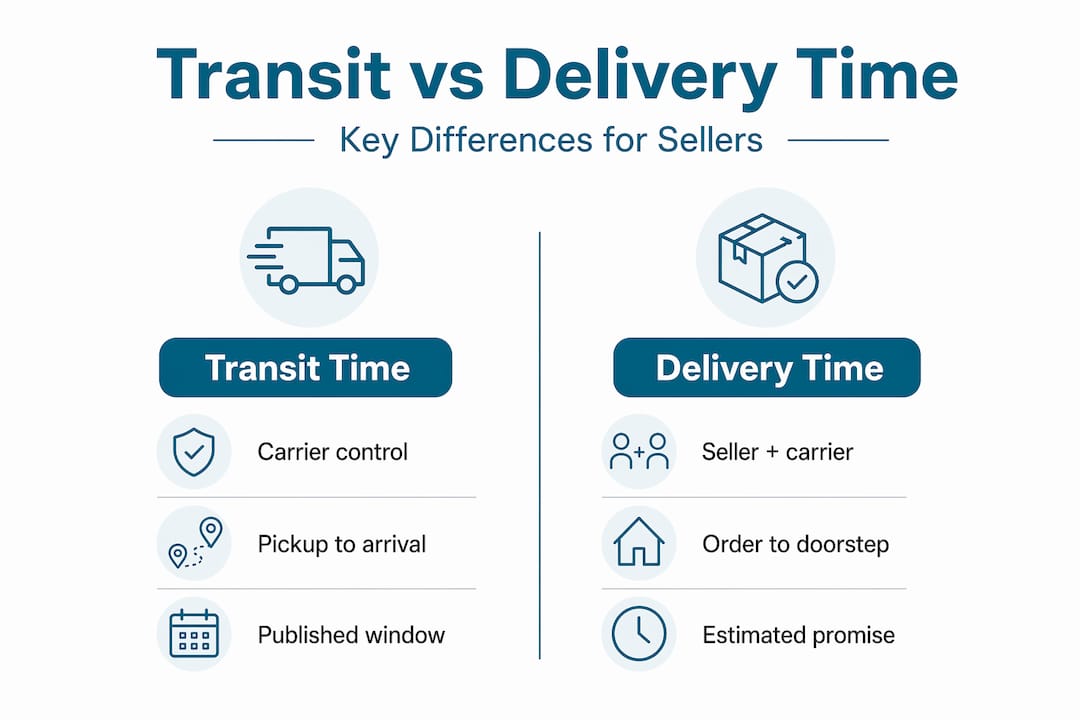
Delivery time, on the other hand, is what your customer actually experiences. It counts every day from when they placed the order to when the package lands in their hands. That includes the time your team spent picking, packing, and printing the label before the carrier ever touched the box.
Here is the practical difference laid out clearly:
- Transit time = carrier pickup date to delivery date
- Delivery time = order placement date to delivery date
- The gap between them = your seller processing time
- Transit time does not include pre-shipment preparation unless the seller explicitly states otherwise
- The formula for delivery time calculation is: order date + processing time + transit time = estimated delivery date
This means two sellers using the same carrier and the same shipping service can deliver at very different speeds depending entirely on how fast each seller hands off the parcel. Understanding the difference between transit and delivery time is not just semantics. It is the difference between a checkout page that says “arrives by Friday” accurately and one that sets you up for a one-star review.
If your goal is to reduce delivery times without switching carriers or paying for premium shipping, looking at your internal processing phase is almost always the highest-leverage place to start.
How seller processing impacts estimated delivery time
Processing time is the period between a customer placing an order and your team handing the parcel to a carrier. It sounds simple, but it quietly kills delivery ETAs at hundreds of ecommerce businesses every day.
Here is the sequence that determines your actual delivery estimate:
- Customer places order
- Seller picks and packs the item (processing time begins)
- Label is printed and parcel is staged
- Carrier picks up the parcel or seller drops it off (transit time begins)
- Parcel moves through the carrier network
- Parcel is delivered to the customer (delivery time ends)
The problem is that most sellers calculate their delivery estimate using only the carrier’s published transit window. If a carrier says “2-day shipping,” the seller advertises “2-day delivery” but forgets to account for the 24 or 48 hours the package sits in their warehouse waiting for pickup. That is how processing delays and missed carrier cutoffs quietly add days to the customer’s actual experience.
Carrier pickup cutoffs are a particularly overlooked factor. Most carriers have a same-day cutoff of 2 or 3 PM. An order placed at 4 PM on a Tuesday that takes eight hours to process will miss Tuesday’s pickup entirely. Transit does not begin until Wednesday. If that Wednesday happens to be the day before a holiday, you have lost another day.
Pro Tip: Map your average order-to-pickup time by day of week. Many sellers discover that Friday afternoon orders routinely miss the last pickup before the weekend, adding two full days to delivery time with no carrier involvement at all.
Understanding how processing connects to the order fulfillment steps is what separates sellers who consistently meet their delivery promises from those who are always apologizing for late arrivals. If your team needs to move faster, applying faster fulfillment tips to your warehouse workflow can shave hours off your processing window without adding headcount.

Breaking down transit time: carrier network and shipment status
Once your carrier takes possession, transit time begins. But that period is not a single uninterrupted journey. It is a chain of distinct carrier-controlled phases, and understanding each one helps you diagnose delays and set better customer expectations.
A typical transit lifecycle looks like this:
- Carrier pickup: The parcel leaves your facility and enters the carrier network
- Origin sorting hub: Package is scanned, sorted, and routed to the correct transport
- Line haul transportation: Ground, air, or sea movement to the destination region
- Destination sorting hub: Package is sorted again for local distribution
- Final mile delivery: The parcel reaches a local delivery vehicle for that day’s route
Each phase has its own timing and risk profile. A delay at the origin sorting hub can cascade through every downstream phase. This is why transit time covers the full interval from carrier pickup through sorting hubs to delivery.
Understanding tracking statuses within this process is directly useful for customer communication. Here is a quick reference:
| Tracking Status | What It Means | Typical Customer Action |
|---|---|---|
| Shipment created | Label printed, carrier not yet in possession | No action needed |
| In transit | Package moving through carrier network | Monitor, no immediate concern |
| Out for delivery | On local driver’s vehicle for today | Prepare to receive |
| Delivery attempt failed | Driver could not complete delivery | Contact carrier or reschedule |
| Delivered | Parcel confirmed at destination | Mark order complete |
The distinction between “in transit” and “out for delivery” matters more than most sellers realize. “In transit” could mean the package is anywhere in the country. “Out for delivery” means it is on a truck within miles of the customer’s door. These are very different moments requiring different communication responses. Tracking your delivery performance metrics across these stages tells you exactly where your carrier loses time.
Pro Tip: If a high volume of your packages sit in “in transit” status for longer than the carrier’s average transit time, that is a signal to audit which routes or facilities are creating bottlenecks, not to adjust your customer-facing delivery estimate.
How to use transit and delivery times to optimize fulfillment and customer promises
Knowing the definitions is only useful if you apply them operationally. Here is a framework for turning this knowledge into better delivery ETAs and fewer customer complaints.
-
Run three separate clocks. Track warehouse processing time, carrier transit time, and customer promise buffer as distinct measurements. When something goes wrong, you will immediately know which clock is broken. As ETA management research shows, avoiding ETA drift requires separating these clocks because merging them leads to misdiagnoses of delays.
-
Build in buffer for weekends and holidays. Average transit time figures from carriers are almost always quoted in business days. A “3-day transit” over a long weekend is actually five or six calendar days. Build this into your customer promise, not after the fact.
-
Set carrier-specific processing cutoffs. Know the pickup time for each carrier you use and work backward to set your internal cutoff. If your carrier picks up at 3 PM, your warehouse cutoff for same-day processing might be 1 PM to give your team enough time.
-
Use live tracking status to update ETAs dynamically. Do not rely on the original estimated delivery date if the package is already showing delays at a hub. Proactive communication based on real tracking data reduces inbound customer service contacts dramatically.
-
Tell customers what you control and what you do not. A checkout page that says “Orders ship within 1 business day; delivery takes 3-5 business days depending on location” is honest and specific. It also shifts responsibility for carrier delays away from you appropriately.
Sellers scaling cross-border operations should also review the Amazon Vendor Flex guide for fulfillment timing expectations within managed programs. For a full framework on applying these principles to daily operations, the time management practices for ecommerce logistics guide is a useful companion resource. When you are ready to look at your carrier relationships and routing, streamlining your logistics at the carrier level is the next step after mastering your internal timeline.
Why most ecommerce shipping ETAs miss the mark — and how to fix it
Here is the uncomfortable reality: the majority of late delivery complaints are not carrier problems. They are calculation problems that originate in the seller’s own systems.
The single most common mistake is using the carrier’s transit estimate as the total delivery estimate. A seller signs up for a service that advertises “2-day transit” and immediately tells customers “2-day delivery.” No processing time. No buffer. No accounting for order cutoffs. Most ETA failures stem directly from conflating processing and transit time or ignoring cutoff and buffer complexities, which leads to inaccurate promises that are nearly impossible to keep consistently.
The second mistake is ignoring weekend and holiday cutoffs until they cause a problem. Sellers will run a successful Tuesday through Thursday operation and then get a flood of complaints about Friday orders. The packages are not late because the carrier failed. They are late because no one accounted for the fact that a Friday 5 PM order placed after cutoff will not move until Monday.
The third and most consequential mistake is blaming the wrong phase for delays. When you merge your processing time and transit time into a single number, you cannot tell whether a delay came from your warehouse or the carrier’s network. That means you cannot fix it. You just apologize and repeat the cycle. Separating your fulfillment clocks is not just good measurement hygiene. It is the only way to improve reliably.
Here is the part most advice skips: transparent communication about what is happening and why actually reduces customer frustration even when delays are real. A customer who receives a message saying “your order is delayed at our warehouse but will ship tomorrow” is far less likely to leave a negative review than a customer who sees an expected delivery date come and go in silence. Honesty about the components of shipping duration vs delivery time builds the kind of trust that survives imperfect operations.
If you want to act on this today, start by auditing your delivery time reduction options from the inside out, starting with processing before touching carrier relationships.
Streamline your shipping with ORNER’s global logistics solutions
Knowing the theory behind transit time vs delivery time only moves the needle when you have tools that let you act on it in real time. ORNER’s global logistics platform gives ecommerce sellers and logistics managers the visibility to track processing and transit phases separately, surface delays before customers notice them, and set accurate delivery estimates at checkout.
ORNER integrates with your existing carrier network and warehouse workflows to give you live tracking across all shipment stages, automated exception alerts, and the data you need to hold each phase of your fulfillment accountable. Whether you are managing domestic orders or cross-border shipments, the platform’s cloud logistics tools for ecommerce make delivery time calculation far less guesswork and far more science. Explore the full range of logistics solutions for ecommerce and see where your operation can gain the most time back.
Frequently asked questions
What exactly is the difference between transit time and delivery time?
Transit time is the period when the carrier moves the parcel through its network, whereas delivery time is when the parcel physically arrives at the customer’s address. As defined in shipping date tracking guides, transit time covers the carrier’s network movement while delivery time is the customer-facing arrival date.
Does transit time include the time a seller takes to prepare an order?
No. Transit time excludes pre-shipment processing unless the seller explicitly commits otherwise. Preparation time is a separate clock that runs before the carrier takes possession.
How can understanding transit vs delivery time improve customer satisfaction?
By clearly communicating both processing and transit durations, sellers set realistic expectations and reduce missed delivery promises. Transparency about shipping and delivery dates ensures customers know when to expect their purchases, which directly reduces complaints.
What does ‘in transit’ status mean in shipment tracking?
‘In transit’ indicates the package is moving through the carrier’s network but has not reached the local delivery vehicle stage yet. Per shipment tracking standards, ‘out for delivery’ is the status that signals the package is with the local driver for same-day delivery.
Can improving seller processing time reduce delivery times even if transit remains the same?
Yes. Reducing processing delays and hitting earlier carrier cutoffs moves the shipping date forward, which improves the delivery estimate without any change to the carrier’s transit window. Earlier transit starts directly translate to earlier delivery dates from the customer’s perspective.