TL;DR:
- Effective cross-border logistics require thorough understanding of complex regulations, accurate documentation, and proactive shipment management. Implementing strategic planning, selecting appropriate transport modes, and monitoring aggregated shipment values help prevent customs holds and cost surprises. Streamlining operations through integrated platforms like ORNER enhances visibility, compliance, and efficiency for international e-commerce shipping.
Shipments stuck at customs. Surprise duty bills. A customer in Germany waiting three weeks for an order that should have taken seven days. These are not edge cases for e-commerce businesses moving goods internationally — they are routine consequences of operating without a clear guide to cross-border logistics. The difference between companies that scale globally and those that bleed margin on international shipping almost always comes down to one thing: understanding the process before a problem forces them to. This guide gives you that understanding, with specific steps for documentation, compliance, transport selection, and cost control.
Table of Contents
- Understanding cross-border logistics essentials
- Preparing your shipments: documentation and compliance essentials
- Executing cross-border shipments smoothly
- Navigating customs regulations and threshold management
- Verifying success and managing cross-border logistics risks
- The overlooked impact of aggregated shipment value management
- Optimize your cross-border logistics with ORNER solutions
- Frequently asked questions
Key Takeaways
| Point | Details |
|---|---|
| Understand core logistics | Cross-border logistics involve complex compliance, documentation, and multiple transport modes unique from domestic shipping. |
| Prepare documents carefully | Accurate invoices, packing lists, and HS codes are vital to avoid costly customs delays and ensure tariff benefits. |
| Manage $800 threshold | Design systems to track aggregated shipment values per consignee per day to prevent automated holds and fees. |
| Use Incoterms strategically | Incoterms clarify buyer and seller responsibilities and help mitigate risks amid tariff changes. |
| Monitor and mitigate risks | Implement real-time tracking and clear return policies to control delays and the high costs of reverse logistics. |
Understanding cross-border logistics essentials
Cross-border logistics is not domestic shipping with a longer transit time. As multiple jurisdictions add complexity compared to domestic shipping, you are dealing with different customs agencies, import regulations, restricted goods lists, and currency-denominated duty calculations that change based on trade agreements. Each country you ship to or from adds a new layer of rules that your domestic carrier knows nothing about.
The core activities in the cross-border logistics process include:
- Inventory positioning: Placing stock in warehouses close to demand centers to cut transit times
- Transport mode selection: Choosing between air, ocean, or ground based on cost, speed, and cargo type
- Freight forwarding: Engaging agents who manage carrier relationships, booking, and documentation
- Customs documentation: Preparing invoices, packing lists, and classification codes
- Customs clearance: Filing entries with the importing country’s agency and paying applicable duties
- Last-mile delivery: Getting the package from a local hub to the end customer
The table below shows where cross-border and domestic logistics diverge most sharply:
| Factor | Domestic logistics | Cross-border logistics |
|---|---|---|
| Regulatory complexity | Single set of rules | Multiple country regulations |
| Transit time | Predictable, days | Variable, days to weeks |
| Cost structure | Fixed carrier rates | Duties, taxes, and variable tariffs |
| Documentation | Minimal | Commercial invoice, HS codes, bill of lading |
| Customs exposure | None | High; errors cause holds and fines |
| Return complexity | Simple | 1.5x cost multiplier |
Read our master cross-border logistics guide for a deeper breakdown of each activity by shipping corridor.
With this foundation in place, let’s prepare by covering crucial compliance and documentation needs.
Preparing your shipments: documentation and compliance essentials
Every customs delay you have ever experienced traces back to a document error. Incorrect HS codes lead to costly audits and clearance holds that can last weeks, not days. Getting documentation right before the shipment leaves your warehouse is the single highest-return action in international logistics.
The documents you need for almost every cross-border shipment:
- Commercial invoice: Must include seller and buyer details, a full description of goods, country of origin, declared value, and currency
- Packing list: Itemized breakdown of each box, including dimensions and weight
- Bill of lading (or airway bill): The contract between shipper and carrier; also serves as a receipt and title document
- HS code classification: The 6-to-10-digit Harmonized System code that determines duty rates; getting this wrong is the most common and costly documentation mistake
- Certificate of origin: Required for claiming preferential tariff rates under trade agreements like USMCA
Beyond the paperwork, cross-border logistics strategies that work consistently include using Incoterms to define exactly who pays for freight, insurance, and duties at each stage of the journey. Consult our Incoterms shipping guide to choose the right term for your trade relationships. Using DDP (Delivered Duty Paid) removes uncertainty for your customer because you absorb all import costs. Using DAP (Delivered at Place) shifts duty responsibility to the buyer, which lowers your upfront cost but can create customer service problems if they are surprised by an unexpected bill at delivery.
Pro Tip: Before shipping to a new country, run your product’s HS code through that country’s tariff schedule tool. A single misclassification can shift your duty rate from 0% to 25%, which erases margin instantly.
After preparing documents, you’ll need to execute your shipping process efficiently.
Executing cross-border shipments smoothly
Choosing the right transport mode is not just a cost decision. As transport mode affects cost, speed, and carbon footprint, you are also making decisions about your brand’s delivery promise and environmental commitments. Here is how to think through each option:
- Air freight: Best for high-value, time-sensitive, or lightweight goods. Typical transit is 2 to 7 days internationally. Cost per kilogram is significantly higher than ocean, but when you factor in holding costs and stockout risk, air often wins for fast-moving consumer goods.
- Ocean freight: Best for heavy, bulky, or lower-value goods. Full Container Load (FCL) gives you a predictable cost; Less than Container Load (LCL) allows smaller shipments but adds handling time at consolidation points. Transit from Asia to the US West Coast typically runs 14 to 21 days.
- Ground/road freight: Best for regional cross-border moves, such as US-Canada or US-Mexico trade corridors. Faster than ocean and cheaper than air for nearby markets.
Once you have chosen a mode, engage a licensed freight forwarder. A good forwarder does more than book space on a carrier. They know which ports are experiencing congestion, which routes have customs pre-clearance programs, and how to structure a Bill of Lading to avoid common holds.
Proactive monitoring matters as much as good planning. Carriers do not always notify you when a shipment is delayed. Build a monitoring cadence into your operations:
- Check shipment status at every transit milestone (origin departure, transshipment hub, destination arrival)
- Set automated alerts for exceptions like missed scans or customs holds
- Assign one team member ownership of in-transit escalations
Cross-border delivery challenges multiply when you operate across multiple carriers without a unified view. Also, keep a cross-border logistics checklist handy for each new shipping lane you open.
Note that Incoterms allocate responsibilities across the supply chain and help you manage risk when tariff volatility threatens your margins. Revisit your Incoterms selection any time there is a significant shift in trade policy.

Pro Tip: Negotiate with your freight forwarder for Named Accounts pricing on your top three corridors. Volume commitments, even modest ones, often unlock 15 to 30% rate reductions compared to spot pricing.
With shipment execution underway, next is verifying compliance and avoiding regulatory risks.
Navigating customs regulations and threshold management
The U.S. de minimis rule is the most misunderstood area of customs compliance for e-commerce businesses. Here is exactly how it works and where people get burned.
The $800 threshold is not per-order. CBP aggregates all shipments per consignee per day and if the combined value exceeds $800, CBP can hold every shipment in that batch and require formal customs entries for all of them. A customer who places two orders totaling $850 on the same day can trigger a hold on both, even if each individual order is below the threshold.
The regulatory landscape shifted further in 2025. Goods at or below $800 lost duty-free treatment starting August 29, 2025, meaning all imported goods now face applicable duties and fees regardless of value.
| Scenario | Pre-Aug 29, 2025 | Post-Aug 29, 2025 |
|---|---|---|
| Single shipment valued at $400 | Duty-free | Duties apply |
| Two shipments same day totaling $900 | Both held; formal entry required | Both held; duties plus formal entry |
| Shipment with informal entry at $750 | Cleared duty-free | Duties assessed |
| Commercial shipment above $2,500 | Formal entry always required | No change |
To operate cleanly under these rules, build the following into your order management system:
- Track the aggregated daily shipment value per consignee in your logistics platform
- Stagger shipment releases to different consignees if they have multiple pending orders
- Use label sequencing to avoid triggering ACE aggregation flags
- Subscribe to ACE system notifications through CBP’s shipment value monitoring solutions or your freight forwarder’s compliance dashboard
Also read our cross-border shipping guide for corridor-specific compliance requirements beyond the US de minimis rules.
Pro Tip: Build a daily dashboard that shows each consignee’s aggregated shipment value before your warehouse releases orders. A simple flag for any consignee approaching $750 in a single day gives your team time to hold or reroute before a customs system does it for you.
Understanding customs rules prepares you for verifying logistics success and managing risks.
Verifying success and managing cross-border logistics risks
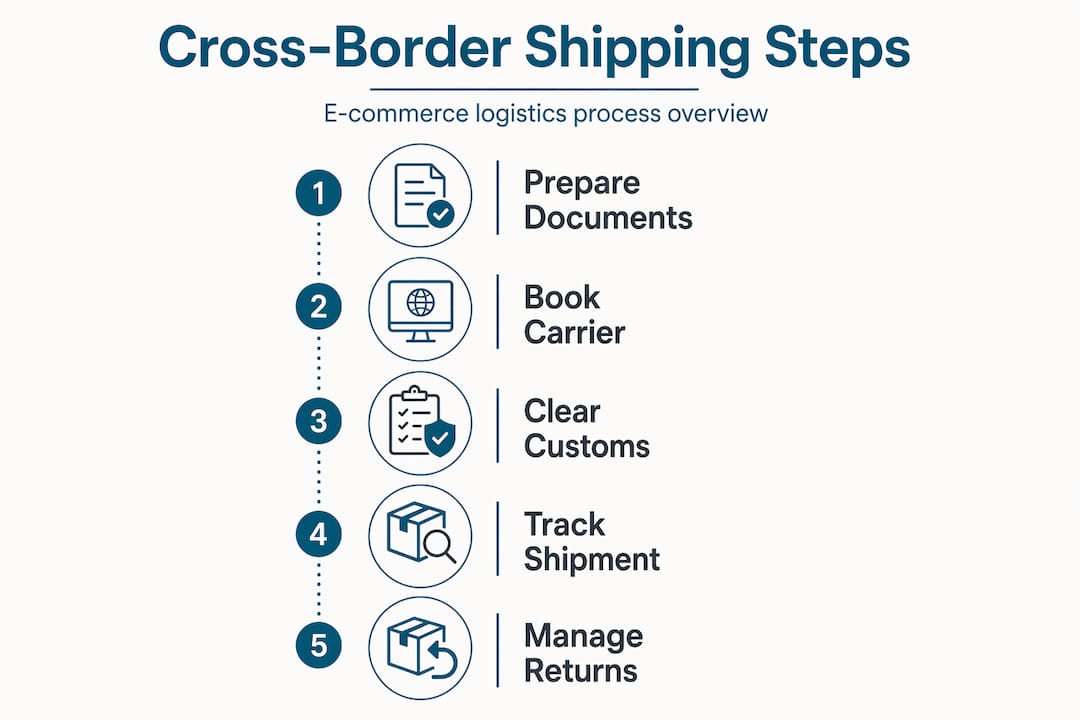
Real-time tracking is not a customer-facing luxury. It is your primary tool for catching problems before they become costly. Here is how to structure your verification process:
- Set tracking checkpoints: Origin scan, departure from origin country, arrival at transit hub, customs clearance confirmation, last-mile handoff, and delivery confirmation.
- Monitor exception rates by carrier and corridor: If one carrier consistently shows 10% exception rates on a given route, that data justifies switching partners, not just filing a claim.
- Analyze delivery time variance: Average transit time matters less than the spread. A lane that averages 10 days but ranges from 6 to 21 days is far more disruptive to your business than one that consistently runs 13 days.
Use shipment tracking basics to build your tracking infrastructure across all modes.
Returns are where most e-commerce businesses discover that their cross-border cost model was wrong. Returns cost 1.5 times outbound shipping because reverse customs, re-import duties, and return carrier fees stack up quickly. Your return policy is a cost control document, not just a customer experience document.
Practical risk management steps:
- Develop a clear, posted return window and process for each market you serve
- Consider partial refunds without physical return for low-value items where return shipping exceeds the product value
- Build relationships with courier services for small businesses that specialize in reverse logistics in your key markets
- Review carrier performance quarterly and replace underperformers before they damage customer retention rates
Pro Tip: Negotiate a pre-paid return label program with your local-market carrier in your top two international markets. It feels like a cost, but it cuts your average return processing time by 40 to 60% and dramatically reduces customer service contacts.
With verification methods implemented, here is a fresh expert perspective on cross-border logistics challenges and solutions.
The overlooked impact of aggregated shipment value management
Most logistics teams focus on the per-shipment cost. Very few focus on the aggregated compliance exposure they are generating daily. This is where the real operational risk lives, and it is almost entirely preventable.
The CBP’s ACE system has gotten significantly more sophisticated. Label sequencing and order batching decisions now directly influence whether your shipments trigger automated holds. This is not a customs officer making a judgment call. It is an automated system flagging consignees who exceed thresholds before a human ever touches the package.
What this means practically: the way your warehouse management system releases orders matters as much as the accuracy of your customs documentation. Companies that get this right build a consignee value aggregation check directly into their order release workflow. Companies that ignore it deal with batches of held shipments, emergency formal entry filings, and furious customers who have no idea why their order is stuck.
The deeper problem is that most cross-border logistics strategies focus on the outbound journey and treat customs as a one-time documentation task. That framing is outdated. Customs compliance is now a continuous, data-driven operational function. You need daily visibility into consignee-level shipment values, not just weekly freight reports.
Adapting your digital infrastructure to support this is not a major project. It requires adding one or two data fields to your order management system and building a simple daily roll-up report. The companies that do this work in advance never face the surprise of a held batch. The ones that don’t do it eventually face it at the worst possible time, usually during a peak season.
Optimize your cross-border logistics with ORNER solutions
You now have a practical framework covering the full cross-border logistics process, from documentation and transport selection to customs threshold management and returns. Putting that framework into action consistently requires tools that connect every stage of the journey in one place.
ORNER’s platform gives e-commerce businesses and logistics managers real-time shipment visibility, automated documentation workflows, and freight booking explained tools that compare rates across air, ocean, and ground carriers instantly. The platform integrates with customs systems to support compliance with the latest regulations, including post-August 2025 duty rules. Shipment tracking basics become automated alerts and exception dashboards, not manual checks. And with essential courier services built into the network, last-mile delivery across your key markets becomes a managed process, not a guessing game.
Frequently asked questions
What is the $800 de minimis threshold in US imports?
It is the maximum daily value of goods a single consignee can receive duty-free, and CBP aggregates all shipments to that consignee per day, meaning multiple orders can trigger a formal entry requirement even if each individual order is below $800.
How do Incoterms help in cross-border logistics?
Incoterms define exactly who pays for freight, insurance, and duties at each point in the journey, reducing disputes when trade conditions change. Note that Incoterms do not change tariffs or customs procedures themselves, but they do clarify which party bears the financial exposure.
Why is accurate documentation critical for international shipments?
Errors on invoices or HS codes are the leading cause of customs holds, and documentation errors cause weeks-long delays plus fines that compound quickly when multiple shipments are affected in the same filing.
What changes took effect in 2025 for duty-free shipments at or below $800?
Starting August 29, 2025, goods valued at or below $800 lost duty-free treatment and are now subject to applicable duties, taxes, and fees regardless of value.
How can e-commerce businesses reduce costs associated with cross-border returns?
Implement clear market-specific return policies, use store credit or partial refunds for low-value items, and build reverse logistics partnerships in your top markets to control the fact that returns cost 1.5x more than outbound shipping due to reverse customs and transport complexity.