TL;DR:
- Multimodal shipping consolidates multiple transport modes under a single operator, simplifying logistics and increasing accountability for ecommerce merchants. It enhances visibility, reduces delays, and optimizes costs by integrating end-to-end tracking and flexible routing options. Choosing the right multimodal setup involves assessing product needs, trade lanes, total costs, and operator reliability for sustainable growth.
Shipping across borders sounds complicated until you realize that most of the complexity ecommerce businesses fear is a product of fragmented logistics, not the nature of global trade itself. Many online retailers assume that combining ocean freight, rail, and last-mile trucking into one shipment means managing multiple vendors, chasing separate invoices, and absorbing full liability when something goes wrong. The reality is the opposite. Multimodal shipping consolidates that entire journey under a single operator and one contract, giving growing ecommerce brands a cleaner, more accountable path to international markets. This guide breaks down exactly how it works, what it costs in real terms, and how to pick the right setup for your business.
Table of Contents
- What is multimodal shipping and why does it matter?
- How multimodal shipping enhances visibility and efficiency
- Evaluating costs: More than just the freight rate
- Choosing the right multimodal option for your business
- Perspective: What most businesses miss when choosing multimodal shipping
- Maximize your global reach with the right logistics partner
- Frequently asked questions
Key Takeaways
| Point | Details |
|---|---|
| Single-contract simplicity | Multimodal shipping consolidates contracts, reducing admin hassle and clarifying accountability. |
| Enhanced end-to-end visibility | Unified tracking yields fewer lost parcels and faster problem resolution across all transport modes. |
| Comprehensive cost analysis | Smart logistics managers consider inventory, environmental, and transit factors—not just freight rates. |
| Strategic mode selection | Choosing the right multimodal setup depends on your business scale, speed needs, and supply chain complexity. |
| Expert perspective matters | Avoid common mistakes by benchmarking the entire supply chain, not just lowest quotes. |
What is multimodal shipping and why does it matter?
Multimodal shipping is the movement of goods using two or more transportation modes, where the entire journey is covered by a single contract and managed by one operator. That single-operator structure is what separates it from other combined-transport arrangements. Instead of coordinating with an ocean freight company, a rail carrier, and a final-mile courier separately, you work with one party who orchestrates everything.
This matters because, as research on unified transport document overview confirms, accountability under a multimodal arrangement sits with the operator regardless of which leg of the journey causes a problem. If your container is delayed at a rail interchange or damaged during truck delivery, you are not left arguing between two carriers about who is responsible. One party owns the outcome.
Multimodal shipping uses one contract and a single operator, simplifying administration and concentrating accountability in a way that segmented shipping simply cannot match. For ecommerce businesses scaling across multiple markets, that simplification is not just convenient. It is operationally essential.
Here is a quick breakdown of the core benefits that make multimodal shipping a strong fit for ecommerce operations:
- Single point of contact for the entire shipment, regardless of how many modes or handoffs are involved
- Simplified documentation with one transport document rather than separate bills of lading and airway bills
- Concentrated liability so you always know who is responsible when exceptions occur
- Flexible route optimization that lets you mix ocean, rail, air, and truck based on cost, speed, and capacity
- Scalability to handle volume spikes without renegotiating with multiple carrier networks
- Cleaner customs workflows when a single operator manages all handoffs and documentation
“The administrative simplicity of a single multimodal transport document, combined with consolidated liability, gives ecommerce operators a significant edge when managing high-volume cross-border shipments compared to managing each leg independently.”
Understanding your transportation mode selection strategy is the foundation for getting multimodal shipping right. Before you book a single shipment, knowing which mode combinations work for your product categories, delivery windows, and destination markets will drive better decisions throughout.
How multimodal shipping enhances visibility and efficiency
Now that you know the backbone of multimodal shipping, let’s dig into how it transforms your supply chain’s visibility and efficiency.
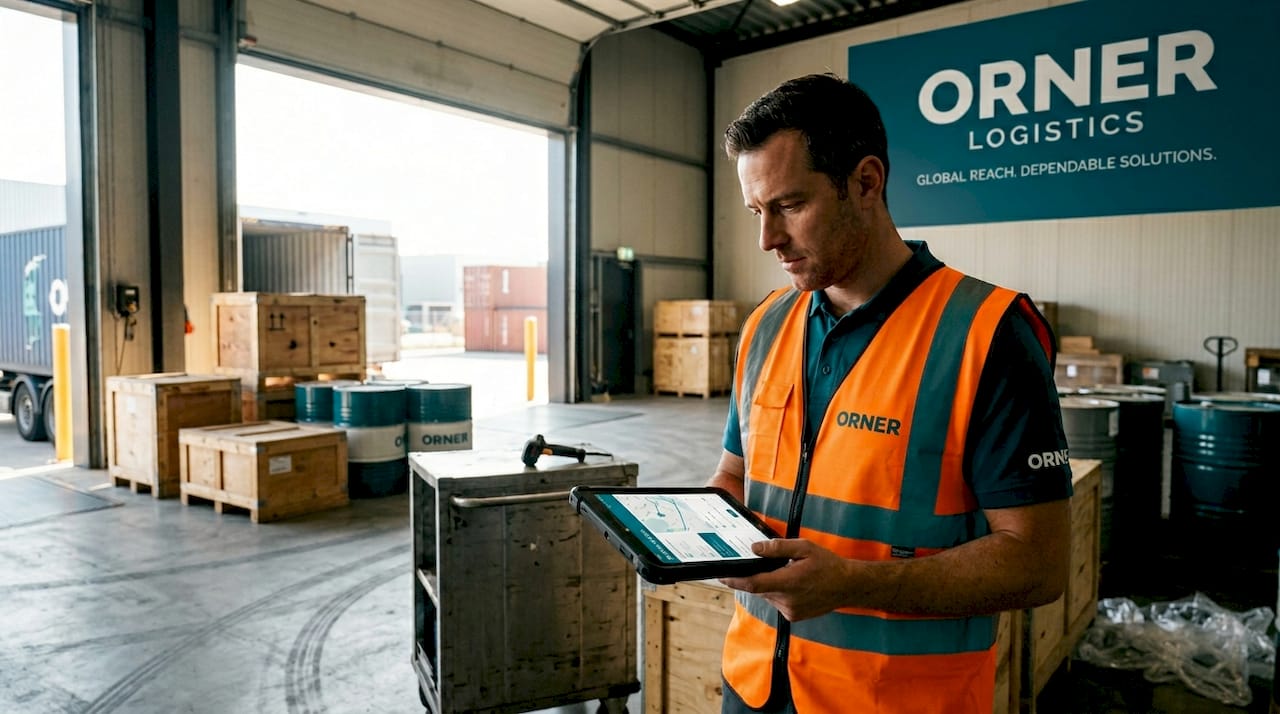
The biggest operational challenge in any multi-leg shipment is the gap in information between transport modes. When your goods transfer from a ship to a rail car to a delivery truck, visibility can drop out entirely if the systems used by each carrier do not communicate. Multimodal logistics platforms solve this by maintaining a single shipment record that updates in real time at every milestone, supported by technologies like IoT sensors embedded in containers and pallets.
End-to-end visibility with a single shipment record and synchronized milestones is critical in multimodal logistics, supported by technologies like IoT tracking that flag exceptions the moment they happen rather than after the delay has already cost you. For ecommerce brands, that speed of information is directly tied to customer satisfaction.
Here is how a well-managed multimodal shipment flows from booking to delivery, with the key synchronization points called out:
- Booking and documentation — A single booking creates one transport document covering all legs. Your operator confirms capacity across all modes before the shipment moves.
- Origin pickup and inland transport — Goods are collected and moved to the port or rail terminal. IoT tags confirm departure time and condition.
- Primary leg transit — Whether ocean or rail, the shipment is tracked against planned milestones. Any deviation triggers an alert to your logistics dashboard.
- Transshipment or interchange — The highest-risk point in any multimodal journey. A good operator has pre-arranged handoffs that minimize dwell time and re-confirm tracking handover between modes.
- Destination inland delivery — Final-mile trucking is coordinated by the same operator, so no information is lost between the port and your warehouse or customer address.
- Proof of delivery and exception close-out — A single system records delivery confirmation or initiates a claim process if issues arose during transit.
The latest news on multimodal integration shows platforms increasingly connecting logistics data to fulfillment workflows, warehouse management systems, and customer-facing tracking portals in one loop. This is the direction the industry is moving, and ecommerce businesses that adopt integrated platforms now will have a measurable advantage.
Practical benefits of this level of visibility include:
- Fewer lost or misrouted parcels due to continuous tracking handoffs between modes
- Real-time alerts that let your team act on delays before customers are impacted
- Faster exception handling because the problem is attributed to a specific leg immediately
- Better inventory planning because you have accurate ETAs rather than estimated ranges
Understanding global logistics solutions and how they integrate with multimodal setups is the next natural step for any ecommerce team managing cross-border ecommerce shipping strategies.
Pro Tip: Connect your multimodal operator’s tracking API directly to your warehouse management system. When your fulfillment team sees accurate ETAs updated in real time, they can pre-stage inventory, schedule labor, and reduce receiving backlogs by as much as 30%.
Evaluating costs: More than just the freight rate
Moving from the nuts-and-bolts of tracking, let’s explore what “total shipping cost” really means in multimodal operations.
Most ecommerce businesses start cost comparisons with the freight quote. That is understandable, but it leads to systematically wrong decisions. Multimodal route evaluation includes direct costs, transit time, and environmental and inventory carrying effects, not just freight price. When you only look at the rate per container, you miss the expenses that accumulate while your goods are in transit.
Consider a shipment of consumer electronics from Southeast Asia to Central Europe. A sea-only route might carry the lowest freight rate, but a 35-day transit ties up capital in inventory for over a month. A sea-rail combination might cost 12% more in freight but cut transit to 22 days, freeing cash and reducing the volume of safety stock you need to hold. Over a full year, the “cheaper” option often turns out to cost more when you do the full accounting.
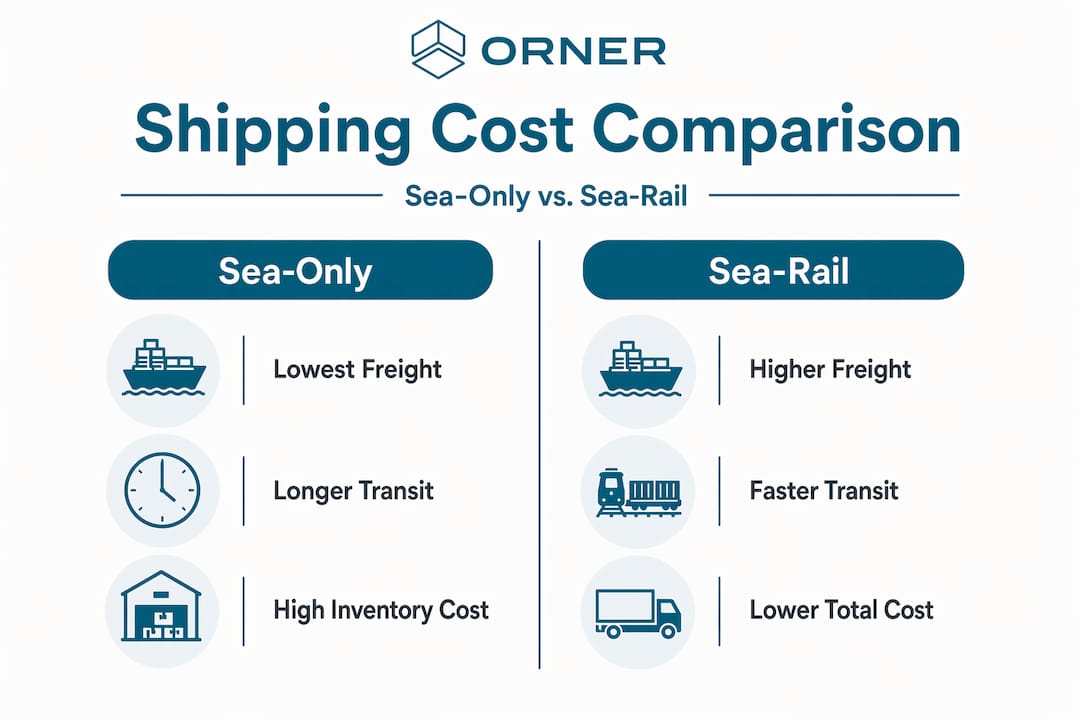
Here is a simplified cost comparison for illustrative purposes:
| Shipping configuration | Freight rate (index) | Transit time | Inventory carrying cost (index) | CO2 impact | Total cost index |
|---|---|---|---|---|---|
| Sea only | 100 | 35 days | High (1.4) | Low | 140 |
| Rail only | 130 | 18 days | Medium (1.1) | Medium | 143 |
| Sea and rail (intermodal) | 112 | 22 days | Medium-low (1.15) | Low-medium | 129 |
| Air and truck | 310 | 5 days | Very low (1.0) | Very high | 310 |
The sea-rail combination delivers the lowest total cost index in this scenario despite having a higher freight rate than sea-only. That is the core insight ecommerce logistics managers need to internalize.
Seasonal factors also shift the math significantly. During peak shipping seasons, ocean freight rates can surge 40 to 60%, making rail-heavy routes more competitive on freight rate alone, not just transit time. Environmental regulations like carbon pricing in certain trade lanes are starting to affect the true cost of air freight for high-volume shippers, a factor the cost and mode overview research is beginning to quantify more rigorously.
Connecting multimodal cost strategy to the right logistics solution types for your product category is one of the fastest ways to lower ecommerce shipping costs without cutting service levels.
Pro Tip: For any route with a transit time exceeding 20 days, calculate your daily inventory carrying cost (typically 20 to 30% of product value annually, divided by 365). Multiply that by the days saved on a faster multimodal option. In most cases, the carrying cost savings justify a 10 to 15% higher freight rate on a quicker route.
Choosing the right multimodal option for your business
With costs fully in view, let’s look at how ecommerce teams can systematically compare and select the best multimodal approach for their needs.
The right multimodal configuration depends on four variables: your product type, your target market, your volume, and your delivery speed requirement. Here is a step-by-step framework for working through those variables:
- Define your delivery window requirements — What is the maximum acceptable transit time for your product category? Perishables and high-demand seasonal goods need faster modes. Furniture and home goods can typically tolerate longer transits.
- Map your volume against carrier minimums — Some multimodal configurations require full container loads (FCL) to be cost-effective. If your volume is lower, look for LCL (less-than-container-load) compatible multimodal arrangements.
- Identify your trade lane — The best multimodal configurations differ by corridor. Europe-to-Asia routes have strong rail options via the China-Europe railway. North America routes rely more heavily on sea-truck and air-truck combinations.
- Benchmark total cost, not just rate — Use the cost framework from the previous section to compare configurations on a total-cost basis.
- Evaluate operator reliability — Ask for on-time delivery rates, exception frequency, and customer references for your specific trade lane before committing.
Here is a practical comparison of common multimodal configurations for ecommerce:
| Configuration | Speed | Cost | Best for | Key risk |
|---|---|---|---|---|
| Sea and truck | Slow to medium | Low | High-volume, non-urgent goods | Port congestion delays |
| Sea and rail | Medium | Medium-low | Bulky, moderate-urgency goods | Rail capacity at peak season |
| Rail and truck | Medium-fast | Medium | Landlocked destination markets | Limited rail infrastructure |
| Air and truck | Fast | High | High-value, time-sensitive goods | Cost unsustainable at scale |
| Sea, rail, and truck | Medium | Low-medium | Long-haul cross-continental routes | Complex coordination |
Benchmarking multimodal performance requires looking at multiple cost and performance dimensions, as route decisions can shift significantly based on assumptions about transit time, seasonal demand, and carrier reliability.
Key pitfalls to avoid when selecting a multimodal option:
- Choosing a configuration based on a single season’s rates without accounting for year-round variability
- Ignoring last-mile reliability, which often determines customer satisfaction more than the primary freight leg
- Underestimating the documentation complexity for multi-country transit routes
Reviewing your freight booking options and resources for streamlining global deliveries will give your team the operational playbook to execute on whichever configuration fits your business best.
Perspective: What most businesses miss when choosing multimodal shipping
The frameworks above provide clarity, but real-world multimodal decisions involve blind spots that even experienced logistics managers walk right past.
The most common mistake we see is treating freight rate as the primary selection criterion and then layering in other factors as an afterthought. This produces a subtle but costly bias toward routes that look cheaper on the quote sheet but erode margins through longer transit times, higher safety stock requirements, and weaker exception handling. The lowest quote almost never delivers the lowest total cost.
A second blind spot is treating the multimodal selection as a one-time decision. Trade lanes evolve. Rail infrastructure expands. Port congestion patterns shift seasonally. A configuration that outperforms in the first quarter can become a liability by the third quarter if you have not built in a review cadence. The businesses that consistently win on logistics costs are the ones that re-evaluate assumptions every six months, not annually.
There is also a structural issue that rarely gets discussed: most ecommerce businesses benchmark their multimodal performance against their own previous rates rather than against the market. That creates a false sense of optimization. You might be improving year over year while still overpaying relative to what a well-structured multimodal arrangement with the right operator could deliver.
What we have also seen consistently is that sustainability is shifting from a values conversation to a cost conversation. Carbon pricing mechanisms and environmental surcharges are already influencing freight costs in several trade lanes, and that trend is accelerating. Businesses that incorporate carbon impact into their multimodal selection process today are building a cost advantage for the next five years, not just checking a reporting box.
What to always evaluate beyond price:
- End-to-end visibility capability of the operator’s platform
- On-time performance data for your specific trade lane
- Flexibility to scale volume up or down without penalty during demand shifts
- Environmental cost trajectory as regulations tighten on high-emission modes
- Alignment with inventory strategy, particularly for businesses with lean or just-in-time fulfillment models
For businesses shipping large ecommerce items, the mode selection decision has an even bigger impact because freight costs represent a higher percentage of the landed cost, making every percentage point of optimization more consequential.
Maximize your global reach with the right logistics partner
Ready to put these insights to work and drive your ecommerce business further? Here is how a strategic partnership can remove the pain from multimodal shipping.
At ORNER, we built our platform to give ecommerce businesses exactly the kind of end-to-end control this guide describes. From booking to delivery, every mode and milestone is tracked in one place, with real-time alerts, customs clearance support, and a global fulfillment network that scales with your growth.
Whether you are moving home goods via sea-rail combinations or managing time-sensitive air-truck deliveries for seasonal peaks, our cross-border logistics solutions are designed to handle complexity so your team does not have to. Pair that with our warehousing best practices guidance and you have a complete operational foundation for international growth. Our reliable courier services connect your multimodal freight strategy to your last-mile delivery network, closing the gap between the warehouse and your customer’s door.
Frequently asked questions
How does multimodal shipping differ from intermodal shipping?
Multimodal shipping uses one contract and operator for the entire journey, while intermodal shipping typically involves separate contracts for each leg or mode, spreading accountability across multiple parties.
What technology is most useful for tracking multimodal shipments?
IoT tracking and platform integration enable synchronized milestones and real-time alerts across all transport modes, making them the most effective tools for maintaining end-to-end visibility in multimodal logistics.
What costs should I consider besides freight rate when evaluating multimodal shipping?
Include transit time, inventory carrying costs, environmental impact, and delay risk in your analysis, since comprehensive cost evaluation consistently shows these factors shift which option delivers the lowest total cost.
Why is a single contract beneficial in multimodal shipping?
A single contract means one contract simplifies administration and places accountability with one operator, eliminating the disputes between carriers that frequently delay resolutions in segmented shipping arrangements.
How do I choose the best multimodal configuration for my ecommerce shipments?
Assess your products, volume, speed requirements, and trade lanes, then benchmark multimodal options using all cost dimensions and route-specific performance data rather than freight rate alone.