TL;DR:
- Successful same day delivery requires strategic inventory placement and rapid fulfillment processes.
- Advanced routing and real-time tracking technology increase efficiency and customer satisfaction.
- Building a resilient operation focuses on reliability, data-driven improvements, and balancing speed with margin.
Same day delivery sounds simple until you’re the one running the operation. Most ecommerce sellers assume the hardest part is just finding a fast courier, but the real obstacles run much deeper. Inventory placement, order routing, driver availability, and real-time visibility all have to align perfectly within a window that leaves zero room for error. Businesses that treat same day delivery as a speed problem alone consistently fall short. This guide breaks down the actual barriers and gives you a practical framework to build a same day operation that holds up under pressure.
Table of Contents
- What makes same day delivery uniquely challenging?
- Core logistics barriers and cost drivers
- Technology solutions: Optimizing routes and tracking in real time
- Practical solutions: Building a resilient same day delivery operation
- Why ‘more speed’ is the wrong mindset for same day delivery
- How ORNER helps you master same day delivery logistics
- Frequently asked questions
Key Takeaways
| Point | Details |
|---|---|
| Inventory proximity matters | Locating inventory close to customers is crucial for fast, reliable same day delivery. |
| Technology reduces friction | AI and real-time tracking tools streamline operations and improve delivery reliability. |
| Hybrid fulfillment models win | Blending micro-fulfillment, 3PL partners, and crowdsourced drivers offers essential flexibility and cost control. |
| Reliability over raw speed | Focusing on consistent delivery performance beats a single-minded push for speed. |
What makes same day delivery uniquely challenging?
Same day delivery sits at the intersection of customer expectation and operational reality, and the gap between those two things is wider than most sellers expect. Shoppers who click “same day” at checkout assume the package will arrive by evening without understanding what that promise demands behind the scenes. When it fails, they don’t blame the complexity. They blame you.
The first barrier is inventory proximity. You can’t ship same day from a warehouse 300 miles away. Products need to be physically close to the buyer, which means same day delivery feasibility depends heavily on where your stock lives, not just how fast your courier runs. This is why splitting inventory across micro-fulfillment centers and stores is a key solution for retailers serious about this service.
The second barrier is order velocity management. Same day windows compress every step of what same day delivery involves into a fraction of the normal timeline. Picking, packing, labeling, and handoff all need to happen in minutes, not hours. Any bottleneck in that chain breaks the promise.
Here’s what typically goes wrong in real operations:
- Inventory stockouts at local fulfillment points force split orders or cancellations
- Unanticipated demand spikes during promotions overwhelm picking staff and courier capacity
- Failed first-attempt deliveries with no time for a second try create immediate customer complaints
- Route conflicts when multiple orders cluster in the same zone at the same time
- Cost overruns from emergency courier bookings that erode margins on already thin orders
“The retailers who succeed at same day delivery don’t just move faster. They redesign their entire fulfillment architecture around proximity and predictability.”
The last mile delivery challenges that come with same day are also distinct from standard shipping. Traffic patterns, parking restrictions, building access, and recipient availability all become critical variables when there’s no buffer time. One missed delivery is a failed promise, not a delayed one.
Profitability is the final pressure point. Same day delivery costs significantly more to execute than next day or standard shipping, but customers rarely want to pay the full premium. Sellers end up absorbing part of that cost, which makes every operational inefficiency directly visible on the bottom line.
Core logistics barriers and cost drivers
After exploring the broad reasons same day delivery is challenging, let’s clarify which logistics barriers and cost drivers create the biggest obstacles.
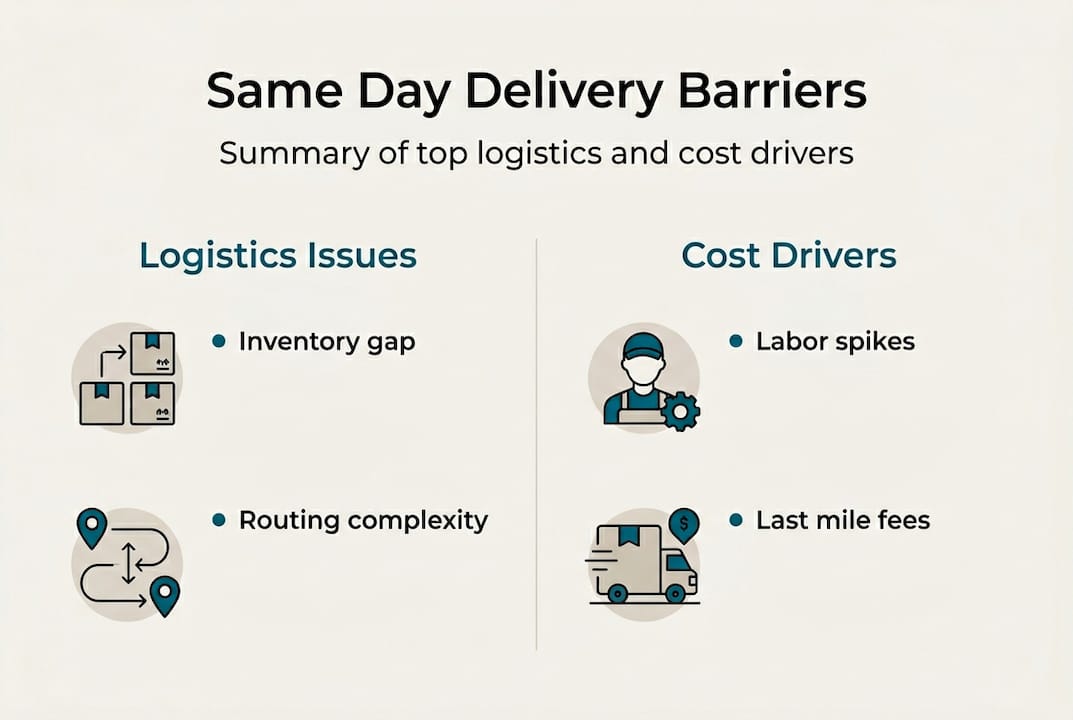
The most fundamental barrier is inventory distribution. Centralized fulfillment models, where all stock lives in one large warehouse, simply can’t support same day delivery at any meaningful geographic scale. Distributed models, where inventory is spread across multiple smaller locations, solve the proximity problem but introduce complexity in stock balancing, replenishment, and order routing.
| Fulfillment model | Speed potential | Cost per order | Complexity |
|---|---|---|---|
| Centralized warehouse | Low for same day | Lower at scale | Low |
| Distributed micro-fulfillment | High for same day | Higher per unit | High |
| Hybrid (central + local nodes) | Medium to high | Moderate | Medium |
Labor is another major cost driver. Same day windows require staff to be on-call and responsive throughout the day, not just during scheduled shifts. Overtime, shift premiums, and the need for cross-trained pickers all add up quickly.

Statistic callout: Delivery costs for same day orders can run 1.5 to 3 times higher than standard fulfillment, depending on order density and geography.
Dynamic order routing to nearest fulfillment centers and hybrid fleets including crowdsourced drivers can address both cost and flexibility challenges. Crowdsourced drivers, similar to gig economy models, allow you to scale delivery capacity up or down based on real demand without maintaining a fixed fleet.
The last mile delivery explained section of any logistics plan needs to account for urban density differences. Dense city environments have shorter travel times but more access challenges. Suburban zones have easier access but longer drive times between stops.
Balancing speed with margin is where most sellers struggle. Chasing same day delivery without controlling these top logistics challenges leads to a service that impresses customers but quietly destroys profitability.
Pro Tip: Before expanding same day delivery to new zones, model the cost per delivery at your expected order volume. If the math doesn’t work at 80% capacity, it won’t work in practice either.
Technology solutions: Optimizing routes and tracking in real time
Once cost and logistics hurdles are clear, advanced technology provides an edge in making same day promises achievable.
AI-driven route optimization and real-time tracking increase reliability and efficiency in ways that manual dispatch simply can’t match. AI systems evaluate hundreds of routing variables simultaneously, including traffic, driver location, order priority, and delivery windows, to assign the most efficient path in seconds.
Here’s how the technology stack typically improves operations:
- AI route optimization reduces total driver miles by 15 to 25%, cutting fuel costs and delivery time simultaneously
- Dynamic order routing assigns incoming orders to the nearest available fulfillment node in real time, reducing pickup lag
- Real-time tracking gives customers live visibility into their delivery, reducing inbound support contacts by up to 30%
- Automated customer notifications trigger at key milestones, such as order picked, out for delivery, and delivered, without manual intervention
- Exception alerts flag potential failures early, such as a driver running behind schedule, so dispatch can intervene before a promise is broken
| Technology tool | Primary benefit | Impact metric |
|---|---|---|
| AI route optimization | Shorter, faster routes | 15 to 25% fewer miles |
| Real-time tracking | Customer visibility | Up to 30% fewer support tickets |
| Dynamic routing | Faster order assignment | Reduced fulfillment lag |
| Automated notifications | Proactive communication | Higher satisfaction scores |
The right shipment tracking solutions do more than show a dot on a map. They integrate with your order management system, your courier network, and your customer communication tools to create a seamless information flow.
Track and trace technology also plays a role in post-delivery analysis. When you can review exactly what happened on every route, you can identify patterns, such as which zones consistently run late, and fix them before they become chronic failures.
For sellers exploring last mile solutions, technology is not optional. It’s the operational backbone that makes same day delivery scalable rather than a one-off heroic effort.
Practical solutions: Building a resilient same day delivery operation
With technology in place, how can you pull all the pieces together for a robust same day offering?
Building a resilient operation requires more than fast tools. It requires deliberate design across inventory, partnerships, workforce, and feedback systems. Here’s a step-by-step approach:
- Map your customer geography. Identify where your highest-order-density zones are and position inventory at micro-fulfillment nodes within 10 to 15 miles of those clusters.
- Audit your SKU velocity. Not every product needs to be same day eligible. Focus on your top 20% of SKUs by order volume and make those available for same day first.
- Build a hybrid driver pool. Combine employed drivers for predictable base volume with crowdsourced drivers for surge capacity. This keeps fixed labor costs manageable while preserving flexibility.
- Integrate with a 3PL partner. Partnering with 3PL providers and leveraging hybrid fleets are key for managing cost and flexibility, especially when you’re scaling into new markets without building owned infrastructure.
- Set up a delivery feedback loop. After every same day delivery, capture data on on-time rate, failed attempts, and customer satisfaction. Review it weekly and make targeted adjustments.
Pro Tip: Start same day delivery in one or two high-density zones before rolling it out broadly. A controlled launch lets you stress-test your operation and fix gaps without damaging your brand reputation at scale.
To reduce delivery times sustainably, you need systems that learn and adapt, not just fast hands. Continuous improvement cycles, where data from each delivery informs the next routing and staffing decision, are what separate sellers who sustain same day delivery from those who burn out trying.
Focusing on how to improve customer delivery experience means treating every touchpoint, from order confirmation to delivery notification, as part of the same day promise. Customers remember the full experience, not just whether the package arrived.
Why ‘more speed’ is the wrong mindset for same day delivery
Here’s the uncomfortable truth most logistics content won’t tell you: obsessing over speed is one of the fastest ways to break your same day operation.
When sellers prioritize raw speed above everything else, they cut corners on confirmation, skip quality checks, and push couriers beyond safe working limits. The result is more errors, more failed deliveries, and more frustrated customers than a slightly slower but reliable service would ever produce.
Reliability and transparency earn more customer trust than shaving 30 minutes off a delivery window. A customer who receives their order at 7 PM with three proactive notifications feels better served than one who was promised 5 PM and got nothing until 8 PM.
The sellers who build lasting same day programs focus on urban logistics solutions that are designed for consistency, not just peak performance. They invest in communication systems, fallback routing, and honest cutoff times rather than promising windows they can’t reliably hit.
Speed matters. But resilience, transparency, and smart design matter more.
How ORNER helps you master same day delivery logistics
If you’re ready to apply these lessons for your business, ORNER’s platform gives you the tools to do it without rebuilding your operation from scratch.
ORNER offers end-to-end support for ecommerce sellers navigating the complexity of fast fulfillment. From resources that help you streamline ecommerce shipping to a practical freight booking checklist that keeps your operation organized, the platform is built for sellers who need reliable courier services at scale. You can also access shipment tracking tools that give you and your customers real-time visibility across every delivery. Whether you’re launching same day in one city or scaling across regions, ORNER connects the logistics dots so you can focus on growing your business.
Frequently asked questions
What is the hardest part of offering same day delivery?
Inventory positioning and rapid fulfillment are the toughest logistical challenges. Stock must be close to the buyer, and picking and shipping must happen in minutes, not hours.
How can technology help same day delivery?
AI routes and real-time tracking improve reliability by selecting the fastest driver paths and keeping customers informed at every step without manual effort.
What is a cost-effective way to handle same day delivery spikes?
Hybrid fleets and dynamic order routing cut costs during surges by scaling crowdsourced driver capacity up or down based on real-time demand without fixed overhead.
Is offering same day delivery worth the investment?
Same day delivery boosts conversion and loyalty only when it can be delivered profitably and reliably. ROI depends on execution with the right inventory positioning and technology investments in place first.
Recommended
- What Is Same Day Delivery? 2025 Guide for Online Retailers – ORNER
- Assessing same day delivery feasibility for ecommerce growth – ORNER
- How to Measure Delivery Performance for Ecommerce Success – ORNER
- 7 Proven Ways to Reduce Delivery Times for Online Sellers – ORNER
- Nectar Blog | Q4 Ecommerce Strategy Guide for Maximizing Sales Results
- Role of analytics in ecommerce growth: 2026 success guide