TL;DR:
- The US same day delivery market is projected to reach $10.41 billion in 2026 and grow steadily.
- Small and mid-sized retailers can succeed by focusing on local inventory, technology, and customer experience.
- Profitability depends on volume, delivery fees, and operational efficiency, with micro-fulfillment playing a key role.
Most ecommerce business owners assume same day delivery belongs to Amazon and big-box retailers with massive infrastructure budgets. That assumption is costing them customers. The US same day delivery market sits at $10.41 billion in 2026 and is growing steadily, with small and mid-sized retailers capturing a meaningful slice. The real question isn’t whether same day delivery is reserved for the giants. It’s whether your specific operation, inventory setup, and customer base make it viable. This article breaks down the market forces, operational requirements, cost realities, and a real small business case study so you can make a confident go or no-go decision.
Table of Contents
- The same day delivery market: Growth and drivers
- The key operational factors impacting feasibility
- Cost considerations and profitability analysis
- Case study: Small business success with micro-fulfillment
- A fresh take on same day delivery feasibility
- Take the next step: Reliable same day delivery solutions
- Frequently asked questions
Key Takeaways
| Point | Details |
|---|---|
| Market viability | Same day delivery is accessible for more retailers due to ecommerce-driven growth and new logistics models. |
| Operational essentials | Proximity, tech infrastructure, and delivery partners are critical to feasibility. |
| Profit drivers | Proper implementation can raise margins and order values when volume and customer demand align. |
| Case study proof | Small businesses can succeed with phased, localized approaches like micro-fulfillment. |
The same day delivery market: Growth and drivers
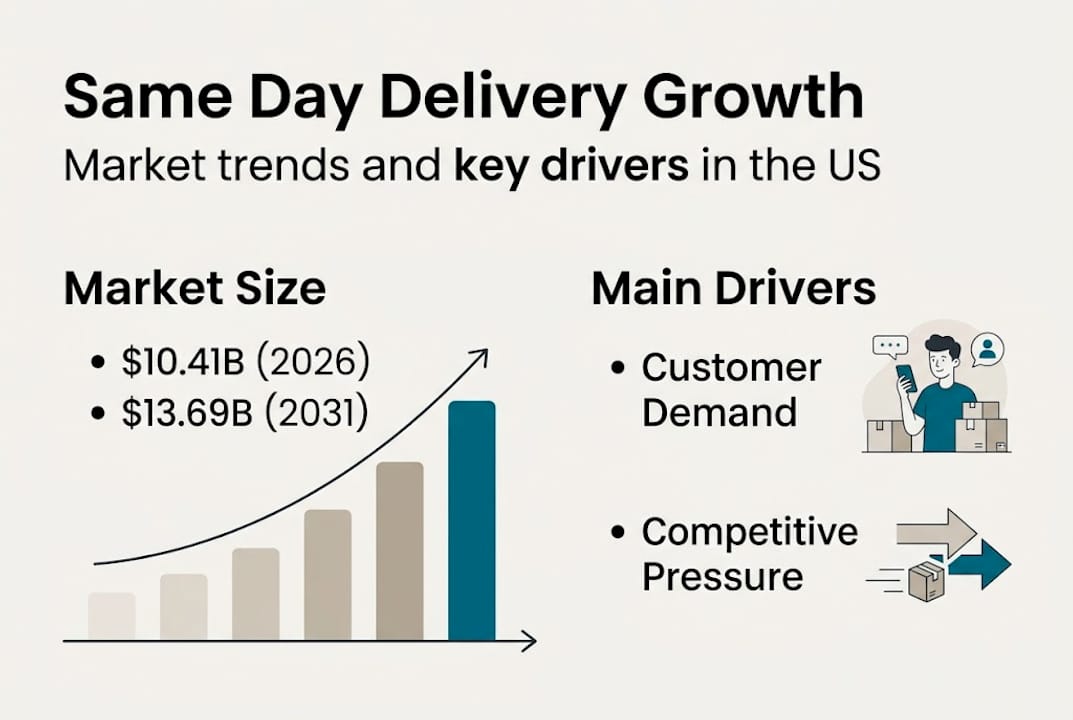
The numbers tell a clear story. The US same day delivery market is projected to grow from $10.41 billion in 2026 to $13.69 billion by 2031, representing a 5.62% compound annual growth rate. Ecommerce accounts for 53% of that market share, making it the single largest driver of expansion. This isn’t a niche trend. It’s a structural shift in how customers expect goods to move.
| Metric | Value |
|---|---|
| US market size (2026) | $10.41 billion |
| Projected size (2031) | $13.69 billion |
| CAGR | 5.62% |
| Ecommerce market share | 53% |
Three forces are accelerating this growth faster than most logistics managers anticipated.
Customer expectations have fundamentally changed. Two-day shipping was the gold standard five years ago. Today, a growing segment of shoppers treats same day delivery as a baseline expectation for urgent purchases, not a premium luxury. Retailers who can’t meet that expectation often lose the sale entirely.
Competitive pressure is intensifying across categories. Grocery, pharmacy, and electronics retailers moved into same day delivery first. Now apparel, home goods, and specialty retail are following. Understanding what same day delivery means for your specific category is the first step toward evaluating whether it fits your model.
Willingness to pay is real and measurable. Studies consistently show that a significant portion of shoppers will pay a premium for same day or next-hour delivery when the purchase is time-sensitive. That premium can offset a meaningful portion of your fulfillment cost.
The types of retailers entering this space are broader than most expect:
- Independent specialty retailers with localized inventory
- Direct-to-consumer brands with urban customer concentrations
- Wholesale distributors serving local business accounts
- Omnichannel brands using physical store locations as fulfillment nodes
With this context in mind, let’s clarify what it really takes to offer same day delivery.
The key operational factors impacting feasibility
To evaluate if same day delivery is realistic for your business, you need to start with the operational fundamentals. No amount of marketing enthusiasm overcomes a broken fulfillment setup.
Warehouse and inventory proximity is the single most important factor. If your inventory sits in a central warehouse 200 miles from your primary customer base, same day delivery is nearly impossible without a network redesign. Businesses that succeed place inventory closer to demand, often through micro-fulfillment centers (small, localized storage points positioned near urban customer clusters).
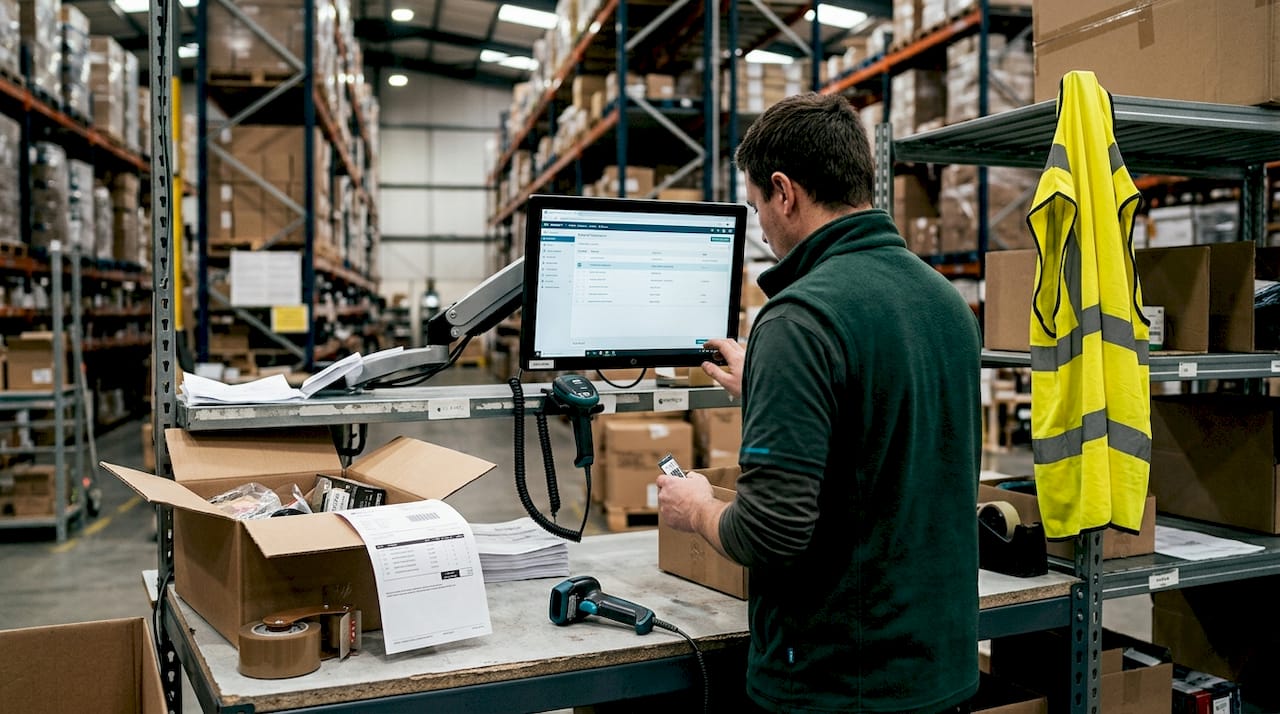
A compelling example: a small toy shop used micro-fulfillment to cut delivery time from four days to under 24 hours, improving net margin by 3.5% and average order value by 12%. Proximity to customers wasn’t just a logistics decision. It was a revenue decision.
Technology integration separates businesses that can execute same day delivery from those that can’t. You need three core systems working together:
- Order management software that captures and processes orders in real time
- Automated routing tools that assign orders to the nearest fulfillment point and courier
- Real-time tracking that keeps customers informed and reduces inbound support contacts
These aren’t optional extras. Without them, the top logistics challenges around speed and accuracy become impossible to manage at scale.
Carrier and partner selection shapes your geographic reach and your cost structure. Evaluating last mile delivery partners carefully, specifically their coverage zones, pickup windows, and failure rates, determines whether your service promise holds up in practice.
| Factor | In-house | Third-party partner |
|---|---|---|
| Upfront cost | High | Low to moderate |
| Scalability | Limited | High |
| Control | Full | Shared |
| Speed to launch | Slow | Fast |
| Risk | Higher | Distributed |
Order cut-off times directly affect how many orders qualify for same day fulfillment. Most operations set a cut-off between noon and 2 PM. Batching orders efficiently before that window closes is a skill that takes time to develop.
Pro Tip: Start with a limited geographic zone and a narrow product selection before expanding. Proving the model in one city or neighborhood gives you real data without overextending your team or capital.
Cost considerations and profitability analysis
Once you understand the operational setup, the next big question is whether same day delivery makes financial sense. The answer depends on your volume, your margins, and how you structure the service.
Direct incremental costs include:
- Same day courier premiums, typically 2 to 4 times standard ground shipping rates
- Additional labor for faster pick, pack, and handoff workflows
- Technology licensing fees for routing and tracking software
- Potential micro-fulfillment facility costs if you’re repositioning inventory
Variable vs. fixed cost breakdown matters enormously. At low order volumes, same day delivery is almost always unprofitable on a per-order basis. The economics improve significantly as volume grows and fixed costs get spread across more shipments. This is why piloting in a high-density urban area first is a smarter move than launching nationally.
The revenue side of the equation often gets underestimated. When a toy shop reduced delivery times through micro-fulfillment, net margin improved by 3.5% and average order value climbed 12%. Customers who trust fast delivery tend to add more items to their cart and return more frequently.
Hidden costs that catch businesses off guard:
- Failed delivery attempts and re-delivery fees
- Customer service spikes during the learning curve
- Inventory imbalances when stock is split across multiple fulfillment points
- Integration costs for connecting your ecommerce platform to new logistics software
Pro Tip: Charge customers a transparent same day delivery fee rather than absorbing the full cost. Most customers who want same day delivery are willing to pay $8 to $15 for it. That fee alone can cover 40% to 60% of your incremental courier cost.
The break-even point for most small ecommerce operations falls somewhere between 15 and 30 same day orders per day per fulfillment zone. Below that threshold, subsidizing the service through higher product margins or a delivery fee is usually necessary.
Case study: Small business success with micro-fulfillment
Let’s see what these concepts look like in real life by examining a specific small business transformation.
A specialty toy retailer was losing customers to larger competitors who could promise faster delivery. Their central warehouse model meant most orders took three to four days to arrive, even for customers located in the same city. They decided to test a micro-fulfillment approach rather than wait until they could afford a full logistics overhaul.
“We didn’t need a massive infrastructure investment. We needed smarter inventory placement and the right courier partnerships. Once we made those two changes, everything else followed.”
Here’s the step-by-step approach they took:
- Identified their top 20% of SKUs by local demand and moved that inventory to a small urban fulfillment point closer to their primary customer cluster
- Integrated order management software that automatically routed same day orders to the nearest fulfillment location
- Partnered with a local courier network that offered scheduled pickup windows aligned with their order cut-off time
- Set a noon cut-off and communicated it clearly on the product page and at checkout
- Monitored results weekly and adjusted inventory allocation based on actual demand patterns
The micro-fulfillment results were measurable within the first 60 days. Delivery time dropped from four days to under 24 hours. Net margin improved by 3.5%. Average order value increased by 12%, likely because customers who trusted fast delivery were more willing to add complementary items.
Building a strong end-to-end logistics overview was central to their success. They also leaned on urban logistics solutions to navigate the specific challenges of dense city delivery zones.
The key lesson: they didn’t try to offer same day delivery on every product or in every market. They focused on a specific geography, a specific product set, and a specific customer segment. That focus made the economics work before they scaled.
A fresh take on same day delivery feasibility
Most feasibility checklists ask the wrong questions. They focus on whether you have the budget, the warehouse space, or the carrier contracts. Those things matter, but they’re not what separates businesses that succeed with same day delivery from those that don’t.
The businesses that make it work treat same day delivery as a brand promise, not a logistics feature. They ask: what does speed mean to our specific customers, and how do we deliver that experience consistently? That mindset shift changes everything from how you place inventory to how you communicate delivery windows.
Scale is also less important than most people assume. A small retailer with tight geographic focus and smart inventory placement can outperform a larger competitor with a sprawling, inefficient network. Agility beats size when the delivery window is measured in hours.
If you want to streamline logistics for reliable courier performance, the starting point is clarity about your customer’s urgency, not your own operational comfort. Build the model around their need, and the operational pieces tend to fall into place more naturally than you’d expect.
Take the next step: Reliable same day delivery solutions
If this analysis has you thinking seriously about implementing or scaling same day delivery, the next move is finding logistics partners who specialize in exactly this challenge. The right courier network and warehousing setup can compress your timeline from months to weeks.
At or-ner.com, we work with ecommerce businesses of all sizes to build fulfillment models that support fast, reliable delivery. Whether you need reliable courier services for urban delivery zones, courier services for small businesses that scale with your growth, or guidance on warehousing best practices to position inventory closer to your customers, we have the tools and partnerships to make it happen. Talk to our team and get a fulfillment strategy built around your specific market and product mix.
Frequently asked questions
What types of businesses can offer same day delivery feasibly?
Retailers with localized inventory, efficient order management, and urban customer bases have the highest feasibility. Even small specialty retailers can succeed, as shown when a toy shop cut delivery from four days to under 24 hours using micro-fulfillment.
Is same day delivery always profitable for small ecommerce businesses?
Profitability depends on order volume, operational efficiency, and customer willingness to pay for speed. Businesses that structure the service correctly, like the toy retailer that saw a net margin gain of 3.5%, can make it work even at smaller scale.
What technology is required for successful same day delivery?
You need order management software, real-time tracking, and automated routing working together. The growth of same day delivery is closely tied to technology integration that enables faster, more accurate fulfillment.
How big is the US same day delivery market in 2026?
The US same day delivery market is estimated at $10.41 billion in 2026, with ecommerce driving 53% of that total market share.