
TL;DR:
- Choosing reliable couriers with high on-time delivery rates reduces customer cart abandonment.
- Building a data-driven scorecard with key KPIs guides objective carrier selection and negotiations.
- Continuous monitoring and testing are essential as carrier performance and costs evolve over time.
Choosing the wrong courier partner costs more than a few late deliveries. It costs you customers. 48% cart abandonment happens because of unexpected shipping costs and poor delivery experiences, and that number hits hardest when you have no backup plan. The good news is that a structured, data-driven approach to courier selection removes most of that risk before it reaches your customers. This guide walks you through defining your requirements, building a carrier scorecard, evaluating technology fit, and avoiding the most common mistakes ecommerce businesses make when choosing reliable courier services.
Table of Contents
- Defining your requirements and benchmarks
- Building your carrier scorecard and evaluation process
- Technology, integration, and operational fit
- Common mistakes and troubleshooting in courier selection
- The uncomfortable truth about picking a courier partner
- Partnering for shipping success
- Frequently asked questions
Key Takeaways
| Point | Details |
|---|---|
| Set clear KPIs | Defining key metrics upfront enables objective courier evaluation and reliable comparison. |
| Use test shipments | Testing carriers with real orders before committing prevents costly mistakes and poor performance. |
| Prioritize tech integration | Selecting partners with robust API and automation reduces errors and support workload significantly. |
| Avoid common errors | Don’t let price-only decisions, single-carrier dependency, or untested SLAs derail your shipping efficiency. |
Defining your requirements and benchmarks
Before you compare a single carrier, you need to know exactly what you are asking a courier to do. Skipping this step is why so many businesses end up locked into agreements that look good on paper but fail in practice.
Start by mapping your operational profile. Ask yourself these questions:
- Which shipping zones do you serve? Domestic only, regional, or cross-border?
- What is your average monthly shipment volume? And how does that spike during peak seasons?
- How diverse is your SKU mix? Fragile goods, oversized items, and apparel each carry different handling requirements.
- What are your SLA commitments to customers? Same-day, next-day, or standard 3-5 day windows?
Once you have those answers, set measurable benchmarks. The most critical metrics for choosing shipping carriers are on-time delivery rate (OTD), claims ratio, return-to-origin (RTO) rate, and damage percentage. Do not guess at what good looks like. Use real industry data.
| Carrier | OTD Rate |
|---|---|
| DHL | 98.8% |
| UPS | 96.5% |
| FedEx | 91.8% |
| USPS | 90.4% |
| Industry average | 88-91% |
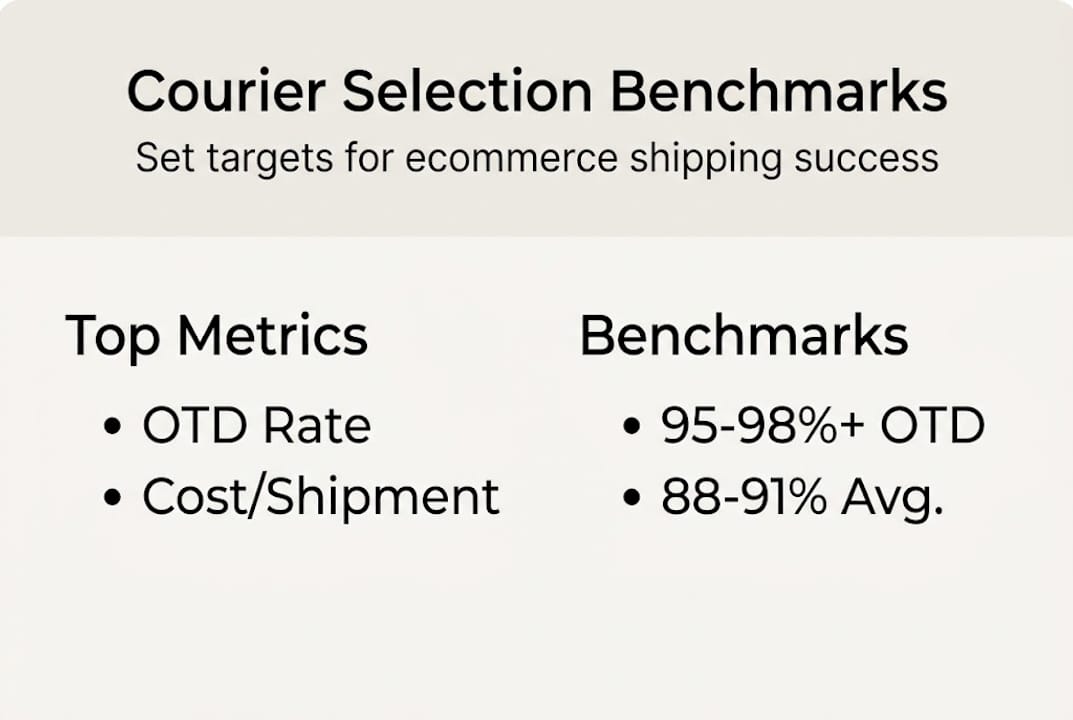
According to published benchmarks, top-tier OTD targets sit at 95-98%+, while the industry average hovers between 88-91%. If a carrier cannot show you data above that average, you are accepting below-standard risk from day one.
Segment your benchmarks by SKU category, shipping zone, and SLA tier. A carrier that performs well on standard domestic parcels may struggle with fragile or oversized goods shipped internationally. This granular view is especially important for courier services for small businesses where every failed delivery has an outsized impact on margins and reputation.
Write your benchmarks down as minimum thresholds and target thresholds. Minimum is the floor below which you will not sign a contract. Target is what you negotiate toward. Having both numbers in writing keeps your evaluation objective and removes emotion from the process.
Building your carrier scorecard and evaluation process
With your benchmarks set, you need a structured way to compare carriers side by side. A carrier scorecard does exactly that. It assigns weighted scores to the KPIs that matter most to your business, so you can make decisions based on data rather than sales pitches.
Here is how to build one:
- List your KPIs. Start with cost per shipment, OTD rate, claims ratio, RTO rate, and customer support responsiveness.
- Assign weights. Not every KPI matters equally. If your customers are highly price-sensitive, weight cost higher. If you ship fragile goods, weight claims ratio and damage percentage more heavily.
- Score each carrier. Use a 1-10 scale for each KPI, then multiply by the weight to get a weighted score.
- Add up the totals. The carrier with the highest weighted score is your strongest candidate, not necessarily the cheapest one.
| KPI | Weight | Carrier A score | Carrier B score |
|---|---|---|---|
| Cost per shipment | 25% | 8 | 6 |
| OTD rate | 30% | 7 | 9 |
| Claims ratio | 20% | 9 | 8 |
| RTO rate | 15% | 6 | 7 |
| Support responsiveness | 10% | 8 | 7 |
| Weighted total | 7.55 | 7.65 |
As carrier performance research confirms, segmenting your scorecard by SKU type, carrier, and region gives you far more actionable insight than a single aggregate score. Run quarterly or monthly audits to keep the data fresh.

Pro Tip: Never commit to a carrier based on their sales deck alone. Run test shipments across your top SKUs and zones before signing any contract. Use the real performance data from those tests to negotiate rates and SLAs.
Building strong supplier relationships and applying smart networking for courier selection can also surface carrier options you would not find through standard RFP processes. Peer recommendations from businesses shipping similar volumes and SKU profiles are often more reliable than analyst reports.
Technology, integration, and operational fit
A carrier can have excellent OTD numbers and still create operational chaos if their technology does not integrate with your ecommerce stack. This is one of the most underestimated factors in courier selection.
Here are the must-have technology features to evaluate:
- Real-time shipment tracking with customer-facing notifications
- API connectivity that syncs with your order management system (OMS) and warehouse management system (WMS)
- Multi-carrier automation for rate shopping and label generation
- Automated NDR (non-delivery report) and RTO workflows to reduce manual intervention
- Returns portal integration for seamless reverse logistics
“Automated NDR and RTO handling can reduce support tickets by 60%, freeing your team to focus on growth rather than firefighting.”
That 60% reduction is not a minor efficiency gain. For a business handling hundreds of shipments daily, it translates directly into lower labor costs and faster resolution times for customers. Think about what your support team currently spends time on and how much of that is chasing delivery status updates.
Operational fit also means evaluating whether the carrier’s pickup schedules, cutoff times, and packaging requirements align with your warehouse workflows. A carrier with a 2 PM cutoff when your team does not finish packing until 3 PM is a daily problem, not a minor inconvenience.
Pro Tip: Prioritize carriers that have pre-built integrations with platforms like Shopify, WooCommerce, or Amazon. Custom API builds take time and money, and they introduce new failure points. For guidance on streamlining logistics and understanding parcel tracking insights, these resources can help you build a smarter tech evaluation checklist.
Always ask carriers for a sandbox environment to test their API before going live. A carrier that cannot provide this is signaling that their tech infrastructure may not be production-ready for your scale.
Common mistakes and troubleshooting in courier selection
Even experienced logistics managers make avoidable errors when selecting courier partners. Knowing what to watch for saves you from expensive course corrections later.
Here are the most common mistakes:
- Choosing on price alone. The cheapest carrier almost always has the worst OTD and highest claims ratio. The math rarely works out in your favor.
- Single-carrier dependency. One carrier going down during peak season can halt your entire operation. Always maintain at least two active carrier relationships.
- Ignoring dimensional weight and surcharges. Carriers calculate costs on dimensional weight (DIM weight), not just actual weight. Missing this inflates your true shipping cost significantly.
- Skipping SLA review and testing. Signing a contract without reviewing SLA penalty clauses or running test shipments is a major risk.
- Poor platform integration. A carrier that cannot connect cleanly to your systems creates manual work and errors at scale.
As carrier selection analysis shows, these mistakes compound over time, turning a manageable logistics operation into a reactive one.
“48% of shoppers abandon carts due to unexpected shipping costs. Transparent pricing and reliable delivery are not optional features.”
When issues do arise, troubleshoot systematically. Pull your scorecard data, isolate which carrier and zone is underperforming, and run a fresh batch of test shipments to confirm whether the problem is systemic or situational. Review your efficient courier tips and assess whether route optimization or reducing shipping costs strategies could address the gap before switching carriers entirely.
Pro Tip: Schedule quarterly carrier reviews as a standing calendar event. Do not wait for a customer complaint to trigger a performance audit. Proactive reviews catch degrading performance before it becomes a crisis.
The uncomfortable truth about picking a courier partner
Here is what most logistics guides will not tell you: even a perfectly built scorecard can become obsolete within a quarter. Carrier networks shift. Fuel surcharges spike. A carrier that ranked first in January may be your worst performer by July.
The businesses that consistently win on logistics treat carrier selection as an ongoing process, not a one-time decision. A 3-5 percentage point improvement in OTD directly reduces customer churn, and that gain only comes from continuous monitoring, test shipments, and renegotiating based on fresh data.
Peak season planning is where this discipline matters most. Load balancing across carriers, pre-negotiating capacity guarantees, and running stress-test shipments before Q4 are the moves that separate resilient operations from reactive ones. Static annual reviews simply cannot keep pace with how fast carrier performance and pricing change.
True reliability is iterative. You build it by staying vigilant, adjusting fast, and never assuming last year’s best carrier is still this year’s best option. For practical guidance on reducing delivery times, revisit your carrier mix with fresh data every single quarter.
Partnering for shipping success
Building a reliable courier network takes the right tools, the right data, and the right partners behind you. At or-ner.com, we work with ecommerce businesses to take the guesswork out of logistics, from carrier selection to cross-border fulfillment.
Explore our reliable courier services to find vetted carrier options that match your shipping zones and volume needs. If you want to sharpen your day-to-day shipping operations, our best ecommerce shipping tips guide covers practical tactics you can apply immediately. And if cross-border growth is on your roadmap, our cross-border logistics guide walks you through every step of scaling internationally with confidence.
Frequently asked questions
What are the most important courier KPIs for ecommerce businesses?
On-time delivery rate, claims ratio, RTO rate, and cost per shipment are the top metrics. Scorecards weighting these KPIs give you an objective basis for carrier comparison and contract negotiation.
How can I test a new courier partner before committing?
Run test shipments across your top SKUs and zones, review their SLA terms carefully, and collect customer feedback during the trial period before signing any long-term agreement. Test shipments and SLA review are essential steps before any formal commitment.
How does technology impact courier performance for ecommerce?
Real-time tracking and API integration improve delivery reliability and reduce support workload significantly. Automated NDR and RTO workflows can cut support tickets by up to 60%, freeing your team for higher-value tasks.
What percentage of deliveries should arrive on time for a top courier?
Top-tier couriers hit 95-98%+ OTD rates, while the industry average sits between 88-91%. Anything below the industry average should be a hard disqualifier.
How can I minimize cart abandonment caused by shipping issues?
Transparent pricing, reliable carrier performance, and clear delivery timelines are the most effective levers. Addressing unexpected shipping costs at checkout directly reduces the 48% abandonment rate tied to surprise fees.