
TL;DR:
- Small gaps in order tracking cause 30-40% of customer support tickets.
- Modern tracking relies on data pipeline steps like ingestion, normalization, deduplication, and orchestration.
- Future trends include blockchain, edge computing, and predictive AI for enhanced transparency and speed.
Even small gaps in order tracking cause 30-40% of ecommerce customer support tickets, yet most sellers treat tracking as an afterthought. When customers can’t find their order status, they flood your support team with WISMO (Where Is My Order) requests, driving up costs and eroding trust. The good news is that modern tracking technology has advanced far beyond basic carrier emails. This guide breaks down the core components, leading technologies, and practical strategies you can use right now to cut support volume, boost shipment visibility, and build the kind of customer loyalty that keeps buyers coming back.
Table of Contents
- How order tracking systems work: Core components and workflow
- Key technologies powering modern order tracking
- Unified tracking platforms: Cross-carrier, OMS/WMS integration, and data flow
- Solving common order tracking challenges: Dirty data, edge cases, and blind spots
- Future trends: Blockchain, edge computing, and predictive AI
- Our perspective: Why smarter order tracking pays off where others fail
- Unlock seamless order tracking and visibility for your business
- Frequently asked questions
Key Takeaways
| Point | Details |
|---|---|
| Solid tracking foundation | A strong tracking workflow with clean data and normalization ensures reliable shipment visibility. |
| Embrace new tech | Leveraging RFID, IoT, GPS, and AI increases accuracy and efficiency throughout your supply chain. |
| Fix data issues fast | Prioritize addressing dirty data and gaps to minimize service errors and customer support costs. |
| Think unified platforms | Adopt unified tracking and OMS/WMS integration for seamless multi-carrier operations. |
| Get ahead with AI | Predictive analytics and future-ready solutions like blockchain deliver more transparency and proactive management. |
How order tracking systems work: Core components and workflow
With the importance of order tracking clear, let’s examine the foundational systems that power visibility and automation.
At its core, an order tracking system is a data pipeline. Every time a parcel moves, a scan event is generated and sent to your platform. The system then processes that raw data through several critical stages before it ever reaches your customer or your support team. Understanding these stages helps you spot exactly where things go wrong.
The four foundational steps are:
- Event ingestion: Carrier APIs and webhooks push raw scan data into your system in real time.
- Status normalization: Each carrier uses different status codes. Normalization maps them to a consistent internal language so “In Transit,” “Out for Delivery,” and “On the Way” all mean the same thing across carriers.
- Deduplication: Carriers sometimes send the same scan event multiple times. Deduplication filters out redundant records so customers don’t see confusing repeated updates.
- Orchestration: Once clean data is in place, the system triggers automations, such as sending a delivery notification or flagging a delayed shipment for review.
As parcel tracking systems show, this four-step process of carrier API ingestion, normalization, deduplication, and orchestration is what separates reliable tracking from chaotic, error-prone updates.
Skipping even one of these steps creates what logistics teams call “dirty data.” Dirty data means inaccurate ETAs, duplicate status messages, and timestamp mismatches that confuse customers and overwhelm support agents.
For a deeper look at how this pipeline works in practice, parcel tracking explained is a useful resource that walks through each stage with real-world examples. The bottom line is that your tracking system is only as strong as its data foundation. Build it right, and everything downstream, including customer communication and exception handling, becomes dramatically easier.
Key technologies powering modern order tracking
Now that you know the building blocks, let’s explore the best-in-class technologies making advanced tracking possible.
Not all tracking tools are created equal. The technology layer you choose determines how accurate, real-time, and actionable your shipment data actually is. Here’s what each major technology brings to the table.
RFID (Radio Frequency Identification) uses radio waves to identify tagged assets without requiring line-of-sight scanning. It’s especially powerful in warehouse environments where thousands of items move simultaneously. RFID in warehousing shows how this translates directly into inventory accuracy gains. According to supply chain research, RFID achieves 98.7% tracking accuracy, making it the most precise option for high-volume operations.
IoT sensors go beyond location. They monitor temperature, humidity, shock, and light exposure in real time, which is critical for pharmaceuticals, perishables, and fragile electronics. If a refrigerated shipment warms above threshold, an alert fires before the product is ruined.
GPS and telematics provide continuous vehicle and parcel position data during transit. This is your primary tool for last-mile visibility, letting you show customers a live map of their delivery driver’s route.

AI and machine learning power predictive ETAs and anomaly detection. These systems learn from historical shipment data to flag likely delays 24 to 48 hours before they happen, giving you time to intervene proactively. AI/ML delivers 85-92% ETA accuracy, a significant improvement over static carrier estimates.
| Technology | Best use case | Key strength |
|---|---|---|
| RFID | Warehouse and inventory | 98.7% accuracy, no line-of-sight needed |
| IoT sensors | Sensitive or high-value cargo | Real-time condition monitoring |
| GPS/telematics | Last-mile delivery | Live vehicle and parcel positioning |
| AI/ML | ETA prediction, anomaly detection | 85-92% predictive accuracy |
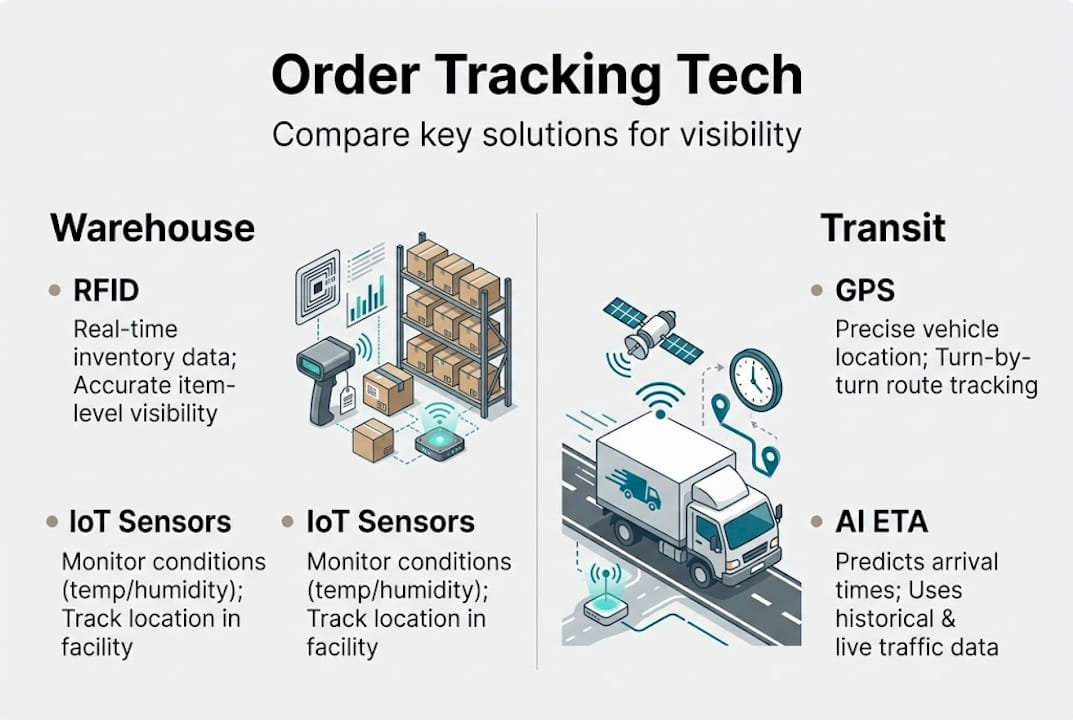
Pro Tip: Don’t pick just one technology. Layer GPS for in-transit visibility, IoT for condition monitoring, and AI for predictive alerts. Each layer fills a blind spot the others miss, giving you true end-to-end coverage.
Unified tracking platforms: Cross-carrier, OMS/WMS integration, and data flow
Once the right technologies are in place, the next step is integrating them seamlessly across your shipping channels.
Most growing ecommerce businesses ship with multiple carriers. That’s smart for redundancy and rate optimization, but it creates a fragmented visibility problem. Each carrier has its own portal, its own status language, and its own update frequency. Without a unified platform, your team is constantly switching tabs and manually reconciling data.
Cross-carrier tracking solves this by pulling data from every carrier into a single dashboard. Unified systems like Shippo or ShippingEasy enable centralized oversight for all shipments, regardless of which carrier is handling the parcel at any given moment.
Here’s how point solutions compare to unified platforms:
| Feature | Point solution | Unified platform |
|---|---|---|
| Carrier coverage | Single carrier | Multi-carrier |
| OMS/WMS integration | Limited | Native or API-based |
| Data normalization | Manual | Automated |
| Exception management | Reactive | Proactive alerts |
| Support ticket reduction | Minimal | Significant |
To integrate multiple carriers and data sources effectively, follow these steps:
- Audit your current carrier mix and identify which APIs or webhooks each supports.
- Select a shipment tracking software platform that natively connects to your OMS and WMS.
- Map each carrier’s status codes to your normalized internal taxonomy.
- Set up automated alerts for exception events like delays, failed deliveries, and customs holds.
- Test data flow end-to-end before going live, checking for deduplication and timestamp accuracy.
The payoff is real. Centralized tracking reduces manual data entry errors, cuts the support workload from WISMO tickets, and gives your operations team a single source of truth for every shipment in motion.
Solving common order tracking challenges: Dirty data, edge cases, and blind spots
Of course, even the best systems face occasional disruptions. Here’s how to anticipate and minimize common tracking pitfalls.
Tracking failures rarely come from a single catastrophic event. They accumulate from dozens of small, overlooked process gaps. Knowing where they hide is the first step to fixing them.
The most common sources of tracking headaches include:
- Carrier hand-offs: When a parcel transfers between carriers (for example, from a freight forwarder to a last-mile carrier), tracking often goes dark for hours or days.
- Dirty data: Inconsistent status codes, missing timestamps, and duplicate scan events corrupt your ETA calculations. Dirty data causes 38-42% of ETA errors, and 78% of shoppers abandon a retailer after poor tracking updates.
- Manual scan omissions: Warehouse staff occasionally skip scans during peak periods, creating phantom gaps in the tracking timeline.
- Customs delays: International shipments can sit in customs without any carrier-generated scan event, leaving customers in the dark.
- System overloads: During peak season, carrier APIs slow down or drop webhook events entirely.
The fix involves layering several strategies. Data normalization cleans incoming feeds automatically. AI-driven ETA models compensate for missing scan events by inferring location from historical patterns. Anomaly detection flags shipments that deviate from expected transit times. For high-value or regulated shipments, blockchain in logistics creates an immutable audit trail that eliminates disputes about when and where a parcel was handled.
Pro Tip: Run a monthly audit of your tracking data pipeline. Pull a sample of completed shipments and check for timestamp gaps, duplicate events, and status inconsistencies. Even a 30-minute review can reveal systemic issues before they scale into a customer service crisis.
Future trends: Blockchain, edge computing, and predictive AI
With the current landscape mapped, let’s look ahead to the emerging advances that will shape the future of order tracking.
The next wave of order tracking technology is already in early deployment. Three trends stand out as genuinely transformative for ecommerce sellers and logistics managers.
- Blockchain for record-keeping: Every scan event is written to an immutable, shared ledger. No single party can alter the record, which eliminates disputes between carriers, customs authorities, and sellers. Blockchain in supply chain adoption is accelerating as cross-border trade grows more complex.
- Edge computing for last-mile speed: Instead of sending raw sensor data to a central cloud server for processing, edge computing handles it locally, on the device or at a nearby node. This cuts latency from seconds to milliseconds, enabling near-instant status updates even in areas with poor connectivity.
- Predictive AI for proactive intervention: Next-generation AI models don’t just estimate ETAs. They flag shipments at risk of delay 24 to 48 hours in advance, giving your team time to reroute, notify the customer, or arrange a replacement before the problem becomes visible.
As blockchain, edge computing, and AI mature, they will set new standards for transparency and speed across the entire supply chain. Sellers who adopt these tools early will gain a measurable competitive edge in customer satisfaction and operational cost.
To prepare, start by ensuring your current data pipeline is clean and normalized. Advanced AI and blockchain tools multiply their value on high-quality data. A messy foundation will produce messy predictions, no matter how sophisticated the model.
Our perspective: Why smarter order tracking pays off where others fail
While the tech and trends are essential to know, here’s a hard-won perspective on what truly separates effective tracking from the rest.
Most businesses chase the wrong things. They add more carriers to their network, invest in sleek customer-facing dashboards, or bolt on another SaaS tool, and then wonder why support tickets keep climbing. The uncomfortable truth is that flashy interfaces built on dirty data are just expensive noise.
What top-performing logistics operations actually prioritize is data integrity first, automation second, and interface last. When your normalization layer is solid and your anomaly alerts fire reliably, every other tool in your stack becomes more effective. A predictive AI model trained on clean, consistent data outperforms one running on messy feeds by a wide margin.
We’ve seen this pattern repeatedly. The businesses that achieve the lowest WISMO rates aren’t the ones with the most carriers or the prettiest portals. They’re the ones obsessed with their data pipeline. They audit regularly, they fix edge cases fast, and they treat streamlining logistics as an ongoing discipline, not a one-time project. That mindset is what turns tracking from a cost center into a genuine competitive advantage.
Unlock seamless order tracking and visibility for your business
Ready to apply these insights to your own business? Discover how our platform brings them to life.
At or-ner.com, we built our global logistics platform specifically for ecommerce sellers who need reliable, real-time shipment visibility across every carrier and channel. Our AI-enabled tracking tools normalize data automatically, surface exceptions before they become problems, and reduce WISMO support volume from day one.
Whether you’re scaling a direct-to-consumer brand or managing complex cross-border fulfillment, our cloud logistics platforms connect your entire operation in one place. Explore our end-to-end logistics solutions to see how smarter tracking translates directly into lower costs, happier customers, and a supply chain you can actually trust.
Frequently asked questions
How does order tracking technology reduce customer support workload?
Robust tracking systems provide real-time, accurate updates that answer customer questions automatically, cutting WISMO tickets by 30-40% without any agent involvement.
What is the most accurate order tracking technology?
RFID is the gold standard, delivering up to 98.7% accuracy for inventory and parcel location tracking, even in environments where barcode scanning isn’t practical.
What are the main causes of tracking data errors?
Dirty data, carrier hand-offs, timestamp inconsistencies, and missed manual scans are the leading culprits, with dirty data alone responsible for 38-42% of ETA errors.
How do unified tracking platforms help ecommerce businesses?
They pull data from all carriers into one normalized view, eliminating tab-switching and manual reconciliation, which consolidates shipment data for consistent visibility and fewer errors.
What’s the future of order tracking technology?
Blockchain, edge computing, and predictive AI will enable tamper-proof records, near-instant updates, and proactive delay alerts that flag problems 24 to 48 hours before they reach the customer.