During the 2025 peak season, major carriers delivered 2.3 billion parcels with UPS hitting 97.2% on-time performance, yet logistics managers still wrestle with fragmented data, inconsistent status updates, and customers flooding support queues with “where is my order?” requests. The gap between raw carrier data and actionable shipment visibility is where most ecommerce operations lose time, money, and customer trust. This guide breaks down exactly how parcel tracking systems work, why data quality and AI matter more than most sellers realize, and how automation can turn tracking events into margin-saving decisions across your entire supply chain.
Table of Contents
- What is a parcel tracking system?
- How parcel tracking systems work: The technical mechanics
- Why data quality and AI power modern tracking
- How CRM-triggered logistics actions reduce returns
- Future innovations and what’s next for parcel tracking
- Unlock next-level logistics with advanced parcel tracking solutions
- Frequently asked questions
Key Takeaways
| Point | Details |
|---|---|
| Unified event tracking | Parcel tracking systems standardize status updates for greater visibility across carriers. |
| Data quality matters | Clean data and AI-powered ETAs significantly reduce errors and delivery delays. |
| Automation reduces returns | Automated CRM-triggered logistics actions cut return rates and improve margins. |
| Future-ready technology | AI, blockchain, and edge computing will transform how shipments are monitored and managed. |
What is a parcel tracking system?
A parcel tracking system is a technology layer that collects, processes, and communicates shipment status data from the moment a label is created to the moment a package lands at the customer’s door. It sits between carriers, sellers, logistics managers, and end customers, translating raw carrier data into meaningful, actionable updates.
The main stakeholders who rely on these systems include:
- Ecommerce sellers who need visibility across multiple carriers and fulfillment centers
- Logistics managers who monitor exceptions, delays, and carrier performance
- Carriers who generate raw event data at each scan point
- Customers who expect accurate, real-time delivery updates
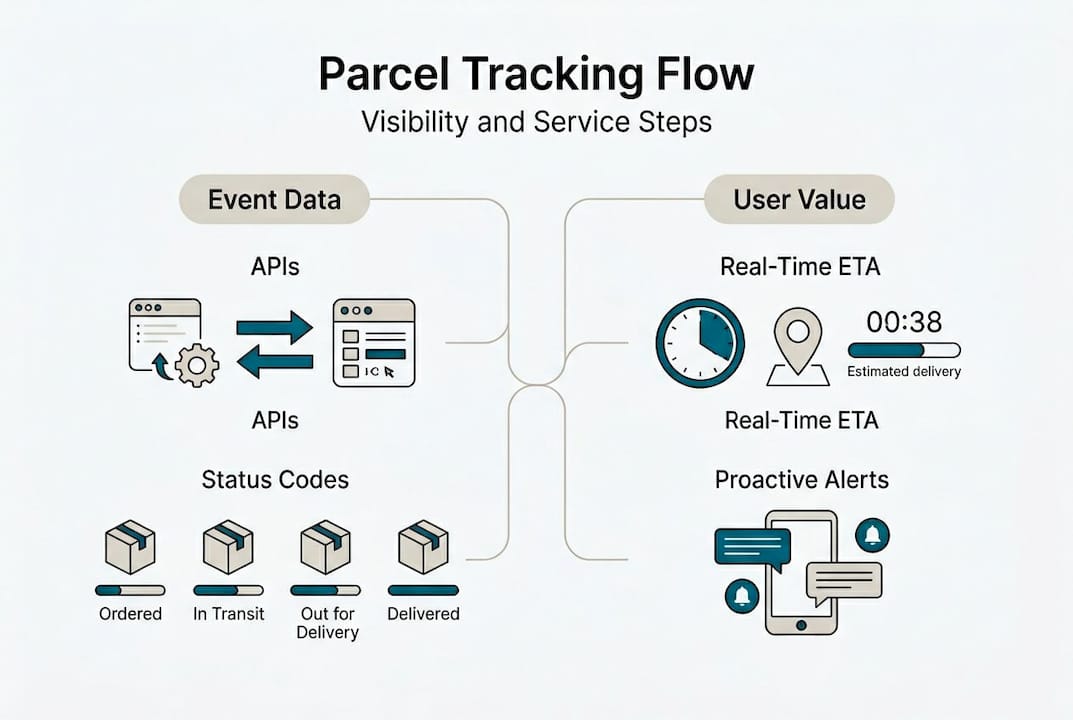
Core features that define a capable system include event collection from carrier APIs, status normalization, automated customer notifications, and exception management. As parcel tracking explained in depth, the real power comes from unifying data across dozens of carriers into a single, coherent view. The system must handle CRM-triggered logistics intervention workflows, mapping carrier-specific codes to canonical events like “attempted delivery” so every stakeholder sees the same picture regardless of which carrier is moving the parcel.
How parcel tracking systems work: The technical mechanics
With the basics defined, let’s examine how parcel tracking systems actually process shipment data across carriers and systems. The process is more sophisticated than most sellers expect, and understanding it helps you ask better questions when evaluating vendors.
Here is the step-by-step data flow:
- Event ingestion: The system pulls raw scan data from carrier APIs or receives it via webhooks in near real time.
- Status normalization: Carrier-specific codes (like “DEX 01” or “PSLIP”) are mapped to unified, human-readable events such as “In Transit” or “Out for Delivery.”
- Deduplication: Duplicate events from multiple carrier systems are filtered out to prevent false alerts.
- Timestamp normalization: All event times are converted to UTC so cross-carrier comparisons are accurate.
- Orchestration: A decision engine evaluates each event and triggers automated actions, such as rerouting a parcel after a failed delivery attempt.
The table below shows how carrier-specific codes map to unified tracking events:
| Carrier | Raw status code | Unified event label |
|---|---|---|
| UPS | DEX 01 | Attempted delivery |
| FedEx | DE | Attempted delivery |
| USPS | 09 | Out for delivery |
| DHL | TRANSIT | In transit |
| Generic | DLVD | Delivered |
Pro Tip: When evaluating a tracking platform, ask vendors how they handle deduplication. Duplicate events are a silent killer of notification accuracy and can trigger unnecessary customer alerts or automated reroutes.
“The core mechanics of modern parcel tracking involve event ingestion from carrier APIs and webhooks, canonical status normalization, deduplication, timestamp normalization to UTC, and orchestration via decision engines for actions like reroutes.”
A reliable parcel delivery service depends on this entire chain functioning without gaps. One broken link, such as a carrier API outage or a missing status mapping, can cascade into customer complaints and costly manual interventions.
Why data quality and AI power modern tracking
Understanding data flows leads to the next challenge: how to ensure information is accurate and actionable, and what difference smart AI makes. This is where many logistics operations quietly bleed efficiency.
Poor data quality is not a minor inconvenience. Dirty data causes 38 to 42% of ETA errors in parcel tracking systems. That means nearly half of all inaccurate delivery estimates trace back to bad input data, not carrier delays. Incorrect address formats, missing postal codes, and inconsistent carrier codes all compound into ETAs that frustrate customers and inflate support costs.
AI and machine learning change the equation significantly. Modern shipment tracking software uses predictive models trained on historical carrier performance, weather patterns, and regional capacity data to generate ETAs with 85 to 92% accuracy. That is a meaningful jump over static rule-based estimates.
Best practices for maintaining data hygiene in your tracking stack include:
- Standardize address formats at the point of order capture, not after the fact
- Validate carrier account codes before label generation to prevent ingestion failures
- Audit status mappings quarterly as carriers update their internal code libraries
- Use GS1 standards for cross-carrier barcode and data interoperability
- Monitor data completeness scores in your tracking dashboard to catch gaps early
Pro Tip: Run a monthly audit of your carrier API connections. Carriers update their status code libraries more often than most sellers realize, and a stale mapping table silently corrupts your tracking data for weeks before anyone notices.
How CRM-triggered logistics actions reduce returns
With accurate tracking and predictive ETAs as a foundation, the next frontier is acting on shipment data in real time to boost results. This is where parcel tracking stops being a passive reporting tool and becomes an active business driver.

CRM-triggered process automation connects tracking events directly to business workflows. When a carrier logs an “attempted delivery” event, the system does not just update a status field. It can automatically trigger a hold at the nearest pickup point, send the customer a reroute link, or flag the order for a customer service callback before the customer even realizes there was a problem.
Here is how the intervention process works in practice:
- Carrier scans parcel as “attempted delivery” and pushes the event via webhook.
- Tracking system normalizes the event and passes it to the CRM decision engine.
- CRM checks customer preferences and order value to select the best intervention.
- Automated action fires: reroute request, hold instruction, or proactive customer notification.
- Outcome is logged for carrier performance reporting and future model training.
The difference between traditional and automated approaches is significant:
| Process step | Traditional approach | Automated intervention |
|---|---|---|
| Failed delivery detected | Manual review next business day | Real-time webhook trigger |
| Customer notification | Support team sends email | Automated SMS or app push |
| Reroute or hold request | Customer calls carrier | System submits request automatically |
| Return initiated | Default after 3 failed attempts | Prevented via proactive reroute |
CRM-triggered interventions on tracking events can reduce returns by automating reroutes and holds, with retailers reporting measurable margin gains from smarter return management. When you reduce delivery times and prevent failed deliveries proactively, you also increase online sales by building the kind of post-purchase experience that drives repeat orders.
Future innovations and what’s next for parcel tracking
Looking ahead, these trends promise to continue reshaping how ecommerce sellers and logistics teams capture value from parcel tracking. The technology is moving fast, and the sellers who understand what is coming will be better positioned to adapt.
Key innovations shaping the next generation of parcel tracking include:
- AI for predictive delay management: Models that flag at-risk shipments 24 to 48 hours before a delay occurs, giving logistics teams time to intervene before customers are affected
- Blockchain-based visibility: Immutable, shared ledgers that give every supply chain participant a tamper-proof record of each shipment event, reducing disputes and fraud
- Edge computing for last-mile tracking: Processing tracking data at the local level, such as smart lockers and delivery vehicles, enables hyper-local visibility for the final 100 feet of delivery
- Industry interoperability standards: Broader adoption of GS1 and similar frameworks will reduce the friction of onboarding new carriers and cross-border logistics partners
“The next frontier for parcel tracking includes AI for predictive delays, blockchain for immutable records, and edge computing for last-100-feet visibility at lockers and delivery points.”
Blockchain in particular is gaining traction for cross-border shipments where multiple parties, including freight forwarders, customs brokers, and carriers, need a single source of truth. Explore how blockchain in logistics is already changing carrier accountability, and how track and trace technology is evolving to support these new architectures across global supply chains.
Unlock next-level logistics with advanced parcel tracking solutions
The insights above are only valuable if you have the right infrastructure to act on them. Fragmented carrier portals and manual status checks cannot scale with your business, and they certainly cannot trigger the kind of real-time interventions that protect your margins and customer relationships.
At or-ner.com, we built our platform specifically for ecommerce sellers and logistics managers who need more than a status page. Our shipment tracking software connects to major carriers, normalizes data in real time, and feeds your CRM with clean, actionable events. Pair that with our reliable courier services across the USA and our freight booking solutions for cross-border shipments, and you get end-to-end visibility from the first mile to the customer’s door. Whether you are managing 500 orders a month or 50,000, our tools scale with your operation without adding complexity.
Frequently asked questions
How do parcel tracking systems improve customer service?
They deliver real-time status updates and accurate ETAs directly to customers, which cuts “where is my order?” support tickets significantly. Real-time orchestration also enables proactive notifications before customers even think to ask.
What causes errors in parcel ETA estimates?
Dirty data causes 38 to 42% of ETA errors, meaning inconsistent address formats, stale carrier code mappings, and missing data fields are the primary culprits, not carrier performance alone.
Can parcel tracking help reduce returns?
Yes. CRM-triggered interventions on events like failed delivery attempts automate reroutes and holds, preventing the default return cycle and protecting your margins on each order.
What future technologies will impact parcel tracking systems?
AI for predictive delays, blockchain for tamper-proof shipment records, and edge computing for last-mile visibility at smart lockers are the three technologies most likely to reshape parcel tracking in the next three to five years.