Shipment tracking systems collect, standardize, and surface shipment events across carriers, modes, and warehouses so that teams and customers see where an order is at any point in transit. The buying priority is interoperable, carrier-validated visibility paired with automated exception handling, not the longest feature list. Choose a system that proves real carrier connectivity and resolves exceptions before they reach a customer, and most other benefits follow.
TL;DR:
- Prioritize shipment systems that connect directly with verified carrier event logs to ensure real-time accuracy and avoid missed scans.
- Use standards like EPCIS to facilitate integration across carriers and partners by supporting consistent recording of shipment events.
- Validate carrier event timestamps against their portals during pilots, and automate exception detection to prevent delays and support tickets.
- Focus on measurable KPIs such as on-time delivery, exception rates, and support time, ensuring data quality metrics underpin these outcomes.
- Starting with high-value lanes and validating timestamps before expanding improves rollout success and prevents blind spots in the tracking process.
Table of Contents
- Why shipment tracking systems matter for ecommerce and logistics operations
- Key capabilities to evaluate when choosing a tracking platform
- How to roll out a tracking system without creating new blind spots
- Business use cases and what teams actually gain
- How to measure ROI and set meaningful KPIs for a visibility program
- ORNER perspective: operationalizing visibility on an integrated platform
- Author perspective and prioritized next steps
- ORNER as a direct option for integrated tracking
- FAQ
- Sources
Why shipment tracking systems matter for ecommerce and logistics operations
Every unresolved shipment status becomes a support ticket. “Where is my order” (WISMO) inquiries are one of the most predictable, and most fixable, cost centers in ecommerce operations, and they scale directly with order volume whenever tracking data is incomplete or delayed. A tracking system that closes the gap between a carrier scan and a customer-facing update removes that ticket before it is ever opened.
The same visibility that quiets a support queue also tightens planning upstream. When a warehouse team can see a delay forming three days out instead of learning about it at the dock, they can reroute, expedite, or notify the customer proactively. That earlier signal is what improves on-time, in-full (OTIF) performance and lets planners hold less buff inventory against uncertainty, because the uncertainty itself shrinks.
The stakes rise further with cold chain and multimodal freight, where a tracking gap is not just an annoyance but a compliance or spoilage risk. A temperature-sensitive shipment that loses visibility between an ocean leg and a final-mile handoff can arrive out of spec with no record of when the excursion happened. Operations teams that work across ocean, air, and land legs feel this acutely, since each handoff is a point where data can silently drop.
What visibility gaps cost operations teams:
- Rising WISMO ticket volume that scales with order growth instead of shrinking with better systems.
- Larger safety-stock buffers held to compensate for unreliable delivery estimates.
- Delayed exception response, turning minor delays into missed delivery windows.
- Compliance exposure on temperature-controlled or high-value freight with incomplete event trails.
A deeper breakdown of how parcel-level tracking fundamentals translate into efficiency gains is worth reviewing before setting requirements.
Key capabilities to evaluate when choosing a tracking platform
Most shipment tracking evaluations focus on dashboards and branding. The harder, more consequential questions are about data integrity: does the system actually receive validated events from carriers, and does it act on them without a human in the loop.
Carrier connectivity, validated, not self-reported. Ask any vendor to show live event logs from your actual carrier mix, not a demo account. A platform that only ingests tracking numbers and scrapes public tracking pages will lag, and sometimes miss, scan events entirely.
Standards support and event model mapping. GS1’s EPCIS standard defines a structured way to record the what, when, where, why, and how of a supply chain event, which gives vendors and trading partners a common language instead of proprietary status codes. A platform that maps its internal events to an EPCIS-like model is far easier to integrate with new carriers or partners later.
APIs, webhooks, and integration patterns. Real-time milestone updates should arrive by webhook push, with REST endpoints available for querying historical event chains during audits or disputes. Batch file transfer still has a place for backfilling older records, but it should never be the only option for live status.
Dynamic ETA and exception detection. Static transit-time estimates are a guess. Systems that recompute ETAs from live scan data and flag deviations automatically let exception teams work from a short, prioritized list instead of scanning every shipment manually.
Sensor and IoT data for cold chain and tamper alerts. Temperature, humidity, and shock sensors tied into the same event stream turn a compliance requirement into a searchable record instead of a paper log.

Multimodal coverage, cross-border handling, and selective disclosure. A platform needs to carry a shipment’s identity across an ocean leg, a customs clearance, and a last-mile delivery without losing continuity, while still letting each party see only the data relevant to its role.
Pro Tip: Before signing with any vendor, request a live trace for a shipment moving through your actual carrier network, not a sample account, and compare its timestamps against the carrier’s own portal.
Evaluation checklist for procurement and engineering teams:
- Confirm carrier connectivity with live, verifiable event logs rather than marketing claims.
- Require documented mapping between vendor events and a standardized model such as EPCIS.
- Test webhook latency and failure handling under simulated carrier outages.
- Verify sensor data ties to the same shipment ID as scan events, not a separate system.
This checklist overlaps with order tracking technology considerations for teams evaluating integration depth alongside carrier coverage.
How to roll out a tracking system without creating new blind spots
Integration is where most visibility programs quietly fail, making an AI-driven warehouse orchestration platform essential to eliminate blind spots across systems. The data looks complete in a demo, then gaps appear once real carriers, warehouses, and legacy systems are connected. A structured rollout sequence prevents that.
- Map every data producer and consumer first: carriers, warehouse management systems, ERP, and customer-facing channels that will send or receive tracking events.
- Choose an event model, ideally EPCIS-style, and document how each vendor’s native events map to it before writing any integration code.
- Use REST APIs and webhooks for real-time milestone updates, reserving batch sync for backfilling historical records only.
- Define exception workflows and remediation rules, who gets alerted, and what action follows, before go-live, not after the first delay occurs.
- Pilot on a single high-value lane, validate timestamp accuracy and event completeness against the carrier’s own records, then expand lane by lane.
- Set governance rules for data retention, access control, and selective disclosure so partners see only what their role requires.
GS1’s EPCIS guidance is the clearest reference point for step two, since it specifies both the event structure and how sensor or provenance metadata can ride along with standard milestones. Practical pilot sequencing is covered in more detail in a guide to tracking shipments efficiently.
Business use cases and what teams actually gain
The return on a tracking program shows up differently depending on where a team sits in the order lifecycle, but the common thread is fewer manual interventions per shipment.
Customer-facing gains include branded tracking pages, delivery-window scheduling, and a measurable drop in WISMO contact rates once customers can self-serve accurate status instead of calling support.
Operational gains show up in yard and dock planning, where advance notice of inbound arrivals lets teams schedule labor and dock doors instead of reacting to trucks as they show up, and in lower buffer inventory once delivery estimates become reliable enough to plan against.
Risk and compliance gains matter most for temperature-sensitive or high-value freight, where a continuous event record turns an excursion into a documented, time-stamped incident instead of a dispute with no evidence either way.
Measurable outcomes teams report:
- Branded, self-service tracking that reduces inbound support contact rates.
- Tighter OTIF performance once exception alerts arrive before a delivery window is missed.
- Lower safety-stock requirements as delivery variance shrinks.
- Documented temperature and handling records for cold-chain or regulated freight.
Enterprise case studies across visibility platform deployments report measurable improvements in OTIF performance and reduced manual tracking time, according to industry visibility workshop findings, reflecting what happens when exception detection shifts from manual review to automated alerting.
Teams sourcing couriers directly can see how these gains apply in practice through a review of what actually works for ecommerce couriers.
How to measure ROI and set meaningful KPIs for a visibility program
A tracking program is only as good as the KPIs used to judge it, and the most common mistake is measuring dashboard adoption instead of shipment outcomes. Start with a small set of primary KPIs, baseline them before rollout, then set staged targets.
Primary KPIs should include OTIF rate, exceptions per 1,000 shipments, and average support handling time per tracking-related ticket. Underneath those, instrumented metrics such as event completeness rate, ETA accuracy, and time-to-detect an exception reveal whether the underlying data is trustworthy enough for the primary KPIs to mean anything. NIST’s supply chain traceability meta-framework makes this point directly: business KPIs depend on data-quality metrics like event completeness and timestamp accuracy, so a program that skips those instrumented measures is building on an unverified foundation.
| KPI category | Metric | What it reveals |
|---|---|---|
| Primary | OTIF rate | Whether deliveries arrive on time and complete |
| Primary | Exceptions per 1,000 shipments | Frequency of disruption requiring intervention |
| Primary | Average support handling time | Cost of unresolved tracking inquiries |
| Instrumented | Event completeness rate | Whether carrier data is actually arriving |
| Instrumented | ETA accuracy | Whether dynamic ETAs can be trusted for planning |
| Instrumented | Time-to-detect exception | Speed of automated alerting versus manual review |
Set 3, 6, and 12 month targets against the baseline for each metric, and tie improvement in exceptions and support handling time directly to projected cost reduction. Track CSAT shifts and the drop in manual interventions as supporting, qualitative confirmation that the numbers are translating into a better customer experience.
ORNER perspective: operationalizing visibility on an integrated platform
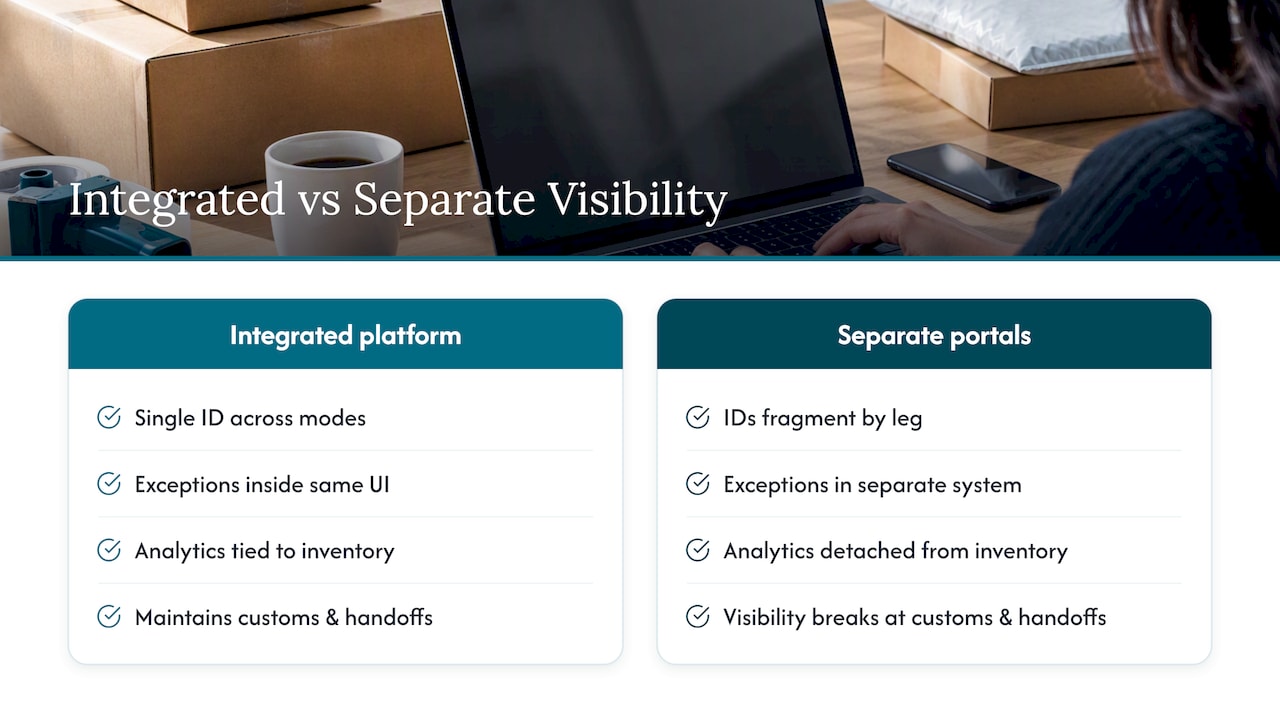
A platform built around the same checklist outlined above offers real-time shipment tracking connected to freight booking, customs clearance, and warehousing so that a single shipment ID carries through ocean, air, and land legs instead of fragmenting at each handoff. Exception management and analytics can sit inside the same interface used for catalog and inventory management, which keeps a delay signal attached to the inventory decision it affects rather than living in a separate system.
For ecommerce sellers running fulfillment through a global warehouse network, continuity matters most at the points where visibility typically breaks: the customs clearance step and the transfer from freight carrier to last-mile courier. Keeping those events on one platform, rather than stitched together after the fact from separate carrier portals, can be the practical difference between catching a delay early and explaining it to a customer after the fact.
The deeper mechanics of multimodal visibility, including what to prioritize when evaluating a platform for global operations, are covered in global logistics solutions tracking and in a dedicated look at exception management’s role in reliable courier service.
Author perspective and prioritized next steps
The industry conversation around shipment tracking spends too much time on dashboards and too little on data integrity. A system with a beautiful interface and unverified carrier feeds is worse than a plain one with validated data, because it creates false confidence.
If you are starting an evaluation, do three things in order: pilot one high-value lane rather than your whole network, validate that carrier event timestamps match what the carrier itself reports, and automate exception detection before you automate anything else. A managed, integrated platform tends to suit teams that want fewer integration points to maintain, while a modular, best-of-breed stack suits teams with the engineering capacity to own that integration work themselves.
Keep an eye on public-private data-sharing initiatives like FLOW, which lets participants forecast freight capacity demand up to 90 days ahead using shared, anonymized data, since the direction of the industry is toward standardized event sharing, not proprietary silos.
— Maayan
ORNER as a direct option for integrated tracking
If you would rather run shipment visibility, freight booking, customs clearance, and warehousing on one connected platform instead of stitching together point solutions, a comprehensive platform built for this purpose may suit your needs. Real-time tracking integrated with fulfillment and inventory management can make an exception on an inbound freight leg visible to the same team managing warehouse stock, without a manual handoff between tools.
For sellers who want an immediate operational number to plan against, you can request a freight shipping estimate directly, or review ORNER’s full range of courier, freight, and fulfillment services to see how the platform fits your specific lane and volume.
FAQ
What is the main difference between a shipment tracking system and basic carrier tracking?
A carrier’s own tracking page shows only that carrier’s scans, while a shipment tracking system aggregates events across multiple carriers, modes, and warehouses into one continuous record. That aggregation is what enables cross-carrier exception alerts and a single branded tracking experience for customers.
How does EPCIS improve shipment tracking accuracy?
GS1’s EPCIS standard defines a structured event format covering what happened, when, where, why, and how, which lets different systems interpret the same shipment event consistently. That consistency reduces the mismatched or missing statuses that happen when vendors use incompatible proprietary codes.
What KPIs best show that a tracking program is working?
OTIF rate, exceptions per 1,000 shipments, and average support handling time are the primary indicators, backed by instrumented metrics like event completeness and ETA accuracy. NIST’s traceability framework notes that these instrumented data-quality metrics need to be reliable before the business-level KPIs can be trusted.
Does ORNER offer real-time shipment tracking as part of its platform?
Yes, ORNER provides real-time shipment tracking as part of its end-to-end platform alongside freight booking, customs clearance, and warehousing. Pricing for specific services is available on request through ORNER’s services page.
What is the FLOW initiative and why does it matter for shippers?
FLOW is a U.S. Department of Transportation initiative that lets participating shippers, carriers, and ports share aggregated, anonymized freight data to forecast capacity demand up to 90 days in advance. Industry leaders have endorsed the initiative as a way to reduce the data silos that create blind spots across the supply chain.
Sources
- Bureau of Transportation Statistics — FLOW
- GS1 — EPCIS
- NIST — Supply Chain Traceability Principles: A Manufacturing Meta-Framework
- U.S. Department of Transportation — Industry leaders endorse FLOW initiative