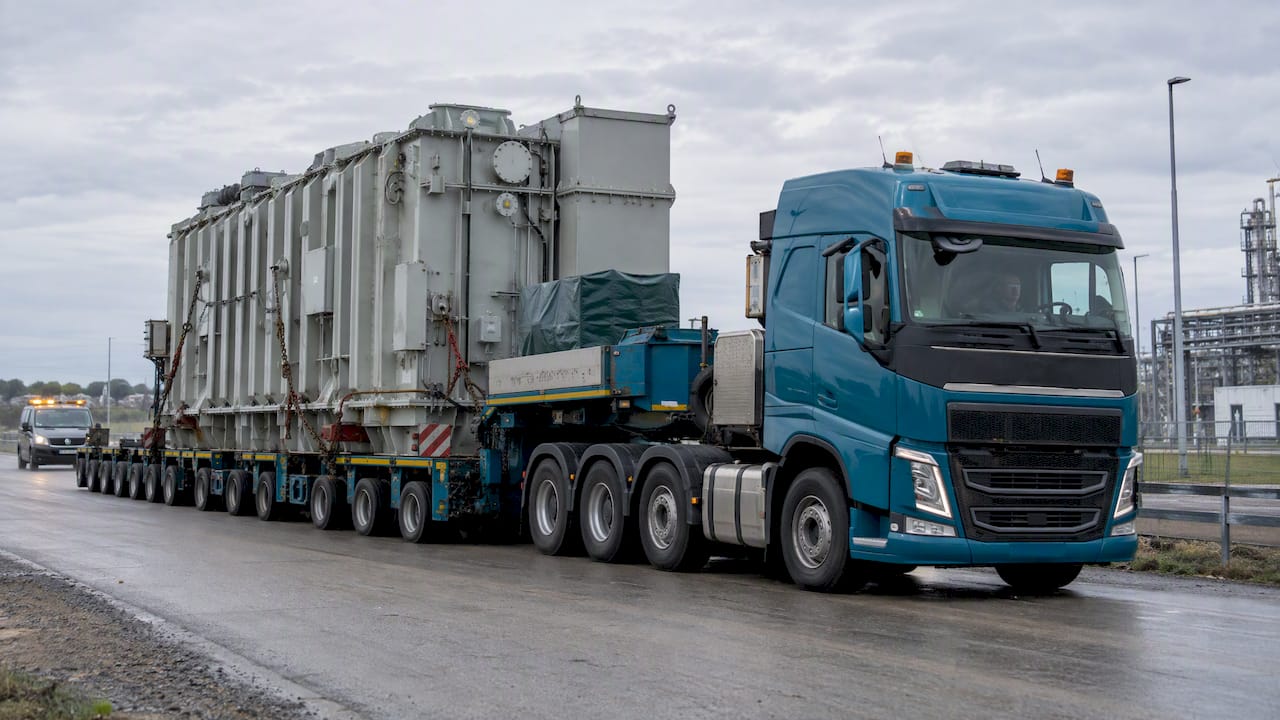
In freight management, EDI is the standardized, automated exchange of freight documents such as tenders, status updates, invoices, and advance ship notices that replaces manual paper and phone-based coordination. This guide walks through the transaction sets that matter, the measurable operational payoff, and the architecture and implementation steps that turn EDI from a compliance checkbox into a working system.
TL;DR:
- Most freight operations rely on EDI transaction sets like 204, 214, and 210 to automate booking, tracking, and invoicing, reducing manual effort.
- Implementation requires careful version control and partner-specific guides to prevent transaction rejections caused by inconsistencies.
- EDI improves visibility by enabling earlier exception detection and shortens tender-to-pickup cycle times through automation.
- Integrating EDI with TMS and APIs allows balancing structured document exchange with real-time data needs, often in hybrid setups.
- Ensuring proper monitoring of functional acknowledgments like 997 reduces unnoticed message failures, which is critical for reliable freight automation.
Table of Contents
- What EDI means in freight: standards, envelopes, and the tech stack
- Core EDI transaction sets for freight and their freight-use cases
- How EDI improves freight operations: measurable benefits and KPIs
- Integration and architecture: EDI, TMS, APIs, and hybrid stacks
- Implementation checklist and best practices for freight teams
- Or-ner perspective: applying EDI and modern integration at scale
- Where the conventional advice on EDI falls short
- Or-ner as a practical option for EDI-enabled freight automation
- Authoritative standards and program links
- Sources
- FAQ
What EDI means in freight: standards, envelopes, and the tech stack
EDI in freight runs on ANSI X12, a standard that defines transaction sets: structured electronic forms for specific business documents. Each message travels inside a nested envelope structure. The ISA segment identifies the sender and receiver, the GS segment groups related transactions, and the ST segment marks the start of an individual transaction set, such as a load tender or an invoice.
Partners rarely implement the raw standard as written. Carriers and shippers publish their own implementation guides (IGs) that specify which fields are required, which codes apply, and how exceptions are handled. Versioning matters too: a partner running X12 version 004010 and another running a newer version need a translator that reconciles the difference before messages exchange cleanly.
In practice, these messages map directly to freight events. A shipper tenders a load, the carrier accepts or rejects it, status updates flow in as the shipment moves, a ship notice confirms what left the dock, and an invoice follows once the freight delivers. Batching still happens in many legacy setups, where messages queue and transmit on a schedule rather than firing instantly, which matters when comparing EDI against real-time API alternatives later in this guide.
Core EDI transaction sets for freight and their freight-use cases
A handful of transaction sets cover most freight operations. Knowing what each one does, and where it breaks down, determines how fast a team can prioritize implementation with a given partner.
- 204 (Motor Carrier Load Tender): offers a shipment to a carrier with origin, destination, equipment, and commodity details. Carrier implementation guides note that some partners treat the 204 as truckload-only and expect a functional acknowledgment in return, so LTL shipments may need a different workflow entirely.
- 214 (Shipment Status): reports location and milestone codes, such as pickup, in-transit, and delivery, at a cadence the carrier controls. The 204 tends to function as the tender while the 214 supplies the ongoing status that keeps shippers informed between pickup and delivery.
- 210 (Motor Carrier Freight Details and Invoice): carries the billed charges once a shipment delivers, feeding accounts payable and triggering freight audit against the original rate agreement. Carrier 210 implementation guides detail the required fields and the acknowledgment flow that confirms receipt.
- 856 (Ship Notice/Manifest): tells the receiver what is coming before it arrives, down to SKU and unit level, which lets warehouses pre-stage labor and scan against an expected manifest rather than keying data manually. X12 documents the 856 as a core supply-chain transaction set tying the order to the physical delivery.
- Other sets worth knowing: 310 covers ocean freight receipt and invoice, 223 and 224 serve consolidators and motor-carrier shipment information, and 997 is the functional acknowledgment that confirms a prior message was received and syntactically valid.
How EDI improves freight operations: measurable benefits and KPIs
The operational case for EDI comes down to three things: faster visibility, fewer manual touches, and tighter financial control. Visibility shows up as earlier exception detection. When a 214 status update is late or missing, that gap itself becomes a signal that something on the lane needs attention before a customer calls to ask where their freight is.
Efficiency gains are trackable. Tender-to-pickup time shortens when a 204 reaches a carrier’s system automatically instead of through a phone call or e-mail. Dock throughput improves when an 856 lets a warehouse crew know what is arriving and in what quantity, cutting the receiving steps that used to depend on paper packing slips.

Historical USDOT evaluations of electronic freight management found that shifting to near-real-time data exchange improved the frequency and accuracy of status updates across trading partners, according to the Columbus Electronic Freight Management evaluation. On the cost side, teams watch invoice dispute rates and cycle time: a 210 that matches the original tender and accessorial charges clears accounts payable faster than a paper invoice that needs manual reconciliation.
Integration and architecture: EDI, TMS, APIs, and hybrid stacks
EDI reaches a trading partner through a few common paths. Direct EDI connects two systems point to point. A Value-Added Network (VAN) acts as an intermediary mailbox that many carriers still use for routing and translation. An EDI translator converts between a company’s internal data format and the X12 standard, and middleware sits between that translator and the rest of the tech stack, often handling the mapping logic that keeps versions and partner-specific IGs in sync.
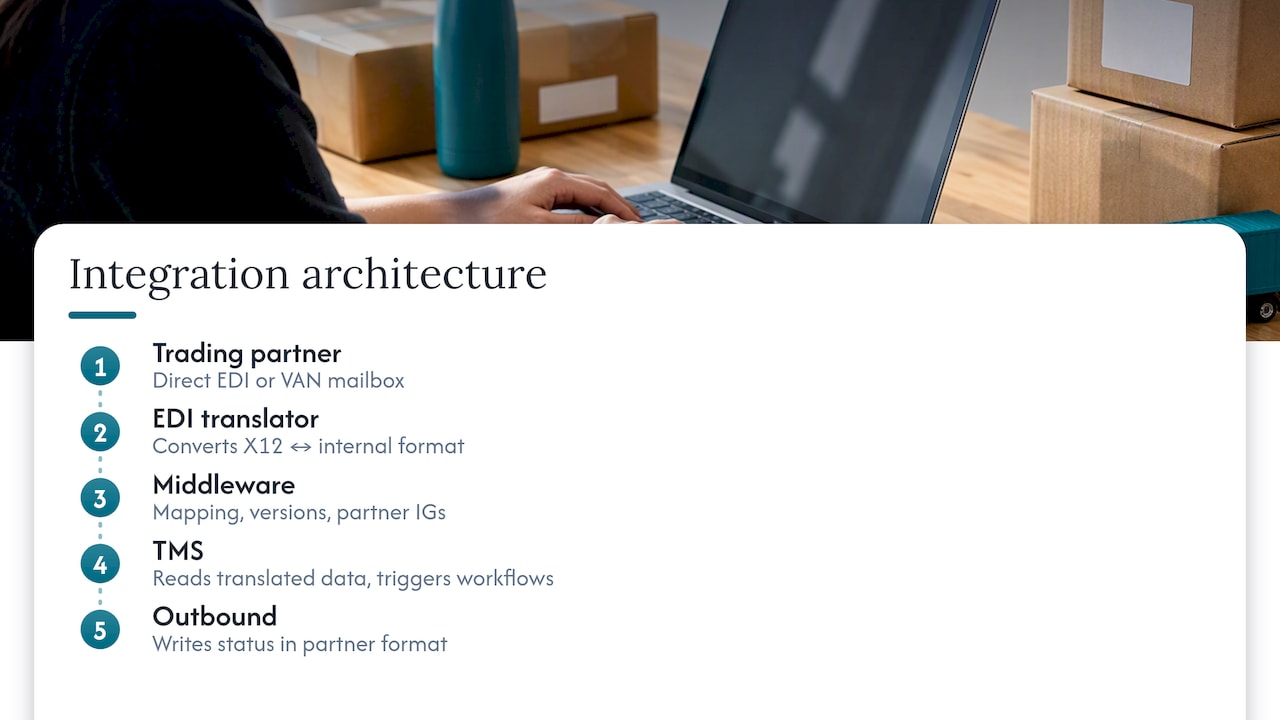
A transportation management system (TMS) typically consumes EDI through that same translator or middleware layer rather than parsing raw X12 natively. The TMS reads the translated data, triggers the appropriate workflow such as tender acceptance or exception handling, and writes status back out in the format the next partner expects. This integration architecture is where most implementation time actually goes, not in the standard itself.
APIs fit better for real-time needs: instant rate quotes, live tracking pings, or booking confirmations where a few seconds matter. EDI remains the stronger choice for standardized business documents like invoices and tenders, where structure and auditability matter more than speed. Most freight operations today run both, which is why mapping and middleware design deserve more attention than either technology alone.
Implementation checklist and best practices for freight teams
Getting a new EDI partner live follows a fairly consistent sequence, whether the team is onboarding a carrier or a retail consignee.
- Confirm which transaction sets the partner requires and request their implementation guide before writing any mapping logic.
- Scope versions early: mismatched X12 versions between partners are a common source of rejected transactions.
- Build and test mappings in a sandbox environment using sample files from the partner’s IG, not production data.
- Set ISA and GS control numbers correctly from the start, since duplicate or out-of-sequence values cause downstream rejections.
- Automate 997 acknowledgment handling so a missing or negative 997 triggers an alert rather than going unnoticed.
- Define exception workflows and SLAs for acknowledgments, so operations knows how long to wait before escalating a stalled transaction.
- Schedule periodic re-tests after any partner system change, and keep a change-control log tied to each partner’s IG version.
Pro Tip: Treat the 997 acknowledgment as a monitoring tool, not just a formality: a spike in negative acknowledgments from one partner usually points to a mapping or version mismatch before anyone notices missed shipments.
Teams managing multiple carriers often pair this checklist with a documented process flow so new hires can see where EDI touches each handoff.
Or-ner perspective: applying EDI and modern integration at scale
Some logistics platforms combine freight booking, tracking, customs clearance, and warehousing into one system, which can reduce the number of manual handoffs between booking a shipment and confirming it landed in inventory. Automation at the platform level, rather than at each individual carrier connection, is what keeps exception handling and data visibility consistent across ocean, air, and land modes for the sellers and brands that rely on it.
Where the conventional advice on EDI falls short
Most explainers treat EDI as a solved problem: pick the transaction sets, map the fields, done. That undersells how much of the real work is partner-specific. Two carriers both claiming 204 support can still disagree on required fields, equipment codes, or whether LTL shipments are even in scope, and that gap only surfaces during testing, not during planning.
The bigger miss is treating EDI and APIs as competitors. They solve different problems: EDI standardizes the documents that need to be auditable, like invoices and tenders, while APIs handle the real-time pings that do not need a permanent paper trail. Teams that try to force one technology to do both jobs end up with brittle integrations.
If there is one thing to prioritize first, it is the functional acknowledgment. A 997 that nobody monitors is worse than no acknowledgment at all, because it creates false confidence that a message arrived when it did not. Get that monitoring right before investing in more transaction sets.
— Maayan
Or-ner as a practical option for EDI-enabled freight automation
Running EDI well takes mapping work, partner testing, and ongoing monitoring that most ecommerce sellers would rather not manage in-house. Some providers handle that layer as part of a broader logistics platform, so freight booking, tracking, customs clearance, and warehousing work from one connected system instead of a patchwork of carrier portals.
- Request a freight estimate to see how booking and tracking connect in practice.
- Talk to the integration team about customs clearance and warehousing for cross-border volume.
- Review the main services overview to see how the platform fits an existing carrier mix.
Authoritative standards and program links
For technical detail, consult X12’s own supply-chain transaction set documentation, carrier implementation guides such as the 204 load tender guide, and the USDOT’s FLOW program for capacity-forecast data that complements company-level EDI visibility.
Sources
- X12 | Flow: Supply chain
- ANSI ASC X12 Load Tender (204) Version 004010 (YRC implementation guide)
- Freight Logistics Optimization Works (FLOW) | U.S. DOT
- ANSI ASC X12 FREIGHT INVOICE (210) VERSION 004010 (YRC implementation guide)
FAQ
What is EDI for freight?
EDI for freight is the standardized electronic exchange of documents like load tenders, status updates, and invoices between shippers, carriers, and other trading partners. It replaces manual processes such as phone calls, faxes, and paper packing slips with structured messages that systems can read and act on automatically.
What does EDI stand for in logistics?
EDI stands for Electronic Data Interchange, the broader standard for exchanging business documents electronically between organizations. In logistics, it specifically governs freight-related messages such as tenders, status reports, and invoices using formats like ANSI X12 transaction sets.
What is the role of EDI in logistics?
EDI’s role in logistics is to standardize how trading partners exchange operational and financial documents, from booking a shipment to confirming delivery and invoicing. Public-private programs like the USDOT’s FLOW initiative extend that value by adding a regional view of capacity and demand that complements the company-level visibility EDI provides.
What is the difference between EDI 204 and 214?
The 204 is the Motor Carrier Load Tender, used to offer a shipment to a carrier before it moves. The 214 is the Shipment Status message, sent after the carrier accepts the load, reporting location and milestone updates as the shipment travels to delivery.