
A courier cost calculator built for B2B ecommerce must return five things: per-shipment freight by mode and lane, per-unit fulfillment and warehouse charges, insurance, the full stack of duties, taxes and customs fees, and a rolled-up landed cost showing margin impact under the Incoterm you selected. Every number it produces should be labeled as an estimate tied to the assumptions behind it, including the contract rate, HS code, and Incoterm used to generate it.
TL;DR:
- Using actual carrier contract rates and regularly updated surcharge feeds prevents significant overestimation in landed cost calculations.
- Incoterm choices like DDP, CPT, or CIF dramatically influence who pays duties, freight, and customs fees, affecting the final margin.
- High-value shipments require precise HS classification and broker verification, as classification errors can materially alter duty costs.
- Metrics such as per-unit landed cost, shipment total, and margin impact must be labeled as estimates and tied to current assumptions for reliability.
- Spreadsheets become insufficient when shipment volume grows or cross-border complexity increases, requiring integrated platforms for accuracy and traceability.
Table of Contents
- What a reliable courier cost calculator should estimate
- Key inputs and data sources for accurate estimates
- Modeling landed cost and Incoterms with a worked example
- Building or validating your own courier cost calculator
- When a spreadsheet stops being enough
- How Or-ner supports courier cost estimation
- Sources
- FAQ
What a reliable courier cost calculator should estimate
A calculator that only quotes freight is answering half the question. Landed cost, the true price of getting a unit from origin to a customer’s door, includes everything that touches the shipment along the way, and a B2B tool needs to itemize each piece so buyers can see where money goes.
The core buckets look like this:
- Base freight: rate by lane, mode (ocean, air, ground) and service level, usually the largest single line item.
- Fuel and general rate increase (GRI) surcharges: carrier-imposed adjustments that shift with fuel markets and capacity, often revised weekly.
- Accessorials: liftgate, residential delivery, address correction and similar fees that published rate sheets tend to bury.
- Insurance: cargo coverage tied to declared invoice value.
- Customs, duties and taxes: tariff obligations tied to HS classification and country of origin.
- Brokerage and clearance fees: charges for filing entry documents and managing customs interactions.
- Fulfillment and warehousing: per-unit picking, storage and handling, plus per-batch charges for palletization or labeling.
- Returns processing: reverse logistics and any penalty fees tied to damaged or refused shipments.
The outputs worth building around are per-unit landed cost, a per-shipment total, per-batch breakouts for bulk orders, and the resulting hit or gain on product margin. A calculator that surfaces margin impact, not just a shipping quote, is doing the job a wholesale buyer or logistics manager actually needs. Every result should sit next to an assumptions panel documenting the contract rate used, the Incoterm applied, the HS code, the insurance level, and the currency and date the rates were pulled, since total landed cost often hides in line items like assists, commissions and expedite fees that a simpler quote tool skips entirely.
Key inputs and data sources for accurate estimates
The quality of any landed-cost output depends entirely on the inputs feeding it. Garbage measurements or stale rate tables produce a confident-looking number that is wrong.
Start with physical inputs: product dimensions, gross and net weight, and palletization details. GS1 guidance recommends determining the product’s natural base first, then measuring height, width and depth in a consistent order, since inconsistent measurement is a common source of downstream billing disputes. Recording both gross and net weight matters because carriers bill on gross, but net weight matters for duty calculations tied to product content.

Commercial inputs come next: invoice value, currency, origin and destination countries, and the Incoterm governing the transaction. Tariff inputs require an HS or HTS code lookup, and tools like the Customs Info Database cover duty rates, including preferential rates under free trade agreements, across more than 170 markets once you input the correct classification code.
Rate inputs are where many calculators fall short. Using published list rates instead of actual carrier contract rates and account-specific discounts skews every estimate high, and weekly surcharge feeds for GRIs and fuel adjustments need to be pulled in separately rather than assumed static.
- Confirm physical dimensions and weights against GS1 measurement order.
- Pull HS/HTS classification and verify against USITC tariff schedules.
- Load actual carrier contract rates, not published tariffs.
- Layer in current fuel and GRI surcharge feeds.
- Apply volumetric weight rules where they exceed actual weight, a calculation tied to carrier billing formulas that determine which weight figure gets billed.
Pro Tip: Refresh contract rates and surcharge feeds on a fixed weekly cadence rather than whenever someone remembers, since fuel and GRI adjustments change often enough to quietly erode margin if left stale.
Modeling landed cost and Incoterms with a worked example
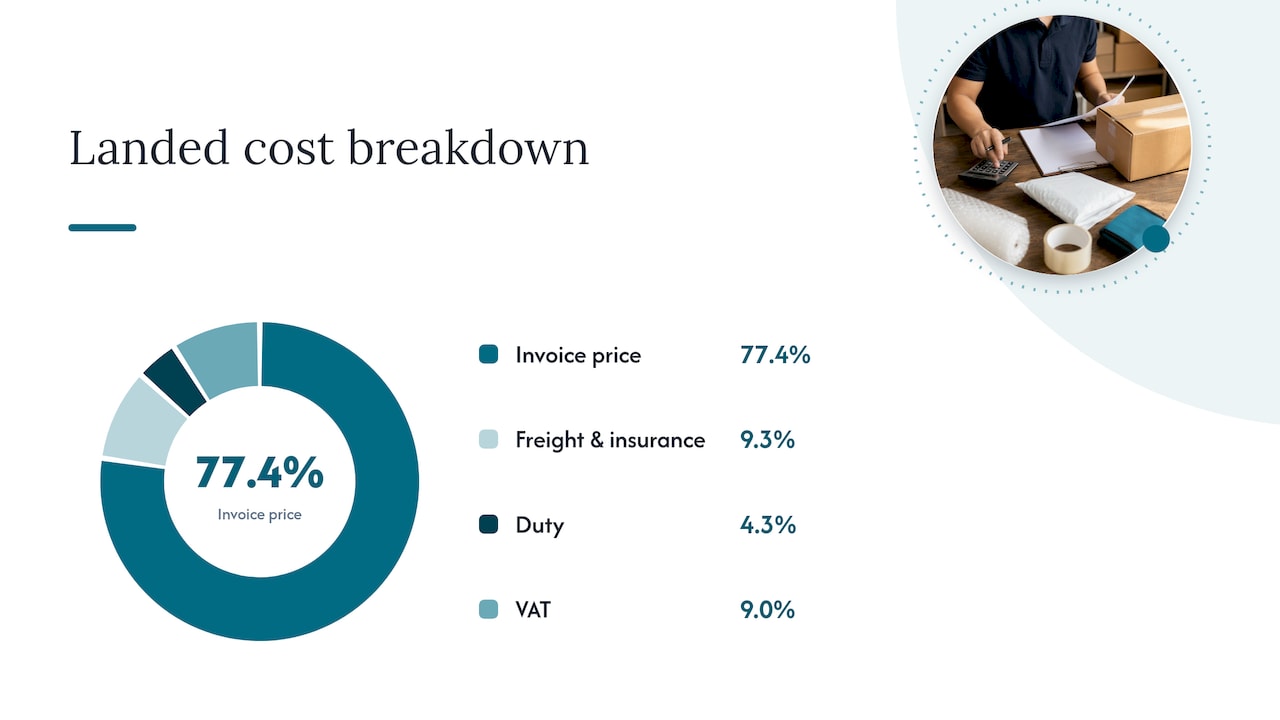
The landed-cost formula is straightforward once the inputs are in place: invoice price plus freight, insurance, duties, taxes, customs fees and fulfillment or handling equals landed cost. What changes case to case is who pays which line.
Incoterms determine that allocation. Under DDP (Delivered Duty Paid), the seller carries clearance and duty responsibility all the way to the buyer’s door. Under CPT (Carriage Paid To), the seller pays freight to a named point but the buyer typically absorbs destination duties. Under CIF (Cost, Insurance and Freight), the seller covers cost, insurance and freight to the port, but the buyer often takes on duties and taxes from that point forward.
Here is a simplified worked example following trade.gov’s methodology for calculating total export price:
- Say a shipment has a product cost of $10,000 and freight plus insurance of $1,200, giving a CIF value of $11,200.
- Say the applicable duty rate for the HS code is 5%: $11,200 times 5% equals $560 in duty.
- Say the destination VAT is 10%, applied to CIF plus duty ($11,760): that adds $1,176.
- Landed cost totals $11,200 plus $560 plus $1,176, or $12,936, before fulfillment and handling charges.
Small classification errors carry real weight. Trade.gov’s own guidance notes that an incorrect HS code or an omitted assist can materially change the duty outcome, which is why a calculator should flag results as estimates and route high-value loads through broker verification rather than treating the math as final.
Building or validating your own courier cost calculator
Getting from a spreadsheet with formulas to a defensible landed-cost model is a five-step exercise, not a one-time build.
- Gather your datasets: signed carrier contract rates, a year or more of historical invoices, HS code mappings for your catalog, and current surcharge schedules.
- Normalize units and currency across every dataset, then implement dimensional and billable weight rules so the tool bills the way carriers actually do.
- Build Incoterm logic into the model so each shipment’s outputs reflect who is actually paying duties, freight and clearance fees.
- Validate the model against historical shipments, comparing estimated landed cost to what was actually invoiced, and set an acceptable error tolerance before trusting it for pricing decisions.
- Add scenario modeling for trade-lane shifts, tariff changes and GRI movement, and set a refresh cadence for rate and tariff data.
Governance matters as much as the build. Someone needs to own rate-feed updates and log the assumptions behind each model run, since an unaudited calculator drifts from reality within a few rate cycles.
Pro Tip: Log the Incoterm, HS code and rate date with every estimate you generate, so a finance or procurement review six months later can trace exactly why a number came out the way it did.
When a spreadsheet stops being enough
Three signals suggest it is time to move past spreadsheets: rising shipment volume that outpaces manual rate updates, cross-border complexity spanning multiple HS codes and Incoterms, and audit or reporting needs that demand traceable assumptions. Spreadsheets offer control and transparency early on; platforms offer reliability and integration once the volume outgrows manual upkeep.
— Maayan
How Or-ner supports courier cost estimation
Or-ner ties freight booking, customs clearance and fulfillment charges into one view, so landed-cost inputs do not live in five disconnected spreadsheets.
- Rate integration pulls contract terms directly into shipment planning instead of relying on published list rates.
- Customs and fulfillment visibility sit alongside freight, so a landed-cost estimate reflects the full shipment, not just the carrier leg.
- Cross-border and warehousing services connect to the same platform used for booking, cutting down on manual reconciliation.
Get a freight estimate or explore Or-ner’s logistics platform to see how contract-rate and landed-cost data come together for your shipping volume.
Sources
FAQ
What is landed cost and why does it matter for B2B shipping?
Landed cost is the full price of getting a product from origin to a buyer’s door, including freight, insurance, duties, taxes, customs fees and handling. It matters because a freight quote alone can hide charges that erase margin once duties, VAT and fulfillment fees are added, as Inbound Logistics explains.
How do Incoterms affect a landed-cost calculation?
Incoterms assign which party pays for freight, insurance, duties and clearance at each stage of a shipment. Under DDP the seller covers duties and clearance to the buyer’s door, while under CIF or CPT the buyer typically picks up destination duties and taxes, according to trade.gov’s Incoterms overview.
How do I find the right HS or HTS code for a product?
You classify the product using the destination country’s tariff schedule, then confirm the resulting duty rate through a database such as the Customs Info Database, which covers rates across more than 170 markets. A misclassified code can significantly change the duty owed, so high-value shipments often warrant a broker check.
What is volumetric or dimensional weight, and when does it apply?
Volumetric weight is a calculated weight based on a package’s dimensions rather than its actual weight, and carriers bill whichever figure, actual or dimensional, is higher. This applies most often to bulky, lightweight shipments, where carrier billing formulas can push the billable weight well above the scale weight.
Should I use actual carrier contract rates or published list rates in my calculator?
Contract rates reflect the discounts and terms your business actually negotiated, while published list rates are the carrier’s default and usually higher. Building a calculator around contract rates and current surcharge feeds gives a far more accurate estimate for bulk and recurring B2B shipments than relying on list pricing.