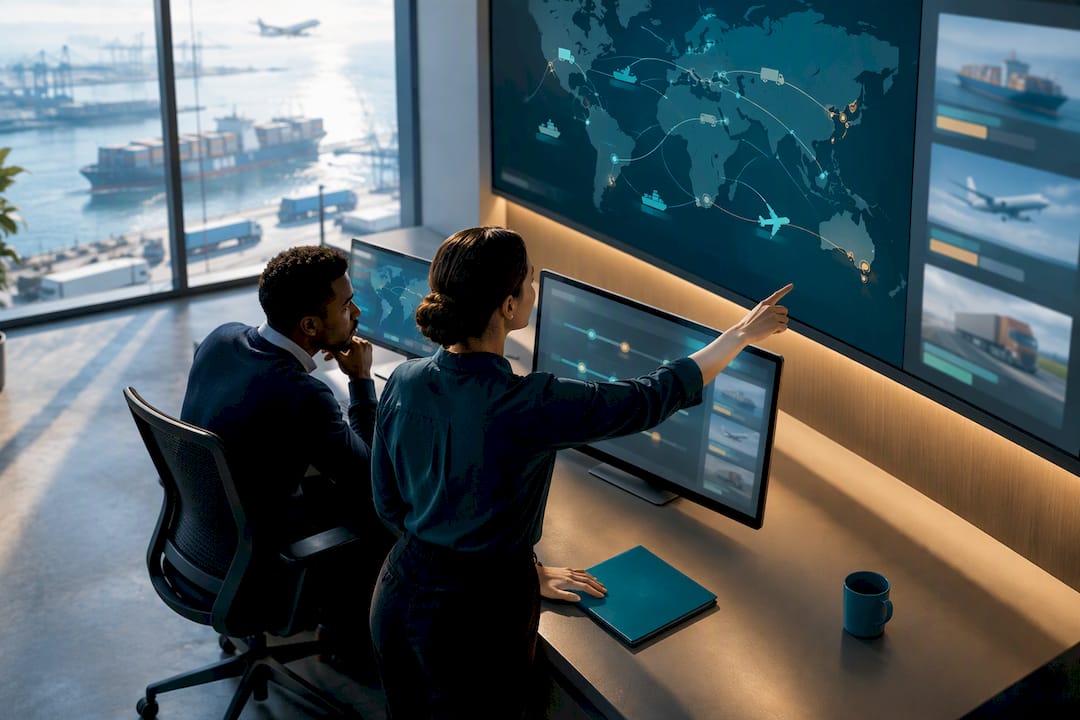
Global order tracking, in the B2B sense that matters to sellers and logistics managers, means control-tower visibility: one connected view of every purchase order, shipment, and inventory position across carriers, freight modes, and warehouses. Done right, it cuts the time teams spend chasing status updates and shrinks exceptions before they turn into missed deliveries. This article covers the features, the implementation steps, and the metrics that make that visibility measurable.
TL;DR:
- Control-tower visibility requires continuous data feeds from multiple carriers, warehouses, and customs to track full order lifecycle across all transport modes.
- AI-driven predictions and automated alerts are key to reducing delays and resolving exceptions faster, improving delivery reliability and lowering costs.
- Implementing a standardized milestone model and role-based dashboards ensures real-time inventory sync and effective exception management across all logistics channels.
- Most teams focus on shipment status updates rather than whether those updates lead to actual decisions or actions that improve delivery performance.
- Over 68% of shippers now see control-tower visibility as essential, making it a non-negotiable capability for competitive supply chain management.
Table of Contents
- What “global order tracking” actually covers
- Business benefits of centralized real-time visibility
- Key features a control-tower tracking platform must provide
- Implementation checklist: standing up global order tracking fast and safely
- Metrics and KPIs to measure the program’s success
- Why Or-ner: how an integrated platform delivers global order tracking in practice
- What logistics teams get wrong about tracking
- Get control-tower visibility with Or-ner
- Sources
- FAQ
What “global order tracking” actually covers
Control-tower visibility spans the full order lifecycle, from purchase order to final delivery, across ocean, air, land transport, and every fulfillment node in between. That is different from carrier track-and-trace, which only shows where one shipment sits on one carrier’s network. A control tower pulls data from many carriers and many modes into a single record per order.
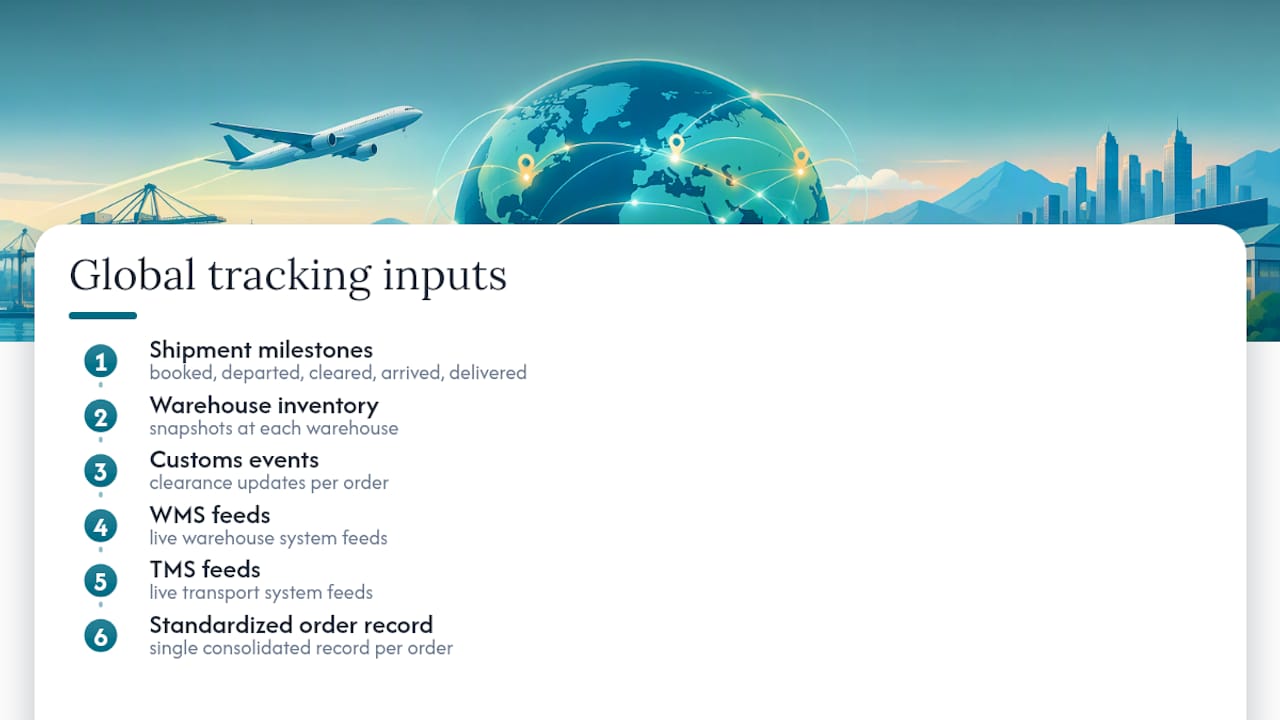
To work, it needs several data inputs feeding it continuously: shipment milestones (booked, departed, customs cleared, arrived, delivered), inventory snapshots at each warehouse, customs clearance events, and live feeds from warehouse management systems (WMS) and transportation management systems (TMS). Without those feeds arriving in a standard format, teams end up reconciling spreadsheets instead of watching a dashboard.
This distinction matters because many platforms marketed as “tracking tools” only aggregate carrier statuses. A real control tower connects that status data to inventory and fulfillment decisions, which is what lets a team reroute a delayed container or reallocate stock before a stockout hits a marketplace listing. For a closer look at how these systems handle carriers, transport modes, and delivery networks together, see this overview of global logistics tracking.
Business benefits of centralized real-time visibility
The payoff from centralized visibility shows up in four places: inventory allocation, exception speed, cost to serve, and the delivery experience customers actually feel.
- Better inventory allocation: Teams can shift stock across fulfillment channels in real time instead of discovering a shortfall after an order fails.
- Faster exception resolution: A single view of every shipment cuts the mean time to resolution because staff no longer have to call five carriers to find one missing container.
- Lower cost to serve: Fewer rush reroutes, less demurrage, and less detention fee exposure when teams see a delay coming instead of finding out at the port.
- Faster, more reliable delivery: Customers feel the difference when orders arrive on the promised date instead of a vague window.
MIT CTL research found that more than half of supply chain leaders now consider real-time inventory management “highly relevant” for keeping fragmented fulfillment channels synchronized, a signal that this is becoming table stakes rather than a nice-to-have. For more on how live data supports these gains, see this guide to real-time data in logistics.
Key features a control-tower tracking platform must provide
Evaluating a platform or planning an internal build comes down to five requirements.
- A standardized milestone model that ingests data through APIs, EDI, or webhooks rather than manual uploads.
- Real-time inventory sync across every warehouse and every marketplace channel the business sells through.
- AI-driven prediction and exception automation that flags ETA drift and forecasts capacity constraints before they cause delays.
- Dashboards with role-based alerting, plus audit logs and historical time-stamped events for claims and root-cause analysis.
- Customs and carrier status integration that covers every lane the business ships, not just the busiest ones.
The DOT’s Freight Logistics Optimization Works initiative is pushing exactly this kind of shared, time-stamped event data across ports, carriers, and warehouses, which suggests that platforms aligning with these emerging standards will integrate more easily as more partners adopt them.
Pro Tip: Ask any vendor how far back their historical time-stamped events go. If they can’t show data older than a few weeks, root-cause analysis on a recurring delay becomes guesswork.
For a deeper look at how these capabilities come together in practice, see this breakdown of order tracking technology.
Implementation checklist: standing up global order tracking fast and safely
Rolling out control-tower visibility works best as a sequence, not a single big-bang launch.
- Map every data source and milestone need, including purchase orders, WMS and TMS feeds, carrier statuses, and marketplace order data.
- Prioritize integrations for your highest-volume, highest-variability lanes first, using APIs and webhooks over manual data entry wherever possible.
- Define exception playbooks with clear ownership and SLA thresholds before the first alert ever fires.
- Pilot with two or three lanes, instrument the KPIs you plan to track, and iterate before scaling to the full network.
- Train teams on the new alerts and automated remediation, enabling automation only where the failure mode is well understood.
Pro Tip: Start the pilot with a lane that already has a known pain point, like a customs bottleneck or a chronically late carrier. A visible fix builds internal buy-in faster than a smooth lane ever will.
Skipping the playbook step is the most common mistake. Without clear ownership, an automated alert just becomes noise that nobody actually resolves. For more on structuring these playbooks, see these order tracking best practices for ecommerce.
Metrics and KPIs to measure the program’s success
A tracking rollout is only worth the investment if it moves numbers a logistics manager already reports on.
- On-time delivery (OTD) and ETA accuracy, the clearest signal that visibility is translating into reliability.
- Exception rate and mean time to resolution (MTTR), which should fall as automated alerts replace manual status checks.
- Inventory availability and discrepancy rates across fulfillment nodes.
- Dock-to-delivery lead time, along with demurrage and detention cost trends.
- Adoption metrics: how many lanes are fully instrumented and what share of exceptions resolve automatically.
The 2025 Third-Party Logistics Study found that a majority of shippers now cite control-tower visibility as essential, up from 49% the year before. That jump shows how quickly this capability moved from a competitive edge to an expectation.
Why Or-ner: how an integrated platform delivers global order tracking in practice
Or-ner operates a logistics and supply chain platform built around exactly this kind of end-to-end visibility, combining freight booking, real-time shipment tracking, customs clearance, cross-border logistics, warehousing, and inventory management in one place for ecommerce sellers and businesses.
- The platform integrates with major ecommerce operators, enabling sellers to automate workflows and track shipments across multiple transport modes from a single dashboard.
- It operates a global network of warehouses and fulfillment centers, supporting fast and flexible logistics for cross-border trade and end-user delivery.
- The tools are designed for key logistics management decision points: data analytics, exception management, and real-time communication rather than status pages alone.
That combination maps directly onto the checklist above: a shared platform for freight, warehousing, and inventory means fewer handoffs between disconnected tools, which is where most visibility gaps start in the first place and explains the real-time production tracking benefits for manufacturers.
What logistics teams get wrong about tracking
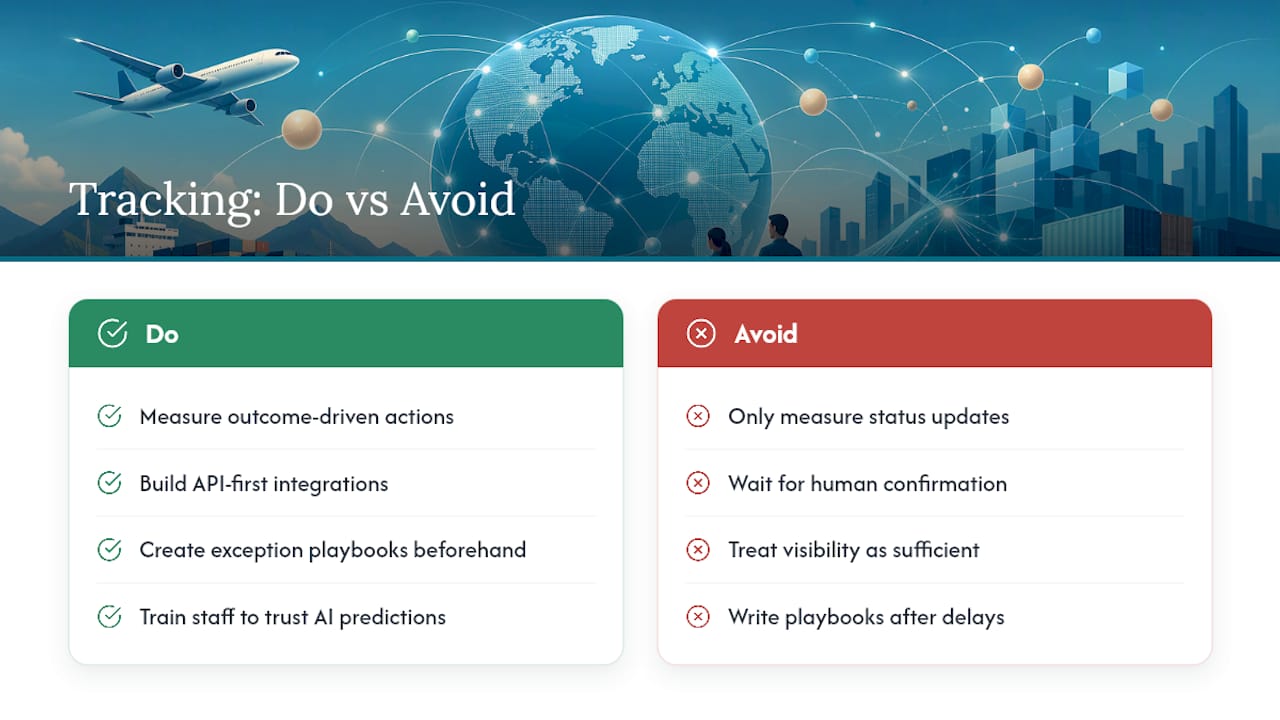
Most teams measure whether a shipment status updated on time. Few measure whether that update led to a decision, a reroute, a reallocation, a customer notice sent early. That is the gap between status and orchestration, and it is the one that actually saves money.
The fix starts with API-first integrations and exception playbooks written before the first delay hits, not after. It also means investing in training so staff trust the AI-driven predictions enough to act on an ETA drift instead of waiting for a human to confirm it manually. Visibility without action is just a more expensive spreadsheet.
— Maayan
Get control-tower visibility with Or-ner
Building this kind of visibility in-house takes months of integration work across carriers, warehouses, and marketplaces. Or-ner offers that same control-tower approach as a ready platform: freight booking, real-time tracking, customs clearance, and warehousing already connected, so ecommerce sellers, wholesalers, and manufacturers can get a working view of their global orders without building it from scratch.
- Request a freight booking estimate to see live routing and pricing for your lanes.
- Review the global ecommerce fulfillment page for warehousing and customs clearance details.
- Visit Or-ner to see the full range of freight, fulfillment, and inventory services and start a conversation about your specific network.
Sources
- AI is ‘Not Optional Anymore’ in Omnichannel Supply Chains — MIT CTL (2026)
- DOT: Supply chain companies collaborate to speed up movement of goods, cut costs for consumers (FLOW)
FAQ
What is the difference between global order tracking and carrier tracking?
Carrier tracking shows the status of one shipment on one carrier’s network, while global order tracking (control-tower visibility) combines data from every carrier, freight mode, and warehouse into a single view per order. This lets logistics teams see inventory, in-transit freight, and customs status together instead of checking each system separately.
How does AI improve exception management in order tracking?
AI-driven orchestration flags ETA drift and forecasts capacity constraints before they cause a missed delivery, rather than just reporting a delay after it happens. MIT CTL research found that teams combining visibility with AI-driven orchestration outperform peers that only collect status updates.
What data do I need to set up control-tower visibility?
You need milestone data from every carrier and mode, inventory snapshots from each warehouse, customs clearance events, and live feeds from your WMS and TMS. Standardized, time-stamped events, the kind promoted by initiatives like DOT’s FLOW program, make these integrations far easier to maintain.
How do I keep shipment data secure when sharing it across partners?
Share data through role-based access and standardized APIs or webhooks rather than open file transfers, so each partner only sees the milestones relevant to their part of the shipment. Historical audit logs also matter, since they let you trace exactly who accessed or changed a shipment record if a dispute or customs question comes up later.
What KPIs show that a tracking rollout is working?
On-time delivery, ETA accuracy, and exception rate are the core three, alongside mean time to resolution and inventory discrepancy rates. The 2025 Third-Party Logistics Study found that 68% of shippers now rank control-tower visibility as essential, which is a useful benchmark for gauging how far behind or ahead your own program sits.