In ecommerce logistics, a parcel tracking device is a carrier-integrated platform function, not a physical gadget stuck on a box. It pulls status updates from every carrier you use, normalizes them into one shipment record, and turns raw scan data into real-time, actionable visibility. The payoff is fewer “where is my order” tickets, faster exception resolution, and a better delivery experience for sellers, wholesalers, and manufacturers managing high shipment volume.
TL;DR:
- A parcel tracking platform normalizes carrier status updates into a single shipment view, improving visibility without relying on hardware sensors.
- It relies on strong carrier API integration, high identity join rates, and scalability during peak seasons to avoid data gaps and false delay alerts.
- Selection should focus on carrier network coverage, API uptime, security, and implementation timelines, especially for cross-border and multimodal shipments.
- A successful rollout involves staged pilots on high-value lanes, setting clear success metrics, and avoiding alert fatigue through careful threshold tuning.
- Key KPIs to measure ROI include improvements in OTIF, reductions in WISMO tickets, faster exception resolution, and high accuracy of predictive ETA models.
Table of Contents
- What Is a Parcel Tracking Device in a Platform Sense?
- Core Capabilities to Expect From a Tracking Platform
- How Does Platform Tracking Actually Work?
- How Do You Choose the Right Parcel Tracking Platform?
- Implementation Checklist: Pilot to Full Scale
- Which KPIs Actually Prove ROI?
- What We See Go Wrong, and How to Fix It
- Get Carrier-Integrated Visibility Running With Or-ner
- Sources
- FAQ
What Is a Parcel Tracking Device in a Platform Sense?
Forget the picture of a GPS tag riding inside a box. In the context ecommerce sellers actually operate in, a parcel tracking device is software: a platform layer that ingests carrier scan events and turns them into one coherent view of where a shipment stands. Hardware sensors give you continuous location data on a single package. A platform gives you status across thousands of shipments, tied to orders, customers, and warehouses, updated the moment a carrier reports an event.
That distinction matters because sellers don’t need to know GPS coordinates. They need to know which shipments are late, which ones are stuck at customs, and which customer is about to call support.
Platform tracking typically shows up in a few deployment shapes:
- SaaS dashboards that plug into your existing order management system
- Control-tower layers that sit above multiple carriers and fulfillment partners at once
- Embedded APIs that feed tracking data directly into your own storefront or app
Common use cases include monitoring outbound parcels across regional carriers, reconciling delivery status for marketplace orders, and giving customer service teams one screen instead of five carrier logins.
Core Capabilities to Expect From a Tracking Platform
A platform is only as useful as the workflows built on top of the data it collects. Four capabilities separate a genuinely useful system from a glorified status page.
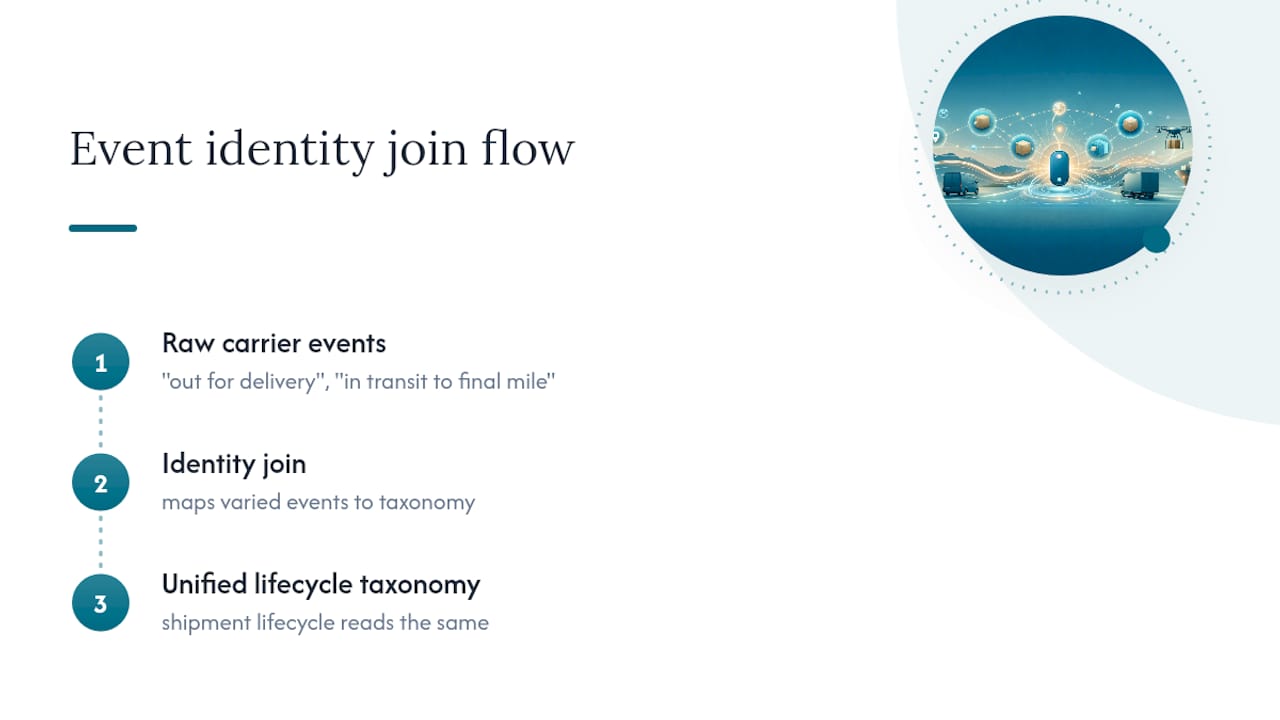
Carrier connectivity and event normalization. Every carrier reports status differently. One says “out for delivery,” another says “in transit to final mile.” A capable platform maps these into a single, consistent event taxonomy, a process sometimes called identity join, so a shipment’s lifecycle reads the same way no matter which carrier handled it.
Predictive ETA and delay detection. The stronger platforms run machine learning models against historical transit data to flag a shipment that’s trending late before it actually misses its window.
Exception management with real workflows. An alert that just says “delayed” isn’t enough. The platform should surface a short list of next actions, like rebooking a lane, rerouting to a different hub, or auto-notifying the customer.
Portals, notifications, analytics, and governance. Customers and partners need self-serve visibility, and your team needs dashboards that show performance trends, not just individual shipment status.
Pro Tip: Ask any vendor how they define “real-time.” Some refresh every few minutes; others refresh only when a new carrier scan arrives, which can mean hours of silence on a slow leg. That gap changes how much you can trust the dashboard during a rush period.
Or-ner’s parcel tracking overview covers how this data feeds into broader shipping analytics for teams managing multiple carriers at once.
How Does Platform Tracking Actually Work?
Visibility platforms pull from several data sources at once, then stitch them into a single shipment record. The mechanics matter because sloppy integration is where most tracking projects quietly fail.
- Carrier APIs and webhooks deliver scan events as they happen, from pickup through final delivery.
- EDI feeds handle the older, batch-style data exchange still common with freight carriers and some regional couriers.
- TMS, WMS, and ERP systems contribute order, inventory, and routing context so a tracking event connects to an actual customer order.
- Sensor and IoT feeds, where used, add temperature or handling data for sensitive cargo.
None of that data is useful until it’s reconciled into one shipment identity. Harmonizing carrier status codes and building that single identity is what lets a platform reconstruct a shipment’s full lifecycle and cut down on WISMO calls. Without it, you get five disconnected timelines for one order instead of one clear story.
Multimodal handovers, say, ocean leg to trucking to last-mile courier, create gaps where no single carrier owns the full picture. Good platforms reconcile these handover points explicitly rather than leaving a blind spot between legs.

Peak volume is the real stress test. Scalability challenges tend to surface during high-volume periods, when event queues back up and carriers fall behind on reporting. A platform built for peak season needs backfill logic so a flood of delayed scans doesn’t create false “stuck” alerts once it catches up.
How Do You Choose the Right Parcel Tracking Platform?
Picking a platform comes down to a handful of concrete questions, not a features checklist. Start with carrier network breadth, since a platform with deep coverage in one region and thin coverage elsewhere will leave gaps exactly where your cross-border shipments run into trouble.
Ask about identity join rate specifically. A vendor should be able to tell you, in a number, what percentage of shipments resolve to a single clean record versus how many require manual reconciliation. That number tells you more about real-world reliability than any glossy demo.
Beyond that, prioritize:
- Orchestration depth — does the platform recommend or trigger actions, or just send alerts?
- API coverage and uptime SLAs — what happens when a carrier feed goes down?
- Implementation timeline — weeks or quarters to go live with your carrier mix?
- Security and data ownership — where does shipment data live, and who can export it?
- Pricing model — per-shipment, per-carrier, or flat platform fee, and what that means at your volume?
Security and carrier-onboarding requirements often overlap with broader compliance needs, particularly for teams managing their own fleets or contracted haulier relationships; compliance-focused platforms for hauliers cover some of that adjacent ground. Or-ner’s rundown of leading shipment tracking software is a useful cross-check before you shortlist vendors.
Implementation Checklist: Pilot to Full Scale
Rolling out a tracking platform works best as a staged pilot, not a big-bang launch across every carrier at once.
- Pick pilot lanes and define success metrics upfront, such as identity join rate and exception resolution time.
- Map stakeholders across ops, customer service, and finance so everyone knows who owns what.
- Integrate carriers for the pilot lanes and run identity-join tests against real historical shipments.
- Tune alert thresholds to avoid flooding your team with low-value notifications.
- Set escalation flows so a flagged exception routes to the right person automatically.
- Train customer service and operations teams on the new dashboards before go-live.
- Onboard customers or partners to shared tracking views once internal workflows are stable.
- Scale carrier activation in waves, adding regions or partners once the pilot proves out.
Pro Tip: Run your pilot on your worst-performing lane, not your best one. If the platform can clean up messy data on a problem route, it will handle your easy lanes without a second thought.
A realistic timeline runs 4 to 8 weeks for pilot integration and validation, then another 2 to 3 months to activate remaining carriers in waves. Or-ner’s guide on tracking systems and customer service walks through how to sequence customer-facing rollout alongside internal adoption.
Which KPIs Actually Prove ROI?
Five numbers tell you whether a tracking platform is paying for itself: OTIF (on-time-in-full), WISMO ticket volume, exception resolution time, identity join rate, and ETA accuracy.
- OTIF shows whether promises to customers are actually being kept.
- WISMO volume drops sharply once customers can self-serve accurate status instead of calling support.
- Exception resolution time measures how fast a flagged delay gets fixed, not just noticed.
- Identity join rate is the technical health check behind all the others.
- ETA accuracy determines whether your predictive alerts are trustworthy enough to act on.
Consolidating fragmented systems into a single orchestration layer has driven exception resolution down to under two hours in some deployments, largely by cutting the manual dispatch work that used to eat up ops time. For a mid-size ecommerce operation, a reasonable first target is a measurable drop in WISMO tickets within the first quarter, followed by tighter ETA accuracy as more carriers get activated.
What We See Go Wrong, and How to Fix It
The most common failure isn’t a bad platform. It’s a fragmented shipment identity that never gets fixed before launch, so the dashboard looks complete while half the records are silently duplicated or orphaned. The second failure is alert fatigue: teams turn on every notification, then start ignoring all of them within a month. The third is carrier activation that drags on for a year because nobody prioritized which lanes actually mattered.
The fix is sequencing. Get identity join right before anything else. Start with your highest-value lanes, not your full carrier list. Automate the simplest exceptions first, like auto-rebooking a missed pickup, before tackling complex multimodal handovers. Visibility only pays off once workflows turn data into action, not before.
— Maayan
Get Carrier-Integrated Visibility Running With Or-ner
A parcel tracking platform gives ecommerce sellers, wholesalers, and manufacturers one place to see every carrier’s status without logging into five separate systems. Instead of stitching together spreadsheets and carrier portals yourself, you get exception management and cross-border tracking support built into the same platform that handles your freight booking and fulfillment.
Before you commit to any platform, including this one, ask three questions on the demo: what’s the actual carrier coverage in your shipping regions, what identity join rate they see on similar shipment volumes, and how long a pilot realistically takes to validate. Those answers separate a platform that works from one that just looks good in a slide deck.
If you’re ready to see how this looks with your own shipment data, Or-ner’s shipment tracking page walks through what a pilot setup involves and how to request a demo.
Sources
For deeper technical context, see Or-ner’s guides on global parcel tracking at enterprise scale and real-time data architecture in logistics.
- Challenges of real-time visibility in logistics
- Order to POD: Real-Time Visibility Blind Spots
- The Ultimate Guide to Supply Chain Visibility Software
FAQ
Is a Parcel Tracking Device a Physical GPS Tag?
No. In ecommerce logistics, the term refers to a software platform that aggregates carrier scan data into real-time shipment visibility, not a hardware device attached to a package.
What Is Identity Join and Why Does It Matter?
Identity join is the process of matching scan events from different carriers and systems to a single shipment record. A low join rate means fragmented data and slower exception resolution.
How Long Does It Take to Implement a Tracking Platform?
A pilot typically takes 4 to 8 weeks to integrate and validate on select lanes, with full carrier activation following over the next 2 to 3 months.
What KPIs Should I Track First?
Start with OTIF, WISMO ticket volume, and exception resolution time. These three reveal whether the platform is actually reducing manual work, not just displaying more data.
Can Or-ner Handle Cross-Border Parcel Visibility?
Or-ner supports carrier-integrated tracking alongside its customs clearance and cross-border logistics services, making it a fit for sellers shipping across multiple regions.